Questões de Concurso Público Prefeitura de Soledade - PB 2024 para Professor com Licenciatura em Língua Inglesa
Foram encontradas 40 questões


Read Text I to answer the question.
TEXT I
“One very active research tradition in the field of second language acquisition (SLA) attempts to establish causal relationships between environmental factors and learning. These include the type and quantity of input, instruction and feedback, and the interactional context of learning (Larsen-Freeman and Long 1991). A second very influential line of research and theory in SLA that came to fruition during the 1980s investigates the possible role of universal grammar (UG) in SLA (Eubank 1991b, White 1989). In the Chomskyan tradition, UG refers not to properties of language as the external object of learning but to innate properties of mind that direct the course of primary language acquisition. One question asked within this tradition has been whether or not second language this tradition learners still “have access” to UG, but it is assumed that UG principles are not accessible to learner awareness for any kind of conscious analysis of input. It is possible that SLA is the result of UG (a deep internal factor) acting upon input (an external factor), as proposed by White (1989), but what seems to be left out of such an account is the role of the learner's conscious mental processes.” […]
Available at: https://www.cambridge.org/core/journals/annual-review-of-applied-linguistics/ (adapted)
Read Text I to answer the question.
TEXT I
“One very active research tradition in the field of second language acquisition (SLA) attempts to establish causal relationships between environmental factors and learning. These include the type and quantity of input, instruction and feedback, and the interactional context of learning (Larsen-Freeman and Long 1991). A second very influential line of research and theory in SLA that came to fruition during the 1980s investigates the possible role of universal grammar (UG) in SLA (Eubank 1991b, White 1989). In the Chomskyan tradition, UG refers not to properties of language as the external object of learning but to innate properties of mind that direct the course of primary language acquisition. One question asked within this tradition has been whether or not second language this tradition learners still “have access” to UG, but it is assumed that UG principles are not accessible to learner awareness for any kind of conscious analysis of input. It is possible that SLA is the result of UG (a deep internal factor) acting upon input (an external factor), as proposed by White (1989), but what seems to be left out of such an account is the role of the learner's conscious mental processes.” […]
Available at: https://www.cambridge.org/core/journals/annual-review-of-applied-linguistics/ (adapted)
Read Text I to answer the question.
TEXT I
“One very active research tradition in the field of second language acquisition (SLA) attempts to establish causal relationships between environmental factors and learning. These include the type and quantity of input, instruction and feedback, and the interactional context of learning (Larsen-Freeman and Long 1991). A second very influential line of research and theory in SLA that came to fruition during the 1980s investigates the possible role of universal grammar (UG) in SLA (Eubank 1991b, White 1989). In the Chomskyan tradition, UG refers not to properties of language as the external object of learning but to innate properties of mind that direct the course of primary language acquisition. One question asked within this tradition has been whether or not second language this tradition learners still “have access” to UG, but it is assumed that UG principles are not accessible to learner awareness for any kind of conscious analysis of input. It is possible that SLA is the result of UG (a deep internal factor) acting upon input (an external factor), as proposed by White (1989), but what seems to be left out of such an account is the role of the learner's conscious mental processes.” […]
Available at: https://www.cambridge.org/core/journals/annual-review-of-applied-linguistics/ (adapted)
Read Text I to answer the question.
TEXT I
“One very active research tradition in the field of second language acquisition (SLA) attempts to establish causal relationships between environmental factors and learning. These include the type and quantity of input, instruction and feedback, and the interactional context of learning (Larsen-Freeman and Long 1991). A second very influential line of research and theory in SLA that came to fruition during the 1980s investigates the possible role of universal grammar (UG) in SLA (Eubank 1991b, White 1989). In the Chomskyan tradition, UG refers not to properties of language as the external object of learning but to innate properties of mind that direct the course of primary language acquisition. One question asked within this tradition has been whether or not second language this tradition learners still “have access” to UG, but it is assumed that UG principles are not accessible to learner awareness for any kind of conscious analysis of input. It is possible that SLA is the result of UG (a deep internal factor) acting upon input (an external factor), as proposed by White (1989), but what seems to be left out of such an account is the role of the learner's conscious mental processes.” […]
Available at: https://www.cambridge.org/core/journals/annual-review-of-applied-linguistics/ (adapted)
Read Text I to answer the question.
TEXT I
“One very active research tradition in the field of second language acquisition (SLA) attempts to establish causal relationships between environmental factors and learning. These include the type and quantity of input, instruction and feedback, and the interactional context of learning (Larsen-Freeman and Long 1991). A second very influential line of research and theory in SLA that came to fruition during the 1980s investigates the possible role of universal grammar (UG) in SLA (Eubank 1991b, White 1989). In the Chomskyan tradition, UG refers not to properties of language as the external object of learning but to innate properties of mind that direct the course of primary language acquisition. One question asked within this tradition has been whether or not second language this tradition learners still “have access” to UG, but it is assumed that UG principles are not accessible to learner awareness for any kind of conscious analysis of input. It is possible that SLA is the result of UG (a deep internal factor) acting upon input (an external factor), as proposed by White (1989), but what seems to be left out of such an account is the role of the learner's conscious mental processes.” […]
Available at: https://www.cambridge.org/core/journals/annual-review-of-applied-linguistics/ (adapted)
I- Karen could see someone running towards her. II- We spent an enjoyable evening on the movies. III- Michelle is not here at the moment. She is to the store. IV- Does this bus go in Ipanema?
The preposition is CORRECT in:
Read Text II to answer the question:
TEXT II

Available at: https://culturalanalytics.org/article/87560 (adapted)
Read Text II to answer the question:
TEXT II
Available at: https://culturalanalytics.org/article/87560 (adapted)
Read Text II to answer the question:
TEXT II
Available at: https://culturalanalytics.org/article/87560 (adapted)
Considerando a leitura do texto abaixo, responda à questão.
ESTUDO EXPLICA A LENTIDÃO DOS ANTIDEPRESSIVOS
Considerando a leitura do texto abaixo, responda à questão.
ESTUDO EXPLICA A LENTIDÃO DOS ANTIDEPRESSIVOS
I- ELE (L.1) – pronome pessoal cujo referente é o termo “alguém”. II- ONDE (L.1) – advérbio relativo cujo referente é o constituinte “no cérebro”. III- SÓ QUE (L.3) – locução conjuntiva com valor de oposição/ressalva. IV- ISSO (L.7) – pronome relativo cujo referente é o termo “sinapses”. V- TESTE (L.6) – substantivo que rotula todo o conteúdo relativo ao experimento com os voluntários.
São CORRETAS as explicações fornecidas apenas em:
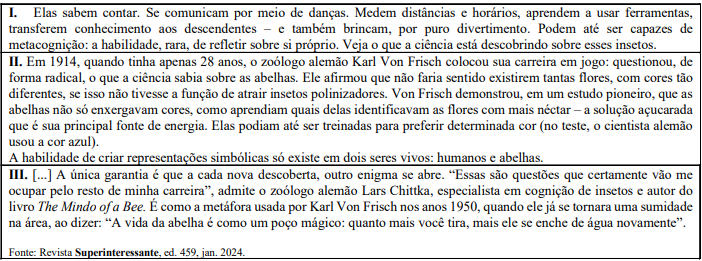
I- No período: “Em 1914, quando tinha apenas 28 anos, o zoólogo alemão Karl Von Frisch colocou sua carreira em jogo: [...]”, oração introduzida por QUANDO vem isolada por vírgulas por se tratar de uma oração adverbial temporal. II- : Em: “o zoólogo alemão Karl Von Frisch colocou sua carreira em jogo ”, questionou, de forma radical, o que a ciência sabia [...] em vez do emprego dos dois-pontos, a segunda oração poderia ter sido introduzida pelo conector “pois”, caracterizando uma oração coordenada explicativa. III- TANTAS Em: “Ele afirmou que não faria sentido existirem tantas flores, com cores tão diferentes, se [...]”, o constituinte TANTAS FLORES tem a função de complemento – objeto direto – do verbo existir. IV- Em: “Von Frisch demonstrou, em um estudo pioneiro, que as abelhas não só enxergavam cores, como aprendiam quais delas identificavam as flores com mais néctar.”, as estruturas introduzidas por NÃO SÓ....COMO são coordenadas aditivas.
É CORRETO o que se afirma apenas em:

 Conheça nossos planos