Questões de Concurso
Sobre vocabulário | vocabulary em inglês
Foram encontradas 3.149 questões


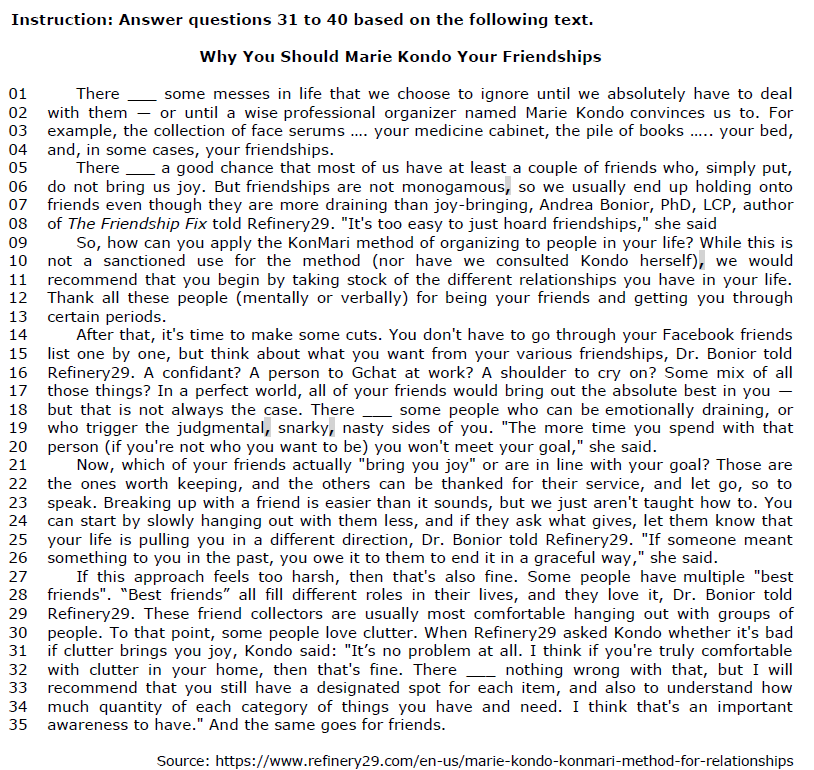
I. is an adverb. II. may be translated as ‘bagunça’. III. could be replaced by ‘hush’.
Which ones are correct?
A Better Way to Paint a House
Fall is by far the best time to paint a house in most locations. The cooler, drier weather allows the paint to cure properly and also makes the work more _____________ rather than suffering through the summer heat or spring showers.
Keeping your house painted is the best way to keep issues like rot or termites at bay and should be a regularly scheduled part of your maintenance every 10-20 years depending on your climate and the condition of your paint.
If you let a paint job go too long you run the risk of damage to the underlying structure and increased costs for more involved surface prep. Heavy sanding, scraping and carpentry repairs can be budget busters so keeping your house painted regularly is a time and money saver.
https://thecraftsmanblog.com/... - adapted
A Better Way to Paint a House
Fall is by far the best time to paint a house in most locations. The cooler, drier weather allows the paint to cure properly and also makes the work more _____________ rather than suffering through the summer heat or spring showers.
Keeping your house painted is the best way to keep issues like rot or termites at bay and should be a regularly scheduled part of your maintenance every 10-20 years depending on your climate and the condition of your paint.
If you let a paint job go too long you run the risk of damage to the underlying structure and increased costs for more involved surface prep. Heavy sanding, scraping and carpentry repairs can be budget busters so keeping your house painted regularly is a time and money saver.
https://thecraftsmanblog.com/... - adapted
A Better Way to Paint a House
Fall is by far the best time to paint a house in most locations. The cooler, drier weather allows the paint to cure properly and also makes the work more _____________ rather than suffering through the summer heat or spring showers.
Keeping your house painted is the best way to keep issues like rot or termites at bay and should be a regularly scheduled part of your maintenance every 10-20 years depending on your climate and the condition of your paint.
If you let a paint job go too long you run the risk of damage to the underlying structure and increased costs for more involved surface prep. Heavy sanding, scraping and carpentry repairs can be budget busters so keeping your house painted regularly is a time and money saver.
https://thecraftsmanblog.com/... - adapted
Check the alternative that fills the gap below CORRECTLY:
She participated ______________ in the festivities.
First column:
1- break down
2- get by
3- take off
4- take somebody in
5- call off
Second column: ( ) go into the air
( ) cancel
( ) manage
( ) stop working
( ) deceive
Choose the alternative that presents the correct match:
Leia o texto e responda à questão.
Culture is really an integral part of the interaction between language and thought. Cultural patterns, customs, and ways of life are expressed in language; culture-specific world views are reflected in language. Each culture has at its disposal a particular range of colours, illustrating its particular world view on what color is and how to identify color. The African Shona and Bassa peoples, for example, have fewer color categories than speakers of European languages and they break up the spectrum at different points, as shown below:

Of course, the Shona or Bassa are able to perceive and describe other colors, in the same way that an English speaker might describe a “dark bluish green”, but the labels which the language provides tend to shape the person’s overall cognitive organization of color and to cause varying degrees of color discrimination. Eskimo tribes commonly have as many as seven different words for snow to distinguish among different types of snow (falling snow, snow on the ground, fluffy snow, wet snow, etc.), whereas certain African cultures in the equatorial forests of Zaire have no word at all for snow.
(Douglas Brown. Principles of language learning and teaching.
5th ed. Longman, 2000. Adaptado)

(Source: https://www.sciencedaily.com/releases/2019/11/191114141247.htm– Adapted)
I. Replacement of ‘sheds light on’ (l.07) with ‘clarifies’. II. Replacement of ‘handful’ (l.18) with ‘large number’. III. Replacement of ‘corroborate’ (l.37) with ‘validate’.
Disregarding any grammatical aspects, which ones alter the meaning of the sentence?
Pete is talking to his English teacher about the strategies he has been using to study at home. He seems to have forgotten the phrasal verbs he was studying and trying to use during this conversation in order to impress the teacher. Read an extract of their dialogue:
(…)
(Pete) – Phrasal verbs are so difficult! Well, I have been studying really, really hard. I have to learn so many things before the tests. There are some things I have been doing… For example, I try to… to…
memorize the expressions by reading them out loud several times a day.
(Teacher) – What else have you been doing that you consider effective?
(Pete) – I try to use the expressions and new words in stories… but often times they don’t… they don’t… make sense.
(Teacher) – There’s a phrasal verb for that.
(Pete) – I can’t remember it! I have to understand how I learn better…
(Teacher) – Maybe you are exaggerating a bit.
(Pete) – I am not. I have problems… reaching the same level of my classmates.
(Teacher) – I don’t agree with you, but if you feel you need to improve, we can talk about this later.
(Pete) – That would be great! Thank you!
Read the text below.
(CNN) US Secretary of State Mike Pompeo has denounced President Nicolas Maduro's obstruction of aid deliveries to Venezuela as the actions of a "sick tyrant."
At the call of opposition leader and the nation's selfdeclared interim president, Juan Guaido, foreign aid has been shipped to Venezuela in response to worsening food and medicine shortages.
Maduro, who has been in a standoff with Guaido for the presidency, denies that a humanitarian crisis exists in Venezuela and suggests that aid efforts are part of a US plot to orchestrate a coup.
After Guaido named Saturday as the deadline for the aid to cross the border, Maduro vowed to stop the supplies from coming into the country. At a large rally in Caracas on Saturday, he dared the opposition to call for elections and called Guaido a "clown" and a "US puppet."
Trucks carrying supplies were blocked at most spots Saturday. Witnesses said two trucks were set ablaze while attempting to cross into Venezuela from Colombia.
Witnesses who spoke to CNN said the trucks went up in flames as Venezuelan troops loyal to Maduro prevented the vehicles from crossing the border. CNN cannot independently confirm the incident or the circumstances of how the two trucks were set on fire. National Assembly Representative and Guaido supporter Adriana Pichardo told CNN that at least five people were also killed in clashes with Venezuelan security forces on Saturday. CNN cannot independently confirm the number of fatalities.
Adapted from:
https://edition.cnn.com/2019/02/24/americas/venezuela-pompeo-maduro-colombia/index.html. Acesso em: 24 de fevereiro de 2019.


 Conheça nossos planos