Questões de Concurso Sobre vocabulário | vocabulary em inglês

Foram encontradas 3.314 questões

Q3147573 Inglês
        “The High Priestess of Soul,” Nina Simone was a singer, pianist, songwriter, and civil rights activist. Mostly known as a jazz singer, her music blended gospel, blues, folk, pop, and classical styles. No popular singer was more closely associated with the Civil Rights Movement than Simone.

         Nina Simone was born Eunice Kathleen Waymon on February 21st, 1933, in Tryon, North Carolina. Her mother, Mary Kate Irvin, was a Methodist preacher and housekeeper, and her father, John Divine Waymon, worked as an entertainer, barber, and dry-cleaner. The family’s home was filled with music and Simone’s mother encouraged her musical pursuits but she did not approve of nonreligious music like blues and jazz. Simone took up the piano before her feet could reach the pedals, and by the age of six, she was playing during church services.

         In 2008, Rolling Stone named Simone to its list of the 100 Greatest Singers of All Time, and, in 2018, Simone was inducted into the Rock & Roll Hall of Fame.

Internet:<womenshistory.org>  (adapted).  

Based on the previous text, judge the following item. 


Replacing the excerpt “civil rights activist” (first sentence) with activist for the civil rights would violate natural collocation in English.

Alternativas
Q3147569 Inglês

Internet:<phdcomics.com>  (adapted)

Regarding the language usage in the preceding comic strip, judge the following item.


The word “hope”, in the comic strip, is used both as an adjective and as a verb. 

Alternativas
Q3147568 Inglês

Internet:<phdcomics.com>  (adapted)

Regarding the language usage in the preceding comic strip, judge the following item.


The adverb “entirely” (second panel) could be successfully replaced with completely, maintaining the same meaning.  

Alternativas
Q3147567 Inglês
        Global issues, global education, and transcultural learning all take two conditions of a globalizing world as their point of departure: (1) all social, cultural, economic, and ecological issues are increasingly interconnected and there is no such thing as an isolated, merely local issue; (2) globalization and hybridization affect all cultures and cultural phenomena. There are no pure, homogeneous, unchanging elements of culture, and this affects the life of all individuals and social groups. Global learning takes on a transcultural perspective and aims to enable learners to effectively acquire a foreign or second language while empowering them with the knowledge, skills and commitment required by world citizens to solve global problems. Here, local problems, challenges, and solutions are always seen as inextricably intertwined with global issues.

Michael Meyer, Laurenz Volkmann, and Nancy Grimm.
Teaching English. Narr: Tübigen, 2022. p. 163 (adapted). 

Based on the ideas presented in the previous text, judge the item that follow.


The authors have a negative perspective on globalization because it makes global problems also local problems.

Alternativas
Q3147562 Inglês
        Girls play outside in nature less than boys do, even at the age of two, according to the first national survey of play among preschool-age children in Britain. While researchers expect to see older children socialised to particular gender roles, they were shocked to see similar patterns of behaviour starting to emerge at such a young age. They fear it could have long-term implications for girls’ health, as girls are less physically active as they get older and are more likely than boys to have difficulties with their mental health.

         The study also found that preschool-age children from a minority ethnic background play less outdoors than their white counterparts, and children in urban areas play less outdoors than those in rural areas. “The results highlight inequalities in play even in the youngest age group, which may exacerbate existing inequalities in health,” the report concluded.

         The research surveyed more than 1,100 parents and carers of children aged two, three and four. They found that preschool children spent approximately four hours a day at play, of which one hour and 45 minutes was spent playing outdoors, mainly in back gardens at home. Away from home, children played in playgrounds and green spaces, with the most adventurous play usually associated with indoor play centres.

         “The popularity of these play centers is growing,” the report said. “This may be driven by indoor play centres providing adventurous play experiences that overcome some of the barriers to outdoor adventurous play such as traffic, weather and safety concerns.”

Sally Weale. Girls play outside less than boys even at two years old, UK survey reveals.
In: The Guardian. Internet:<theguardian.com>  (adapted). 

According to the preceding text, judge the following item.


From the research mentioned, it is possible to conclude that young age playing habits may have consequences in adult life in terms of physical and mental health.

Alternativas
Q3147559 Inglês
        Girls play outside in nature less than boys do, even at the age of two, according to the first national survey of play among preschool-age children in Britain. While researchers expect to see older children socialised to particular gender roles, they were shocked to see similar patterns of behaviour starting to emerge at such a young age. They fear it could have long-term implications for girls’ health, as girls are less physically active as they get older and are more likely than boys to have difficulties with their mental health.

         The study also found that preschool-age children from a minority ethnic background play less outdoors than their white counterparts, and children in urban areas play less outdoors than those in rural areas. “The results highlight inequalities in play even in the youngest age group, which may exacerbate existing inequalities in health,” the report concluded.

         The research surveyed more than 1,100 parents and carers of children aged two, three and four. They found that preschool children spent approximately four hours a day at play, of which one hour and 45 minutes was spent playing outdoors, mainly in back gardens at home. Away from home, children played in playgrounds and green spaces, with the most adventurous play usually associated with indoor play centres.

         “The popularity of these play centers is growing,” the report said. “This may be driven by indoor play centres providing adventurous play experiences that overcome some of the barriers to outdoor adventurous play such as traffic, weather and safety concerns.”

Sally Weale. Girls play outside less than boys even at two years old, UK survey reveals.
In: The Guardian. Internet:<theguardian.com>  (adapted). 

According to the preceding text, judge the following item.


In the text, the words “survey” (first sentence of the text), “study” (first sentence of the second paragraph), and “research” (first sentence of the third paragraph) were used to refer to the same thing.

Alternativas
Q3147558 Inglês
        We do not know how art began any more than we know how language started. If we take art to mean such activities as building temples and houses, making pictures and sculptures, or weaving patterns, there is no people in all the world without art. If, on the other hand, we mean by art some kind of beautiful luxury, something to enjoy in museums and exhibitions or something special to use as a precious decoration in the best parlour, we must realize that this use of the word is a very recent development. We can best understand this difference if we think of architecture. There is scarcely any building in the world which was not erected for a particular purpose. Those who use these buildings as places of worship or entertainment, or as dwellings, judge them first and foremost by standards of utility. But apart from this, they may like or dislike the design or the proportions of the structure, and appreciate the efforts of the good architect to make it not only practical but right. In the past the attitude to paintings and statues was often similar. They were not thought of as mere works of art but as objects which had a definite function.

         Similarly, we are not likely to understand the art of the past if we are quite ignorant of the aims it had to serve. The further we go back in history, the more definite but also the more strange are the aims which art was supposed to serve. The same applies if we leave towns and cities and go to the peasants or, better still, if we travel to the peoples whose ways of life still resemble the conditions in which our remote ancestors lived. Among them there is no difference between building and image-making as far as usefulness is concerned. Their huts are there to shelter them from rain, wind and sunshine and the spirits which produce them; images are made to protect them against other powers which are, to them, as real as the forces of nature. Pictures and statues, in other words, are used to work magic.

E. H. Gombrich. The story of art.
New York, Phaidon, 2024. 16th ed. p. 9-10 (adapted). 

Based on the previous text, its ideas and its linguistic aspects, judge the following item.


In the fragment “which had a definite function” (last sentence of the first paragraph), the word “definite” could be replaced with clear without harming the coherence of the text.

Alternativas
Q3143784 Inglês

Read the text to answer question 


Men fear thought as they fear nothing else on earth – more than ruin, more even than death. Thought is subversive and revolutionary, destructive and terrible; thought is merciless to privilege, established institutions, and comfortable habits; thought is anarchic and lawless, indifferent to authority, careless of the well-tried wisdom of the ages. Thought looks into the pit of hell and is not afraid.


Bertrand Russell (“Why Men Fight: A Method of Abolishing the International Duel”, pp. 178-179)
Which of the following is a synonym for "subversive" as used in the passage?
Alternativas
Q3143783 Inglês

Read the text to answer question 


Men fear thought as they fear nothing else on earth – more than ruin, more even than death. Thought is subversive and revolutionary, destructive and terrible; thought is merciless to privilege, established institutions, and comfortable habits; thought is anarchic and lawless, indifferent to authority, careless of the well-tried wisdom of the ages. Thought looks into the pit of hell and is not afraid.


Bertrand Russell (“Why Men Fight: A Method of Abolishing the International Duel”, pp. 178-179)

Which word is an antonym of "merciless" in the passage?
Alternativas
Q3143782 Inglês

Read the text to answer question 


Men fear thought as they fear nothing else on earth – more than ruin, more even than death. Thought is subversive and revolutionary, destructive and terrible; thought is merciless to privilege, established institutions, and comfortable habits; thought is anarchic and lawless, indifferent to authority, careless of the well-tried wisdom of the ages. Thought looks into the pit of hell and is not afraid.


Bertrand Russell (“Why Men Fight: A Method of Abolishing the International Duel”, pp. 178-179)

Regarding the words careless, lawless, and merciless in the text, what does the suffix '-less' mean?
Alternativas
Q3139904 Inglês
Who votes for the Academy Awards?

        After the glitzy red-carpet arrivals, the feel-good montages, and the host’s opening roast, the Oscars ceremony switches to its raison d’être: revealing the previous year’s highest achievers in cinema. One after another, the presenters list the nominees, open a lavish envelope, and reveal the winner in each category. The champions breathlessly accept their awards and, over and over, effusively thank their mothers, God, and the academy... What is this obscure body? The academy—that is, the Academy of Motion Picture Arts and Sciences—is the organization that votes for the Oscar winners.
        The academy is an exclusive Hollywood institution that has its own governing body, 17 separate branches, and a thorough rule book on membership eligibility and voting processes. Since 2016, when the board announced that it would diversify its membership, the academy has grown to about 8,000 members. It doesn’t publicize the names of all those members, but each spring it releases a list of the individuals it has invited to join its ranks.
        The rest of the academy members are not listed, but we can guess who a few are by looking at some of the requirements to join the institution. To qualify, an individual must work in the film industry. This means that neither individuals who work exclusively in television nor members of the press may join. Oscar nominees are often considered for membership automatically, while other candidates must be sponsored by two active members of the branch they wish to join. Each branch also has its own specific requirements.

Encyclopaedia Britannica. Adaptation.
“Roast”, underlined in the text, is being used figuratively. With that in mind, which item also displays figurative use of words? 
Alternativas
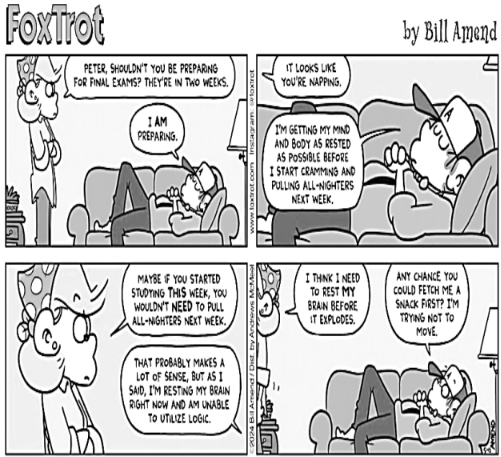
Q4412413 Inglês
Read the text below to answer question.

Captura_de tela 2026-10-28 071313.png (501×457)

Source: https://www.gocomics.com/foxtrot/2024/05/1 2 (Accessed: Nov 28, 2024).
In the second panel, Peter talks about “pulling all-nighters”, which means to: 
Alternativas
Q4412410 Inglês
Read the text below to answer question.

Yes, that viral LinkedIn post you read was probably AI-generated

[1] AI-generated writing is now all over the internet. The introduction of automated prose can sometimes change a website’s character, like when once beloved publications get purchased and overhauled into AI content mills. Other times, however, it’s harder to argue that AI really changed anything. For example, look at LinkedIn. The Microsoft-owned social media site for business professionals has embraced AI, even offering LinkedIn Premium subscribers access to its own in-house AI writing tools that can “rewrite” posts, profiles, and direct messages. The initiative appears to be working: over 54 percent of longer English-language posts on LinkedIn are likely AI-generated, according to an analysis by the startup Originality AI.

The startup scanned a sample of 8,795 public LinkedIn posts over 100 words long that were published from January 2018 to October 2024. It found out that the use of AI writing tools on LinkedIn was negligible for the first few years. A major increase then occurred at the beginning of 2023. At that point, Originality found the number of likely AI-generated posts had spiked 189 percent; it has since leveled off.

About this topic, LinkedIn says it doesn’t track how many posts on the site are written or edited with AI tools. Adam Walkiewicz, the platform’s head of feed relevance, points out “we do have robust defenses in place to proactively identify low-quality, and exact or near-exact duplicate content. When we detect such content, we take action to ensure it is not broadly promoted. We see AI as a tool that can help with review of a draft or to beat the blank page problem”.

[2] Generally, LinkedIn is used for finding a new job and keeping in touch with former coworkers, that is, a relatively staid social media platform. Nevertheless, in recent years, it’s developed its own network of influencers and is surprisingly popular with Gen Z, including teenagers. Like everywhere else on the internet, people on LinkedIn are thirsty for attention, and companies have realized there’s money to be made helping them grow their audiences.

That is why there’s a cottage industry of AI LinkedIn comment and post generators to help the career-minded churn out content to dazzle potential bosses or prospective customers. Instead of spending four minutes puzzling over the right tone with which to congratulate an ex-colleague on their promotion, it now takes four seconds to conjure up an algorithmically generated accolade. 

[3] But writing with AI is a topic that receives varied opinions. On the one hand, LinkedIn users who spoke to WIRED say that they do not rely on AI tools when trying to cobble their LinkedIn posts together. On the other hand, several non-native English speakers who also spoke to WIRED say they lean on AI tools to polish their English writing and fix grammar errors.

Besides, some people who have embraced AI on LinkedIn have received blowback. For instance, the entrepreneur Zack Fosdyck has gotten mixed feedback about his use of automated tools. According to him, some people engaged positively, appreciating the clarity and structure of the posts. Others, though, were skeptical or critical, often focusing on the fact that AI was involved rather than the content itself. He completes by saying “I find it fascinating how polarizing this technology can be, especially since tools like calculators or spellcheck, which are also forms of assistance, are widely accepted.”

[4] From one angle, LinkedIn may have inadvertently created the ideal laboratory for AI writing. Nobody’s logging on expecting profundity, hilarity, or sincerity. It’s the place where people strive to be the most anodyne versions of themselves, pleasant and inoffensive. Artificiality, in other words, is what everyone is expecting from it. 

Adapted from: https://www.wired.com/story/linkedin-aigenerated-influencers/

Published: Nov 26, 2024 – Accessed: Nov 28, 2024.
In the segment [4], the author states that LinkedIn is “the place where people strive to be the most anodyne versions of themselves”, which means people are:
Alternativas
Q4412404 Inglês
Read the text below to answer question.

Captura_de tela 2026-10-28 070306.png (302×253)

Source: https://www.glasbergen.com/educationcartoons/education-technology/ (Accessed: Nov 28, 2024).
The humor relies on:
Alternativas
Q4412402 Inglês
Read the text below to answer question.

Captura_de tela 2026-10-28 070306.png (302×253)

Source: https://www.glasbergen.com/educationcartoons/education-technology/ (Accessed: Nov 28, 2024).
The kid adjusted a popular phrase used as an excuse for some students when failing to do something on time, which is:
Alternativas
Q4412394 Inglês
Read the text below to answer question.

Screen Tourism

Screen tourism is a powerful tool for attracting visitors to destinations. The success of Harry Potter in the U.K. and The Lord of the Rings in New Zealand demonstrate the significant impact that film and television productions can have on tourism. In today’s competitive global market, leveraging screen tourism helps destinations stand out, showcase their unique qualities and gain a competitive edge. However, it’s no slam-dunk. As parts of the world grapple with excess tourism, some destinations see the damage that a sudden or continuous influx of tourists can wreak on communities and the environment. Therefore, there are pitfalls to avoid.

Across the globe, the U.K. and Ireland have emerged as highly desirable screen tourism destinations due to the international success of beloved franchises. For example, Game of Thrones played a significant role in attracting one in every six out-of-state visitors to Northern Ireland in 2018, contributing to 350,000 visitors and over $60 million for the local economy. 

A survey conducted by PhotoAid revealed that Hawaii is regarded as the most desirable film tourism destination in the U.S., thanks to the Jurassic Park franchise. The economic boost resulting from films like Jurassic World: Fallen Kingdom provided a $31 million boost to Hawaii’s economy and generated $7 million in wages for more than 1,200 workers, according to Budget Travel.

Seeing a place on screen can be an easy win for a destination marketing campaign, as the release of a film or TV show set in the region offers a springboard for conversation. For lesser-known destinations in particular, screen tourism offers a global spotlight they might otherwise never experience. Besides, if done carefully, screen tourism has the potential to attract year-round visitors who remain interested in regions due to their on-screen association.

However, despite its benefits, screen tourism can lead to challenges such as tourism burnout. Instances like the closure of the Thai beach featured in the film The Beach because of the impact on the local ecosystem, or the “Disneyification” of the Mamma Mia location in Greece, demonstrate the need for careful management. While at first the small Greek island of Skopelos was pleased to be in the spotlight, it quickly became overrun with tourists looking for the Mamma Mia experience, which didn’t actually reflect daily life on the island. Even France recently launched a campaign to pull tourists away from its most famous destinations, citing Netflix’s Emily in Paris and Lupin as causing an overload in visitors.

Authenticity plays a crucial role in leveraging screen tourism effectively. A good film will reflect the true essence of a place, as well as using that positive light, and destination brands should capitalize on that. If a film or TV show is hero-ing a location, creators should incorporate the local character, spirit and unique attributes, providing an authentic representation. Genres like Nordic Noir, for example, are great at captivating viewers without a rose-tinted lens, portraying a place’s true nature.

A successful story in this respect is Rye Lane. Raine Allen-Miller, who had a personal connection to Peckham in South London, moved the planned location of the film from Camden to Peckham. The film authentically shows Peckham’s diversity, vibrancy, and unique potential, and offers an opportunity to reshape the perception of the area beyond its association with Only Fools and Horses. This goes to show that destination campaigns that leverage screen tourism should make sure what they share is authentic and highlight parts of the area not seen on screen.

Film tour companies should also pay attention to partnership opportunities. To illustrate, they can collaborate with local restaurants and accommodation providers to offer inclusive trips, fostering a sense of community and support for local businesses. Working closely with production companies can be a crucial aspect to develop a genuine partnership that benefits both parties. Tourism Ireland’s collaboration with Game of Thrones serves as a prime example. Other areas are known for appearing in Game of Thrones – Croatia and Malta for example – but it’s Northern Ireland that has that official connection, because Tourism Ireland worked hard to make a partnership deal. They’ve also added really unique and creative ideas to draw in the superfans.

As have been demonstrated, screen tourism presents both benefits and challenges for destination brands. While the impact may be fleeting in some cases due to the abundance of film and television content available today, certain productions have the potential for enduring influence. By carefully leveraging screen tourism, destinations can generate global exposure, attract visitors year-round and foster partnerships that benefit local businesses and communities.

Adapted from: https://musebyclios.com/filmtv/screen-tourism-what-destination-brandscan-gain-our-favorite-films-and-shows/

Published: Jul 20, 2023 – Accessed: Nov 28, 2024. 
In the context of the text, the sentence “However, it’s no slam-dunk” suggests that:
Alternativas
Q4328793 Inglês
Match the columns about phrasal verbs and their definition then mark the alternative that contains the correct sequence.

1. Drop in
2. Join in.
3. Plug in.
4. Fill in.

( ) Connect something to the electricity supply.
( ) Visit somebody for a short time without arranging to do this.
( ) Write the necessary information on a form.
( ) Take part in an activity that is already going on. 
Alternativas
Q4328786 Inglês
Choose the correct alternative to fill in the gaps.
1. I get very _______ doing my job.
2. This rainy day makes me _______.
3. I’m not ________ in politics. 
Alternativas
Q4208658 Inglês
Leia o texto a seguir.


For decades, it seemed that the purpose of our education system was to encourage competition. Schools would award prizes to the most talented student and proudly display their names on bulletin boards. Nowadays, in many institutions, the key word has become "inclusion": no one should be left behind. Resources are channeled into helping the east capable; everyone's work (good or bad) is on the walls; and prize tables are heavily loaded with awards to make sure everyone is awarded a prize for something. Which approach is right?

Attempts to make education more inclusive are frequently criticized. Many point out that once students leave the protective environment of the classroom, they will face the challenges of the working world: what use will false reassurance be then? The purpose of school must be to reveal to people their limitations, so that they can find a vocation that suits them.

In the past, allowing the talented to rise to the top through competition would certainly have been important. In most factories, it was useful to separate the potential managers from the unskilled workforce, and companies relied on finding talented individuals to win business before their competitors did. An ethos of competition also helped countries to compete effectively with other nations as they scrambled for territory, raced to accumulate armaments or even traveled into space ahead of rivals.

But in the 21st century, are we really preparing young people for a world of competition? The academic James F. Moore argues that the days when businesses competed with each other are ending. Moore believes we should talk of "business ecosystems" nowadays. International corporations operate in global networks of suppliers and partners. Sometimes; even rival corporations work together. For example: companies often have to collaborate to define common industry standards.

What's more, hierarchies are disappearing within organizations. Modern companies have a wider range of business functions (public relations, IT, research and development), and so skills. Knowledge and decision-making are spread throughout the organization. In a modern marketing department alone, there are teams for collecting and analyzing a wealth of customer data, designing brands, advertising, etc. Each individual contributes vital skills and must receive equal training. Low-skilled work, by comparison, is increasingly being performed by automated labor; that is, robots.

But it isn't just in businesses that cooperation is becoming the norm. In the past, individuals, colleges, governments, and companies didn't have to collaborate. Now', 'collective impact" is becoming the gold standard. For example, an anti-obesity project called "Shape Up Somerville" managed to significantly bring down the average BMI (body mass index) in the town in just three years, by involving schools, colleges, local businesses, charities, government, and local citizens in a program of collective action. Led by academics, and funded by four agencies. The work involved designing school lunch menus, improving walkways, introducing gym membership packages, and running campaigns amongst the public.

Competition can still be useful. It's stimulating and can help us learn about ourselves. But it should not become a dominant feature of education systems. Those who do not receive investment will find it increasingly hard to fit into the modern world. It really is learning to take part that counts.

Fonte: (Texto retirado do livro Accelerate 2 p. 56.)
Dentre as palavras presentes no texto analisado, aquela que NÃO é cognato é:
Alternativas
Q4208657 Inglês
Leia o texto a seguir.


For decades, it seemed that the purpose of our education system was to encourage competition. Schools would award prizes to the most talented student and proudly display their names on bulletin boards. Nowadays, in many institutions, the key word has become "inclusion": no one should be left behind. Resources are channeled into helping the east capable; everyone's work (good or bad) is on the walls; and prize tables are heavily loaded with awards to make sure everyone is awarded a prize for something. Which approach is right?

Attempts to make education more inclusive are frequently criticized. Many point out that once students leave the protective environment of the classroom, they will face the challenges of the working world: what use will false reassurance be then? The purpose of school must be to reveal to people their limitations, so that they can find a vocation that suits them.

In the past, allowing the talented to rise to the top through competition would certainly have been important. In most factories, it was useful to separate the potential managers from the unskilled workforce, and companies relied on finding talented individuals to win business before their competitors did. An ethos of competition also helped countries to compete effectively with other nations as they scrambled for territory, raced to accumulate armaments or even traveled into space ahead of rivals.

But in the 21st century, are we really preparing young people for a world of competition? The academic James F. Moore argues that the days when businesses competed with each other are ending. Moore believes we should talk of "business ecosystems" nowadays. International corporations operate in global networks of suppliers and partners. Sometimes; even rival corporations work together. For example: companies often have to collaborate to define common industry standards.

What's more, hierarchies are disappearing within organizations. Modern companies have a wider range of business functions (public relations, IT, research and development), and so skills. Knowledge and decision-making are spread throughout the organization. In a modern marketing department alone, there are teams for collecting and analyzing a wealth of customer data, designing brands, advertising, etc. Each individual contributes vital skills and must receive equal training. Low-skilled work, by comparison, is increasingly being performed by automated labor; that is, robots.

But it isn't just in businesses that cooperation is becoming the norm. In the past, individuals, colleges, governments, and companies didn't have to collaborate. Now', 'collective impact" is becoming the gold standard. For example, an anti-obesity project called "Shape Up Somerville" managed to significantly bring down the average BMI (body mass index) in the town in just three years, by involving schools, colleges, local businesses, charities, government, and local citizens in a program of collective action. Led by academics, and funded by four agencies. The work involved designing school lunch menus, improving walkways, introducing gym membership packages, and running campaigns amongst the public.

Competition can still be useful. It's stimulating and can help us learn about ourselves. But it should not become a dominant feature of education systems. Those who do not receive investment will find it increasingly hard to fit into the modern world. It really is learning to take part that counts.

Fonte: (Texto retirado do livro Accelerate 2 p. 56.)
A palavra "argues" pode ser substituída por diferentes termos sem perder o sentido, EXCETO por:
"The academic James F. Moore argues that the days when businesses competed with each other are ending." 

Alternativas
Respostas
701: C
702: E
703: C
704: E
705: C
706: C
707: C
708: B
709: D
710: C
711: A
712: A
713: A
714: B
715: C
716: D
717: D
718: B
719: C
720: A