Questões de Concurso
Sobre vocabulário | vocabulary em inglês
Foram encontradas 3.148 questões


Ano: 2012
Banca:
Makiyama
Órgão:
CPTM
Prova:
Makiyama - 2012 - CPTM - Analista Trainee – Ciências Contábeis |
Q508223
Inglês
Texto associado
Generation Y
By Sally Kane, About.com Guide
Born in the mid-1980's and later, Generation Y legal professionals are in their 20s and are just entering the workforce. With numbers estimated as high as 70 million, Generation Y (also -1- as the Millennials) is the fastest growing segment of today's workforce. As law firms compete for available talent, employers cannot ignore the needs, desires and attitudes of this vast generation. Below are a few common traits that define Generation Y.
Tech-Savvy: Generation Y grew up with technology and rely on it to perform their jobs better. Armed with BlackBerrys, laptops, cellphones and other gadgets, Generation Y is plugged-in 24 hours a day, 7 days a week. This generation prefers to communicate through e-mail and text messaging rather than face-to-face contact and -2- webinars and online technology to traditional lecture-based presentations.
Family-Centric: The fast-track has lost much of its appeal for Generation Y who is willing to trade high pay for fewer billable hours, flexible schedules and a better work/life balance. While older generations may view this attitude as narcissistic or lacking commitment, discipline and drive, Generation Y legal professionals have a different vision of workplace expectations and prioritize family over work.
Achievement-Oriented: Nurtured and pampered -3- parents who did not want to make the mistakes of the previous generation, Generation Y is confident, ambitious and achievement-oriented. They have high expectations of their employers, seek out new challenges and are not afraid to question authority. Generation Y wants meaningful work and a solid learning curve
Team-Oriented: As children, Generation Y participated in team sports, play groups and other group activities. They value teamwork and seek the input and affirmation of others. Part of a no-person-left-behind generation, Generation Y is loyal, committed and wants to be included and involved.
Attention-Craving: Generation Y craves attention in the forms of feedback and guidance. They appreciate being kept in the loop and seek frequent praise and reassurance. Generation Y may benefit greatly from mentors who can help guide and develop their young careers.
Font: http://legalcareers.about.com/od/practicetips/a/Ge...
By Sally Kane, About.com Guide
Born in the mid-1980's and later, Generation Y legal professionals are in their 20s and are just entering the workforce. With numbers estimated as high as 70 million, Generation Y (also -1- as the Millennials) is the fastest growing segment of today's workforce. As law firms compete for available talent, employers cannot ignore the needs, desires and attitudes of this vast generation. Below are a few common traits that define Generation Y.
Tech-Savvy: Generation Y grew up with technology and rely on it to perform their jobs better. Armed with BlackBerrys, laptops, cellphones and other gadgets, Generation Y is plugged-in 24 hours a day, 7 days a week. This generation prefers to communicate through e-mail and text messaging rather than face-to-face contact and -2- webinars and online technology to traditional lecture-based presentations.
Family-Centric: The fast-track has lost much of its appeal for Generation Y who is willing to trade high pay for fewer billable hours, flexible schedules and a better work/life balance. While older generations may view this attitude as narcissistic or lacking commitment, discipline and drive, Generation Y legal professionals have a different vision of workplace expectations and prioritize family over work.
Achievement-Oriented: Nurtured and pampered -3- parents who did not want to make the mistakes of the previous generation, Generation Y is confident, ambitious and achievement-oriented. They have high expectations of their employers, seek out new challenges and are not afraid to question authority. Generation Y wants meaningful work and a solid learning curve
Team-Oriented: As children, Generation Y participated in team sports, play groups and other group activities. They value teamwork and seek the input and affirmation of others. Part of a no-person-left-behind generation, Generation Y is loyal, committed and wants to be included and involved.
Attention-Craving: Generation Y craves attention in the forms of feedback and guidance. They appreciate being kept in the loop and seek frequent praise and reassurance. Generation Y may benefit greatly from mentors who can help guide and develop their young careers.
Font: http://legalcareers.about.com/od/practicetips/a/Ge...
No primeiro parágrafo, o termo available pode ser traduzido como:
Ano: 2012
Banca:
CESPE / CEBRASPE
Órgão:
Câmara dos Deputados
Prova:
CESPE - 2012 - Câmara dos Deputados - Todos os Cargos - Conhecimentos Básicos - exceto para Técnico em Material e Patrimônio |
Q470887
Inglês

Based on the text above it can be said that
“fray" (L.19) is synonymous with fighting.
“fray" (L.19) is synonymous with fighting.
Ano: 2012
Banca:
CESPE / CEBRASPE
Órgão:
Câmara dos Deputados
Prova:
CESPE - 2012 - Câmara dos Deputados - Todos os Cargos - Conhecimentos Básicos - exceto para Técnico em Material e Patrimônio |
Q470884
Inglês
Based on the text above it can be said that
“surreptitious” (5.16) is synonymous with concealed.
“surreptitious” (5.16) is synonymous with concealed.
Ano: 2012
Banca:
CESPE / CEBRASPE
Órgão:
Câmara dos Deputados
Prova:
CESPE - 2012 - Câmara dos Deputados - Todos os Cargos - Conhecimentos Básicos - exceto para Técnico em Material e Patrimônio |
Q470880
Inglês

Judge the following items according to the text above.
The word “entrepreneurs” (5.30) can be defined as people who organizes, operates, and assumes the risk for a business venture
The word “entrepreneurs” (5.30) can be defined as people who organizes, operates, and assumes the risk for a business venture
Ano: 2012
Banca:
CESPE / CEBRASPE
Órgão:
Câmara dos Deputados
Prova:
CESPE - 2012 - Câmara dos Deputados - Todos os Cargos - Conhecimentos Básicos - exceto para Técnico em Material e Patrimônio |
Q470879
Inglês
Judge the following items according to the text above.
In the text, the verb to comply, in ‘You don’t want to get hit with a fine because you’re not complying’ (5.11-12), means to act in accordance with.
In the text, the verb to comply, in ‘You don’t want to get hit with a fine because you’re not complying’ (5.11-12), means to act in accordance with.
Ano: 2012
Banca:
CESPE / CEBRASPE
Órgão:
Câmara dos Deputados
Prova:
CESPE - 2012 - Câmara dos Deputados - Todos os Cargos - Conhecimentos Básicos - exceto para Técnico em Material e Patrimônio |
Q470878
Inglês
Judge the following items according to the text above.
The phrasal verb “lay out” (5.6) could be correctly replaced in the text by avoid.
The phrasal verb “lay out” (5.6) could be correctly replaced in the text by avoid.
Ano: 2012
Banca:
CESPE / CEBRASPE
Órgão:
Câmara dos Deputados
Prova:
CESPE - 2012 - Câmara dos Deputados - Todos os Cargos - Conhecimentos Básicos - exceto para Técnico em Material e Patrimônio |
Q470875
Inglês

According to the text above, judge the following items.
In the text, “outperform” (5.25) is synonymous with surpass.
In the text, “outperform” (5.25) is synonymous with surpass.
Ano: 2012
Banca:
CESGRANRIO
Órgão:
Petrobras
Provas:
CESGRANRIO - 2012 - BR Distribuidora - Profissional Júnior - Formação Administração
|
CESGRANRIO - 2012 - BR Distribuidora - Profissional Júnior - Formação Engenharia Mecânica |
CESGRANRIO - 2012 - BR Distribuidora - Profissional Júnior - Formação Ciências Contábeis |
CESGRANRIO - 2012 - BR Distribuidora - Profissional Júnior - Formação Analista de Sistemas - Ênfase em Java - Crm e Web |
Q460778
Inglês

Based on the meanings in the text, the two items are synonymous in
Ano: 2012
Banca:
Quadrix
Órgão:
DATAPREV
Provas:
Quadrix - 2012 - DATAPREV - Engenheiro de Segurança do Trabalho
|
Quadrix - 2012 - DATAPREV - Analista de Tecnologia da Informação - Administração de Pessoal e Benefício |
Quadrix - 2012 - DATAPREV - Analista de Tecnologia da Informação - Arquitetura |
Quadrix - 2012 - DATAPREV - Analista de Tecnologia da Informação - Comunicação Social |
Quadrix - 2012 - DATAPREV - Analista de Tecnologia da Informação - Advocacia |
Quadrix - 2012 - DATAPREV - Analista de Tecnologia da Informação - Engenharia Elétrica |
Quadrix - 2012 - DATAPREV - Analista de Tecnologia da Informação - Contabilidade |
Quadrix - 2012 - DATAPREV - Analista de Tecnologia da Informação - Engenharia Civil |
Quadrix - 2012 - DATAPREV - Analista de Tecnologia da Informação - Engenharia Mecânica |
Quadrix - 2012 - DATAPREV - Médico do Trabalho |
Quadrix - 2012 - DATAPREV - Analista de Tecnologia da Informação - Análise de Negócios |
Quadrix - 2012 - DATAPREV - Analista de Tecnologia da Informação - Desenvolvimento |
Quadrix - 2012 - DATAPREV - Analista de Tecnologia da Informação - Análise de Informações |
Quadrix - 2012 - DATAPREV - Analista de Tecnologia da Informação - Finanças |
Quadrix - 2012 - DATAPREV - Analista de Tecnologia da Informação - Processos Administrativos |
Quadrix - 2012 - DATAPREV - Analista de Tecnologia da Informação - Qualidade de Vida |
Quadrix - 2012 - DATAPREV - Analista de Tecnologia da Informação - Banco de Dados |
Q441881
Inglês
Texto associado
Read the text below and answer the questions.
Hedge Fund Manager Donates $100 Million for
Central Park
(h ttp ://www. nytimes. com)
Hedge Fund Manager Donates $100 Million for
Central Park
Mayor Michael R. Bloomberg and the Central Park Conservancy announced that the hedge fund billionaire John A. Paulson, along with the Paulson Family Foundation, were giving $100 million to the Central Park Conservancy. It is believed to be the largest gift ever to a public park.
Mr. Paulson, a lifelong New Yorker, said that as an infant he was pushed around in a baby carriage in the park and that he later remembered going to Bethesda Fountain as a teenager and seeing it covered in graffiti, with no water flowing. The announcement of the gift carne during a
ceremony at the fountain.
When asked at the news conference what prompted the gift, Mr. Paulson said: "Walking through the
park in different seasons, it kept coming back that in my mind Central Park is the most deserving of ali of New York's cultural institutions. And I wanted the amount to make a difference. The park is very large, and its endowment is relatively small."
The park's current endowment stands at $144 million. Half of Mr. Paulson's gift will go to the endowment, while the other half will be used for capital improvements. Mr. Paulson mentioned that he considered important: Restoring the park's North Woods, and sprucing up the Merchanfs Gate entrance at the park's Southwest comer, the most heavily used entrance.
Mr. Paulson has been a supporter of the Central Park Conservancy for 20 years, but this is his first major gift to the park. He joined the conservancy's board in June.
Two former parks commissioners, Henry Stern and Adrian Benepe, were at the news conference on Tuesday. It was also attended by Elizabeth Barlow Rogers and Richard Gilder, key figures in the conservancy's founding.
The announcement was made under cloudy skies in a ceremony attended by hundreds of employees of the Central Park Conservancy in their gray sweatshirts, as well as the conservancy's board. Doug Blonsky, the president and chief executive officer of the conservancy, which operates Central Park for the city, hailed the gift as "transformational," saying that it would break the cycle of restoration and decline that has marked the park throughout its 153-year history.
ceremony at the fountain.
When asked at the news conference what prompted the gift, Mr. Paulson said: "Walking through the
park in different seasons, it kept coming back that in my mind Central Park is the most deserving of ali of New York's cultural institutions. And I wanted the amount to make a difference. The park is very large, and its endowment is relatively small."
The park's current endowment stands at $144 million. Half of Mr. Paulson's gift will go to the endowment, while the other half will be used for capital improvements. Mr. Paulson mentioned that he considered important: Restoring the park's North Woods, and sprucing up the Merchanfs Gate entrance at the park's Southwest comer, the most heavily used entrance.
Mr. Paulson has been a supporter of the Central Park Conservancy for 20 years, but this is his first major gift to the park. He joined the conservancy's board in June.
Two former parks commissioners, Henry Stern and Adrian Benepe, were at the news conference on Tuesday. It was also attended by Elizabeth Barlow Rogers and Richard Gilder, key figures in the conservancy's founding.
The announcement was made under cloudy skies in a ceremony attended by hundreds of employees of the Central Park Conservancy in their gray sweatshirts, as well as the conservancy's board. Doug Blonsky, the president and chief executive officer of the conservancy, which operates Central Park for the city, hailed the gift as "transformational," saying that it would break the cycle of restoration and decline that has marked the park throughout its 153-year history.
(h ttp ://www. nytimes. com)
The word "capitar' in "capital improvements":
Ano: 2012
Banca:
Quadrix
Órgão:
DATAPREV
Prova:
Quadrix - 2012 - DATAPREV - Auxiliar de Enfermagem do Trabalho |
Q440317
Inglês
Texto associado
Snacking at the Colosseum? Prepare to Pay a Fine
Dapper as always in their bleached white shirts and matching caps, members of Rome's municipal police force were out on the Spanish Steps one warm autumn day, trolling for offenders.
"Stefano, look! There's another eater," one officer said to another before sauntering over to a baffled couple who had begun munching on an inoffensive-looking meai while sitting on the steps. The culprits, a couple of foreign tourists, had settled down on the landmark, one of Rome's most famous. In their hands were the offending items: sandwiches.
The officers pounced, and after much waving of hands, the couple wrapped up the sandwiches and slouched away, looking sheepish.
They were in violation unwittingly, in ali probability - of a municipal ordinance that went into force this month. The measure outlaws eating and drinking in areas of "particular historie, artistic, architectonic and cultural value" in Rome's center, to better protect the city's monuments, which include landmarks like the Colosseum, the Pantheon and the Spanish Steps. Fines range ali the way up to $650 for culinary recidivists.
Italian cities, Rome included, have long enacted ordinances and regulations to protect monuments from ill- mannered tourists (and residents). But after a recent stroll through the city center, where he saw several people making themselves at home, literally, Rome's mayor, Gianni Alemanno, decided the rules needed toughening.
"There were people camped out, and we weren't able to move them," said Antonio Gazzellone, the municipal council member responsible for tourism, noting that alcohol may have been involved. The new ordinance, which also outlaws camping or "setting up makeshift beds," will "give monuments back their proper decorum," he said. "Rome needs to be protected, its beauty respected."
(http://www.nytimes.com)
Dapper as always in their bleached white shirts and matching caps, members of Rome's municipal police force were out on the Spanish Steps one warm autumn day, trolling for offenders.
"Stefano, look! There's another eater," one officer said to another before sauntering over to a baffled couple who had begun munching on an inoffensive-looking meai while sitting on the steps. The culprits, a couple of foreign tourists, had settled down on the landmark, one of Rome's most famous. In their hands were the offending items: sandwiches.
The officers pounced, and after much waving of hands, the couple wrapped up the sandwiches and slouched away, looking sheepish.
They were in violation unwittingly, in ali probability - of a municipal ordinance that went into force this month. The measure outlaws eating and drinking in areas of "particular historie, artistic, architectonic and cultural value" in Rome's center, to better protect the city's monuments, which include landmarks like the Colosseum, the Pantheon and the Spanish Steps. Fines range ali the way up to $650 for culinary recidivists.
Italian cities, Rome included, have long enacted ordinances and regulations to protect monuments from ill- mannered tourists (and residents). But after a recent stroll through the city center, where he saw several people making themselves at home, literally, Rome's mayor, Gianni Alemanno, decided the rules needed toughening.
"There were people camped out, and we weren't able to move them," said Antonio Gazzellone, the municipal council member responsible for tourism, noting that alcohol may have been involved. The new ordinance, which also outlaws camping or "setting up makeshift beds," will "give monuments back their proper decorum," he said. "Rome needs to be protected, its beauty respected."
(http://www.nytimes.com)
"Unwittingly", in the text, means that:
Ano: 2012
Banca:
Quadrix
Órgão:
DATAPREV
Prova:
Quadrix - 2012 - DATAPREV - Auxiliar de Enfermagem do Trabalho |
Q440316
Inglês
Texto associado
Snacking at the Colosseum? Prepare to Pay a Fine
Dapper as always in their bleached white shirts and matching caps, members of Rome's municipal police force were out on the Spanish Steps one warm autumn day, trolling for offenders.
"Stefano, look! There's another eater," one officer said to another before sauntering over to a baffled couple who had begun munching on an inoffensive-looking meai while sitting on the steps. The culprits, a couple of foreign tourists, had settled down on the landmark, one of Rome's most famous. In their hands were the offending items: sandwiches.
The officers pounced, and after much waving of hands, the couple wrapped up the sandwiches and slouched away, looking sheepish.
They were in violation unwittingly, in ali probability - of a municipal ordinance that went into force this month. The measure outlaws eating and drinking in areas of "particular historie, artistic, architectonic and cultural value" in Rome's center, to better protect the city's monuments, which include landmarks like the Colosseum, the Pantheon and the Spanish Steps. Fines range ali the way up to $650 for culinary recidivists.
Italian cities, Rome included, have long enacted ordinances and regulations to protect monuments from ill- mannered tourists (and residents). But after a recent stroll through the city center, where he saw several people making themselves at home, literally, Rome's mayor, Gianni Alemanno, decided the rules needed toughening.
"There were people camped out, and we weren't able to move them," said Antonio Gazzellone, the municipal council member responsible for tourism, noting that alcohol may have been involved. The new ordinance, which also outlaws camping or "setting up makeshift beds," will "give monuments back their proper decorum," he said. "Rome needs to be protected, its beauty respected."
(http://www.nytimes.com)
Dapper as always in their bleached white shirts and matching caps, members of Rome's municipal police force were out on the Spanish Steps one warm autumn day, trolling for offenders.
"Stefano, look! There's another eater," one officer said to another before sauntering over to a baffled couple who had begun munching on an inoffensive-looking meai while sitting on the steps. The culprits, a couple of foreign tourists, had settled down on the landmark, one of Rome's most famous. In their hands were the offending items: sandwiches.
The officers pounced, and after much waving of hands, the couple wrapped up the sandwiches and slouched away, looking sheepish.
They were in violation unwittingly, in ali probability - of a municipal ordinance that went into force this month. The measure outlaws eating and drinking in areas of "particular historie, artistic, architectonic and cultural value" in Rome's center, to better protect the city's monuments, which include landmarks like the Colosseum, the Pantheon and the Spanish Steps. Fines range ali the way up to $650 for culinary recidivists.
Italian cities, Rome included, have long enacted ordinances and regulations to protect monuments from ill- mannered tourists (and residents). But after a recent stroll through the city center, where he saw several people making themselves at home, literally, Rome's mayor, Gianni Alemanno, decided the rules needed toughening.
"There were people camped out, and we weren't able to move them," said Antonio Gazzellone, the municipal council member responsible for tourism, noting that alcohol may have been involved. The new ordinance, which also outlaws camping or "setting up makeshift beds," will "give monuments back their proper decorum," he said. "Rome needs to be protected, its beauty respected."
(http://www.nytimes.com)
In the text, "culprits" means:
Ano: 2012
Banca:
IDECAN
Órgão:
Banestes
Provas:
IDECAN - 2012 - Banestes - Analista de Tecnologia da Informação - Desenvolvimento de Sistemas
|
IDECAN - 2012 - Banestes - Analista de Tecnologia da Informação - Suporte e Infraestrutura |
Q365267
Inglês
They are some of the functions people have in a bank except for:
Ano: 2012
Banca:
IDECAN
Órgão:
Banestes
Provas:
IDECAN - 2012 - Banestes - Analista de Tecnologia da Informação - Desenvolvimento de Sistemas
|
IDECAN - 2012 - Banestes - Analista de Tecnologia da Informação - Suporte e Infraestrutura |
Q365266
Inglês
Match the two columns.
1. Banking account.
2. Savings account.
3. Interests.
4. Profit.
5. Fine.
( ) Ammount of money that must be paid as a penalty.
( ) Income and expenses assigned to a person, business in a bank.
( ) A banking account to supply money for future use.
( ) Money made after all expenses are paid.
( ) Money a lender charges to someone who borrows money
Mark the option with the right sequence.
1. Banking account.
2. Savings account.
3. Interests.
4. Profit.
5. Fine.
( ) Ammount of money that must be paid as a penalty.
( ) Income and expenses assigned to a person, business in a bank.
( ) A banking account to supply money for future use.
( ) Money made after all expenses are paid.
( ) Money a lender charges to someone who borrows money
Mark the option with the right sequence.
Ano: 2012
Banca:
Makiyama
Órgão:
CPTM
Provas:
Makiyama - 2012 - CPTM - Analista Administrativo Júnior
|
Makiyama - 2012 - CPTM - Analista de Recursos Humanos Júnior - Administração de Empresas |
Makiyama - 2012 - CPTM - Advogado Júnior |
Makiyama - 2012 - CPTM - Auditor Júnior |
Q328063
Inglês
Texto associado
Generation Y
By Sally Kane, About.com Guide
Born in the mid-1980's and later, Generation Y legal professionals are in their 20s and are just entering the workforce. With numbers estimated as high as 70 million, Generation Y (also -1- as the Millennials) is the fastest growing segment of today's workforce. As law firms compete for available talent, employers cannot ignore the needs, desires and attitudes of this vast generation. Below are a few common traits that define Generation Y.
Tech-Savvy: Generation Y grew up with technology and rely on it to perform their jobs better. Armed with BlackBerrys, laptops, cellphones and other gadgets, Generation Y is plugged-in 24 hours a day, 7 days a week. This generation prefers to communicate through e-mail and text messaging rather than face-to-face contact and -2- webinars and online technology to traditional lecture-based presentations.
Family-Centric: The fast-track has lost much of its appeal for Generation Y who is willing to trade high pay for fewer billable hours, flexible schedules and a better work/life balance. While older generations may view this attitude as narcissistic or lacking commitment, discipline and drive, Generation Y legal professionals have a different vision of workplace expectations and prioritize family over work.
Achievement-Oriented: Nurtured and pampered -3- parents who did not want to make the mistakes of the previous generation, Generation Y is confident, ambitious and achievement-oriented. They have high expectations of their employers, seek out new challenges and are not afraid to question authority. Generation Y wants meaningful work and a solid learning curve
Team-Oriented: As children, Generation Y participated in team sports, play groups and other group activities. They value teamwork and seek the input and affirmation of others. Part of a no-person-left-behind generation, Generation Y is loyal, committed and wants to be included and involved.
Attention-Craving: Generation Y craves attention in the forms of feedback and guidance. They appreciate being kept in the loop and seek frequent praise and reassurance. Generation Y may benefit greatly from mentors who can help guide and develop their young careers.
Font: http://legalcareers.about.com/od/practicetips/a/Ge...
By Sally Kane, About.com Guide
Born in the mid-1980's and later, Generation Y legal professionals are in their 20s and are just entering the workforce. With numbers estimated as high as 70 million, Generation Y (also -1- as the Millennials) is the fastest growing segment of today's workforce. As law firms compete for available talent, employers cannot ignore the needs, desires and attitudes of this vast generation. Below are a few common traits that define Generation Y.
Tech-Savvy: Generation Y grew up with technology and rely on it to perform their jobs better. Armed with BlackBerrys, laptops, cellphones and other gadgets, Generation Y is plugged-in 24 hours a day, 7 days a week. This generation prefers to communicate through e-mail and text messaging rather than face-to-face contact and -2- webinars and online technology to traditional lecture-based presentations.
Family-Centric: The fast-track has lost much of its appeal for Generation Y who is willing to trade high pay for fewer billable hours, flexible schedules and a better work/life balance. While older generations may view this attitude as narcissistic or lacking commitment, discipline and drive, Generation Y legal professionals have a different vision of workplace expectations and prioritize family over work.
Achievement-Oriented: Nurtured and pampered -3- parents who did not want to make the mistakes of the previous generation, Generation Y is confident, ambitious and achievement-oriented. They have high expectations of their employers, seek out new challenges and are not afraid to question authority. Generation Y wants meaningful work and a solid learning curve
Team-Oriented: As children, Generation Y participated in team sports, play groups and other group activities. They value teamwork and seek the input and affirmation of others. Part of a no-person-left-behind generation, Generation Y is loyal, committed and wants to be included and involved.
Attention-Craving: Generation Y craves attention in the forms of feedback and guidance. They appreciate being kept in the loop and seek frequent praise and reassurance. Generation Y may benefit greatly from mentors who can help guide and develop their young careers.
Font: http://legalcareers.about.com/od/practicetips/a/Ge...
No trecho:“Generation Y craves attention in the forms of feedback and guidance”, a melhor definição para o termo em destaque é:
Ano: 2012
Banca:
CESGRANRIO
Órgão:
TERMOBAHIA
Prova:
CESGRANRIO - 2012 - TERMOBAHIA - Técnico de Segurança Júnior |
Q326239
Inglês

In the text, the word in bold-face type is similar to the word/expression in italics in:
Ano: 2012
Banca:
UNEMAT
Órgão:
CEPROMAT
Prova:
UNEMAT - 2012 - CEPROMAT - Analista de Tecnologia da Informação |
Q299166
Inglês

Relacione as palavras da primeira coluna com as da segunda:
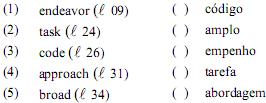
Assinale a alternativa que indica a sequência correta.
Assinale a alternativa que indica a sequência correta.
Ano: 2012
Banca:
IBFC
Órgão:
INEP
Prova:
IBFC - 2012 - INEP - Pesquisador-Tecnologista em Informações e Avaliações Educacionais - Área III |
Q297297
Inglês
Read the following sentences I, II, III: I.
I sent a letter to the airline company complaining about the problems I had during the flight and they have promised to look into the matter.
II. Although that doctor hasn't won the Nobel Prize, I look up to him.
III. I promised her that I would look after her kids if she weren't able to do that.
It's correct to say that the meaning of each underline bold phrasal verb is respectively
I sent a letter to the airline company complaining about the problems I had during the flight and they have promised to look into the matter.
II. Although that doctor hasn't won the Nobel Prize, I look up to him.
III. I promised her that I would look after her kids if she weren't able to do that.
It's correct to say that the meaning of each underline bold phrasal verb is respectively
Ano: 2012
Banca:
IBFC
Órgão:
INEP
Prova:
IBFC - 2012 - INEP - Pesquisador-Tecnologista em Informações e Avaliações Educacionais - Área III |
Q297295
Inglês
Texto associado
Read the text and answer questions 19), 20), 21), 22), 23) and 24).
Lawsuits claim Knoedler made huge profits on fakes
For more than a dozen years the Upper East Side gallery Knoedler & Company was “substantially dependent” on profits it made from selling a mysterious collection of artwork that is at the center of a federal forgery investigation, former clients of this former gallery have charged in court papers. The analysis is based on financial records turned over as part of a lawsuit against the gallery filed by Domenico and Eleanore De Sole, who in 2004 paid $8.3 million for a painting attributed to Mark Rothko that they now say is a worthless fake. The Rothko is one of approximately 40 works that Knoedler, which closed last year, obtained from Glafira Rosales, a littleknown dealer whose collection of works attributed to Modernist masters has no documented provenance and is the subject of an F.B.I. investigation. Between 1996 and 2008, the suit asserts, Knoedler earned approximately $60 million from works that Ms. Rosales provided on consignment or sold outright to the gallery and cleared $40 million in profits. In one year, 2002, for example, the complaint says the gallery’s entire profit — $5.6 million — was derived from the sale of Ms. Rosales’s works. “Knoedler’s viability as a business was substantially — and, in some years, almost entirely — dependent on sales from the Rosales Collection,” the De Soles claimed last month in an amended version of the suit they filed this year. While the forgery allegations are well known and have been the subject of three federal lawsuits against Knoedler, the recent filings expand the known number of Rosales artworks that were handled by the gallery, which was in business for 165 years, and assert that they played a pivotal role in the gallery’s success. After the F.B.I. issued subpoenas to the gallery in the fall of 2009, Michael Hammer, Knoedler’s owner, halted the sale of any Rosales works. Knoedler ended up losing money that year and in 2010, the court papers say. http://www.nytimes.com/2012/10/22/arts/design/knoe...
Lawsuits claim Knoedler made huge profits on fakes
For more than a dozen years the Upper East Side gallery Knoedler & Company was “substantially dependent” on profits it made from selling a mysterious collection of artwork that is at the center of a federal forgery investigation, former clients of this former gallery have charged in court papers. The analysis is based on financial records turned over as part of a lawsuit against the gallery filed by Domenico and Eleanore De Sole, who in 2004 paid $8.3 million for a painting attributed to Mark Rothko that they now say is a worthless fake. The Rothko is one of approximately 40 works that Knoedler, which closed last year, obtained from Glafira Rosales, a littleknown dealer whose collection of works attributed to Modernist masters has no documented provenance and is the subject of an F.B.I. investigation. Between 1996 and 2008, the suit asserts, Knoedler earned approximately $60 million from works that Ms. Rosales provided on consignment or sold outright to the gallery and cleared $40 million in profits. In one year, 2002, for example, the complaint says the gallery’s entire profit — $5.6 million — was derived from the sale of Ms. Rosales’s works. “Knoedler’s viability as a business was substantially — and, in some years, almost entirely — dependent on sales from the Rosales Collection,” the De Soles claimed last month in an amended version of the suit they filed this year. While the forgery allegations are well known and have been the subject of three federal lawsuits against Knoedler, the recent filings expand the known number of Rosales artworks that were handled by the gallery, which was in business for 165 years, and assert that they played a pivotal role in the gallery’s success. After the F.B.I. issued subpoenas to the gallery in the fall of 2009, Michael Hammer, Knoedler’s owner, halted the sale of any Rosales works. Knoedler ended up losing money that year and in 2010, the court papers say. http://www.nytimes.com/2012/10/22/arts/design/knoe...
In the passage “The analysis is based on financial records turned over as part of a lawsuit against the gallery filed by Domenico and Eleanore De Sole" the meaning of the phrasal verb is
Ano: 2012
Banca:
IBFC
Órgão:
INEP
Prova:
IBFC - 2012 - INEP - Pesquisador-Tecnologista em Informações e Avaliações Educacionais - Área III |
Q297294
Inglês
Texto associado
Read the text and answer questions 19), 20), 21), 22), 23) and 24).
Lawsuits claim Knoedler made huge profits on fakes
For more than a dozen years the Upper East Side gallery Knoedler & Company was “substantially dependent” on profits it made from selling a mysterious collection of artwork that is at the center of a federal forgery investigation, former clients of this former gallery have charged in court papers. The analysis is based on financial records turned over as part of a lawsuit against the gallery filed by Domenico and Eleanore De Sole, who in 2004 paid $8.3 million for a painting attributed to Mark Rothko that they now say is a worthless fake. The Rothko is one of approximately 40 works that Knoedler, which closed last year, obtained from Glafira Rosales, a littleknown dealer whose collection of works attributed to Modernist masters has no documented provenance and is the subject of an F.B.I. investigation. Between 1996 and 2008, the suit asserts, Knoedler earned approximately $60 million from works that Ms. Rosales provided on consignment or sold outright to the gallery and cleared $40 million in profits. In one year, 2002, for example, the complaint says the gallery’s entire profit — $5.6 million — was derived from the sale of Ms. Rosales’s works. “Knoedler’s viability as a business was substantially — and, in some years, almost entirely — dependent on sales from the Rosales Collection,” the De Soles claimed last month in an amended version of the suit they filed this year. While the forgery allegations are well known and have been the subject of three federal lawsuits against Knoedler, the recent filings expand the known number of Rosales artworks that were handled by the gallery, which was in business for 165 years, and assert that they played a pivotal role in the gallery’s success. After the F.B.I. issued subpoenas to the gallery in the fall of 2009, Michael Hammer, Knoedler’s owner, halted the sale of any Rosales works. Knoedler ended up losing money that year and in 2010, the court papers say. http://www.nytimes.com/2012/10/22/arts/design/knoe...
Lawsuits claim Knoedler made huge profits on fakes
For more than a dozen years the Upper East Side gallery Knoedler & Company was “substantially dependent” on profits it made from selling a mysterious collection of artwork that is at the center of a federal forgery investigation, former clients of this former gallery have charged in court papers. The analysis is based on financial records turned over as part of a lawsuit against the gallery filed by Domenico and Eleanore De Sole, who in 2004 paid $8.3 million for a painting attributed to Mark Rothko that they now say is a worthless fake. The Rothko is one of approximately 40 works that Knoedler, which closed last year, obtained from Glafira Rosales, a littleknown dealer whose collection of works attributed to Modernist masters has no documented provenance and is the subject of an F.B.I. investigation. Between 1996 and 2008, the suit asserts, Knoedler earned approximately $60 million from works that Ms. Rosales provided on consignment or sold outright to the gallery and cleared $40 million in profits. In one year, 2002, for example, the complaint says the gallery’s entire profit — $5.6 million — was derived from the sale of Ms. Rosales’s works. “Knoedler’s viability as a business was substantially — and, in some years, almost entirely — dependent on sales from the Rosales Collection,” the De Soles claimed last month in an amended version of the suit they filed this year. While the forgery allegations are well known and have been the subject of three federal lawsuits against Knoedler, the recent filings expand the known number of Rosales artworks that were handled by the gallery, which was in business for 165 years, and assert that they played a pivotal role in the gallery’s success. After the F.B.I. issued subpoenas to the gallery in the fall of 2009, Michael Hammer, Knoedler’s owner, halted the sale of any Rosales works. Knoedler ended up losing money that year and in 2010, the court papers say. http://www.nytimes.com/2012/10/22/arts/design/knoe...
The alternative that brings the best synonym to the bold underline idiom in the passage “Knoedler ended up losing money that year and in 2010" is
Q291547
Inglês

n Text II, the idea expressed by the word in boldface type is described in

 Conheça nossos planos