Questões de Concurso
Sobre verbos | verbs em inglês
Foram encontradas 3.093 questões


Ano: 2025
Banca:
Avança SP
Órgão:
Prefeitura de Araçariguama - SP
Prova:
Avança SP - 2025 - Prefeitura de Araçariguama - SP - PEB II - Língua Estrangeira (Inglês) |
Q3764987
Inglês
Which of the following sentences contains an
incorrect negation?
Ano: 2025
Banca:
Instituto Access
Órgão:
Prefeitura de Navegantes - SC
Prova:
Instituto Access - 2025 - Prefeitura de Navegantes - SC - Professor de Inglês |
Q3764860
Inglês
Change the following sentence into Reported Speech: 'I
will finish the report tomorrow,' said John. Judge the
following statements as True (T) or False (F).
(__)John said that he would finish the report the following day.
(__)John said that he will finish the report tomorrow.
(__)John told that he would finish the report the next day.
(__)John said that he would finish the report tomorrow.
Mark the alternative that shows the correct sequence, from top to bottom.
(__)John said that he would finish the report the following day.
(__)John said that he will finish the report tomorrow.
(__)John told that he would finish the report the next day.
(__)John said that he would finish the report tomorrow.
Mark the alternative that shows the correct sequence, from top to bottom.
Ano: 2025
Banca:
Instituto Access
Órgão:
Prefeitura de Navegantes - SC
Prova:
Instituto Access - 2025 - Prefeitura de Navegantes - SC - Professor de Inglês |
Q3764857
Inglês
Select the alternative that adheres to the rules of
standard English subject-verb agreement.
Ano: 2025
Banca:
Instituto Access
Órgão:
Prefeitura de Navegantes - SC
Prova:
Instituto Access - 2025 - Prefeitura de Navegantes - SC - Professor de Inglês |
Q3764844
Inglês
Consider the following verb phrases taken from an
academic argumentative text:
has long been
witnessed in the clause "the late 20th century witnessed ..."
suggests and empowers
Based on these forms and their uses in English, analyze the assertions below:
I.Has long been represents the Present Perfect Simple, indicating a state that started in the past and continues to the present.
II.Witnessed (in "the late 20th century witnessed ...") is in the Simple Past, referring to a definite time in the past.
III.Suggests and empowers are in the Simple Present, used here to express facts or theoretical truths within the author's argument.
Mark the option that presents only the correct statements.
has long been
witnessed in the clause "the late 20th century witnessed ..."
suggests and empowers
Based on these forms and their uses in English, analyze the assertions below:
I.Has long been represents the Present Perfect Simple, indicating a state that started in the past and continues to the present.
II.Witnessed (in "the late 20th century witnessed ...") is in the Simple Past, referring to a definite time in the past.
III.Suggests and empowers are in the Simple Present, used here to express facts or theoretical truths within the author's argument.
Mark the option that presents only the correct statements.
Ano: 2025
Banca:
Quadrix
Órgão:
SEDF
Prova:
Quadrix - 2025 - SEDF - Professor de Educação Básica: Lem/Inglês |
Q3763487
Inglês
Texto associado
During an advanced English class, a student asks about the
difference between these two sentences: (1)“The teacher
stopped talking to the students.” and (2)“The teacher
stopped to talk to the students.”. The trainee teachers give
different interpretations, and you must clarify the semantic
aspects involved.
As a senior English teacher, you are guiding trainee teachers
to analyze semantic nuances in classroom communication,
consider the situation above and judge the following items,
according to English semantics.
The semantic distinction between (1) and (2) arises
from aspectual complementation (gerund vs.
infinitive).
73 From a
Ano: 2025
Banca:
FUNDATEC
Órgão:
Prefeitura de Venâncio Aires - RS
Prova:
FUNDATEC - 2025 - Prefeitura de Venâncio Aires - RS - Professor de Língua Inglesa |
Q3762118
Inglês
Texto associado
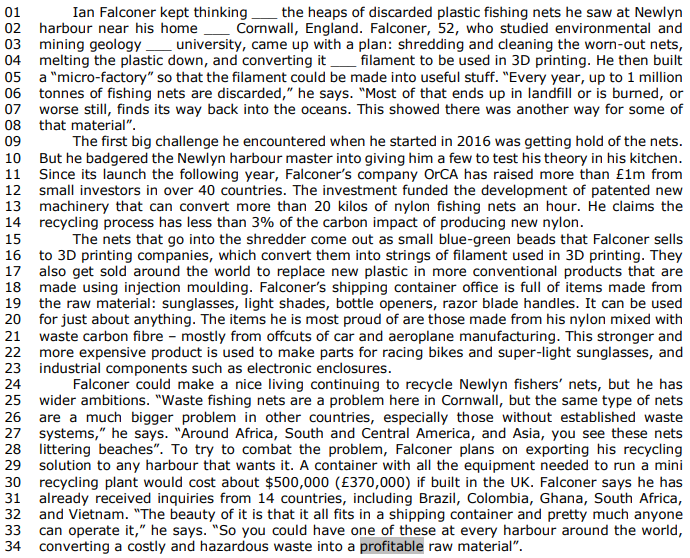
A One-Man Recycling Revolution on The Cornish Coast
By Rupert Neate
(Available at: www.theguardian.com/environment/2025/oct/16/fishing-nets-money-a-one-man-recyclingrevolution-on-the-cornish-coast – text specially adapted for this test).
Analyze the statements below:
I. In “new machinery that can convert more than 20 kilos of nylon fishing nets an hour” (l. 12-13), “can” suggests ability.
II. In “It can be used for just about anything” (l. 19-20), “can” suggests permission.
III. In “Falconer could make a nice living” (l. 24), “make” is in its base form because it follows a modal verb.
Which ones are correct?
I. In “new machinery that can convert more than 20 kilos of nylon fishing nets an hour” (l. 12-13), “can” suggests ability.
II. In “It can be used for just about anything” (l. 19-20), “can” suggests permission.
III. In “Falconer could make a nice living” (l. 24), “make” is in its base form because it follows a modal verb.
Which ones are correct?
Ano: 2025
Banca:
Ápice Consultoria
Órgão:
Prefeitura de Boqueirão - PB
Prova:
Ápice Consultoria - 2025 - Prefeitura de Boqueirão - PB - Professor de Educação Básica II - Inglês |
Q3758792
Inglês
Texto associado
Leia o texto abaixo para responder da questão.
New Study: This Regional Accent Is Considered
the Most Trustworthy in the U.S.—And the
Results Will Really Surprise You!
By Jennifer Geddes
A person’s cadence counts for a lot.
Everyone knows first impressions are important—
and we don’t just make them based on sight. Beyond
a chic outfit and well-coiffed hair, how a person
sounds can also be a big factor when forming an
initial opinion. In fact, a recent analysis of more than a
dozen American accents conducted by BetUS Casino
found that some folks’ speech actually conveys more
honesty and reliability than others’.
At this point, you’re probably praying your own voice
sounds dependable, not shifty or shady, right? Try to
relax, and then read on to learn (nay, hear!) where
the most trustworthy accents are located.
How was the study conducted?
As with many studies today, internet data helped
determine which parts of the country sound the most
steadfast and true. BetUS Casino crafted the report,
which is current as of Aug. 15, 2025, by focusing on
how people feel about 14 different regional accents.
How did the company determine those feelings?
First, researchers looked at internet search terms like
“friendly (accent)” or “professional (accent).” Then,
to complete the rankings, they compiled data on the
rate of financial crimes per 10,000 people, plus the
number of lawyers and primary-care doctors in each
area.
Why doctors and lawyers, you may ask? Well, these
are professions that rely on trust—after all, you might
have to put your life in their hands! The more of these
professionals in an area, the more trustworthy the
accent. Once the study authors had the information
in hand, they weighted the data and ranked the
regions on a scale of 1–100.
Which regional accent is considered the most
trustworthy?
Now hear this: The regional accent that’s considered
to be the most trustworthy hails from Boston!
Yup, the fine citizens of Beantown scored 56.1, which
was enough to take top honors for sounding highly
dependable. Boston ranks so strongly thanks to
more than 23,300 searches related to how kind and
upstanding the accent sounds. The Massachusetts
capital and largest city in New England also sports
a low level of financial crime and is home to tens of
thousands of lawyers and doctors.
Boston shines in other ways too, underlining the trust
factor essential to its distinctive accent. For example,
one recent WalletHub report list Boston as the third
most caring city in the nation, while another names
Massachusetts as the best U.S. state to live in. And
the Bay State has excellent health care, with the
highest childhood vaccination rates, lowest infant
mortality and fewest premature avoidable deaths.
Want to sound just like a Bostonian? Start by
dropping some of your R’s, as in “pahk the cah” and
“wicked smaht.” Or listen to Ben Affleck turn on the
telltale accent in his Dunkin’ commercials. Other
famous Bostonians with perfect inflection include
Matt Damon, Mark Wahlberg and Amy Poehler.
In: https://www.rd.com/article/happiest-cities-america-2025/
Considere o seguinte trecho do texto:
“Once the study authors had the information in hand, they weighted the data and ranked the regions on a scale of 1–100.”
Com base nesse trecho, analise as afirmativas a seguir:
I. O tempo verbal predominante é o past perfect, usado para indicar que uma ação foi concluída antes de outra no passado.
II. Os verbos “weighted” e “ranked” estão no past simple, e seus objetos diretos são, respectivamente, the data e the regions.
III. O verbo “had” funciona como verbo auxiliar na formação do past perfect, e o objeto direto da ação é the study authors.
IV. Não há objeto indireto explícito em nenhuma das orações do trecho citado.
Assinale a alternativa correta:
“Once the study authors had the information in hand, they weighted the data and ranked the regions on a scale of 1–100.”
Com base nesse trecho, analise as afirmativas a seguir:
I. O tempo verbal predominante é o past perfect, usado para indicar que uma ação foi concluída antes de outra no passado.
II. Os verbos “weighted” e “ranked” estão no past simple, e seus objetos diretos são, respectivamente, the data e the regions.
III. O verbo “had” funciona como verbo auxiliar na formação do past perfect, e o objeto direto da ação é the study authors.
IV. Não há objeto indireto explícito em nenhuma das orações do trecho citado.
Assinale a alternativa correta:
Ano: 2025
Banca:
FACET Concursos
Órgão:
Prefeitura de Monteiro - PB
Prova:
FACET Concursos - 2025 - Prefeitura de Monteiro - PB - Professor de Educação Fundamental 2 - Língua Inglesa |
Q3758293
Inglês
English perfect encodes current relevance,
whereas the progressive profiles
temporariness/process; aspect choices interact with
genre and stance (cf. Comrie; Biber). Pick the best
option.
Ano: 2025
Banca:
AMEOSC
Órgão:
Prefeitura de Bandeirante - SC
Prova:
AMEOSC - 2025 - Prefeitura de Bandeirante - SC - Professor de Inglês |
Q3753581
Inglês
Texto associado
O texto seguinte servirá de base para responder à questão.
Tax rises and benefit cuts are on the horizon as
Reeves prepares the UK for a bad-news budget
The UK chancellor, Rachel Reeves, has made it clear
that taxes will go up, and more cuts to welfare spending
are on the horizon. The moves will be deeply unpopular
and controversial − but in an extraordinary press
conference ahead of the UK budget on November 26,
Reeves made it clear that she believes both will be
necessary.
In a highly unusual move, the chancellor used the press
conference to set out her priorities for balancing the
books while growing the economy. Notably, she did not
mention the pledge in Labour's manifesto not to raise
taxes on working people or increase national insurance,
VAT or income tax.
Instead, she said her focus was on lowering the burden
of excessive government borrowing and debt, improving
public services and tackling the cost of living.
Reeves gave particular importance to sticking with her
"iron-clad" fiscal rules. These, she argued, were essential
for showing she is being responsible with the nation's
finances and preventing a further rise in the cost of
borrowing (the interest the government pays on its debt).
At more than £100 billion per year, this already makes up
10% of all government spending. The government's
spending watchdog, the Office for Budget Responsibility
(OBR), projects the total to rise to £111 billion by the next
financial year.
She also emphasised the importance of measures to
boost UK productivity. Productivity forecasts are
expected to be downgraded by the OBR, heaping yet
more pressure on the chancellor's budget choices.
Reeves questioned whether the forecast would
accurately predict the future − but has accepted that she
will have to work within the OBR's constraints in this
year's budget.
The chancellor is right that there is a pressing need to
boost productivity. But it is by no means certain that
planned investment in things like housing, nuclear power
and a third runway at Heathrow will yield big gains, at
least in the near term.
At the same time, she made it clear that to meet her
budget target there will need to be cuts to public
spending. Some cuts will come from more "efficiency"
savings by government departments (that perennial
option that all chancellors reach for).
But they will also come from tackling the UK's rapidly
rising welfare budget, focusing on the large number of
young people who are not in education, employment or
training but depend on state benefits (so-called "Neets").
Any cuts to the welfare budget, as well as a failure to abolish the two-child benefit limit (although she is under
pressure from colleagues to bite the bullet and axe it), will
cause dismay within the parliamentary Labour party as
well as many party activists.
As ever, the budget choices will be political as well as
economic. Both the Conservatives and Reform UK will
accuse Labour of breaking its manifesto promises. They
will also claim Labour is undermining any chance of
growth by raising taxes by a larger amount than any UK
government has done in the last 50 years.
At the same time, it will become even more difficult for
Labour to manage its large but fractious parliamentary
majority. Earlier this year, backbenchers forced the
government to restore the winter fuel payment for some
pensioners and abandon plans to cut personal
independence payments for disabled claimants.
Local government elections, as well as elections to the
Scottish and Welsh parliaments, are looming next May.
Reeves risks further alienating Labour's grassroot
supporters and pushing them towards smaller left-wing
parties such as the Greens. They already seem to be
pulling ahead of Labour among younger voters.
The stakes could not be higher. A bad result could even
lead to questions about the future of both the chancellor
and the prime minister Keir Starmer.
Finally, the chancellor's goal to cut the cost of living for
working people does not seem particularly ambitious. Her
suggested approach involves cutting energy costs by
investing more in electricity generation, and reducing the
cost of food by changing the business rates system to
help small businesses.
Even if effective, these changes will take some time to
work through and may not be enough to convince voters
that Labour is on their side − particularly if inflation is not
brought under control.
Reeves' appeal to the public to back her long-term
approach to sorting out the British economy may be
admirable. But the political risks to her personally − and
Labour more broadly − remain considerable.
https://theconversation.com/tax-rises-and-benefit-cuts-are-on-the-horizo
n-as-reeves-prepares-the-uk-for-a-bad-news-budget-269008
The text contains several instances of passive voice
constructions. Examine this sentence: "Productivity
forecasts are expected to be downgraded by the OBR,
heaping yet more pressure on the chancellor's budget
choices." This sentence uses passive voice with an
infinitive construction. Understanding the transformation
between active and passive voice, particularly with
complex verb structures, is crucial for advanced writing.
Which of the following correctly identifies the grammatical
structure and appropriate active voice transformation?
Ano: 2025
Banca:
Unesc
Órgão:
Prefeitura de Três Barras - SC
Prova:
Unesc - 2025 - Prefeitura de Três Barras - SC - Professor de Inglês |
Q3751460
Inglês
In the sentence "She might travel to the beach this
weekend, but she is not sure yet," what is the primary
semantic function of the modal verb "might"?
Ano: 2025
Banca:
CEV-URCA
Órgão:
Prefeitura de Mauriti - CE
Prova:
CEV-URCA - 2025 - Prefeitura de Mauriti - CE - Professor de Letras - Inglês |
Q3750960
Inglês
Texto associado
Text 2 – The Picture of Dorian Gray
The Picture of Dorian Gray, moral fantasy novel by Irish writer Oscar Wilde, published in an early form in Lippincott’s Monthly Magazine in 1890. The novel, the only one written by Wilde, had six additional chapters when it was released as a book in 1891. An archetypal tale of a young man who purchases eternal youth at the expense of his soul, the work is a romantic exposition of Wilde’s own Aestheticism.
The story begins in the art studio of Basil Hallward, who is discussing a current painting with his witty and amoral friend Lord Henry Wotton. Henry thinks that the painting, a portrait of an extraordinarily beautiful young man, should be displayed, but Basil disagrees, fearing that his obsession with the portrait’s subject, Dorian Gray, can be seen in the work. Dorian then arrives, and he is fascinated as Henry explains his belief that one should live life to the fullest by indulging one’s impulses. Henry also points out that beauty and youth are fleeting, and Dorian declares that he would give his soul if the portrait were to grow old and wrinkled while he remained young and handsome. Basil gives the painting to Dorian.
From: https://www.britannica.com/topic/The-Picture-of-Dorian-Gray-novel-by-Wilde. Accessed on 10/15/2025
Which of the following sentences correctly represents this statement “Basil gives the painting to Dorian.” in reported speech?
Ano: 2025
Banca:
CEV-URCA
Órgão:
Prefeitura de Mauriti - CE
Prova:
CEV-URCA - 2025 - Prefeitura de Mauriti - CE - Professor de Letras - Inglês |
Q3750958
Inglês
Texto associado
Text 2 – The Picture of Dorian Gray
The Picture of Dorian Gray, moral fantasy novel by Irish writer Oscar Wilde, published in an early form in Lippincott’s Monthly Magazine in 1890. The novel, the only one written by Wilde, had six additional chapters when it was released as a book in 1891. An archetypal tale of a young man who purchases eternal youth at the expense of his soul, the work is a romantic exposition of Wilde’s own Aestheticism.
The story begins in the art studio of Basil Hallward, who is discussing a current painting with his witty and amoral friend Lord Henry Wotton. Henry thinks that the painting, a portrait of an extraordinarily beautiful young man, should be displayed, but Basil disagrees, fearing that his obsession with the portrait’s subject, Dorian Gray, can be seen in the work. Dorian then arrives, and he is fascinated as Henry explains his belief that one should live life to the fullest by indulging one’s impulses. Henry also points out that beauty and youth are fleeting, and Dorian declares that he would give his soul if the portrait were to grow old and wrinkled while he remained young and handsome. Basil gives the painting to Dorian.
From: https://www.britannica.com/topic/The-Picture-of-Dorian-Gray-novel-by-Wilde. Accessed on 10/15/2025
Identify the option in which the modal verb should is used with the same meaning as in the phrase “...should be displayed...”
Ano: 2025
Banca:
CEV-URCA
Órgão:
Prefeitura de Mauriti - CE
Prova:
CEV-URCA - 2025 - Prefeitura de Mauriti - CE - Professor de Letras - Inglês |
Q3750957
Inglês
Texto associado
Text 2 – The Picture of Dorian Gray
The Picture of Dorian Gray, moral fantasy novel by Irish writer Oscar Wilde, published in an early form in Lippincott’s Monthly Magazine in 1890. The novel, the only one written by Wilde, had six additional chapters when it was released as a book in 1891. An archetypal tale of a young man who purchases eternal youth at the expense of his soul, the work is a romantic exposition of Wilde’s own Aestheticism.
The story begins in the art studio of Basil Hallward, who is discussing a current painting with his witty and amoral friend Lord Henry Wotton. Henry thinks that the painting, a portrait of an extraordinarily beautiful young man, should be displayed, but Basil disagrees, fearing that his obsession with the portrait’s subject, Dorian Gray, can be seen in the work. Dorian then arrives, and he is fascinated as Henry explains his belief that one should live life to the fullest by indulging one’s impulses. Henry also points out that beauty and youth are fleeting, and Dorian declares that he would give his soul if the portrait were to grow old and wrinkled while he remained young and handsome. Basil gives the painting to Dorian.
From: https://www.britannica.com/topic/The-Picture-of-Dorian-Gray-novel-by-Wilde. Accessed on 10/15/2025
In the passage “...can be seen in the work...”, the modal verb can expresses:
Ano: 2025
Banca:
CEV-URCA
Órgão:
Prefeitura de Mauriti - CE
Prova:
CEV-URCA - 2025 - Prefeitura de Mauriti - CE - Professor de Letras - Inglês |
Q3750955
Inglês
Texto associado
Text 2 – The Picture of Dorian Gray
The Picture of Dorian Gray, moral fantasy novel by Irish writer Oscar Wilde, published in an early form in Lippincott’s Monthly Magazine in 1890. The novel, the only one written by Wilde, had six additional chapters when it was released as a book in 1891. An archetypal tale of a young man who purchases eternal youth at the expense of his soul, the work is a romantic exposition of Wilde’s own Aestheticism.
The story begins in the art studio of Basil Hallward, who is discussing a current painting with his witty and amoral friend Lord Henry Wotton. Henry thinks that the painting, a portrait of an extraordinarily beautiful young man, should be displayed, but Basil disagrees, fearing that his obsession with the portrait’s subject, Dorian Gray, can be seen in the work. Dorian then arrives, and he is fascinated as Henry explains his belief that one should live life to the fullest by indulging one’s impulses. Henry also points out that beauty and youth are fleeting, and Dorian declares that he would give his soul if the portrait were to grow old and wrinkled while he remained young and handsome. Basil gives the painting to Dorian.
From: https://www.britannica.com/topic/The-Picture-of-Dorian-Gray-novel-by-Wilde. Accessed on 10/15/2025
When teaching the process of word formation and the allophonic variations of the inflectional suffix -s in the third person singular of verbs in the simple present tense, the teacher may employ the excerpt from The Picture of Dorian Gray, in which the allophone [s] is illustrated in:
Ano: 2025
Banca:
CEV-URCA
Órgão:
Prefeitura de Mauriti - CE
Prova:
CEV-URCA - 2025 - Prefeitura de Mauriti - CE - Professor de Letras - Inglês |
Q3750951
Inglês
Texto associado
Text 1– The Black Cat (Edgar Allan Poe)
Pluto– this was the cat’s name– was my favorite pet and
playmate. I alone Blank I him, and he attended me wherever I
went about the house. It was even with difficulty that I could
prevent him from following me through the streets.
Our friendship lasted, in this manner, for several years, during which my general temperament and character– through the
instrumentality of the Fiend Intemperance– had (I blush to confess it) experienced a radical alteration for the worse. I Blank II,
day by day, more moody, more irritable, more regardless of the
feelings of others. I suffered myself to use intemperate language
to my wife. At length, I even offered her personal violence. My
pets, of course, were made to feel the change in my disposition.
I not only neglected, but ill-used them. For Pluto, however, I still
retained sufficient regard to restrain me from maltreating him, as
I made no scruple of maltreating the rabbits, the monkey, or even
the dog, when by accident, or through affection, they came in my
way. But my disease grew upon me– for what disease is like
Alcohol!– and at length even Pluto, who was now becoming
old, and consequently somewhat peevish– even Pluto Blank III
to experience the effects of my ill temper.
From: https://poestories.com/read/blackcat. Accessed on 10/15/2025
The verbs that correctly fill in Blanks I, II and III are respectively:
Ano: 2025
Banca:
Quadrix
Órgão:
CORE-SP
Provas:
Quadrix - 2025 - CORE-SP - Analista de Tecnologia da Informação
|
Quadrix - 2025 - CORE-SP - Assistente Jurídico |
Quadrix - 2025 - CORE-SP - Contador |
Q3748902
Inglês
Texto associado
Since the 1950s, researchers, inventors and
entrepreneurs have been fascinated by the idea of
Artificial Intelligence (AI) to replicate human behaviour
and thinking into technology. Over time AI has evolved to
mimic human behaviour in information technology (IT)
with key milestones like machine learning, natural
language processing and understanding, generative AI
and orchestrating decision making and now the latest
advancement: agentic AI.
Today, AI is not just a technology but a critical
part of modern IT strategies. AI in the IT industry has been
a transformative force, automating tasks, analysing vast
amounts of data and improving operational processes. By
using AI for ITSM, organisations can adapt to a changing
technology landscape and complex digital environments
and keep their IT infrastructure future proof.
AI has come a long way from theory to software
to recent innovations like machine learning (ML). ML is
about developing AI algorithms and models that help
systems learn and make decisions based on patterns and
relationships in data. Instead of programming each decision
manually, systems can make decisions on their own based
on large amounts of data. Continuous learning on data
allows systems to get better over time. At the next level
is natural language processing (NLP), a branch of machine
learning that’s about interpreting human language and
generating intelligent and contextual responses. By using
ML algorithms on language, machines can do things
like response generation, speech recognition, language
translation and more. NLP is the foundation for modern
day chatbots that can understand user intent and generate
responses to user requests.
AI is revolutionizing ITSM by introducing innovative
solutions such as an AI service desk that enhances IT
operations. With automated ticket triaging, routing,
deflection, and process automation, organizations can
streamline tasks that IT agents encounter daily.
By providing agents with agent assist capabilities
and an AI Copilot, organizations can reduce redundant
and repetitive service tasks and improve productivity,
thereby minimizing the need for human intervention
in these repetitive tasks. With AIOps, organizations can
also stay ahead of potential incidents and outages with
proactive detection and remediation, as well as automated
incident management.
AI also plays a big role in software development
and testing. It helps quality assurance teams by generating
test cases and predicting defects. This means they can catch
and fix bugs much earlier which prevents bigger issues
down the line. When it comes to data center security,
computer vision is a powerful tool. It allows systems to
analyze images and videos to monitor infrastructure and
spot anything unusual. Additionally, machine learning
models can analyze network traffic in real time to detect
cyber threats and fraud and allow teams to respond quickly
and protect their systems.
Internet:<aisera.com> (adapted).
In the period “This means they can catch and fix bugs much
earlier which prevents bigger issues down the line.” the
modal verb “can” has the meaning of
Ano: 2025
Banca:
OBJETIVA
Órgão:
Prefeitura de São José do Ouro - RS
Prova:
OBJETIVA - 2025 - Prefeitura de São José do Ouro - RS - Professor – Português-Habilitação Língua Inglesa |
Q3747831
Inglês
Texto associado
We might be confronted on a weekly basis by a
different trend or TikTok 'aesthetic' to try, but all the bestdressed people in the world stick to what they know works
best. Having distinctive personal style is all about defining
what suits you and never venturing too far from it. Of
course, this makes getting dressed every morning easier and
leads to a lot less stress when shopping – but embracing
your own uniqueness in fashion can have a positive impact
on your mental health more generally.
According to the fashion psychologist Shakaila
Forbes-Bell, standing out via your clothing is all about
gaining validation, and this can boost your confidence and
change the way that others interact with you.
“As humans, our desire to stand out is ingrained
because achieving special recognition and validation boosts
our self-image and increases our likelihood of being
rewarded,” she explains.
Source: Harper’s Bazaar. Adaptation.
The underlined phrasal verb in the 3rd paragraph of the
text means:
Ano: 2025
Banca:
EDUCA
Órgão:
Prefeitura de Brejo do Cruz - PB
Prova:
EDUCA - 2025 - Prefeitura de Brejo do Cruz - PB - Professor Classe B – Inglês |
Q3747551
Inglês
Texto associado
TEXT 2
English Should Not Be Taught Like It’s Physics:
Rethinking How We Teach Beginner Level Learners
Introduction
When teaching English to beginner-level learners, one of
the biggest mistakes we make is treating the language like
a set of scientific formulas to be memorized. In the
quintessential classroom of traditional, test-focused
educational systems, English is often taught as though it
were physics; it’s rigid, theoretical, and abstract. Language,
however, is a far cry from the aforementioned descriptions.
Language is dynamic, flexible, and has a certain “feel” to
it.
The problem with the “Physics” Approach
Picture this: you walk into a physics class and sit down.
Immediately, all sorts of theories, equations, and
vocabulary you’ve never heard before are being thrown at
you without any context. Doesn’t feel good, does it? That’s
how many beginner-level English learners feel. This
method relies heavily on grammar drills, vocabulary lists,
and some pretty unnatural textbook dialogues. Learners
may know the structure of the present perfect tense, but
they choke when asked, “How was your weekend?” Why? Because they’ve been trained to decode language
like a formula; not use it as a tool for expression.
What language really is
Language is instinctive. We don’t learn our first language
by studying grammar rules, but rather through interaction,
repetition, and real-life use. Babies don’t sit down with
textbooks in their lap. They listen, observe, repeat, and
gradually experiment; with zero fear of making mistakes.
This is how language sticks. For beginner-level learners,
especially adults, we need to replicate that natural process
as much as possible. The focus should shift from
knowledge about the language to using the language. There
should also be some emphasis on making sure the process
is enjoyable.
Rethinking success
We need to redefine what success looks like in beginner
English classes. It’s not about perfect grammar. It’s about
confidence, connection, and the ability to navigate simple
conversations. It’s about the listener’s ability to understand
what is being said by the speaker and vice-versa. I
remember when I’d tease my grandma for mispronouncing
words (for example, she’d say “brade” instead of “blade”),
and her retort would be, “You understood me though, didn’t
you?!”
It’s a win if a student can say, “I like sushi. You?” If they
can ask, “Where is the toilet?” when they’re pressed,
they’ve got more success than someone who has 50 verbs
memorized but can’t use them.
Conclusion
English is NOT physics. It’s not about solving problems on
paper; it’s about expressing thoughts and being understood,
building relationships and making life easier in an everchanging global world. If we want our students to thrive, as
well as keep being interested in improving and using
English long after moving on from our lessons together, we
need to stop treating the language like a set of scientific
formulas and start treating it like what it truly is: a human
skill.
Let’s make the classroom a space of interaction and
communication, not calculation.
Content extracted and adapted from:
https://www.hltmag.co.uk/oct25/english-should-not-be-taught-like-it-sphysics
Consider this sentence extracted from Text 2: “Learners
may know the structure of the present perfect tense”.
Now, preserving its original meaning and use in the
given context, choose the option that correctly classify
the underlined word (“may”):
Ano: 2025
Banca:
EDUCA
Órgão:
Prefeitura de Brejo do Cruz - PB
Prova:
EDUCA - 2025 - Prefeitura de Brejo do Cruz - PB - Professor Classe B – Inglês |
Q3747545
Inglês
Texto associado

The Design Thinking Classroom: Using Design
Thinking to Reimagine the Role and Practice of
Educators (English Edition)
By David Jakes (Author) | ☆☆☆☆☆
A Design-Oriented Approach That Can Best Serve
Today's Students and Educators Alike
How can we make schools more relevant, engaging, and
capable of supporting the development of skills and
dispositions that will help students themselves design a life
worth living?
Drawing from his ample experience in the classroom, as a
school administrator, and as a designer, author David Jakes
makes the case that design thinking offers an approach to
education that is responsive, collaborative, and well-suited
to the opportunities of the twenty-first century. Full of
exercises and suggestions for how design thinking can
change educators’ approach to classroom layout, virtual
learning, assessment, and more, this book shows how we
can make today's classrooms better places to teach and
learn.
The Design Thinking Classroom helps create the
conditions for K–12 teachers and school leaders to innovate
and improve a new kind of educational experience. It’s a
book for readers who are invested in rising to the challenges
faced by modern institutions and a powerful argument for
the ways design thinking can transform education.
Excerpt extracted and adapted from:
https://www.amazon.com.br/Design-Thinking-Classroom-ReimagineEducators-ebook/dp/B0BR8MPY76?ref_=ast_author_mpb
In Text 1, it is said that “This book shows how we can
make today's classrooms better places to teach and
learn”. Based on this excerpt, choose the alternative that correctly rewrite this sentence from Present Simple to
Present Perfect tense:
Ano: 2025
Banca:
IBAM
Órgão:
Prefeitura de Cachoeiras de Macacu - RJ
Prova:
IBAM - 2025 - Prefeitura de Cachoeiras de Macacu - RJ - Professor I (Língua Estrangeira Moderna - Inglês) |
Q3743515
Inglês
Some verbs, due to their stative nature, are
generally not used in Continuous (Progressive)
Tenses, as they describe mental states, emotions,
or possession rather than dynamic actions. The
option in which both verbs are typically considered
stative and not commonly used in continuous forms
is:

 Conheça nossos planos