Questões de Concurso
Sobre verbos | verbs em inglês
Foram encontradas 3.093 questões


A forma verbal correta para completar a frase é:
If teachers _____ the context, learning becomes more meaningful.
I.Esta estrutura mista é utilizada para descrever uma condição hipotética no passado (que não aconteceu) e seu resultado provável no presente (agora), conectando o Passado Irreal ao Presente.
II.Um exemplo correto dessa estrutura seria: "If I had accepted that job (in the past), I would be a millionaire now."
III.Esta estrutura é idêntica à Terceira Condicional (Third Conditional), pois ambas referem-se exclusivamente a eventos passados que são impossíveis de alterar.
Está correto o que se afirma em:
I.The Future Perfect Continuous (e.g., "By next year, I will have been working here for ten years") emphasizes the duration of an activity that will be in progress before a specific reference time in the future.
II.Unlike the Future Perfect Simple ("will have worked"), which focuses on the completion of the action, the Continuous form draws attention to the ongoing nature and length of the event up to that future point.
III.Stative verbs (like 'know', 'believe', 'own') are frequently used in the Future Perfect Continuous to emphasize the long duration of the state, as in "I will have been knowing him for years".
Is it correct what is stated
(__)"Look into" is a transitive, inseparable phrasal verb meaning "to investigate" or "to examine" a problem or situation; therefore, one cannot say "The police looked the matter into."
(__)The verb "look into" can be used as an intransitive verb meaning only "to look inside" something physical, with no need for a verbal object.
(__)Being a prepositional verb, the preposition "into" is closely linked to the verb and must come before the object, even when the object is a pronoun (e.g., "I will look into it," never "I will look it into").
(__)"Look into" is an exact synonym of "look for," and they can be used interchangeably in sentences such as "I am looking into my keys."
After analysis, choose the alternative that presents the correct sequence of the items above, from top to bottom:
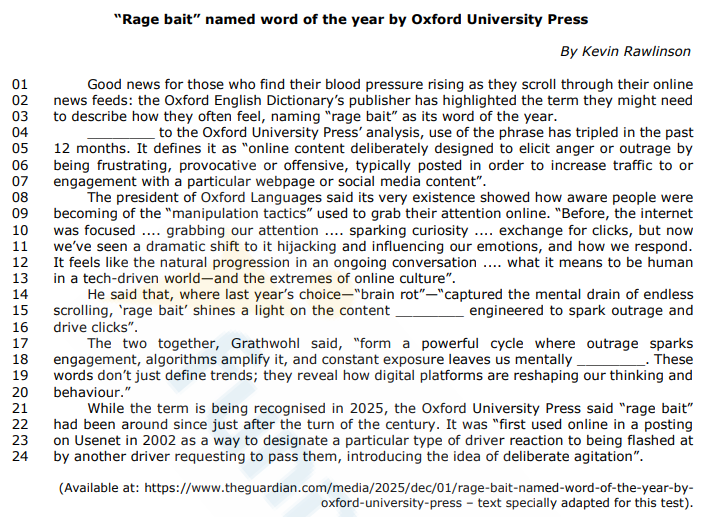
I. In “reshaping” (l. 19), re- is a prefix meaning again, the same as in “recognize”.
II. The modal verb “might” (l. 02) expresses certainty that people will use the term “rage bait” to describe how they feel.
III. The sentence “‘rage bait’ had been around since just after the turn of the century” (l. 21-22) uses the past perfect to indicate that the term already existed before another point in the past.
Which ones are correct?
I. "Look forward to" é um verbo phrasal-prepositional de três partes e é inseparável, de modo que o objeto deve ocorrer após a cadeia de partículas.
II. No phrasal verb "turn on" (transitivo e separável), quando o objeto é um pronome (por exemplo, it), ele deve ser colocado entre o verbo e a partícula.
III. Prepositional verbs como "rely on" permitem que o objeto seja colocado antes da preposição (por exemplo, rely it on) para dar ênfase.
Está correto o que se afirma em:
texto seguinte servirá de base para responder à questão.
CNN Health Exhausted? The reason may be how you're using technology
Analysis by Kara Alaimo
Oct 7, 2025
Kara Alaimo is a professor of communication at Fairleigh Dickinson University. Her book "Over the Influence: Why Social Media Is Toxic for Women and Girls — And How We Can Take It Back" was published in 2024 by Alcove Press.
You may think you're exhausted because, like me, you have too many things on your plate. But there's another reason, according to a new book.
Case in point: While | was writing this piece, | responded to dozens of emails from colleagues and students, got a huge medical bill, replied to a text about a home repair, and learned that my older daughter needs to wear white to school next Monday while the younger one is supposed to wear the colors of fall.
This relentless barrage of interruptions and switching between thoughts and technology platforms is leaving us utterly exhausted, says Paul Leonardi, department chair and Duca Family Professor of Technology Management | at the University of California, Santa Barbara.
He explains how this happens in his new book, "Digital Exhaustion: Simple Rules for Reclaiming Your Life."
| spoke to Leonardi about what's making us all so tired | and what we can do about it.
CNN: You say one reason we're so exhausted is that we keep switching between platforms. How does that make us exhausted?
Paul Leonardi: Every tool we use requires some amount of cognitive focus. We have to learn the tool we're enmeshed in. When we switch, we have to disengage | and reengage in another area of focus, and we also have to switch how we're using that tool. Our brains do not do a good job of switching that quickly. The main issue is that we haven't evolved to make the switches as quickly as we do today. It leaves us feeling exhausted.
CNN: You found that we often don't realize we're getting exhausted from all this digital switching. Why?
Leonardi: It comes back to the way our bodies have evolved over time. We have good sensory feedback to show us when we're physically tired. Otherwise, we could collapse, and that's dangerous. So, our body knows to send signals to our brain to say stop. But we didn't evolve to sit in an office in front of a computer, so our brain doesn't know to tell itself it's tired. We can just keep taxing ourselves, but that residue builds up over time. Then we feel like we've been hit by a semitruck
CNN: What can we do to address that exhaustion?
Leonardi: Think about reducing the kinds of switches we make throughout the day.
In the book | talk about three kinds of switches. Switching between modalities is switching across tools. Think about the different videoconferencing platforms you use. You might use Zoom and then switch to Microsoft Teams. They seem like they're roughly the same. But how many times have you been in a meeting and thought, "I need to share my screen. How do | do that on this platform?" And those little changes are enough to really wear us out when they accumulate over time
The second type is what | call switches between domains, and that's when we're working on one task, get interrupted and then switch to a different task. The unplugging and then re-plugging into the other task take quite a bit of effort. It's a tremendous tax that we pay.
The third type is switching between different areas of life. How many times in your day are you getting a quick text from your kid's school? Or the plumber calls to tell you they're going to be late and wants to talk about the problem in your house. Those switches across really big domains are even more exhausting because they pull us completely out of our thought process in one area, and then we have to get back.
CNN: You say social media is the most exhausting type of platform to use. Why?
Leonardi: | talk about three forces that exhaust us. One is attention. On social media we're constantly switching between things because apps are pushing us different notifications. First somebody liked something, and then there's an ad. The second force of exhaustion is making inferences. We get a snippet of data, and it's not quite enough to tell us the whole picture. So, we have to fill in the blanks, and that takes effort. On social media we're constantly different apps and making inferences. We see somebody is on a trip, and we're like, they must have a lot of money. And they're having the time of their life. We're filling in the blanks.
The last is emotion. When our emotions get piqued, whether for good or for bad, that's also exhausting. On social media we do social comparisons, so we get jealous that somebody else is doing something we wish we were doing. Or we get annoyed that we see a bunch of friends hanging out and we're not part of the group.
Social media is so exhausting because it maximizes all three of these forces.
CNN: You say it's especially hard for people who work from home to avoid this kind of exhaustion. Why is that? Leonardi: One of the big reasons remote workers experience exhaustion even more than people in the office — or it feels more acute — is that it's very difficult to create separation between work and home. They're constantly trying to manage that boundary, and that's so exhausting.
They also are more dependent on tools for everything, so they don't get a break. If you're in the office and you have an in-person meeting, you don't have to switch onto your Zoom platform. You actually get a break for a little bit when you're talking to somebody in the hallway. You don't get that on these tools.
You're also managing your presence when you're working from home. You need to make sure people know you're available because it matters for people's perception of your work performance. So, you're putting on a sort of act that's also exhausting
CNN: You recommend turning off the video of ourselves in meetings. Why?
Leonardi: | think it's a good idea sometimes. We tend to fixate on ourselves, and doing that creates a feeling of self-consciousness. It also creates more effort for us to manage our presentation to others.
Imagine if you were talking to friends, or you're in a meeting, and you have a mirror in front of your face the entire time. You're like, oh my gosh, how do | look right now? There are bags under my eyes, and | can't believe | made that stupid facial expression. We don't do that in regular life.
These extra little activities accumulate to wear us out over time.
Communicating in person instead of texting, when possible, can reduce digital exhaustion and create richer relationships.
CNN: What's your best advice for parents who are exhausted from keeping up with endless group chats about car pools and soccer games?
Leonardi: | never intended to write about that in my book, but it came up so often in the interviews | did.
One strategy | heard that was quite effective was calculating whether a car pool is actually worth the time you're putting into coordinating it. If you add up all the time you're spending texting with other people, sometimes it adds up to the same amount of time it would take to just drive your kid yourself.
Another strategy people used was reducing those communications by trying to coordinate in person. When they see each other at the soccer game, they have a long conversation about the plan for the next week. A lot of folks find they're developing richer relationships because that discussion about the car pool is just the entrée to a deeper conversation. Those are much more fulfiling relationships than the transactions taking place via text
CNN
Phrasal verbs are a prime example of how combining a verb with a particle can create multiple meanings, often idiomatic, which challenge learners of English as a second language. Regarding the contextual meanings of the verb "take" combined with different particles, mark T for True and F for False:
(__)"Take after" means to resemble a parent or ancestor in appearance or character.
(__)"Take off" can mean to remove clothing or for an aircraft to leave the ground.
(__)"Take over" means to assume control or responsibility for something.
(__)"Take up" means to refuse an offer or invitation politely.
Choose the alternative that presents the correct sequence, from top to bottom.

 Conheça nossos planos