Questões de Concurso
Sobre verbos | verbs em inglês
Foram encontradas 3.020 questões


Ano: 2015
Banca:
Instituto Legatus
Órgão:
Prefeitura de Pau D'Arco - PI
Prova:
Instituto Legatus - 2015 - Prefeitura de Pau D'Arco - PI - Professor de Inglês |
Q2763246
Inglês
Leia o cartum abaixo e marque a alternativa correta.
O verbo modal que pode substituir “ought to” no texto, sem alteração de significado, é:
Ano: 2015
Banca:
Instituto Legatus
Órgão:
Prefeitura de Pau D'Arco - PI
Prova:
Instituto Legatus - 2015 - Prefeitura de Pau D'Arco - PI - Professor de Inglês |
Q2763216
Inglês
Texto associado
Read the text below and answer questions 28 and 29.
Advantages of Being Bilingual
Most children have the capacity and
facility to learn
more than one language. Researchers say
that there
are advantages to being bilingual. These
advantages
might include;
• Being able to learn new words
easily
• Playing rhyming games with words like
"cat"
and "hat"
• Breaking down words by sounds, such as
C-AT
for cat
• Being able to use information in new
ways
• Putting words into categories
•
Coming up with solutions to problems
• Good listening
skills
• Connecting with others
According to the National Center for
Educational
Statistics, more than one in 5 school-aged
children
(21%) speak a language other than English
at home.
That number of bilingual speakers is
projected to
increase in the coming years.
Children who are learning to
speak two
languages follow
patterns of learning. The sounds of the
first language
can influence how children learn and use a
second
language. It is easier to learn sounds and
words when
the languages you are learning are
similar. Over time,
the more difficult sounds and words will
be learned.
Fact: Communication disorders affect more
than 42
million Americans. Of these, 28 million
have a
hearing loss and 14 million have a speech
or
language disorder.
If a child _______ a speech or
language
problem, it
________up in both languages. However,
these
problems are not caused by learning two
languages. If
you know a child who is learning a second
language and
you have concerns about speech and
language
development, ASHA recommends contacting a
bilingual
speech-language pathologist (SLP). If you
are unable to
find a bilingual speech-language
pathologist, look for a
SLP who has knows the rules and structure
of both
languages and who has access to an
interpreter. For
more information or for a referral to a
SLP, contact
ASHA at 800-638-TALK (8255) (Spanish-
speaking
operators available)
Acessado em 25/02/2015
http://www.asha.org/public/speech/developm
ent/The-
Advantages-of-Being-Bilingual/
Which pair best completes the blanks in the text?
Ano: 2015
Banca:
Instituto Legatus
Órgão:
Prefeitura de Pau D'Arco - PI
Prova:
Instituto Legatus - 2015 - Prefeitura de Pau D'Arco - PI - Professor de Inglês |
Q2763209
Inglês
Texto associado
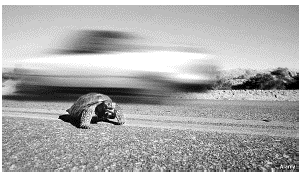
Read the text and answer questions 22 to 25.
Slowly does it
Feb 19th 2015, 17:34 BY R.L.G. |
BERLIN
LAST week’s
column looked at the long
history of
language declinism: for more than 600
years people
have complained that youngsters cannot
write proper
English anymore, and even ancient Sumerian
schoolmasters worried about the state of
the “scribal art”
in the world’s first written language. Two
universal truths
emerge: languages are always changing, and
older
people always worry that the young are not
taking
proper care of the language.
But what if the sticklers have a
point? Of
course
language always changes, but could
technology (or a
simple increase in youthful insouciance
and lack of
respect for tradition) mean that in some
ages it changes
faster than in others? Is change
accelerating? In this
case, a real problem could arise. Even if
language
change is not harmful, the faster language
changes, the
less new generations will be able to
understand what
their forebears wrote.
The
Middle English quotation in last
week’s column
________ the point for some readers: it is
all but
impenetrable to modern understanding
without special
training. It is, in effect, a foreign
language. Is this a
problem? Perhaps it is too much to expect
writing to stay
fresh on the shelf for 600 years. More
recent writing
holds up quite well. Pupils read
Shakespeare with only
modernised spelling and a bit of help from
teachers. And
Thomas Jefferson and Jane Austen are
perfectly
readable.
But maybe a
greater conservatism would let
modern
readers peer further back in their own
literary history. If
change had been slower, perhaps Chaucer
would be
only as difficult as Shakespeare is to us;
“Beowulf” only
as distant as Chaucer is now. What’s not
to like?
The problem is
that conservatism works
differently on
writing than it does on speech. Writing is
more
permanent, so people choose their words
carefully and
conservatively. It is slow and considered,
so people can
avoid new usages widely seen as mistakes.
It is taught
carefully by adults to children, which
naturally exerts
some conservative drag on the written
language. And it
is often edited, so (say) a young
journalist with a breezy
contemporary style may well be edited to a
more
traditional one by an older editor.
Speech is different: instead of
permanent,
slow,
considered and taught, it is impermanent,
fast,
spontaneous and learned naturally by
children from their
surroundings. Speech will—at almost any
level of linguistic conservatism—change
faster than written
language.
The problem with
overly successful
conservatism then
becomes clear. Speech moves on, writing
does not, and
the two diverge over time. Take just one
example:
English spelling. As with all languages,
the
pronunciation of English has changed a lot
over the
centuries. Spelling has changed much more
slowly.
Thanks to the Great Vowel Shift of the
middle of the last
millennium, English uses vowels
differently from almost
all other European languages. Silent
letters like
the gh in night are a
remnant of an
earlier pronunciation
(a bit like the German nicht).
Other odd
spellings were
intended to keep etymologies clear: a b
was inserted
into debt to show the link with Latin
debitum. Some
linguistic innovations do not make it into
writing at all:
nearly everyone says gonna and
writes
going to.
________ a language pays homage to the
past,
_________modern schoolchildren will find
learning to
write a bit like learning to speak a
foreign tongue.
Which words complete the conclusion correctly.
Ano: 2015
Banca:
Instituto Legatus
Órgão:
Prefeitura de Pau D'Arco - PI
Prova:
Instituto Legatus - 2015 - Prefeitura de Pau D'Arco - PI - Professor de Inglês |
Q2763202
Inglês
Texto associado
Read the text and answer questions 22 to 25.
Slowly does it
Feb 19th 2015, 17:34 BY R.L.G. |
BERLIN
LAST week’s
column looked at the long
history of
language declinism: for more than 600
years people
have complained that youngsters cannot
write proper
English anymore, and even ancient Sumerian
schoolmasters worried about the state of
the “scribal art”
in the world’s first written language. Two
universal truths
emerge: languages are always changing, and
older
people always worry that the young are not
taking
proper care of the language.
But what if the sticklers have a
point? Of
course
language always changes, but could
technology (or a
simple increase in youthful insouciance
and lack of
respect for tradition) mean that in some
ages it changes
faster than in others? Is change
accelerating? In this
case, a real problem could arise. Even if
language
change is not harmful, the faster language
changes, the
less new generations will be able to
understand what
their forebears wrote.
The
Middle English quotation in last
week’s column
________ the point for some readers: it is
all but
impenetrable to modern understanding
without special
training. It is, in effect, a foreign
language. Is this a
problem? Perhaps it is too much to expect
writing to stay
fresh on the shelf for 600 years. More
recent writing
holds up quite well. Pupils read
Shakespeare with only
modernised spelling and a bit of help from
teachers. And
Thomas Jefferson and Jane Austen are
perfectly
readable.
But maybe a
greater conservatism would let
modern
readers peer further back in their own
literary history. If
change had been slower, perhaps Chaucer
would be
only as difficult as Shakespeare is to us;
“Beowulf” only
as distant as Chaucer is now. What’s not
to like?
The problem is
that conservatism works
differently on
writing than it does on speech. Writing is
more
permanent, so people choose their words
carefully and
conservatively. It is slow and considered,
so people can
avoid new usages widely seen as mistakes.
It is taught
carefully by adults to children, which
naturally exerts
some conservative drag on the written
language. And it
is often edited, so (say) a young
journalist with a breezy
contemporary style may well be edited to a
more
traditional one by an older editor.
Speech is different: instead of
permanent,
slow,
considered and taught, it is impermanent,
fast,
spontaneous and learned naturally by
children from their
surroundings. Speech will—at almost any
level of linguistic conservatism—change
faster than written
language.
The problem with
overly successful
conservatism then
becomes clear. Speech moves on, writing
does not, and
the two diverge over time. Take just one
example:
English spelling. As with all languages,
the
pronunciation of English has changed a lot
over the
centuries. Spelling has changed much more
slowly.
Thanks to the Great Vowel Shift of the
middle of the last
millennium, English uses vowels
differently from almost
all other European languages. Silent
letters like
the gh in night are a
remnant of an
earlier pronunciation
(a bit like the German nicht).
Other odd
spellings were
intended to keep etymologies clear: a b
was inserted
into debt to show the link with Latin
debitum. Some
linguistic innovations do not make it into
writing at all:
nearly everyone says gonna and
writes
going to.
________ a language pays homage to the
past,
_________modern schoolchildren will find
learning to
write a bit like learning to speak a
foreign tongue.
Which verbal tense best completes the sentence” The Middle English quotation in last week’s column ________ the point for some readers”
Ano: 2015
Banca:
IMPARH
Órgão:
Prefeitura de Fortaleza - CE
Prova:
IMPARH - 2015 - Prefeitura de Fortaleza - CE - Professor Substituto - Língua Inglesa |
Q2122704
Inglês
Choose the option where the future with ‘will’ is used correctly.
Ano: 2015
Banca:
IMPARH
Órgão:
Prefeitura de Fortaleza - CE
Prova:
IMPARH - 2015 - Prefeitura de Fortaleza - CE - Professor Substituto - Língua Inglesa |
Q2122703
Inglês
Choose the option where the future with ‘going to’ is used correctly.
Ano: 2015
Banca:
IMPARH
Órgão:
Prefeitura de Fortaleza - CE
Prova:
IMPARH - 2015 - Prefeitura de Fortaleza - CE - Professor Substituto - Língua Inglesa |
Q2122702
Inglês
Choose the option where the simple past is used incorrectly.
Ano: 2015
Banca:
IMPARH
Órgão:
Prefeitura de Fortaleza - CE
Prova:
IMPARH - 2015 - Prefeitura de Fortaleza - CE - Professor Substituto - Língua Inglesa |
Q2122701
Inglês
Choose the option where the present perfect is used incorrectly.
Ano: 2015
Banca:
IMPARH
Órgão:
Prefeitura de Fortaleza - CE
Prova:
IMPARH - 2015 - Prefeitura de Fortaleza - CE - Professor Substituto - Língua Inglesa |
Q2122700
Inglês
Texto associado
From the question, choose the option that has the same meaning and idea as the sentences in italics.
I think it’s wrong for her to work so late every day.
Ano: 2015
Banca:
IMPARH
Órgão:
Prefeitura de Fortaleza - CE
Prova:
IMPARH - 2015 - Prefeitura de Fortaleza - CE - Professor Substituto - Língua Inglesa |
Q2122699
Inglês
Texto associado
From the question, choose the option that has the same meaning and idea as the sentences in italics.
It’s possible that the train will be very late.
Ano: 2015
Banca:
IMPARH
Órgão:
Prefeitura de Fortaleza - CE
Prova:
IMPARH - 2015 - Prefeitura de Fortaleza - CE - Professor Substituto - Língua Inglesa |
Q2122698
Inglês
Texto associado
From the question, choose the option that has the same meaning and idea as the sentences in italics.
When I lived in Spain, I used to go to the beach every night.
Ano: 2015
Banca:
IMPARH
Órgão:
Prefeitura de Fortaleza - CE
Prova:
IMPARH - 2015 - Prefeitura de Fortaleza - CE - Professor Substituto - Língua Inglesa |
Q2122696
Inglês
Texto associado
In the question, choose the phrasal verb that best replaces the underlined phrase or verb.
I’ll be glad to reach the end of this awful business.
Ano: 2015
Banca:
IMPARH
Órgão:
Prefeitura de Fortaleza - CE
Prova:
IMPARH - 2015 - Prefeitura de Fortaleza - CE - Professor Substituto - Língua Inglesa |
Q2122695
Inglês
Texto associado
In the question, choose the phrasal verb that best replaces the underlined phrase or verb.
I don’t agree with the idea of using force.
Ano: 2015
Banca:
IMPARH
Órgão:
Prefeitura de Fortaleza - CE
Prova:
IMPARH - 2015 - Prefeitura de Fortaleza - CE - Professor Substituto - Língua Inglesa |
Q2122694
Inglês
Texto associado
In the question, choose the phrasal verb that best replaces the underlined phrase or verb.
Simone has kindly agreed to take the place of Paul at the next meeting.
Ano: 2015
Banca:
PROGESP - UFRR
Órgão:
UFRR
Prova:
PROGESP - UFRR - 2015 - UFRR - Vestibular - Seriado - Primeiro Semestre - E2 |
Q1347901
Inglês
Choose the alternative which contains the correct form of
the verbs to fill the gaps in the following paragraph: “The
most notorious computer lifeforms ___________ the
electronic viruses that ____________injected into computer
networks. Like real viruses, these programs ____________
the ability to ____________ a host computer and
___________ without restraint, sometimes ______________
considerable damage.
Ano: 2015
Banca:
PROGESP - UFRR
Órgão:
UFRR
Prova:
PROGESP- UFRR - 2015 - UFRR - Vestibular - Primeiro Semestre - Seriado - E1 |
Q1347376
Inglês
Roraima is an interesting mountain located in the Guiana
Highlands. The peak actually shares the border with
Venezuela, Brazil, and Guyana, but the mountain is almost
always approached from the Venezuela side. The Brazil
and Guyana sides are much more difficult. The mountain's
highest point is Maverick Rock which is at and on the
Venezuela side (though some other sources may differ on
this). The Guiana Highlands is a very unusual mountain
range covering parts of Venezuela, Brazil, Guyana,
Suriname and French Guiana. The highlands are made of
ancient sedimentary rock that is over two billion years old
and are some of the oldest sedimentary rocks on the
planet.
The mountain is known as a Tepui, which describes a flattopped mountain with vertical sides. Many waterfalls spill off Roraima, and the other Tepuis; nearly everyone has heard of Angel Falls, which spills off another nearby Tepui. There are many interesting plants that grow on the summit, including many carnivorous plants, i.e., ones that eat insects. There is little soil on top because the constant rains wash it away.
Monte Roraima was the first of the Tepuis to be climbed and the credit goes to English botanist Everard Im Thurn on an expedition sponsored by the Royal Geographical Society in 1884. It was his subsequent lectures in England, that are believed to have inspired Sir Arthur Conan Doyle's book 'The Lost World'.
Which word below, extracted from the text, is NOT a verb?
The mountain is known as a Tepui, which describes a flattopped mountain with vertical sides. Many waterfalls spill off Roraima, and the other Tepuis; nearly everyone has heard of Angel Falls, which spills off another nearby Tepui. There are many interesting plants that grow on the summit, including many carnivorous plants, i.e., ones that eat insects. There is little soil on top because the constant rains wash it away.
Monte Roraima was the first of the Tepuis to be climbed and the credit goes to English botanist Everard Im Thurn on an expedition sponsored by the Royal Geographical Society in 1884. It was his subsequent lectures in England, that are believed to have inspired Sir Arthur Conan Doyle's book 'The Lost World'.
Which word below, extracted from the text, is NOT a verb?
Ano: 2015
Banca:
CONSULPAM
Órgão:
Prefeitura de Nova Olinda - CE
Prova:
CONSULPAM - 2015 - Prefeitura de Nova Olinda - CE - Professor - Inglês |
Q1250295
Inglês
Choose the best verb sequence for the sentence below.
“When I (1) the awful news yesterday I couldn't (2) it”.
Ano: 2015
Banca:
CONSULPAM
Órgão:
Prefeitura de Nova Olinda - CE
Prova:
CONSULPAM - 2015 - Prefeitura de Nova Olinda - CE - Professor - Inglês |
Q1250289
Inglês
Choose the better modal for the sentence bellow.
“I wish somebody (…) buy me the lunch”.
Ano: 2015
Banca:
CONSULPAM
Órgão:
Prefeitura de Nova Olinda - CE
Prova:
CONSULPAM - 2015 - Prefeitura de Nova Olinda - CE - Professor - Inglês |
Q1250288
Inglês
Complete the sentence with the right verb sequence.
“Last year, when someone (1) scarred by accident or disease, they (2) treated but not always cured”.
“Last year, when someone (1) scarred by accident or disease, they (2) treated but not always cured”.
Ano: 2015
Banca:
CONSULPAM
Órgão:
Prefeitura de Nova Olinda - CE
Prova:
CONSULPAM - 2015 - Prefeitura de Nova Olinda - CE - Professor - Inglês |
Q1250287
Inglês
How can you explain the phrasal verb in the sentence below?
“Please fill in the form with your name, address, and phone number”.

 Conheça nossos planos