Questões de Concurso
Sobre verbos | verbs em inglês
Foram encontradas 3.020 questões


As questões de números 56 a 60 verificam o domínio do conhecimento sistêmico da língua inglesa. Cada uma das questões apresenta uma frase com uma lacuna. Assinale a alternativa que contém a palavra ou expressão que completa a lacuna de maneira adequada quanto ao sentido e ao uso da norma-padrão da língua inglesa.
Each of the new airplanes ______________ large number of very complex parts.
O texto a seguir apresenta lacunas numeradas de 41 a 51, das quais foi omitida uma ou mais palavras. Assinale a alternativa que apresenta a palavra ou expressão que completa corretamente cada uma das lacunas numeradas, tanto quanto à correção gramatical como quanto ao sentido e estruturação do texto.
Why talk about language teaching methods at all? In recent years, a number of writers have criticized the very concept of (41) in our field. “Let’s just focus on learners and teachers and everything else will fall into place,” they seem to suggest. Some say that teachers see methods as prescriptions for classroom behavior and follow them too (42) , too inflexibly. By contrast, others argue that in planning their lessons, (43) don’t really think about codified methods at all. In the one view, methods and the prefabricated materials that embody them (44) teachers to mere technicians; in the other, teachers are mere improvisers in the here-and-now, with no use for general statements about how (45) acts may fit together. Either view should make any writer about methods and materials stop and think.
Having stopped and (46) , I find myself giving a single reply to both of the above objections: Language teachers are simply not “mere.” They are neither mere technicians (47) mere improvisers. They are professionals who make their own decisions, informed by their own (48) but informed also by the findings of researchers and by the accumulated, distilled, crystallized experience of their peers.
Let me then suggest three questions that we might well ask about “method,” together with my proposed answers:
What is a “method”? A method is more concrete than (49) . An approach is a set of understandings about what is at stake in learning and also about the equipment, mechanical or neurological, that is at work in learning. At the same time, a method is more abstract than a teaching act, which is a one-time event that can be recorded on videotape and on the neurocortexes of learners.
Is it possible to evaluate or to profit from an approach without embodying it in some kind of (50) ? Possible, perhaps, to some limited degree, but not easy.
Is it possible to improvise teaching acts apart from some more or less conscious approach? Possible, perhaps, but rare.
“Method,” then, seems to occupy a strategic mid-position between approach and (51) . For this reason, whoever would either think usefully about teaching or would teach thoughtfully can profit from learning about methods.
(E. W. Stevick, Working with Teaching Methods)
46
As questões de números 31 a 35 referem-se ao texto a seguir.
Teaching Children Literacy Skills in a Second Language
by ANNE EDIGER
In recent years, there has been increased focus on the teaching of reading and other literacy skills to children, both in North America and abroad. Part of this may relate to the recognition that reading is probably the most important skill for second language (L2) learners in academic contexts, and part of it may come from an increase in the numbers of children worldwide who are learning English as a second or foreign language (hereafter ESL or EFL). It may also be a result of the recent implementation of standards in much of public education in the United States and Canada, a movement built upon the belief that basic literacy instruction should be a fundamental component of public education.
Another possible factor contributing to an increased focus on literacy instruction to children in EFL contexts may be the growing numbers of countries that are moving toward making English language instruction mandatory from a younger age. Given the portability of books and other reading materials (as well as the increasing availability of reading material over the Internet), reading is gradually being recognized as a valuable source of language input, particularly for students in learning environments (as in some EFL contexts) in which fluent speakers of English are generally not available to provide other kinds of language input.
Notions of literacy are expanding as well. Although many different definitions of literacy can be found in the literature on the subject, and reading still seems to be primary to most of them, the teaching of writing and oral skills is increasingly being integrated with reading instruction for both native English speakers (NES) and English language learners (ELLs). Many of the new standards, both for ELLs and NES children, also integrate expectations for the development of all four language skills — reading, writing, listening, and speaking. In fact, increasingly, the large-scale standardized tests ask students to bring together all of these skills, requiring students to demonstrate competence in synthesizing information from multiple sources, or bringing information they have heard or read into written.
(Marianne Celce-Murcia (ed.), Teaching English as a Second or Foreign Language. Adapted)
In the first paragraph, the modal verb may is used several times to convey the idea of
Em Vocabulando (p. 416), Isa Mara Lando analisa dois diferentes usos e contextos de emprego do verbo “realize”:
1. Realizar, concretizar, cumprir, empreender; implementar; pôr em prática, levar a cabo, fazer acontecer, tornar realidade.
2. Perceber, atinar, dar-se conta, captar, compreender, concluir, conscientizar-se, descobrir, entender, ver, ter um clique, cair a ficha.
Em cada alternativa abaixo, relacione o contexto dos verbos sublinhados aos campos semânticos 1 ou 2 e então marque a alternativa correspondente:
(_) In some cases, a woman with sexually transmitted disease may not learn of her infection until, for example, she tries to become pregnant and realizes she is infertile.
(_) Scientists have realized that they need to make a more serious effort to engage with how their work is presented to the public.
(_) How can we, as researchers, be optimistic about climate change if the level of dangerous anthropogenic impact is actually higher than we realized?
(_) Advances in technology are helping investigators realize their goal of unlocking the secrets of the brains.
TEXT IV
Garfield
Disponível em: <http://fredisrich.blogspot.com.br/2009_02_01_archive.html>. Acesso em: 15 out. 2016.
The idea expressed by the modal verb can in the last picture is
TEXT I
Building Blocks: The First Steps of Creating a Multicultural Classroom
Discovering diversity takes creativity, extra effort, diligence, and courage on the teacher's part. A
multicultural classroom must thrive on these differences and use them as a foundation for growth and
development. Differences command work, resolution, openness, and understanding. Teachers who
address these differences and add them to the curriculum will succeed in creating a multicultural
5 classroom that will advance the educational goals of all students.
(...) Teachers in multicultural classrooms must be open to their students and put forth the effort
needed to get to know their students inside and outside of class. If a teacher is hesitant about being
open, the class will reciprocate and the students will become estranged from one another and the
teacher. In order to be open, teachers must be interested in their students, fearless, willing to try new
10 and different things, sure of themselves in order to avoid taking things personally, and non-
judgmental of his or her students (Canning 196). Also, openness is not making assumptions and being
prepared for the unexpected (Canning 199). (...)Many cultures have many different mores and
folkways. Teachers must be open to what the students are doing and find out why they do what they
do. This openness will create communication in the class, which will ultimately develop into a
15 classroom that is learning, understanding, and culturally fluent.
In addition to openness, teachers must know the learning patterns of the students in their class.
Teachers must understand the learning patterns of the students who grew up in a culture other than
their own. Teachers who open themselves up to cultural difference will effectively handle culture
clash while teachers who assume that student A is rude and student B is dumb will close
20 communication in the classroom and destroy any hope of having a multicultural classroom. The best
way to handle culture clash is to be open, knowledgeable, and not be afraid to talk about the cultural
differences in class no matter what discipline the teacher is teaching (Jones 12). An open teacher will
create an open class and an open class will have open lines of communication that will create a positive
and beneficial learning environment for everyone.
25 (...) Gloria Boutte and Christine McCormick suggest six basic principles for teachers to use when
evaluating their culturally diverse classroom, these are, "1) building multicultural programs, 2)
showing appreciation of differences, 3) avoiding stereotypes, 4) acknowledging differences in
children, 5) discovering the diversity within the classroom, 6) avoiding pseudomulticulturalism"
(140). Showing appreciation of differences is very important because a teacher who does not show
30 appreciation of all the differences in their class will not get the chance to attempt any of the other five
principles. Teachers need to pay attention to their verbal and nonverbal language when he or she
responds to students who speak differently. For example, if a child reads, "Dere go the sto-man", the
teacher should avoid interrupting the student to provide the correct English version. Instead, the
teacher should thank the student for reading and then model the correct English version when she or
35 he speaks. However, the most important thing to remember about all classrooms is the premise that
every child is unique. All children are different and beautiful in their own way, no one student should
feel excluded from the class.
(...) Creating multicultural classrooms is a growing priority for all teachers and administrators. This
includes restructuring classroom evaluation and punishment techniques, but, more importantly, it
40 includes embracing difference and opening up the classroom for communication.
Larri Fish of Siena College
In the sentence Teachers must understand the learning patterns of the students who grew up in a culture other than their own, GROW UP is a Phrasal Verb.
All of the options bellow are phrasal verbs, except
TEXT I
Building Blocks: The First Steps of Creating a Multicultural Classroom
Discovering diversity takes creativity, extra effort, diligence, and courage on the teacher's part. A
multicultural classroom must thrive on these differences and use them as a foundation for growth and
development. Differences command work, resolution, openness, and understanding. Teachers who
address these differences and add them to the curriculum will succeed in creating a multicultural
5 classroom that will advance the educational goals of all students.
(...) Teachers in multicultural classrooms must be open to their students and put forth the effort
needed to get to know their students inside and outside of class. If a teacher is hesitant about being
open, the class will reciprocate and the students will become estranged from one another and the
teacher. In order to be open, teachers must be interested in their students, fearless, willing to try new
10 and different things, sure of themselves in order to avoid taking things personally, and non-
judgmental of his or her students (Canning 196). Also, openness is not making assumptions and being
prepared for the unexpected (Canning 199). (...)Many cultures have many different mores and
folkways. Teachers must be open to what the students are doing and find out why they do what they
do. This openness will create communication in the class, which will ultimately develop into a
15 classroom that is learning, understanding, and culturally fluent.
In addition to openness, teachers must know the learning patterns of the students in their class.
Teachers must understand the learning patterns of the students who grew up in a culture other than
their own. Teachers who open themselves up to cultural difference will effectively handle culture
clash while teachers who assume that student A is rude and student B is dumb will close
20 communication in the classroom and destroy any hope of having a multicultural classroom. The best
way to handle culture clash is to be open, knowledgeable, and not be afraid to talk about the cultural
differences in class no matter what discipline the teacher is teaching (Jones 12). An open teacher will
create an open class and an open class will have open lines of communication that will create a positive
and beneficial learning environment for everyone.
25 (...) Gloria Boutte and Christine McCormick suggest six basic principles for teachers to use when
evaluating their culturally diverse classroom, these are, "1) building multicultural programs, 2)
showing appreciation of differences, 3) avoiding stereotypes, 4) acknowledging differences in
children, 5) discovering the diversity within the classroom, 6) avoiding pseudomulticulturalism"
(140). Showing appreciation of differences is very important because a teacher who does not show
30 appreciation of all the differences in their class will not get the chance to attempt any of the other five
principles. Teachers need to pay attention to their verbal and nonverbal language when he or she
responds to students who speak differently. For example, if a child reads, "Dere go the sto-man", the
teacher should avoid interrupting the student to provide the correct English version. Instead, the
teacher should thank the student for reading and then model the correct English version when she or
35 he speaks. However, the most important thing to remember about all classrooms is the premise that
every child is unique. All children are different and beautiful in their own way, no one student should
feel excluded from the class.
(...) Creating multicultural classrooms is a growing priority for all teachers and administrators. This
includes restructuring classroom evaluation and punishment techniques, but, more importantly, it
40 includes embracing difference and opening up the classroom for communication.
Larri Fish of Siena College
Consider the sentence: In addition to openness, teachers must know the learning patterns of the students in their class.
Select the correct option regarding the underlined terms:
Instructions: Question are based on the following text.
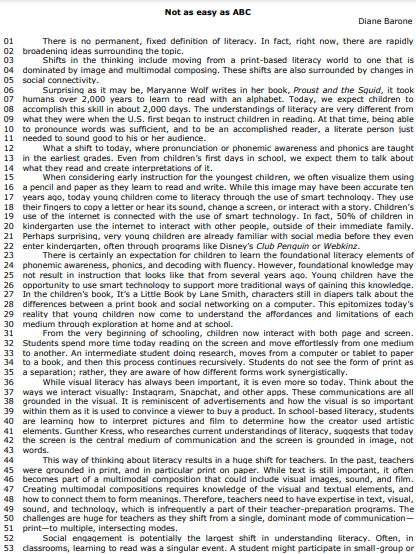
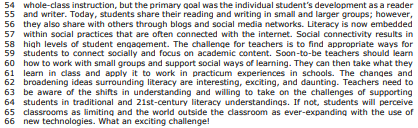
Source: http://languagemagazine.com/?page_id=124967
Instructions: Question are based on the following text.
Source: http://languagemagazine.com/?page_id=124967
TEXT
Dear Mayor Estrosi, Mayor Vivoni, Prime Minister
Manuel Valls, Former President Nicolas Sarkozy,
and other French officials who have supported
France’s burkini ban:
My name is Amara Majeed, and I am a 19-yearold Muslim Sri Lankan American. I am a student at Brown University, studying cognitive neuroscience and public policy.
When I look at the photo circulating of a woman in Nice being surrounded by armed police officers as she is coerced into removing her clothing, because French officials deemed the burkini to be inappropriate beach attire, I see infringement on a woman’s right to choose what she puts on her body by a group of white males. I see the scapegoating, ostracization, and criminalization of Muslims in the aftermath of the Nice terror attacks. I am a woman who wears the hijab, and I see an affront to the rights and civil liberties of women like me.
Deputy Mayor of Nice, Christian Estrosi: You have stated that you support this ban on “inappropriate clothing” in the wake of the Nice terror attacks. Mayor Vivoni, you have described the burkini ban as a necessary measure to “protect the population.” Former French president Nicolas Sarkozy, you have labeled the burkini as a symbol of extremism.
Let me respond to all of you by saying this: any conflation of the burkini with terrorism is invalid, virulent, and discriminatory. Tell me, in what way does our way of dress pose a threat to France’s national security? In what way does the burkini propagate hateful, violent ideologies? How is it that our way of dress poses a national security threat, yet some wetsuits, which take on strikingly similar designs to the burkini, aren’t? While France’s highest administrative court has now overturned the ban, the damage has already been done — this attack on the Muslim way of dress only serves as fodder to the already existing rising anti-Muslim sentiment and stigmatization of Muslims in France. If this institutionalized Islamophobia and fearmongering is being perpetrated by French officials and authorities, I fear how the general public’s poor treatment of hijab-clad women may be exacerbated in the coming weeks. We’re all well aware that hate crimes and violence targeting Muslim women wearing the hijab is not a new phenomenon in France.
As one burkini-clad woman who was forced to leave the beach states, “Because people who have nothing to do with my religion have killed, I no longer have the right to go to the beach.” In the eyes of many authority figures, our religious identity in and of itself is incriminating. Our way of dress is incriminating. Our sheer existence is incriminating.
Many of you have called the hijab an emblem of oppression. In April, France’s Minister for Women’s Rights equated women who choose to wear the hijab with “Negroes who were in favor of slavery.” More recently, France’s prime minister stated that the burkini is a tool of “enslavement,” and former French President Sarkozy insinuated that hijabclad women are imprisoned.
I am genuinely tired of individuals like you imposing your brand of colonial feminism on us and telling us that we are oppressed, that we have been indoctrinated, that this was not our choice, and that we need to be unshackled. Instead of continuing to pursue these offensive and failing attempts at liberating us, I implore you to liberate yourselves from this white savior complex and recognize that we don’t need your saving. The hijab does not oppress me. For me, the hijab is a symbol of feminism and freedom of expression — so who are you to invalidate my experiences, to invalidate a fundamental, inextricable aspect of my identity, and to label me as enslaved, as imprisoned, as oppressed? By depriving us of our rights to dress the way we want, by making public spaces inaccessible to us, by publicly humiliating us and coercing us to remove some of our clothing while we are trying to enjoy a day at the beach — you are oppressing us.
My news feed has been saturated with people posting photos of a Muslim woman at a beach being forced to strip, captioned with outrage and vitriol towards this form of discrimination. While your support of our rights is appreciated, I ask that you refrain from doing a disservice to this individual by circulating this photo. It may not seem like you are violating a woman’s privacy and liberties by sharing a picture revealing her arms or shoulders, but it is incumbent upon us to understand that she did not freely choose to show those parts of her body in public. Even if the intent is to excoriate the burkini ban while circulating these photos, I implore you to not be complicit, whether directly or indirectly, in systems of oppression that are stripping women, literally, of their right to choose what they wear.
Yours truly,
Amara Majeed – a muslin woman
(Source: http://www.bustle.com/articles/180721-an-open-letter-to-french-officials-who-support-the-burkini-ban-from-a-muslim-wo-man)
TEXT
August 24, 2016 / By Digestive Health Team
Are You Pooping All Wrong?
5 tips to keep your bowels healthy
When it comes to our bowels — and their movements — we may not give them much thought. Of course, when things are not going well, we notice.
However, bowel movements don’t just tell us about the health of our digestive system. This may sound strange, but signs of everything from diseases to stress may show up in your bathroom habits. The key is knowing what to look for — and what the signs may mean.
Here are five tips to encourage healthy bowels:
1. Don’t ignore rectal bleeding
The first thing most people worry about when they have minor rectal bleeding is that they have a cancer. Of course, colon cancer is also a concern. But it’s the cause of rectal bleeding only 1 to 2 percent of the time.
Two problems are usually responsible for blood on the paper, on the stool or in the toilet: hemorrhoids and anal fissures. The good news is that both problems are usually easy to fix.
2. Be careful not to be overzealous when you wipe
A lot of people assume they have hemorrhoids. May their bottoms itch and they feel extra skin down there as they wipe. Must be hemorrhoids, right?
So they treat themselves with medicated wipes or cream. And yet the “hemorrhoids” don’t go away — they itch even more.
Often, the problem is, ironically, being too clean. What happens is a circular process. Filled with good intentions, you try to keep yourself scrupulously clean by using flushable wipes. But the unexpected result is that this leads to itching and the feeling that you have hemorrhoids.
3. Don’t treat the bathroom like a library
Think of your time in the bathroom as a necessity, not an extended escape. If your toilet has stacks of magazines or books on the water tank, consider moving them to another room.
Why? The more time you spend on the toilet, the more likely you will strain for bowel movements. Also, the seated position puts extra stress on your anal blood vessels. Both of these factors boost your risk of hemorrhoids.
4. Get enough fiber in your diet
The goal is to eat 25 to 35 grams of fiber each day. The lack of fiber in the American diet is perhaps the major problem that leads to issues with constipation.
One of the challenges is that not all natural sources are equal in the amounts of fiber they contain, so you don’t always get a consistent amount of fiber intake every day, depending on what you eat. One day a bowl of oatmeal may do it. Another day a serving of broccoli may not.
Of course, each person’s needs are different, too, so you have to find what works best for your body.
5. Avoid dehydration if you have diarrhea
The biggest danger with a short bout of diarrhea is dehydration, or the loss of water and nutrients from the body’s tissues. You could become dehydrated if you have diarrhea more than three times a day and are not drinking enough fluids. Dehydration can cause serious complications if it is not treated. The best way to guard against dehydration is to drink liquids that contain both salt and sugar.
(Source: https://health.clevelandclinic.org/2016/08/poop/)
BRAZILIAN INDIANS
The history of Brazil's indigenous
peoples has been marked by brutality, slavery,
violence, diseases, and genocide.
When the first European colonists
arrived in 1500, what is now Brazil was
inhabited by an estimated 11 million Indians,
living in about 2,000 tribes. Within the rst
century of contact, 90% were wiped out, mainly
through diseases imported by the colonists,
such as fiu, measles and smallpox. In the
following centuries, thousands more died,
enslaved in the rubber and sugar cane
plantations.
By the 1950s the population has
dropped to such a low that the eminent senator
and anthropologist Darcy Ribeiro predicted
there would be none left by the year 1980. On
average, it is estimated that one tribe became
extinct every year over the last century.
In 1967, a federal prosecutor named
Jader Figueiredo published a 7,000 page report
cataloguing thousands of atrocities and crimes
committed against the Indians, ranging from
murder to land theft to enslavement.
In one notorious case known as 'The
th massacre of the 11 parallel', a rubber baron
ordered his men to hurl sticks of dynamite into
a Cinta Larga village. Those who survived were
murdered when rubber workers entered the
village on foot and attacked them with
machetes.
The report made int e rna tiona l headlines and led to the disbanding of the government's Indian Protection Service (SPI) which was replaced by FUNAI. This remains the government' s indigenous a ff a ir s department today.
The size of the indigenous population gradually started to grow once more, although when the Amazon was opened up for development by the military in the 1960s, 70s and 80s, a new wave of hydro-electric dams, cattle ranching, mines and roads meant tens of thousands of Indians lost their lands and lives. Dozens of tribes disappeared forever.
Twenty-two years of military dictatorship ended in 1985, and a new Constitution was drawn up. Indians and their supporters lobbied hard for more rights. Much has been achieved, although Indians do not yet enjoy the collective landownership rights they are entitled to under international law.
BRAZILIAN INDIANS
The history of Brazil's indigenous
peoples has been marked by brutality, slavery,
violence, diseases, and genocide.
When the first European colonists
arrived in 1500, what is now Brazil was
inhabited by an estimated 11 million Indians,
living in about 2,000 tribes. Within the rst
century of contact, 90% were wiped out, mainly
through diseases imported by the colonists,
such as fiu, measles and smallpox. In the
following centuries, thousands more died,
enslaved in the rubber and sugar cane
plantations.
By the 1950s the population has
dropped to such a low that the eminent senator
and anthropologist Darcy Ribeiro predicted
there would be none left by the year 1980. On
average, it is estimated that one tribe became
extinct every year over the last century.
In 1967, a federal prosecutor named
Jader Figueiredo published a 7,000 page report
cataloguing thousands of atrocities and crimes
committed against the Indians, ranging from
murder to land theft to enslavement.
In one notorious case known as 'The
th massacre of the 11 parallel', a rubber baron
ordered his men to hurl sticks of dynamite into
a Cinta Larga village. Those who survived were
murdered when rubber workers entered the
village on foot and attacked them with
machetes.
The report made int e rna tiona l headlines and led to the disbanding of the government's Indian Protection Service (SPI) which was replaced by FUNAI. This remains the government' s indigenous a ff a ir s department today.
The size of the indigenous population gradually started to grow once more, although when the Amazon was opened up for development by the military in the 1960s, 70s and 80s, a new wave of hydro-electric dams, cattle ranching, mines and roads meant tens of thousands of Indians lost their lands and lives. Dozens of tribes disappeared forever.
Twenty-two years of military dictatorship ended in 1985, and a new Constitution was drawn up. Indians and their supporters lobbied hard for more rights. Much has been achieved, although Indians do not yet enjoy the collective landownership rights they are entitled to under international law.

 Conheça nossos planos