Questões de Concurso
Sobre verbos | verbs em inglês
Foram encontradas 3.020 questões


Judge the following item according to text 19A3BBB.
It is correct to replace “calling” with call in the phrase “used to
calling” (l.17).

Judge the following item, on the linguistic aspects of text 19A1AAA.
In “like many others before and since” (l. 6 and 7), the verb
phrase would have done is omitted.
Judge the following item, on the linguistic aspects of text 19A1AAA.
The verbal phrase “allowed him to live abroad” (l.4) can be
correctly replaced by allowed him living abroad.

Based on the text, judge the following items.Based on the text, judge the following items.
The idea expressed by “should” in “we should inform the
population” (lines 4 and 5) can also be expressed by
ought to.
Based on the text, judge the following items.
If we want avoiding is a suitable alternative for “If we
want to avoid” (line 4).

Based on the text, judge the following items.
The preposition “up” in “crept up” (line 6) is optional.

Based on the text, judge the following items.
“does away with” (line 10) means eliminates.
Read the text about a tribute to Franz Kafka for the question
Google Doodle celebrates Franz Kafka’s 130th birthday with ‘The Metamorphosis’ tribute Google has created a ‘doodle’ in tribute to Franz Kafka on the 130th anniversary of the Germanlanguage novelist’s birth.
The doodle is based on Kafka’s 1915 novella ‘The Metamorphosis’ – considered by many to be one of the most important works of fiction of the 20th Century – and shows the character Gregor Samsa walking into a room in the guise of a large insect.
In the much-celebrated work, Samsa is a travelling salesman who transforms into an insect overnight. The rest of novella focuses on his struggle to come to terms with his new existence and the burden it places on his family.
Kafka was born into an Ashkenazi Jewish family on 3 July 1883 in Prague, which was then part of the Austro-Hungarian Empire.
He originally trained as a lawyer but began writing short stories in his spare time - eventually coming to consider it his calling – despite only a handful of his works being published during his lifetime.
Regarded as one of the 20th Century’s most influential authors, Kafka’s works are dominated by unreliable narrators who often tell dark tales of existentialist difficulties.
Kafka’s notoriously difficult relationship with his father Hermann is believed to have strongly influenced his work – with The Metamorphosis itself thought to be based upon Kafka’s own fears of insignificance and repulsiveness to his own family.
From: HALL, John. Available at:<http://www.independent.co.uk/life-style/gadgets-and-tech/news/google-doodlecelebrates-franz-kafkas-130th-birthday-with-the-metamorphosis-tribute-8685557.html>.
Read the text about Nobel Prize for the question.
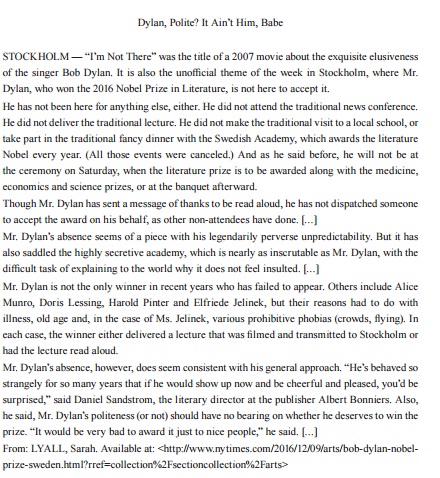
Based on text 2, an adapted forum discussion, answer question below.
Teaching with no books
Dianne Bell
I have started teaching in a language school suggesting no books to teach except for some magazines. These show the framework what should be worked on, for example, countability and that’s it. When it was offered I accepted the job easily because it seemed challenging and at the same time simple but now I’m out of reliable materials. Please help me out in what ways I can find materials for all the suggested frameworks.
Comments

Mila Junior and Senior Teacher
Posted on 02/22/2015
What exactly are you supposed to be teaching (i.e., conversation, grammar, business English, etc.)? Can you give more examples of the “frameworks”? If there are no books or resources, it sounds like the school wants you to do conversation classes. These can be easy to prepare if you tell the students to come prepared with a topic to discuss. Then, you can assist them with keeping a conversation going, asking questions, giving opinions, etc.

Flore
Secondary Teacher
Posted on 01/07/2015
Hi, I think it really does depend on the students and the level you are teaching to. I have found a lot of online resources are useful, especially news articles. If you just type in “Free online English lessons” or something similar you are bound to find resources. I had to teach like that once. They give you a book with a list of what you should be teaching in each lesson but nothing else. The teacher has to make the lesson up out of thin air each time, and it’s pretty time-consuming.

Jake
Science Educator
Posted on 11/22/2015
There are so many other resources out there for teachers to use, online and off, that teaching without textbooks is becoming more and more acceptable including websites, iPod lectures and field trips — that will encourage you to toss out your textbooks. Before you can toss out the textbook and replace it with technology tools, you’ll need to understand how your students — whatever their age — respond to and work with technology.
(Adapted from https://www.englishclub.com/)
Read the following article and answer question based on the text.
Faced with the unprecedented stream of migrants fleeing war and trauma in the Middle East and North Africa, Europe needs to take clear-sighted action.
For its part, the UK has agreed to take 20,000 refugees, a significant portion of whom will likely be children and orphans according to report. One key aspect in ensuring their smooth settlement in the UK will be providing these refugees with language training.
Many Syrians are well-educated and many speak fluent English. Others, however, do not speak English well enough to function professionally within the UK. The issue of language is so fundamental to our lives that we often overlook it. Several multi-million pound training contracts have failed to be delivered on account of not addressing the language barrier. All the goodwill, financial backing, and technical expertise to deliver needed medical, economic, military,engineering, or navigational training may be present; but unless there is a shared language in which to impart that knowledge, little will be accomplished.
One of the biggest misconceptions about language is that if you “just go to the country,” you’ll pick it up. Many people believe that immersion will guarantee fluency; yet you may well know several immigrants who have been in this country for years and still only speak broken English. You might also know dozens of expats in various countries across the world who have failed to pick up the local languages of their host countries. Training and effort are both necessary.
Though not a guarantee of fluency, immersion is a wonderful opportunity. The first issue we need to address with respect to refugees is ensuring that those who come will actually be immersed. That is, that they will be welcomed as part of larger communities, and not simply join communities of other refugees. On the other hand, immersion is just an opportunity, and in order to take full advantage of it, training and education are required. In terms of refugees, we need to consider options for the provision of language training, whether by self-study, classroom instruction, private tuition, or some combination of the three.
The array of needs is staggering. In truth, every language learner has a different set of learning objectives, and will require different training to meet those objectives. Coordinating the actual needs with providers in different regions and accounting for different personal schedules and start dates is a significant challenge. It is, however, a challenge that must be addressed immediately, as proficiency in English will be a key enabler of success for refugees in this country.
(Adapted from Aaron Ralby http://www.blogs.jbs.cam.ac.uk/ socialinnovation/2015/11/16/)
Read the following article and answer question based on the text.
Faced with the unprecedented stream of migrants fleeing war and trauma in the Middle East and North Africa, Europe needs to take clear-sighted action.
For its part, the UK has agreed to take 20,000 refugees, a significant portion of whom will likely be children and orphans according to report. One key aspect in ensuring their smooth settlement in the UK will be providing these refugees with language training.
Many Syrians are well-educated and many speak fluent English. Others, however, do not speak English well enough to function professionally within the UK. The issue of language is so fundamental to our lives that we often overlook it. Several multi-million pound training contracts have failed to be delivered on account of not addressing the language barrier. All the goodwill, financial backing, and technical expertise to deliver needed medical, economic, military,engineering, or navigational training may be present; but unless there is a shared language in which to impart that knowledge, little will be accomplished.
One of the biggest misconceptions about language is that if you “just go to the country,” you’ll pick it up. Many people believe that immersion will guarantee fluency; yet you may well know several immigrants who have been in this country for years and still only speak broken English. You might also know dozens of expats in various countries across the world who have failed to pick up the local languages of their host countries. Training and effort are both necessary.
Though not a guarantee of fluency, immersion is a wonderful opportunity. The first issue we need to address with respect to refugees is ensuring that those who come will actually be immersed. That is, that they will be welcomed as part of larger communities, and not simply join communities of other refugees. On the other hand, immersion is just an opportunity, and in order to take full advantage of it, training and education are required. In terms of refugees, we need to consider options for the provision of language training, whether by self-study, classroom instruction, private tuition, or some combination of the three.
The array of needs is staggering. In truth, every language learner has a different set of learning objectives, and will require different training to meet those objectives. Coordinating the actual needs with providers in different regions and accounting for different personal schedules and start dates is a significant challenge. It is, however, a challenge that must be addressed immediately, as proficiency in English will be a key enabler of success for refugees in this country.
(Adapted from Aaron Ralby http://www.blogs.jbs.cam.ac.uk/ socialinnovation/2015/11/16/)
Read the following article and answer question based on the text.
Faced with the unprecedented stream of migrants fleeing war and trauma in the Middle East and North Africa, Europe needs to take clear-sighted action.
For its part, the UK has agreed to take 20,000 refugees, a significant portion of whom will likely be children and orphans according to report. One key aspect in ensuring their smooth settlement in the UK will be providing these refugees with language training.
Many Syrians are well-educated and many speak fluent English. Others, however, do not speak English well enough to function professionally within the UK. The issue of language is so fundamental to our lives that we often overlook it. Several multi-million pound training contracts have failed to be delivered on account of not addressing the language barrier. All the goodwill, financial backing, and technical expertise to deliver needed medical, economic, military,engineering, or navigational training may be present; but unless there is a shared language in which to impart that knowledge, little will be accomplished.
One of the biggest misconceptions about language is that if you “just go to the country,” you’ll pick it up. Many people believe that immersion will guarantee fluency; yet you may well know several immigrants who have been in this country for years and still only speak broken English. You might also know dozens of expats in various countries across the world who have failed to pick up the local languages of their host countries. Training and effort are both necessary.
Though not a guarantee of fluency, immersion is a wonderful opportunity. The first issue we need to address with respect to refugees is ensuring that those who come will actually be immersed. That is, that they will be welcomed as part of larger communities, and not simply join communities of other refugees. On the other hand, immersion is just an opportunity, and in order to take full advantage of it, training and education are required. In terms of refugees, we need to consider options for the provision of language training, whether by self-study, classroom instruction, private tuition, or some combination of the three.
The array of needs is staggering. In truth, every language learner has a different set of learning objectives, and will require different training to meet those objectives. Coordinating the actual needs with providers in different regions and accounting for different personal schedules and start dates is a significant challenge. It is, however, a challenge that must be addressed immediately, as proficiency in English will be a key enabler of success for refugees in this country.
(Adapted from Aaron Ralby http://www.blogs.jbs.cam.ac.uk/ socialinnovation/2015/11/16/)
Read the following article and answer question based on the text.
Faced with the unprecedented stream of migrants fleeing war and trauma in the Middle East and North Africa, Europe needs to take clear-sighted action.
For its part, the UK has agreed to take 20,000 refugees, a significant portion of whom will likely be children and orphans according to report. One key aspect in ensuring their smooth settlement in the UK will be providing these refugees with language training.
Many Syrians are well-educated and many speak fluent English. Others, however, do not speak English well enough to function professionally within the UK. The issue of language is so fundamental to our lives that we often overlook it. Several multi-million pound training contracts have failed to be delivered on account of not addressing the language barrier. All the goodwill, financial backing, and technical expertise to deliver needed medical, economic, military,engineering, or navigational training may be present; but unless there is a shared language in which to impart that knowledge, little will be accomplished.
One of the biggest misconceptions about language is that if you “just go to the country,” you’ll pick it up. Many people believe that immersion will guarantee fluency; yet you may well know several immigrants who have been in this country for years and still only speak broken English. You might also know dozens of expats in various countries across the world who have failed to pick up the local languages of their host countries. Training and effort are both necessary.
Though not a guarantee of fluency, immersion is a wonderful opportunity. The first issue we need to address with respect to refugees is ensuring that those who come will actually be immersed. That is, that they will be welcomed as part of larger communities, and not simply join communities of other refugees. On the other hand, immersion is just an opportunity, and in order to take full advantage of it, training and education are required. In terms of refugees, we need to consider options for the provision of language training, whether by self-study, classroom instruction, private tuition, or some combination of the three.
The array of needs is staggering. In truth, every language learner has a different set of learning objectives, and will require different training to meet those objectives. Coordinating the actual needs with providers in different regions and accounting for different personal schedules and start dates is a significant challenge. It is, however, a challenge that must be addressed immediately, as proficiency in English will be a key enabler of success for refugees in this country.
(Adapted from Aaron Ralby http://www.blogs.jbs.cam.ac.uk/ socialinnovation/2015/11/16/)
As questões de números 56 a 60 verificam o domínio do conhecimento sistêmico da língua inglesa. Cada uma das questões apresenta uma frase com uma lacuna. Assinale a alternativa que contém a palavra ou expressão que completa a lacuna de maneira adequada quanto ao sentido e ao uso da norma-padrão da língua inglesa.
I didn’t know that Phillip ___________ Italian! I thought he could only speak French and Spanish.
As questões de números 56 a 60 verificam o domínio do conhecimento sistêmico da língua inglesa. Cada uma das questões apresenta uma frase com uma lacuna. Assinale a alternativa que contém a palavra ou expressão que completa a lacuna de maneira adequada quanto ao sentido e ao uso da norma-padrão da língua inglesa.
______________ for almost eight hours, Paul decided to stop and rest for the night.
As questões de números 56 a 60 verificam o domínio do conhecimento sistêmico da língua inglesa. Cada uma das questões apresenta uma frase com uma lacuna. Assinale a alternativa que contém a palavra ou expressão que completa a lacuna de maneira adequada quanto ao sentido e ao uso da norma-padrão da língua inglesa.
Jane must be out of town. She ______________ to class for a whole week and missed a lot of important infomation.

 Conheça nossos planos