Questões de Concurso
Sobre verbos frasais | phrasal verbs em inglês
Foram encontradas 265 questões


( ) The pronoun “it” in the first paragraph refers to the word “illness”. ( ) The modal verb “would”, in the excerpt “fewer patients would arrive at the hospital each day”, adds the idea of possibility to the sentence. ( ) The expressions “showing up”, “look like” and “keep up” are examples of phrasal verbs used in the text. ( ) If the text was all written using Past Simple Tense, none of the words become, have, cause, refer and show would be written using the suffix ed. ( ) The pronoun “them” in the last paragraph refers to “supplies, beds and health care providers”.
Choose the alternative with the correct sequence:
The students have been ____________ (To Laze) all the time in class and now complain about their grades.
Choose the best option to complete the sentences using off, out and up:
1. You need to back ____, or the situation could turn ugly.
2. He backed ____ of the garage.
3. Back ____ your documents folder before applying the update.
4. You should be careful. This guy is
backed ____ by the local gang.
Instructions: answer question based on the following text
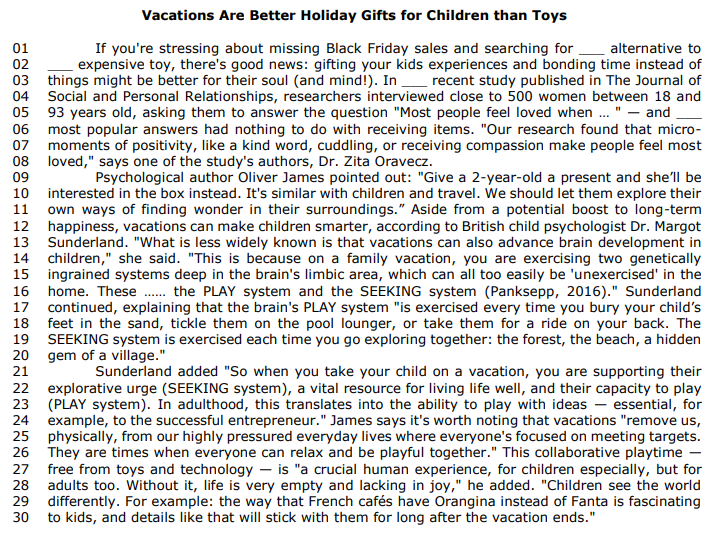
(Avaliable in: https://people.com/parents/vacations-better-than-toys-holiday-gifts-kids/ – text specially
adapted for this test.)
Read the following article and answer question
Can Allergies Cause Coughing — Or Is It Just A Cold?
Important q: Is it phlegmy or dry?
BY CASSIE SHORTSLEEVE
No matter why it's happening, a cough is always annoying—it's loud, it's uncomfortable, and it never fails to garner unwanted attention.
But what's really behind that cough? Can allergies cause coughing — or do you just have an annoying cold?
Well, turns out, there are some pretty distinct differences between allergy coughs and cold coughs...
Just curious: Why do we cough, anyway? "The purpose of a cough is to help us," says Monica Lee, MD, an otolaryngologist at Massachusetts Eye and Ear. It’s your body’s way of trying to expel something it perceives as a threat in the airway, she says.
Those perceived threats can be a bunch of different things: a piece of food stuck in your throat, pollen, air pollution, or swelling or drainage from extra mucus in your throat. All those things irritate the sensory fibers in your airway, which then stimulate a cough.
As for what exactly happens in your body during a cough? It's kind of complex, says Dr. Lee. Basically, your vocal chords close briefly to generate pressure in the lungs. Once enough pressure is built up, your vocal chords open back up, and air flows quickly through your voice box, which generates that coughing sound. Kinda cool, huh?
7So...can allergies cause coughing? Give it to me straight. In short, yes. Usually, allergies create dry coughs (it’s a direct reaction to something you’re sensitive or allergic to in the airways). If that's the case, you’ll likely have other symptoms (think: itchy, watery eyes; a runny nose; an itchy throat; and sneezing, says Dr. Lee). Headaches and wheezing often come with allergies, too, according to the American College of Allergy, Asthma, and Immunology.
Remind Me: When Is Allergy Season?
Timing's also a factor. If you're allergic to pollen (or your BFF's new adorable kitten), for example, you’ll likely notice symptoms (including your cough) almost immediately, or within an hour of being exposed. And those symptoms could last for hours after you've been exposed — even after the allergen isn't nearby anymore.
Coughs related to allergies are also dependent on patterns, so doctors always try to look at the big picture. Say you get a cough every single March. That could be a sign you're actually suffering from allergies, instead of the common cold. "You need to look at everything that's going on," says Paul Bryson, MD, an otolaryngologist at the Cleveland Clinic.
Your best defense for a cough from allergies? Antihistamines like Allegra, Claritin, and Zyrtec, which are all available over-the-counter. Other options include steroid nasal sprays and immunotherapy shots, which can work to regulate your body's response to allergens, instead of just relieving the symptoms.
How do I know my cough is from a cold?
You know how allergy coughs are typically on the drier side? Coughs from colds (or the flu) tend to be on the wetter side (that "wetness" is actually mucus your body which is trying to move out of your body, says Dr. Lee).
Coughs that come along with a cold usually come along with stuffiness, along with postnasal drip (a.k.a., mucus running down the back of your throat), which can cause a sore throat or chest discomfort. A low-grade fever may also signal a cold instead of allergies.
Colds aren't as immediate as allergies. Instead, they tend to develop over the course of a few days, says Dr. Bryson.
You can try a few different things to help relieve a cough. Decongestants can work for, well, congestion. And ingredients like dextromethorphan (found in many multi-symptom products like Vicks NyQuil Cold & Flu Nighttime Relief) can help ease the coughing itself. Just make sure you take any products as-directed. It should be said, however, that a dry cough isn't always allergies, just like a wet cough isn't always a cold. Allergies can plague your nose, for example, causing post-nasal drip (a wet cough), while mild colds might not leave you stuffed up enough to produce any phlegm.
Do I ever need to worry about a cough?
Something important to remember: A cough — no matter its cause — shouldn’t be your norm. Colds usually run their course within a couple of weeks, which means a cough associated with a cold should go away in about three weeks time (though some can linger on for as long as eight weeks), according to the U.S. National Library of Medicine. The length of an allergy-related cough will vary depending on how (if) you're treating it. But if you notice you’re still barking after two months of symptoms, see your doc. You could either be dealing with an allergy you’re not aware of (this is where an allergy test could come into play) or potentially suffering from another issue such as asthma (especially if you notice shortness of breath with any of your symptoms), reflux, pneumonia, or bronchitis, says Dr. Bryson. And if something (allergies or a pesky cold) is bothering you enough to disrupt your life, don't put off getting it checked out. If nothing else, seeing a doc will give you peace of mind and maybe even speed up your recovery time.
SOURCE:https://www.womenshealthmag.com/health/a26289646/co ughing-from-allergies-or-cold/. Access: 02/12/2019
Peter is Fay's best friend. He smokes a lot.
What should Peter do?
He should ...
Choose the verb that completes the sentence above correctly:
Choose the verb that completes the following sentence correctly:
Fay was studying English last night when suddenly the lights ...
4 Types of Deceptive Advertising
By Apryl Duncan
Deceptive advertising is officially defined
by the Federal Trade Commission (FTC) as “practices that have been found
misleading or deceptive. Specific cases include false oral or written
representations, misleading price claims, sales of hazardous or systematically
defective products or services without adequate disclosures, failure to
disclose information regarding pyramid sales, use of bait and switch
techniques, failure to perform promised services, and failure to meet warranty
obligations.

However, it’s important to note that deceptive advertising does not represent the entire industry, and makes up a very small percentage of the ads you will encounter every day. But there are always people out there looking to dupe consumers and make money in any way that they can. Here are some examples of deceptive and unethical advertising practices and scams that you need to look out for.
Often, hidden fees can be spotted by the asterisk (*) that accompanies the incredible deal. Guaranteed, there will be a big difference between “Only $99!” and “Only $99!*” That asterisk basically says “hey, this is not the final price, you will have to jump through major hoops or fork over a lot more cash.” So, if you see an asterisk, read the small print carefully. Whether it’s a small item, a car, or even a home, hidden fees are a deceptive way of luring you in. By the time you realize there’s more to pay, it can be too late.
For instance, suddenly the laptop you wanted is not in stock, but there is a different one that is lower spec and costs twice as much. Chances are that the original laptop was never in stock, or at least, not for the price advertised.
Another example would be advertising a car at the base price, but with all of the top-of-the-line features included in the ad. When you get to the dealership, you have to pay much more to get the car actually shown in the ad. Sometimes, an offer can feel like bait and switch but it’s not. If you want that laptop and it is sold out, but you are offered a similar laptop with a very similar spec, at an almost identical price, that’s perfectly fine. You just missed out on the original deal.
At no time do the hustlers break the law by making claims that are untrue, but the verbiage leads people to believe they are buying something way better than they’re actually getting. One of the cruelest was advertising a DIY model plane for a price that seemed like a steal. Things like “easy to assemble” and “it really flies” were on the box. But inside... it was just a blank sheet of paper, with a set of instructions on how to make a paper plane. Did they break the law? No. Did they deceive? Yes.
Food photography can suffer from the “best case scenario” photography. If you have ever ordered a burger from a fast food place, you will know this well. The burger on the menu is perfect. It’s thick, juicy, 4 inches high, and looks incredible. But the burger you receive, while it may have the same ingredients, is a sad interpretation of that image. The bun is flat, the burger is a mess, ketchup and mustard are pouring out of the sides.
This is something we accept as consumers because we know the burger in the photograph was assembled by expert designers and food artists, over the course of many hours, whereas the poor kitchen hand has to throw your burger together in a few seconds to meet your time demands. But, don’t take that to mean you can never complain about this kind of photography. If you buy something that is clearly of poorer quality than the item shown in the picture, you can demand a refund.(Adapted from www.thebalancecareers.com, February 02, 2019)
Use the text below to answer the question
Japanese Emperor
A Japanese emperor has abdicated for the first time in more than 200 years. Emperor Akihito stepped down from the Chrysanthemum Throne on April 30 after 30 years of being the Japanese monarch. He made way for his son Crown Prince Naruhito to become the new emperor. Akihito decided to step down because of his health. At the age of 85, he has been visibly slowing down for the past few years. He has also had a couple of health scares. He believes his son is now better able to carry out the duties of emperor. Emperor Akihito will be remembered for using a personal touch to bring his people together after many national disasters. He continually visited people after earthquakes, tsunami and other tragedies.
The new Emperor Naruhito became the 126th emperor to ascend the throne of the world's oldest monarchy. Naruhito, 59, spent two years studying at Oxford University. His wife, the new Empress Masako, studied at Harvard University and worked as a diplomat. A traditional ceremony took place as part of the historic handover. In the ceremony, Naruhito received a sacred sword, a jewel and official seals that date back thousands of years. The ceremony took place in the middle of a ten-day Japanese holiday. The traditional Golden Week holiday was extended to allow people to celebrate the new emperor. Millions of Japanese were glued to their TVs and smartphones watching the historic event.
Available at: https://breakingnewsenglish.com Accessed on May,
06th 2019.
“Akihito decided to step down because of his health...” The underlined words indicate a phrasal verb. The incorrect meaning of a phrasal verbs is in:
The World War I began in 1914.
The correspondent phrasal verb is:
There must be training sites where teachers have the opportunity to express those concerns while also learning to come up with ways to approach the multicultural classroom and curriculum.”
The phrasal verb highlighted above means:
I. Está correta a grafia do trecho a seguir: to have little to depend on. II. Está correta a grafia do trecho a seguir: to bring beacki.
Marque a alternativa CORRETA:
First column:
1- break down
2- get by
3- take off
4- take somebody in
5- call off
Second column: ( ) go into the air
( ) cancel
( ) manage
( ) stop working
( ) deceive
Choose the alternative that presents the correct match:

 Conheça nossos planos