Questões de Concurso
Sobre verbos frasais | phrasal verbs em inglês
Foram encontradas 265 questões


He tore up all her letters when she decided to move.
Read the sentences below:
I. John study engineering at my university.
II. Helene is going to live in London last year.
III. Pedro wishes he can read more this month.
IV. When I grew up, I want to be a jazz singer.
Choose the best alternative to replace the words underlined in the sentences above:
Complete the sentence with the correct phrasal verb:
They _______ after seven years of marriage, what a pity.
Sustainable mining – oxymoron or a way of the future?
Mining is an activity that has persisted since the start of humans using tools. However, one might argue that digging a big hole in the ground and selling the finite resources that come out of that hole is not sustainable, especially when the digging involves the use of other finite resources (i.e. fuels) and produces a lot of greenhouse gases.
The counter argument could go along the lines that minerals are not being lost or destroyed through mining and mineral processing – the elements are being shifted around, and converted into new forms. Metals can even be extracted from waste, seawater or even sewage, and recycled. But a more simple argument is possible: a mine can be sustainable if it is economically, socially and environmentally beneficial in the short and long term. To be sustainable, the positive benefits of mining should outweigh any negative impacts. […]
Social positives are often associated with mines in regional areas, such as providing better amenities in a nearby town, or providing employment (an economic and social positive). Social negatives can also occur, such as dust, noise, traffic and visual amenity. These are commonly debated and, whilst sometimes controversial, can be managed with sufficient corporate commitment, stakeholder engagement, and enough time to work through the issues. Time is the key parameter - it may take several years for a respectful process of community input, but as long as it is possible for social negatives to be outweighed by social positives, then the project will be socially sustainable.
It is most likely that a mine development will have some environmental negatives, such as direct impacts on flora and fauna through clearing of vegetation and habitat within the mine footprint. Some mines will have impacts which extend beyond the mine site, such as disruption to groundwater, production of silt and disposal of waste. Certainly these impacts will need to be managed throughout the mine life, along with robust rehabilitation and closure planning. […]
The real turning point will come when mining companies go beyond environmental compliance to create 'heritage projects' that can enhance the environmental or social benefits in a substantial way – by more than the environmental offsets needed just to make up for the negatives created by the mine. In order to foster these innovative mining heritage projects we need to promote 'sustainability assessments' - not just 'environmental assessments'. This will lead to a more mature appreciation of the whole system whereby the economic and social factors, as well as environmental factors, are considered in a holistic manner.
(adapted from https://www.engineersaustralia.org.au/western-australia-division/sustainable-mining-oxymoron-or-way-future. Retrieved on August 10, 2015)
Innovation is the new key to survival
[…]
At its most basic, innovation presents an optimal strategy for controlling costs. Companies that have invested in such technologies as remote mining, autonomous equipment and driverless trucks and trains have reduced expenses by orders of magnitude, while simultaneously driving up productivity.
Yet, gazing towards the horizon, it is rapidly becoming clear that innovation can do much more than reduce capital intensity. Approached strategically, it also has the power to reduce people and energy intensity, while increasing mining intensity.
Capturing the learnings
The key is to think of innovation as much more than research and development (R&D) around particular processes or technologies. Companies can, in fact, innovate in multiple ways, such as leveraging supplier knowledge around specific operational challenges, redefining their participation in the energy value chain or finding new ways to engage and partner with major stakeholders and constituencies.
To reap these rewards, however, mining companies must overcome their traditionally conservative tendencies. In many cases, miners struggle to adopt technologies proven to work at other mining companies, let alone those from other industries. As a result, innovation becomes less of a technology problem and more of an adoption problem.
By breaking this mindset, mining companies can free themselves to adapt practical applications that already exist in other industries and apply them to fit their current needs. For instance, the tunnel boring machines used by civil engineers to excavate the Chunnel can vastly reduce miners' reliance on explosives. Until recently, those machines were too large to apply in a mining setting. Some innovators, however, are now incorporating the underlying technology to build smaller machines—effectively adapting mature solutions from other industries to realize more rapid results.
Re-imagining the future
At the same time, innovation mandates companies to think in entirely new ways. Traditionally, for instance, miners have focused on extracting higher grades and achieving faster throughput by optimizing the pit, schedule, product mix and logistics. A truly innovative mindset, however, will see them adopt an entirely new design paradigm that leverages new information, mining and energy technologies to maximize value. […]
Approached in this way, innovation can drive more than cost reduction. It can help mining companies mitigate and manage risks, strengthen business models and foster more effective community and government relations. It can help mining services companies enhance their value to the industry by developing new products and services. Longer-term, it can even position organizations to move the needle on such endemic issues as corporate social responsibility, environmental performance and sustainability.
(http://www2.deloitte.com/content/dam/Deloitte/ru/Document s/energy-resources/ru_er_tracking_the_trends_2015_eng.pdf)
Read text I and answer the question.

Notion of an 'event horizon', from which nothing _____________ 1 escape, is incompatible with quantum theory, physicist claims.
The defining characteristic of a black hole _____________ 2 have to give, if the two pillars of modern physics – general relativity and quantum theory – are both correct.
Most physicists foolhardy enough to write a paper claiming that “there are no black holes” – at least not in the sense we usually imagine – ____________ 3 probably be dismissed as cranks. But when the call to redefine these cosmic crunchers comes from Stephen Hawking, it’s worth taking notice. In a paper posted online, the physicist, based at the University of Cambridge, UK, and one of the creators of modern black-hole theory, does away with the notion of an event horizon.
But on analysing the situation in detail, Polchinski’s team came to the startling realization that the laws of quantum mechanics, which govern particles on small scales, change the situation completely. Quantum theory, they said, dictates that the event horizon _____________ 4 actually be transformed into a highly energetic region, or 'firewall', that _______________ 5 burn the astronaut to a crisp.
TEXT 5:

TEXT 3:

Anxiety Medication: Over Prescribed and
Causing Overdoses
According to a story on NBC New York, more and more patients are ending up in New York City hospitals having over dosed on Xanax. Xanax is in the benzodiaziepine family of drugs and it’s used to treat anxiety, nervousness, and panic attacks by decreasing brain activity.
Xanax Overdoses Way Up
NBC New York reports:
Between 2004 and 2009, New York City emergency room visits involving Xanax and other anti-anxiety prescription drugs known as benzodiazepines increased more than 50 percent. That’s up from 38 out of 100,000 New Yorkers in 2004 to 59 out of 100,000 New Yorkers.
It’s not the drug by itself that causes the overdoses, but used in combination with other drugs and alcohol, it creates a toxic cocktail which isn’t easily metabolized in the body.
The drug is habit forming and withdrawal symptoms can include sweating, shaking, difficulty falling asleep, difficulty concentrating, depression, and nervousness. Many fear that the drug is being over prescribed.
“I don’t believe they take the time with the patients to figure out what the problems are,” Cali Estes, a drug counselor said to NBC New York. “A doctor who is running short on time and nurses and probably isn’t paid as much as he or she used to be finds it easier to say, ‘OK, this person has a problem, here’s your script, have a nice day. Where’s my next patient?’”
Whitney Houston’s Death Tied to Xanax and Other Drugs
Whitney Houston’s recent death is raising questions as to this and other sedatives. Xanax is most often criticized by those in the psychiatric community because it only lasts 6 to 20 hours.
Forbes reports:
On the face of it, this seems like a great combination – you get a quick hit of anxiety relief and the drug leaves your system within a 24-hour period. But in practice what often happens is that because the drug acts so quickly and dissipates quickly, the patient begins taking more of it to maintain the effect. Two pills a day turns into four, which turns into six and so forth.
According to the CDC, prescription drug overdose is now the leading cause of accidental death in the U.S., topping automobile accidents for the first time in 30 years. Currently, Xanax is the 11th most widely prescribed drug in the nation.
Available in: http://blogs.discovery.com
Read the sentence below taken from the text and analyze the assertions.
“Two pills a day turns into four, which turns into six and so forth.”
I. The phrasal verb “to turn into” can be replaced by “in turn”.
II. “Which” refers to the last quantity of pills mentioned.
III. The expression “so forth” infers that, after having 6 pills, the patient restarts taking four pills.
The correct assertion(s) is(are)

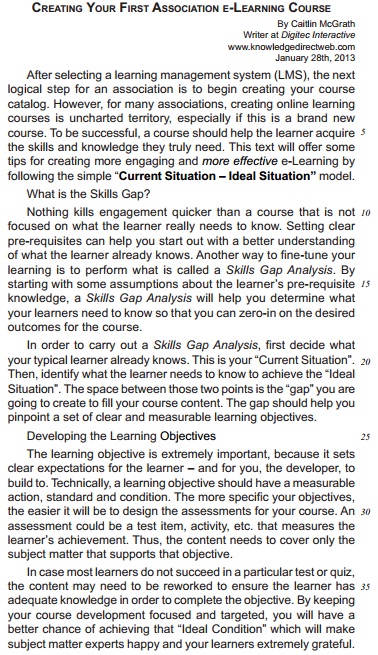
…so that you can zero-in on the desired outcomes for the course. (L. 17-18)
The meaning of the underlined phrasal verb above is parallel to:

 Conheça nossos planos