Questões de Concurso
Sobre substantivos e compostos | nouns and compounds em inglês
Foram encontradas 456 questões


“Since the word entered the American lexicon, it has become a full-blown, Instagram-worthy lifestyle filled with warm blankets and glowing candles.” (l. 02-04).
( ) Warm blankets and glowing candles are representations of Instagram lifestyle. ( ) The word ‘lifestyle’ is a compound noun. ( ) The underlined phrase is an example of the present perfect verb tense. ( ) The word ‘since’ is used to describe the duration of an action, rather than the moment when the action begins.
Choose the alternative with the correct answers, in order.

“...both fathers to young children...” The words in bold are in the plural form. Mark the alternative where all the words are in the plural form:
Newly discovered primate 'already facing extinction'
(Adaptado de https://www.bbc.com/news/science-environment-54894681)

(Avaliable in: https://theplaylist.net/matrix-4-keanu-reeves-script-20200608/ – text adapted specially
for this test).
I. The verb “do” is in the infinitive form. II. The verb “do” is in the gerund form. III. The noun “reason” must be followed by “to”.
Which statements are correct?
Instructions: answer question based on the following text
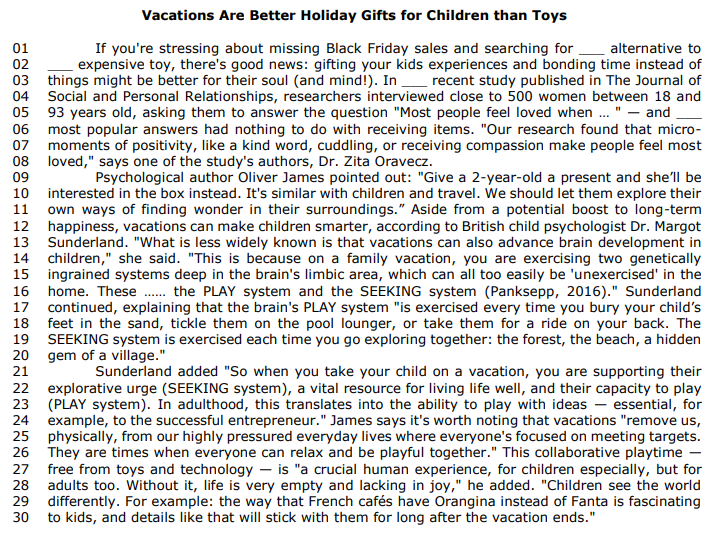
(Avaliable in: https://people.com/parents/vacations-better-than-toys-holiday-gifts-kids/ – text specially
adapted for this test.)
An interview with Paolo Kwan, 20, from Hong Kong, who is improving his English while studying Business Administration at Sierra College in northern California.
WHY DID YOU DECIDE TO STUDY IN THE USA?
It provides a nice education in a beautiful country. When I
was younger I used to watch American movies and I
wanted to visit the United States. They always talked about
the American dream, and I wanted to come and see it.
HOW DID YOU CHOOSE YOUR INTENSIVE ENGLISH PROGRAM?
Sierra College is one of the biggest community colleges in northern California. It is in a quiet location but has a beautiful campus.
The college has a good business program. I can study for two years at Sierra College and then two years at my transfer school to earn my degree.
WHAT DO YOU LIKE BEST?
I also enjoy the quality of the teaching at the college. There is a writing center where I can go at any time. The teachers can make suggestions to improve my essay, regarding grammar and my vocabulary. At the Math Center, they can explain in detail the problems.
WHAT DO YOU MISS MOST?
I miss the food and also my family.
WHAT WAS YOUR BIGGEST SURPRISE?
I was surprised by the cultural difference. The taste and style of food is very different. The amount of food is a lot larger. A small portion in the USA is a large portion in Hong Kong. When people from America find out that I am from another country they ask a lot of questions. They are very interested in you and finding out about Hong Kong.
... YOUR BIGGEST DISAPPOINTMENT?
I have not had any since I came here.
HOW HAVE YOU HANDLED:
... LANGUAGE DIFFERENCES?
It is important not to be shy, as that does not help you when you are trying to improve your language. I make sure that I study, practice and speak as often as I can—that is the only way to improve. ...
FINANCES?
I am being supported by my family.
... ADJUSTING TO A DIFFERENT EDUCATIONAL SYSTEM?
The American system is much more open. In Hong Kong you just learn what the teacher writes on the board. In America, you discuss the issues and focus more on ideas
WHAT ARE YOUR ACTIVITIES?
I am interested in traveling around the USA. I have been to San Francisco, which you can reach by train from Sierra College. In my free time I go out with friends.
HOW EASY OR DIFFICULT IS MAKING FRIENDS?
It has not been that hard to make friends in the USA. Other people at the college are friendly and want to make friends as well.
HOW IS YOUR U.S. EDUCATION RELEVANT TO YOUR PERSONAL GOALS AND TO THE NEEDS OF YOUR COUNTRY?
I think that the U.S. education system will provide me with
good resources and skills to be able to support myself in
order to get hired in my own country
WHAT IS YOUR ADVICE TO OTHER STUDENTS?
An awesome life experience is waiting for you in the future. You will learn so much more than you think. Nothing is impossible, so go ahead and give it a try.
Adapted from: https://www.studyusa.com
The last question that Paolo answered was: “What is your advice to other students?
” Choose the only sentence below in which the noun ADVICE is correctly used.
Read the following article and answer question
Can Allergies Cause Coughing — Or Is It Just A Cold?
Important q: Is it phlegmy or dry?
BY CASSIE SHORTSLEEVE
No matter why it's happening, a cough is always annoying—it's loud, it's uncomfortable, and it never fails to garner unwanted attention.
But what's really behind that cough? Can allergies cause coughing — or do you just have an annoying cold?
Well, turns out, there are some pretty distinct differences between allergy coughs and cold coughs...
Just curious: Why do we cough, anyway? "The purpose of a cough is to help us," says Monica Lee, MD, an otolaryngologist at Massachusetts Eye and Ear. It’s your body’s way of trying to expel something it perceives as a threat in the airway, she says.
Those perceived threats can be a bunch of different things: a piece of food stuck in your throat, pollen, air pollution, or swelling or drainage from extra mucus in your throat. All those things irritate the sensory fibers in your airway, which then stimulate a cough.
As for what exactly happens in your body during a cough? It's kind of complex, says Dr. Lee. Basically, your vocal chords close briefly to generate pressure in the lungs. Once enough pressure is built up, your vocal chords open back up, and air flows quickly through your voice box, which generates that coughing sound. Kinda cool, huh?
7So...can allergies cause coughing? Give it to me straight. In short, yes. Usually, allergies create dry coughs (it’s a direct reaction to something you’re sensitive or allergic to in the airways). If that's the case, you’ll likely have other symptoms (think: itchy, watery eyes; a runny nose; an itchy throat; and sneezing, says Dr. Lee). Headaches and wheezing often come with allergies, too, according to the American College of Allergy, Asthma, and Immunology.
Remind Me: When Is Allergy Season?
Timing's also a factor. If you're allergic to pollen (or your BFF's new adorable kitten), for example, you’ll likely notice symptoms (including your cough) almost immediately, or within an hour of being exposed. And those symptoms could last for hours after you've been exposed — even after the allergen isn't nearby anymore.
Coughs related to allergies are also dependent on patterns, so doctors always try to look at the big picture. Say you get a cough every single March. That could be a sign you're actually suffering from allergies, instead of the common cold. "You need to look at everything that's going on," says Paul Bryson, MD, an otolaryngologist at the Cleveland Clinic.
Your best defense for a cough from allergies? Antihistamines like Allegra, Claritin, and Zyrtec, which are all available over-the-counter. Other options include steroid nasal sprays and immunotherapy shots, which can work to regulate your body's response to allergens, instead of just relieving the symptoms.
How do I know my cough is from a cold?
You know how allergy coughs are typically on the drier side? Coughs from colds (or the flu) tend to be on the wetter side (that "wetness" is actually mucus your body which is trying to move out of your body, says Dr. Lee).
Coughs that come along with a cold usually come along with stuffiness, along with postnasal drip (a.k.a., mucus running down the back of your throat), which can cause a sore throat or chest discomfort. A low-grade fever may also signal a cold instead of allergies.
Colds aren't as immediate as allergies. Instead, they tend to develop over the course of a few days, says Dr. Bryson.
You can try a few different things to help relieve a cough. Decongestants can work for, well, congestion. And ingredients like dextromethorphan (found in many multi-symptom products like Vicks NyQuil Cold & Flu Nighttime Relief) can help ease the coughing itself. Just make sure you take any products as-directed. It should be said, however, that a dry cough isn't always allergies, just like a wet cough isn't always a cold. Allergies can plague your nose, for example, causing post-nasal drip (a wet cough), while mild colds might not leave you stuffed up enough to produce any phlegm.
Do I ever need to worry about a cough?
Something important to remember: A cough — no matter its cause — shouldn’t be your norm. Colds usually run their course within a couple of weeks, which means a cough associated with a cold should go away in about three weeks time (though some can linger on for as long as eight weeks), according to the U.S. National Library of Medicine. The length of an allergy-related cough will vary depending on how (if) you're treating it. But if you notice you’re still barking after two months of symptoms, see your doc. You could either be dealing with an allergy you’re not aware of (this is where an allergy test could come into play) or potentially suffering from another issue such as asthma (especially if you notice shortness of breath with any of your symptoms), reflux, pneumonia, or bronchitis, says Dr. Bryson. And if something (allergies or a pesky cold) is bothering you enough to disrupt your life, don't put off getting it checked out. If nothing else, seeing a doc will give you peace of mind and maybe even speed up your recovery time.
SOURCE:https://www.womenshealthmag.com/health/a26289646/co ughing-from-allergies-or-cold/. Access: 02/12/2019
Match the columns according to the meanings for the words in the article and mark the option which contains the correct sequence:
I. Garner
II. Briefly
III. Wheezing
IV. Itchy
( ) noun – whistling sound produced by difficulty to breathe
( ) adjective – irritating cutaneous sensation
( ) adverb – lasting for a short time
( ) verb – to call; to gather
Text 2:
Bad teaching habits: too much TTT
No teacher is perfect and all teachers have bad habits. Being a good teacher means reflecting (1) the following habits and trying to reduce them as much as possible.
TTT stands (2) teacher talking time. Obviously, during the course of the class, it is necessary for the teacher to explain rules, give advice and talk about instructions, among other things. However, teachers should attempt to limit the amount of time that they spend speaking to the class in order to maximize the opportunity that the students have to speak. A good rule (3) thumb is aiming for around 30% of teacher talk to 70% of student talk. This means planning out what you will say, when and how.
Adapted from: www.bbc.co.uk/learningenglish
According to the third paragraph, there are lots of lessons in music in Finnish schools.
Choose the only sentence in which the noun MUSIC was used correctly.

 Conheça nossos planos