Questões de Concurso
Sobre substantivos e compostos | nouns and compounds em inglês
Foram encontradas 456 questões


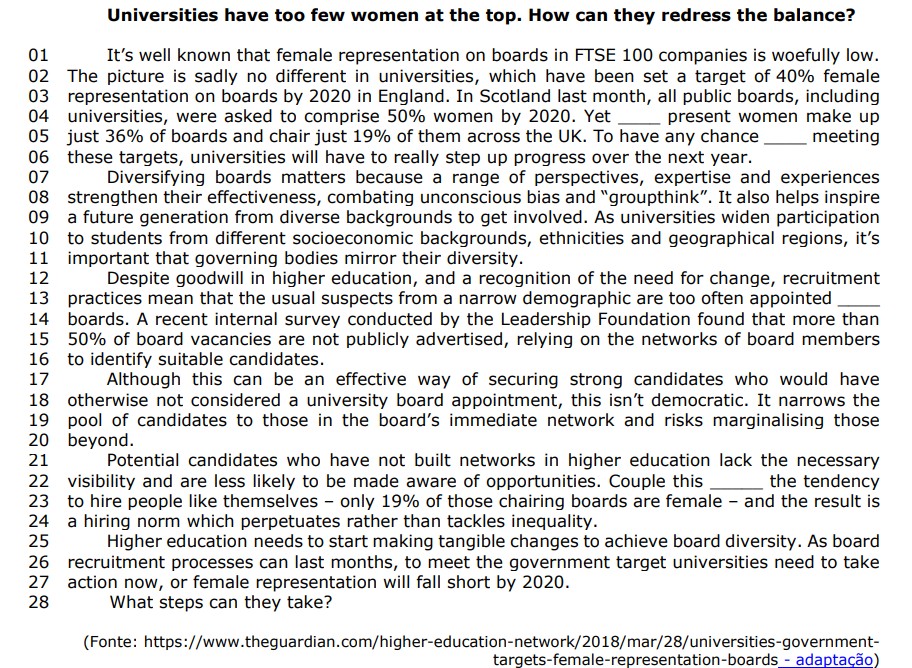
Column 1 1. Adverb. 2. Adjective. 3. Noun. 4. Verb.
Column 2 ( ) known (l.01). ( ) sadly (l.02). ( ) chair (l.05). ( ) unconscious (l.08). ( ) need (l.12). ( ) likely (l.22).
The correct order, top-down, is:

I. It’s classified as a noun. II. It’s compound noun formed by an adverb and a verb. III. The stress is on the second word.
Which ones are INCORRECT?
A questão refere-se ao texto abaixo.

Analyze the sentences below.
I- George had hopes of promotion;
II- Three to five cheeses are a great amount, no matter how many guests;
III- His life was in a danger. Substances are usually uncounted nouns, however they can be also used as count nouns, for instance: May I have a white wine = May I have a [glass of] white wine. (https://learnenglish.britishcouncil.org/en/englishgrammar/common-problems-countuncount-nouns)
Considering the context above, choose the correct option according to the underlined nouns used.
 The fair trade movement, which aims
ensure that fair prices are paid to producers in
developing countries, is one of the true global success
stories recent decades. The International
Fairtrade Certification Mark, a guarantee that producers are getting a fair price, has become one of the
most recognizable logos the world, which
91 percent of customers associate positive
values. When the logo first appeared in the UK, the
country where the largest number of fair-trade products are sold, nobody expected that the number of
certified products would grow from only 3 to over
4,500 in just 18 years. In 2011, people around the
world spent more than 6.5 billion US dollars on fair-
-trade certified goods, signifying a 12 percent increase
in sales from the previous year. This was at a time
when most market segments in the developed world
were still shrinking or stagnating from the after effects
of the 2008 banking crisis. Over 1.2 million farmers
and workers living in 66 countries benefit from fair-
-trade certification by being able to sell their products
at competitive prices, to ensure sustainability.
 Fair-trade initiatives have been growing steadily since the late 1960s, when the fair trade
movement started with only a handful of committed
individuals in the West who believed there was an
alternative to the exploitation of farmers and workers
in the developing world. Fair trade ensures fair prices
for suppliers, as well as payment of a premium that
can be reinvested in the local communities (for example, in schools or sanitation) or in improving productivity. In India, for instance, a group of rice farmers used
the premium to buy farm machinery, which meant a
30 percent improvement in production.
 As consumers look for, and recognize, the logo
and purchase fair-trade products, they put
pressure on companies and governments to do more
for global welfare. They also put pressure on supermarkets to sell fair-trade goods at the same price as
conventional products, shifting the extra costs involved from consumers to the corporations that collect
the profits.
 Critics of the fair trade movement say it is still
not doing enough. They stress that the key to
long-term development is not in small local improvements, but in moving the developing world from
the production of raw materials into processing them,
which can bring in greater profit. There are already some signs of this happening. A group of tea growers
in Kenya recently set up a processing factory to deliver the final products directly to their customers in
the West. By switching from the export of raw tea to
boxed fair-trade products, they achieved 500 percent
higher profits.
 It is important to realize that, despite all of its
benefits, the fair trade movement has its limitations. Some of the poorest farmers can’t afford to pay
the certification fees required for each fair-trade initiative, while others work for big, multinational employers that are excluded from participating. Fair trade is
certainly a step in the right direction, but there is a lot
more we must continue to do in order to help people
in the world’s poorest regions.
“A group of tea growers in Kenya recently set up a processing factory to deliver the final products directly to their customers in the West. By switching from the export of raw tea to boxed fair-trade products, they achieved 500 percent higher profits.”
The underlined words are examples of:
The fair trade movement, which aims
ensure that fair prices are paid to producers in
developing countries, is one of the true global success
stories recent decades. The International
Fairtrade Certification Mark, a guarantee that producers are getting a fair price, has become one of the
most recognizable logos the world, which
91 percent of customers associate positive
values. When the logo first appeared in the UK, the
country where the largest number of fair-trade products are sold, nobody expected that the number of
certified products would grow from only 3 to over
4,500 in just 18 years. In 2011, people around the
world spent more than 6.5 billion US dollars on fair-
-trade certified goods, signifying a 12 percent increase
in sales from the previous year. This was at a time
when most market segments in the developed world
were still shrinking or stagnating from the after effects
of the 2008 banking crisis. Over 1.2 million farmers
and workers living in 66 countries benefit from fair-
-trade certification by being able to sell their products
at competitive prices, to ensure sustainability.
Fair-trade initiatives have been growing steadily since the late 1960s, when the fair trade
movement started with only a handful of committed
individuals in the West who believed there was an
alternative to the exploitation of farmers and workers
in the developing world. Fair trade ensures fair prices
for suppliers, as well as payment of a premium that
can be reinvested in the local communities (for example, in schools or sanitation) or in improving productivity. In India, for instance, a group of rice farmers used
the premium to buy farm machinery, which meant a
30 percent improvement in production.
As consumers look for, and recognize, the logo
and purchase fair-trade products, they put
pressure on companies and governments to do more
for global welfare. They also put pressure on supermarkets to sell fair-trade goods at the same price as
conventional products, shifting the extra costs involved from consumers to the corporations that collect
the profits.
Critics of the fair trade movement say it is still
not doing enough. They stress that the key to
long-term development is not in small local improvements, but in moving the developing world from
the production of raw materials into processing them,
which can bring in greater profit. There are already some signs of this happening. A group of tea growers
in Kenya recently set up a processing factory to deliver the final products directly to their customers in
the West. By switching from the export of raw tea to
boxed fair-trade products, they achieved 500 percent
higher profits.
It is important to realize that, despite all of its
benefits, the fair trade movement has its limitations. Some of the poorest farmers can’t afford to pay
the certification fees required for each fair-trade initiative, while others work for big, multinational employers that are excluded from participating. Fair trade is
certainly a step in the right direction, but there is a lot
more we must continue to do in order to help people
in the world’s poorest regions.( ) The underlined words “As consumers look for …” can be replaced by ‘seek out’ without changing its meaning. ( ) The words ‘meant’; ‘been’ and ‘started’ are irregular verbs. ( ) “Fair-trade initiatives have been growing steadily since the late 1960s.” The underlined words are in the Present perfect continuous Tense. ( ) “They also put pressure on supermarkets to sell fair-trade goods….” The underlined word is the plural form of “good”.
Choose the alternative which presents the correct sequence, from top to bottom.
In the phrase “Only an old man, mittened and scarved”, the two words “mittened” and “scarved” are
In the sentence “The taxi, an old Rover smelling of old cigarette smoke, trundled along the empty, country road at an unhurried pace”, the words “empty” and “country” are used as
Within word classes, there are a number of restrictions. Knowledge of these allows competent speakers to produce well-formed sentences. Speakers of British English might say There isn’t any furniture in the room, but would not say There aren’t any furnitures in the room because furniture is almost always an uncountable noun.
An example of a well-formed sentence with an uncountable noun is:
Texto 03
How is English Used as a Lingua Franca Today?
By Maria Khodorkovsky on August 19, 2013

The term lingua franca was first coined in the beginning of the 17th century by the Italians. At that time, it represented a conglomeration of mostly Italian, with a smattering of French, Portuguese, Spanish, Turkish, Greek, and Arabic, and was used primarily as the language of commerce. The term literally means “Frankish language”, as “Frank” was a common designation for all western Europeans since approximately the 12th century.
Today, English is a common lingua franca across the globe. According to some estimates, almost 80 percent of English speakers in the world are non-native speakers. Below you will find more information about a phenomenon that bears on language, culture, commerce, and diplomacy.
Where is it used?
Apart from serving as a useful heuristic in Europe, where a Spaniard, a Frenchmen, and a German might all carry on a conversation in English, English as a lingua franca (ELF) plays an important role in former Anglophone colonies such as India, Pakistan, Nigeria, Uganda, and Zimbabwe, among many others.
How is it used?
ELF differs from Standard English in a number of ways. Several documented overarching similarities are variances in article usage (or no article usage at all), variances in preposition usage, and novel use of morphemes (such as importancy and smoothfully). Many instances of ELF also incorporate across-the-board third-person singular usage (such as “He go to the store.”), using “who” and “which” interchangeably, and a lack of gerunds. Verbally, noted differences include the omission of some consonants and addition of extra vowels, as well as a general tendency towards efficient communication over grammatically normative English.
Criticisms
While ELF is a widespread and useful mode of communication for many, some scholars and linguists have criticized its proliferation as a form of linguistic imperialism. This term became popular in 1992 with the publication of Robert Phillipson’s influential book of the same name. In it, Phillipson argues that English has long been a tool of submission and cultural domination of colonies. Contemporary critics of ELF cite the problems associated with studying a language in a disorganized, unstructured way. Speakers of ELF may eventually speak both their native language and English imperfectly, leading to issues with effective communication. In spite of these criticisms, ELF continues to flourish in many countries, oftentimes enriching the language with colorful aphorisms and unique turns of phrase.
(Disponível em https://www.altalang.com/beyond-words/how-is-english-used-as-a-lingua-franca-today/)
TEXTO I
English for Specific Purposes
English for specific purposes (ESP) refers to language research and instruction that focuses on the specific communicative needs and practices of particular social groups. Emerging out of Halliday, Macintosh, and Strevens’ (1964) groundbreaking work nearly 40 years ago, ESP started life as a branch of English language teaching, promising a stronger descriptive foundation for pedagogic materials. In the years since, ESP has consistently been at the cutting-edge of both theory development and innovative practice in applied linguistics, making a significant contribution to our understanding of the varied ways language is used in particular communities. Drawing on a range of interdisciplinary influences for its research methods, theory, and practices, ESP has consistently provided grounded insights into the structures and meanings of texts, the demands placed by academic or workplace contexts on communicative behaviors, and the pedagogic practices by which these behaviors can be developed.
HYLAND, K. “English for specific purposes: some influences and impacts”. In: Cummins, J. and Davison, C., (eds.) The International Handbook of English language education. Springer: Norwell, Mass, 2006.

Based on the text, judge the following item.
A little is considered a correct alternative for “a few” in
“a few channels” (lines 7 and 8).
TEXT 1 below, retrieved and adapted from https://chroniclingamerica. loc.gov/lccn/sn83035487/1851-06-21/ed-1/seq-4/ on July 9th, 2018.
Text 1
Women’s rights convention – Sojourner Truth
One of the most unique and interesting speeches of the convention was made by Sojourner Truth, an emancipated slave. It is impossible to transfer it to paper or convey any adequate idea of the effect it produced upon the audience. Those only can appreciate it who saw her powerful form, her whole-souled, earnest gesture, and listened to her strong and truthful tones. She came forward to the platform and addressing the President said with great simplicity:
"May I say a few words?" Receiving an affirmative answer, she proceeded: I want to say a few words about this matter. I am a woman's rights. I have as much muscle as any man and can do as much work as any man. I have plowed and reaped and husked and chopped and mowed, and can any man do more than that? I have heard much about the sexes being equal. I can carry as much as any man, and can eat as much too, if I can get it. I am as strong as any man that is now. As for intellect, all I can say is, if a woman has a pint, and a man a quart -- why can't she have her little pint full? You need not be afraid to give us our rights for fear we will take too much; -- for we can't take more than our pint will hold. The poor men seem to be all in confusion, and don't know what to do. Why children, if you have woman's rights, give it to her and you will feel better. You will have your own rights, and they won't be so much trouble. I can't read, but I can hear. I have heard the bible and have learned that Eve caused man to sin. Well, if a woman upset the world, do give her a chance to set it right side up again. The Lady has spoken about Jesus, how he never spurned woman from him, and she was right. When Lazarus died, Mary and Martha came to him with faith and love and besought him to raise their brother. And Jesus wept and Lazarus came forth. And how came Jesus into the world? Through God who created him and the woman who bore him. Man, where was your part? But the women are coming up blessed be God and a few of the men are coming up with them. But man is in a tight place, the poor slave is on him, woman is coming on him, he is surely between a hawk and a buzzard.
Reference: Robinson, M. (1851, June 21). Women’s
rights convention: Sojourner Truth. Anti-slavery Bugle, vol. 6
no. 41, Page 160.
This question must be answered by looking at the following sentence from Text 1:
“May I say a few words?”
We may keep the sentence grammatically correct by substituting “words” for:
TEXT 1 below, retrieved and adapted from https://chroniclingamerica. loc.gov/lccn/sn83035487/1851-06-21/ed-1/seq-4/ on July 9th, 2018.
Text 1
Women’s rights convention – Sojourner Truth
One of the most unique and interesting speeches of the convention was made by Sojourner Truth, an emancipated slave. It is impossible to transfer it to paper or convey any adequate idea of the effect it produced upon the audience. Those only can appreciate it who saw her powerful form, her whole-souled, earnest gesture, and listened to her strong and truthful tones. She came forward to the platform and addressing the President said with great simplicity:
"May I say a few words?" Receiving an affirmative answer, she proceeded: I want to say a few words about this matter. I am a woman's rights. I have as much muscle as any man and can do as much work as any man. I have plowed and reaped and husked and chopped and mowed, and can any man do more than that? I have heard much about the sexes being equal. I can carry as much as any man, and can eat as much too, if I can get it. I am as strong as any man that is now. As for intellect, all I can say is, if a woman has a pint, and a man a quart -- why can't she have her little pint full? You need not be afraid to give us our rights for fear we will take too much; -- for we can't take more than our pint will hold. The poor men seem to be all in confusion, and don't know what to do. Why children, if you have woman's rights, give it to her and you will feel better. You will have your own rights, and they won't be so much trouble. I can't read, but I can hear. I have heard the bible and have learned that Eve caused man to sin. Well, if a woman upset the world, do give her a chance to set it right side up again. The Lady has spoken about Jesus, how he never spurned woman from him, and she was right. When Lazarus died, Mary and Martha came to him with faith and love and besought him to raise their brother. And Jesus wept and Lazarus came forth. And how came Jesus into the world? Through God who created him and the woman who bore him. Man, where was your part? But the women are coming up blessed be God and a few of the men are coming up with them. But man is in a tight place, the poor slave is on him, woman is coming on him, he is surely between a hawk and a buzzard.
Reference: Robinson, M. (1851, June 21). Women’s
rights convention: Sojourner Truth. Anti-slavery Bugle, vol. 6
no. 41, Page 160.
“One of the most unique and interesting speeches of the convention was made by Sojourner Truth, an emancipated slave.”
The word “whole-souled” in the clause “her whole-souled, earnest gesture” can be defined as:
Read the text and answer to the question.
Cultural diversity and cultural identity in globalization


 Conheça nossos planos