Questões de Concurso Sobre inglês
Foram encontradas 26.027 questões


Column 1 Words 1. Weapon 2. Damage 3. Injury 4. Warm up 5. To wear
Column 2 Meanings ( ) a short practice of exercises that you do to prepare yourself for doing a sport. ( ) to have something on your body as a piece of clothing. ( ) physical harm caused to something in such a way as to impair its normal function. ( ) an object that is used for fighting or attack somebody. ( ) harm done to a person’s or animal’s body.
Choose the alternative which presents the correct sequence, from top to bottom.
1. To put ice on the throwing arm after the competition.
2. After getting up warn up all your body.
3. Wrapping a towel around your arm helps it to keep warm.
4. Athletes should skip breakfast on the day before the competition.
Choose the alternative which contains the correct sentences.
( ) Javelin throwers need to keep their arms cold after the competition
( ) You need special training to throw the javelin.
( ) What drinks are good for javelin throwers.
( ) There are health risks for javelin throwers.
( ) Javelin throwers need to practice too much.
Choose the alternative which presents the correct sequence, from top to bottom.
O professor de Língua Inglesa, em conjunto com a professora de História, pedem para os seus alunos da turma da 1º série do Ensino Médio assistirem ao filme Cruzada (2005) em Língua Inglesa com legenda também em Língua Inglesa. Ao final, os estudantes deverão responder a um questionário elaborado em inglês, mas com questões referentes ao conteúdo de História.
A atividade acima pode ser considerada:
Coluna 1 - Teorias da Aprendizagem (1)Construtivista. (2)Behaviorista. (3)Cognitivista.
Coluna 2 - Explicação (__)A aprendizagem é pautada em estímulos, com enfoque no comportamento observável. (__)A aprendizagem se dá por meio de processos de descobrimentos autônomos. (__)Aulas expositivas com foco na transmissão de conteúdo.
Após analise, assinale a alternativa que apresenta a sequência CORRETA.
1.(__)O estudo da Língua Inglesa é importante somente porque é muito exigida no mercado de trabalho.
2.(__)A globalização é um fenômeno que coopera para a necessidade do aprendizado da Língua Inglesa na Educação Básica.
3.(__)O aumento da comunicação pela internet exige ainda mais conhecimentos da Língua Inglesa.
Após análise, assinale a alternativa que apresenta a sequência CORRETA dos itens acima, de cima para baixo:
I.O ensino bilíngue nas escolas públicas já é uma realidade e está previsto na Base Nacional Comum Curricular (BNCC).
II.Um dos recursos mais utilizados para o ensino de Língua Inglesa nas escolas é a música.
III.O ensino de Língua Inglesa é obrigatório a partir do 7º ano do Ensino Fundamental.
Está (ão) CORRETA (S) a (s) seguinte (s) proposição (ões):
Read the text to answer.
Dear Madam:
I have been shown in the files of the War Department a statement of the Adjutant-General of Massachusetts that you are the mother of five sons who have died gloriously on the field of battle. I feel how weak and fruitless must be any words of mine which should attempt to beguile you from the grief of a loss so overwhelming. But I cannot refrain from tendering to you the consolation that may be found in the thanks of the Republic they died to save. Hence, I pray that our Heavenly Father may assuage the anguish of your bereavement, and the solemn pride that must be yours to have laid so costly a sacrifice upon the altar of freedom.
Your very sincerely and respectfully,
Abraham Lincoln.
(Lederer, Richard. The miracle of language. Pocket Books, New York, NY.)
Analyse the image to answer.

(Available: https://comics.ha.com. Imaged by Heritage Auctions. HA. Com.)
Read the text to answer.
English teaching methods and approaches
Throughout the history of teaching languages a number of
different teaching approaches and methodologies have been
tried and tested with some being more popular and effective
than others. It’s beneficial to be familiar with a few of these.
1 – The Direct Method
The direct method of teaching English is also known as the Natural Method. It’s used to teach a number of different languages not just English, and the main idea of the Direct Method is that it only uses the target language that the students are trying to learn. Its main focus is oral skill and it is taught via repetitive drilling. Grammar is taught using an inductive way and students need to try and guess the rules through the teacher’s oral presentation.
2 – The Grammar Translation Method
This is the traditional or ‘classical’ way of learning a language and it’s still commonly used. Some countries prefer this style of teaching and the main idea behind this method is that the students learn all grammar rules, so they’re able to translate a number of sentences.
3 – The Audio Lingual Method
The Audio Lingual Method otherwise known as the New Key Method or Army Method is based on a behaviourist theory that things are able to be learned by constant reinforcement. This is related to the Direct Method and just like its predecessor it only uses the target language. The biggest difference between the Audio Lingual Method and the Direct Method is its focus of teaching. The Direct Methods focuses on the teaching of vocabulary whereas the Audio Lingual Method focuses on specific grammar teachings.
4 – The Structural Approach
As the name suggests, the method is all about structure. The idea is that any language is made up of complex grammar rules. These rules, according to this approach need to be learnt in a specific order, for example the logical thing would be to teach the verb “to be” prior to teaching the present continuous which requires using the auxiliary form of the verb “to be”.
5 – Suggestopedia
This is a behaviourist theory and related to pseudoscience. This theory is intended to offer learners various choices. It relies a lot on the atmosphere and the physical surroundings of the class. It’s essential that all learners feel equally comfortable and confident. When teachers are training to use the Suggestopedia method, there’s a lot of art and music involved. Each Suggestopedia lesson is divided into three different phases – 1. Deciphering 2. Concert Session 3. Elaboration.
6 – Total Physical Response
Total Physical Response, otherwise known as TPR is an approach that follows the idea of ‘learning by doing’. Beginners will learn English through a series of repetitive actions such as “Stand up”, “Open your book”, “Close the door”, and “Walk to the window and open it.” With TPR, the most important skill is aural comprehension and everything else will follow naturally later. 7 – Communicative Language Teaching CLT The idea behind this approach is to help learners communicate more effectively and correctly in realistic situations that they may find themselves in. This type of teaching involves focusing on important functions like suggesting, thanking, inviting, complaining, and asking for directions to name but a few.
8 – The Silent Way
The main of this way of teaching is for the teacher to say very little, so students can take control of their learning. There’s a big emphasis on pronunciation and a large chunk of the lesson focuses on it. This method of learning English follows a structural syllabus and grammar, vocabulary and pronunciation are constantly drilled and recycled for reinforcement. The teacher evaluates their students through careful observation, and it’s even possible that they may never set a formal test as learners are encouraged to correct their own language errors.
9 – Community Language Learning
This is probably one of the English teaching methods where the student feels the safest as there’s a great emphasis on the relationship and bond between the student and teacher. Unlike a lot of the other methods and approaches of teaching English as a Second Language, a lot of the L1 (mother tongue) is used for translation purposes.
10 – Task Based Language Learning
The main aim of this approach to learning is task completion.
Usually, relevant and interesting tasks are set by the teacher and
students are expected to draw on their pre-existing knowledge
of English to complete the task with as few errors as possible.
11 – The Lexical Approach
The Lexical syllabus or approach is based on computer studies that have previously identified the most commonly used words. This approach in teaching focuses on vocabulary acquisition and teaching lexical chunks in order of their frequency and use. Teachers of the Lexical Approach place a great emphasis on authentic materials.
(Available: http://www.huntesl.com. Adapted.)
Read the text to answer.
The Story Behind TIME’s ‘Resilience of Ukraine’ Cover

(Artwork by JR; Photograph by Artem Iurchenko. A drone was used to capture the cover image on March 14 in Lviv.)
Since Russia’s invasion began, dozens of Ukraine’s 7.5 million children have been killed and thousands of others have fled in search of safety. Among those thousands is 5-year-old Valeriia from Kryvyi Rih, President Volodymyr Zelensky’s hometown in central Ukraine. Her image – a smiling child – appears on one of this issue’s covers.
If you met Valeriia, you might think she’s shy, her mother Taisiia told TIME, but don’t be fooled; at home, she commands attention. She loves the same things as many little girls – her stuffed bunny; her Elsa doll fromCold Heart(which English speakers know as Frozen); and her pink backpack, which she had to leave behind as she ran off her country. Valeriia also has big dreams: in particular, starting her first year of school on Sept. 1. Now, it’s hard to say when and where Valeriia will be able to do so. On March 9, mother and daughter fled to Poland; for safety, they asked that TIME use only their first names. In an interview, Taisiia explained her decision to leave home to keep her child safe. “She is my sunshine, my joy.”
According to Taisiia they woke up early in the morning of Feb. 24 to learn the occupying army had started bombing military bases. “I thought about my daughter, Valeriia; for her safety, I knew we had to go. We left Ukraine before we were bombarded, so we had a chance.” Even though Valeriia is with her now, husband and son stayed in Ukraine and therefore, it was very hard to leave. The day they left, the lines for buses and trainsstretched 3 km, mostly women and children, she says, “We were packed together and had to stand for 18 hours on the train to Lviv”.
The Russians still haven’t come to their city. The people from Kryvyi Rih have fought them off. But they are closer and closer, and you can see them approaching. In the media, Russia says they aren’t at war in Ukraine. But the war is real. People are dying for real. “And here I am, with my sister, my nephew, and my mother in Poland, in a hotel near Warsaw. They take care of us and even in this difficult situation, it was a warm reception. I cannot find the words to express how grateful I am to everyone who has helped”, ends up a crying Taisiia.
(Available: https://time.com/magazine/europe. Adapted.)
Read the text to answer.
English teaching methods and approaches
Throughout the history of teaching languages a number of different teaching approaches and methodologies have been tried and tested with some being more popular and effective than others. It’s beneficial to be familiar with a few of these.
1 – The Direct Method
The direct method of teaching English is also known as the Natural Method. It’s used to teach a number of different languages not just English, and the main idea of the Direct Method is that it only uses the target language that the students are trying to learn. Its main focus is oral skill and it is taught via repetitive drilling. Grammar is taught using an inductive way and students need to try and guess the rules through the teacher’s oral presentation.
2 – The Grammar Translation Method
This is the traditional or ‘classical’ way of learning a language and it’s still commonly used. Some countries prefer this style of teaching and the main idea behind this method is that the students learn all grammar rules, so they’re able to translate a number of sentences.
3 – The Audio Lingual Method
The Audio Lingual Method otherwise known as the New Key Method or Army Method is based on a behaviourist theory that things are able to be learned by constant reinforcement. This is related to the Direct Method and just like its predecessor it only uses the target language. The biggest difference between the Audio Lingual Method and the Direct Method is its focus of teaching. The Direct Methods focuses on the teaching of vocabulary whereas the Audio Lingual Method focuses on specific grammar teachings.
4 – The Structural Approach
As the name suggests, the method is all about structure. The idea is that any language is made up of complex grammar rules. These rules, according to this approach need to be learnt in a specific order, for example the logical thing would be to teach the verb “to be” prior to teaching the present continuous which requires using the auxiliary form of the verb “to be”.
5 – Suggestopedia
This is a behaviourist theory and related to pseudoscience. This
theory is intended to offer learners various choices. It relies a lot
on the atmosphere and the physical surroundings of the class.
It’s essential that all learners feel equally comfortable and
confident. When teachers are training to use the Suggestopedia
method, there’s a lot of art and music involved. Each Suggestopedia lesson is divided into three different phases – 1. Deciphering 2. Concert Session 3. Elaboration.
6 – Total Physical Response
Total Physical Response, otherwise known as TPR is an approach that follows the idea of ‘learning by doing’. Beginners will learn English through a series of repetitive actions such as “Stand up”, “Open your book”, “Close the door”, and “Walk to the window and open it.” With TPR, the most important skill is aural comprehension and everything else will follow naturally later.
7 – Communicative Language Teaching CLT
The idea behind this approach is to help learners communicate more effectively and correctly in realistic situations that they may find themselves in. This type of teaching involves focusing on important functions like suggesting, thanking, inviting, complaining, and asking for directions to name but a few.
8 – The Silent Way
The main of this way of teaching is for the teacher to say very little, so students can take control of their learning. There’s a big emphasis on pronunciation and a large chunk of the lesson focuses on it. This method of learning English follows a structural syllabus and grammar, vocabulary and pronunciation are constantly drilled and recycled for reinforcement. The teacher evaluates their students through careful observation, and it’s even possible that they may never set a formal test as learners are encouraged to correct their own language errors.
9 – Community Language Learning
This is probably one of the English teaching methods where the student feels the safest as there’s a great emphasis on the relationship and bond between the student and teacher. Unlike a lot of the other methods and approaches of teaching English as a Second Language, a lot of the L1 (mother tongue) is used for translation purposes.
10 – Task Based Language Learning
The main aim of this approach to learning is task completion. Usually, relevant and interesting tasks are set by the teacher and students are expected to draw on their pre-existing knowledge of English to complete the task with as few errors as possible.
11 – The Lexical Approach
The Lexical syllabus or approach is based on computer studies that have previously identified the most commonly used words. This approach in teaching focuses on vocabulary acquisition and teaching lexical chunks in order of their frequency and use. Teachers of the Lexical Approach place a great emphasis on authentic materials.
(Available: http://www.huntesl.com. Adapted.)
Learning goals, which are referred to in version 3 of the BNCC as abilities, are intended to list the basic knowledge to be acquired by students, and to serve as a reference for drafting and updating the regional, state and municipal curricula. […]
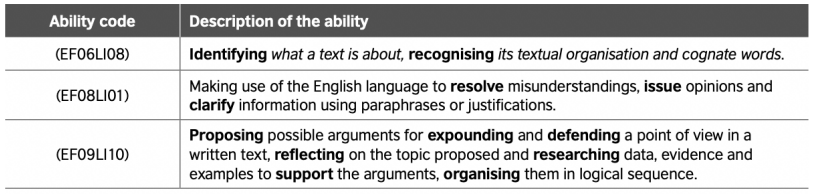
Available at: https://www.britishcouncil.org.br/sites/default/files/leitura_critica_bncc_-_en_-_v4_final.pdf. [Fragment] Accessed on: April 26, 2022.
Cognates are words in two languages that share a similar meaning, spelling, and pronunciation. Researchers who study
first and second language acquisition have found that students benefit from cognate awareness. Cognate awareness is the
ability to use cognates in a primary language as a tool for understanding a second language. To develop the BNCC ability
EF06LI08, which includes recognizing cognate words, an English teacher, when working with a group of beginners, may

Available at: https://newh.org/news/back-to-school/. Accessed on: April 26, 2022.

 Conheça nossos planos