Questões de Concurso Sobre inglês

Foram encontradas 25.701 questões

Q2345007 Inglês
According to Block (1992), there is now no more debate on "whether reading is a bottom-up, languagebased process or a top-down, knowledge-based process." It is also no more problematic to accept the influence of background knowledge on both L1 and L2 readers. Research has gone even further to define the control readers execute on their ability to understand a text.

This control, Block (1992) has referred to as 
Alternativas
Q2345006 Inglês
2023 Theme
Green Skills for Youth: Towards a Sustainable
World


Today, the world is embarking on a green transition. The shift towards an environmentally sustainable and climate-friendly world is critical not only for responding to the global climate crisis but also for achieving the Sustainable Development Goals (SDGs). A successful transition towards a greener world will depend on the development of green skills in the population. Green skills are “knowledge, abilities, values and attitudes needed to live in, develop and support a sustainable and resource-efficient society”. These include technical knowledge and skills that enable the effective use of green technologies and processes in occupational settings, as well as transversal skills that draw on a range of knowledge, values and attitudes to facilitate environmentally sustainable decisions in work and in life. Due to their interdisciplinary nature, the essence of green skills is sometimes expressed, partly if not wholly, through other associated terms such as “skills for the future” and “skills for green jobs”. While green skills are relevant for people of all ages, they have heightened importance for younger people, who can contribute to the green transition for a longer period of time.


https://www.un.org/en/observances/youth-day
The phrase “The shift towards an environmentally sustainable and climate-friendly world” Shift means 
Alternativas
Q2345005 Inglês
2023 Theme
Green Skills for Youth: Towards a Sustainable
World


Today, the world is embarking on a green transition. The shift towards an environmentally sustainable and climate-friendly world is critical not only for responding to the global climate crisis but also for achieving the Sustainable Development Goals (SDGs). A successful transition towards a greener world will depend on the development of green skills in the population. Green skills are “knowledge, abilities, values and attitudes needed to live in, develop and support a sustainable and resource-efficient society”. These include technical knowledge and skills that enable the effective use of green technologies and processes in occupational settings, as well as transversal skills that draw on a range of knowledge, values and attitudes to facilitate environmentally sustainable decisions in work and in life. Due to their interdisciplinary nature, the essence of green skills is sometimes expressed, partly if not wholly, through other associated terms such as “skills for the future” and “skills for green jobs”. While green skills are relevant for people of all ages, they have heightened importance for younger people, who can contribute to the green transition for a longer period of time.


https://www.un.org/en/observances/youth-day
Considering the linguistic elements in the text,
Alternativas
Q2345004 Inglês
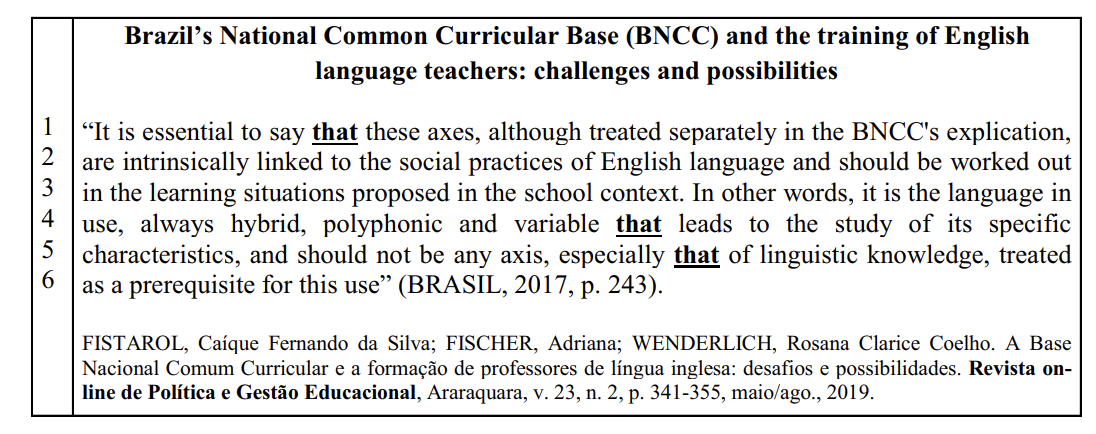
“Conceiving language as a social construction, the subject “interprets”, “reinvents” the meanings in a situated way, creating ways of identifying and expressing ideas, feelings and values. In this sense, a language that materializes in hybrid uses, marked by fluidity and that opens up to the invention of new ways of saying, driven by pluri/multilingual speakers and their multicultural characteristics – the English language becomes a symbolic asset for speakers from all over the world.”
This implication of the National Common Curricular Base concerns (BNCC):
Alternativas
Q2344911 Inglês
Read Text IV and answer the question that follow it 

Text IV


Teaching Reading Strategies


No matter what we are reading there are effective reading strategies we call on in order to make meaning from the text. Many of these strategies can be taught with comics and graphic novels. The ones highlighted below are particularly important when reading graphic texts.


Drawing Inferences


In comics and graphic novels, perhaps more than any other text, readers must build understanding by filling in gaps. A whole world of information is left in the gutter between the panels. The comic artist expects the reader to infer the action that takes place off the page. The more complex and sophisticated the comic, the more important this strategy becomes. If the reader is not making inferences, he is lost. Understanding this strategy and using it effectively will help students read ’between the lines’ in more traditional print narratives.


Visualization


Students who struggle with reading may not understand what should be going on in the reader’s imagination during reading. With comics and other visual texts, the images are there for the reader. Through comics students can be taught how to create their own mental images when reading more traditional texts.

It is important that students understand the visual cues that are provided in the text. Although the words and images work together to tell the story, comics are primarily visual narratives. Therefore readers must draw on and integrate some important background knowledge and understandings about visual texts, comic elements and narrative structures in order to make meaning. The more knowledge readers have about the way visual texts work, the more successful they are likely to be.


Adapted from https://www.literacytoday.ca/home/reading/readingstrategies/reading-visual-texts/reading-comics
In the 3rd paragraph, “Students who struggle” are those who: 
Alternativas
Q2344910 Inglês
Read Text IV and answer the question that follow it 

Text IV


Teaching Reading Strategies


No matter what we are reading there are effective reading strategies we call on in order to make meaning from the text. Many of these strategies can be taught with comics and graphic novels. The ones highlighted below are particularly important when reading graphic texts.


Drawing Inferences


In comics and graphic novels, perhaps more than any other text, readers must build understanding by filling in gaps. A whole world of information is left in the gutter between the panels. The comic artist expects the reader to infer the action that takes place off the page. The more complex and sophisticated the comic, the more important this strategy becomes. If the reader is not making inferences, he is lost. Understanding this strategy and using it effectively will help students read ’between the lines’ in more traditional print narratives.


Visualization


Students who struggle with reading may not understand what should be going on in the reader’s imagination during reading. With comics and other visual texts, the images are there for the reader. Through comics students can be taught how to create their own mental images when reading more traditional texts.

It is important that students understand the visual cues that are provided in the text. Although the words and images work together to tell the story, comics are primarily visual narratives. Therefore readers must draw on and integrate some important background knowledge and understandings about visual texts, comic elements and narrative structures in order to make meaning. The more knowledge readers have about the way visual texts work, the more successful they are likely to be.


Adapted from https://www.literacytoday.ca/home/reading/readingstrategies/reading-visual-texts/reading-comics
The base form, past form, and past participle of the main verb in “he is lost” (2nd paragraph) are: 
Alternativas
Q2344909 Inglês
Read Text IV and answer the question that follow it 

Text IV


Teaching Reading Strategies


No matter what we are reading there are effective reading strategies we call on in order to make meaning from the text. Many of these strategies can be taught with comics and graphic novels. The ones highlighted below are particularly important when reading graphic texts.


Drawing Inferences


In comics and graphic novels, perhaps more than any other text, readers must build understanding by filling in gaps. A whole world of information is left in the gutter between the panels. The comic artist expects the reader to infer the action that takes place off the page. The more complex and sophisticated the comic, the more important this strategy becomes. If the reader is not making inferences, he is lost. Understanding this strategy and using it effectively will help students read ’between the lines’ in more traditional print narratives.


Visualization


Students who struggle with reading may not understand what should be going on in the reader’s imagination during reading. With comics and other visual texts, the images are there for the reader. Through comics students can be taught how to create their own mental images when reading more traditional texts.

It is important that students understand the visual cues that are provided in the text. Although the words and images work together to tell the story, comics are primarily visual narratives. Therefore readers must draw on and integrate some important background knowledge and understandings about visual texts, comic elements and narrative structures in order to make meaning. The more knowledge readers have about the way visual texts work, the more successful they are likely to be.


Adapted from https://www.literacytoday.ca/home/reading/readingstrategies/reading-visual-texts/reading-comics
The excerpt “If the reader is not making inferences” (2nd paragraph) presents a(n): 
Alternativas
Q2344908 Inglês
Read Text IV and answer the question that follow it 

Text IV


Teaching Reading Strategies


No matter what we are reading there are effective reading strategies we call on in order to make meaning from the text. Many of these strategies can be taught with comics and graphic novels. The ones highlighted below are particularly important when reading graphic texts.


Drawing Inferences


In comics and graphic novels, perhaps more than any other text, readers must build understanding by filling in gaps. A whole world of information is left in the gutter between the panels. The comic artist expects the reader to infer the action that takes place off the page. The more complex and sophisticated the comic, the more important this strategy becomes. If the reader is not making inferences, he is lost. Understanding this strategy and using it effectively will help students read ’between the lines’ in more traditional print narratives.


Visualization


Students who struggle with reading may not understand what should be going on in the reader’s imagination during reading. With comics and other visual texts, the images are there for the reader. Through comics students can be taught how to create their own mental images when reading more traditional texts.

It is important that students understand the visual cues that are provided in the text. Although the words and images work together to tell the story, comics are primarily visual narratives. Therefore readers must draw on and integrate some important background knowledge and understandings about visual texts, comic elements and narrative structures in order to make meaning. The more knowledge readers have about the way visual texts work, the more successful they are likely to be.


Adapted from https://www.literacytoday.ca/home/reading/readingstrategies/reading-visual-texts/reading-comics
The structure of the sentence “The more complex and sophisticated the comic, the more important this strategy becomes” (2nd paragraph) shows a:
Alternativas
Q2344907 Inglês
Read Text IV and answer the question that follow it 

Text IV


Teaching Reading Strategies


No matter what we are reading there are effective reading strategies we call on in order to make meaning from the text. Many of these strategies can be taught with comics and graphic novels. The ones highlighted below are particularly important when reading graphic texts.


Drawing Inferences


In comics and graphic novels, perhaps more than any other text, readers must build understanding by filling in gaps. A whole world of information is left in the gutter between the panels. The comic artist expects the reader to infer the action that takes place off the page. The more complex and sophisticated the comic, the more important this strategy becomes. If the reader is not making inferences, he is lost. Understanding this strategy and using it effectively will help students read ’between the lines’ in more traditional print narratives.


Visualization


Students who struggle with reading may not understand what should be going on in the reader’s imagination during reading. With comics and other visual texts, the images are there for the reader. Through comics students can be taught how to create their own mental images when reading more traditional texts.

It is important that students understand the visual cues that are provided in the text. Although the words and images work together to tell the story, comics are primarily visual narratives. Therefore readers must draw on and integrate some important background knowledge and understandings about visual texts, comic elements and narrative structures in order to make meaning. The more knowledge readers have about the way visual texts work, the more successful they are likely to be.


Adapted from https://www.literacytoday.ca/home/reading/readingstrategies/reading-visual-texts/reading-comics
When an action “takes place” (2nd paragraph), it:
Alternativas
Q2344906 Inglês
Read Text IV and answer the question that follow it 

Text IV


Teaching Reading Strategies


No matter what we are reading there are effective reading strategies we call on in order to make meaning from the text. Many of these strategies can be taught with comics and graphic novels. The ones highlighted below are particularly important when reading graphic texts.


Drawing Inferences


In comics and graphic novels, perhaps more than any other text, readers must build understanding by filling in gaps. A whole world of information is left in the gutter between the panels. The comic artist expects the reader to infer the action that takes place off the page. The more complex and sophisticated the comic, the more important this strategy becomes. If the reader is not making inferences, he is lost. Understanding this strategy and using it effectively will help students read ’between the lines’ in more traditional print narratives.


Visualization


Students who struggle with reading may not understand what should be going on in the reader’s imagination during reading. With comics and other visual texts, the images are there for the reader. Through comics students can be taught how to create their own mental images when reading more traditional texts.

It is important that students understand the visual cues that are provided in the text. Although the words and images work together to tell the story, comics are primarily visual narratives. Therefore readers must draw on and integrate some important background knowledge and understandings about visual texts, comic elements and narrative structures in order to make meaning. The more knowledge readers have about the way visual texts work, the more successful they are likely to be.


Adapted from https://www.literacytoday.ca/home/reading/readingstrategies/reading-visual-texts/reading-comics
In the excerpt “readers must build ”(2nd paragraph) one can infer a:
Alternativas
Q2344905 Inglês
Read Text IV and answer the question that follow it 

Text IV


Teaching Reading Strategies


No matter what we are reading there are effective reading strategies we call on in order to make meaning from the text. Many of these strategies can be taught with comics and graphic novels. The ones highlighted below are particularly important when reading graphic texts.


Drawing Inferences


In comics and graphic novels, perhaps more than any other text, readers must build understanding by filling in gaps. A whole world of information is left in the gutter between the panels. The comic artist expects the reader to infer the action that takes place off the page. The more complex and sophisticated the comic, the more important this strategy becomes. If the reader is not making inferences, he is lost. Understanding this strategy and using it effectively will help students read ’between the lines’ in more traditional print narratives.


Visualization


Students who struggle with reading may not understand what should be going on in the reader’s imagination during reading. With comics and other visual texts, the images are there for the reader. Through comics students can be taught how to create their own mental images when reading more traditional texts.

It is important that students understand the visual cues that are provided in the text. Although the words and images work together to tell the story, comics are primarily visual narratives. Therefore readers must draw on and integrate some important background knowledge and understandings about visual texts, comic elements and narrative structures in order to make meaning. The more knowledge readers have about the way visual texts work, the more successful they are likely to be.


Adapted from https://www.literacytoday.ca/home/reading/readingstrategies/reading-visual-texts/reading-comics
The opposite of “below” (1st paragraph) is:
Alternativas
Q2344904 Inglês
Read Text IV and answer the question that follow it 

Text IV


Teaching Reading Strategies


No matter what we are reading there are effective reading strategies we call on in order to make meaning from the text. Many of these strategies can be taught with comics and graphic novels. The ones highlighted below are particularly important when reading graphic texts.


Drawing Inferences


In comics and graphic novels, perhaps more than any other text, readers must build understanding by filling in gaps. A whole world of information is left in the gutter between the panels. The comic artist expects the reader to infer the action that takes place off the page. The more complex and sophisticated the comic, the more important this strategy becomes. If the reader is not making inferences, he is lost. Understanding this strategy and using it effectively will help students read ’between the lines’ in more traditional print narratives.


Visualization


Students who struggle with reading may not understand what should be going on in the reader’s imagination during reading. With comics and other visual texts, the images are there for the reader. Through comics students can be taught how to create their own mental images when reading more traditional texts.

It is important that students understand the visual cues that are provided in the text. Although the words and images work together to tell the story, comics are primarily visual narratives. Therefore readers must draw on and integrate some important background knowledge and understandings about visual texts, comic elements and narrative structures in order to make meaning. The more knowledge readers have about the way visual texts work, the more successful they are likely to be.


Adapted from https://www.literacytoday.ca/home/reading/readingstrategies/reading-visual-texts/reading-comics
The pronoun in “The ones highlighted” (1st paragraph) refers to: 
Alternativas
Q2344903 Inglês
Read Text IV and answer the question that follow it 

Text IV


Teaching Reading Strategies


No matter what we are reading there are effective reading strategies we call on in order to make meaning from the text. Many of these strategies can be taught with comics and graphic novels. The ones highlighted below are particularly important when reading graphic texts.


Drawing Inferences


In comics and graphic novels, perhaps more than any other text, readers must build understanding by filling in gaps. A whole world of information is left in the gutter between the panels. The comic artist expects the reader to infer the action that takes place off the page. The more complex and sophisticated the comic, the more important this strategy becomes. If the reader is not making inferences, he is lost. Understanding this strategy and using it effectively will help students read ’between the lines’ in more traditional print narratives.


Visualization


Students who struggle with reading may not understand what should be going on in the reader’s imagination during reading. With comics and other visual texts, the images are there for the reader. Through comics students can be taught how to create their own mental images when reading more traditional texts.

It is important that students understand the visual cues that are provided in the text. Although the words and images work together to tell the story, comics are primarily visual narratives. Therefore readers must draw on and integrate some important background knowledge and understandings about visual texts, comic elements and narrative structures in order to make meaning. The more knowledge readers have about the way visual texts work, the more successful they are likely to be.


Adapted from https://www.literacytoday.ca/home/reading/readingstrategies/reading-visual-texts/reading-comics
“No matter” in “No matter what we are reading” can be replaced without change in meaning by: 
Alternativas
Q2344902 Inglês
Read Text IV and answer the question that follow it 

Text IV


Teaching Reading Strategies


No matter what we are reading there are effective reading strategies we call on in order to make meaning from the text. Many of these strategies can be taught with comics and graphic novels. The ones highlighted below are particularly important when reading graphic texts.


Drawing Inferences


In comics and graphic novels, perhaps more than any other text, readers must build understanding by filling in gaps. A whole world of information is left in the gutter between the panels. The comic artist expects the reader to infer the action that takes place off the page. The more complex and sophisticated the comic, the more important this strategy becomes. If the reader is not making inferences, he is lost. Understanding this strategy and using it effectively will help students read ’between the lines’ in more traditional print narratives.


Visualization


Students who struggle with reading may not understand what should be going on in the reader’s imagination during reading. With comics and other visual texts, the images are there for the reader. Through comics students can be taught how to create their own mental images when reading more traditional texts.

It is important that students understand the visual cues that are provided in the text. Although the words and images work together to tell the story, comics are primarily visual narratives. Therefore readers must draw on and integrate some important background knowledge and understandings about visual texts, comic elements and narrative structures in order to make meaning. The more knowledge readers have about the way visual texts work, the more successful they are likely to be.


Adapted from https://www.literacytoday.ca/home/reading/readingstrategies/reading-visual-texts/reading-comics
Based on the text, mark the statements below as TRUE (T) or FALSE (F).

( ) This text aims at helping teachers improve their practice.
( ) When reading comics, one should read only the words written on the page.
( ) Visual cues are irrelevant when teaching reading to students.

The statements are, respectively: 
Alternativas
Q2344901 Inglês
Read Text III and answer the question that follow it 


Text III


From: https://peanuts.fandom.com/wiki/January_1994_comic_strips

The word “still” in the third panel is a(n):
Alternativas
Q2344900 Inglês
Read Text III and answer the question that follow it 


Text III


From: https://peanuts.fandom.com/wiki/January_1994_comic_strips

In the second panel “In spite of” may be replaced by: 
Alternativas
Q2344899 Inglês
Read Text III and answer the question that follow it 


Text III


From: https://peanuts.fandom.com/wiki/January_1994_comic_strips

The word “finally” in the first panel is equivalent in meaning to: 
Alternativas
Q2344898 Inglês
Read Text III and answer the question that follow it 


Text III


From: https://peanuts.fandom.com/wiki/January_1994_comic_strips

The verb tense in the first panel is the: 
Alternativas
Q2344897 Inglês
Read Text III and answer the question that follow it 


Text III


From: https://peanuts.fandom.com/wiki/January_1994_comic_strips

In the second panel, Snoopy is:
Alternativas
Q2344896 Inglês
Read Text III and answer the question that follow it 


Text III


From: https://peanuts.fandom.com/wiki/January_1994_comic_strips

In this comic strip, Snoopy is busy writing a(n):
Alternativas
Respostas
10561: D
10562: A
10563: B
10564: C
10565: C
10566: B
10567: C
10568: E
10569: B
10570: D
10571: A
10572: E
10573: C
10574: B
10575: D
10576: A
10577: E
10578: B
10579: E
10580: A