Questões de Concurso Sobre inglês
Foram encontradas 25.994 questões


Ano: 2026
Banca:
FUNDATEC
Órgão:
Prefeitura de Bento Gonçalves - RS
Prova:
FUNDATEC - 2026 - Prefeitura de Bento Gonçalves - RS - Professor Área II Inglês |
Q4186203
Inglês
Texto associado
California is Free of Drought for The First Time in 25 Years
By Clara Harter
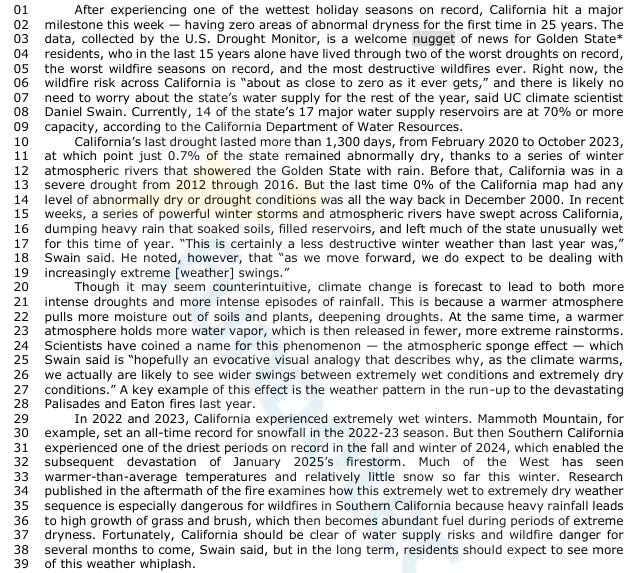
*California can be referred to as “The Golden State”.
(Available at: https://www.latimes.com/california/story/2026-01-09/california-has-no-areas-of-dryness-first- time-in-25-years – text specially adapted for this test).
Analyze the statements below about the text and mark T, if true, or F, if false.
( ) 2025’s holiday season was when there was the most rain in California’s records.
( ) From all the droughts California has faced, two of the worst ever recorded happened in the last 15 years.
( ) It has been 15 years since the most destructive wildfire has ever hit California.
( ) Only three of California’s water supply reservoirs are below 70% of their capacity.
The correct order of filling in the parentheses, from top to bottom, is:
( ) 2025’s holiday season was when there was the most rain in California’s records.
( ) From all the droughts California has faced, two of the worst ever recorded happened in the last 15 years.
( ) It has been 15 years since the most destructive wildfire has ever hit California.
( ) Only three of California’s water supply reservoirs are below 70% of their capacity.
The correct order of filling in the parentheses, from top to bottom, is:
Ano: 2026
Banca:
FUNDATEC
Órgão:
Prefeitura de Bento Gonçalves - RS
Prova:
FUNDATEC - 2026 - Prefeitura de Bento Gonçalves - RS - Professor Área II Inglês |
Q4186202
Inglês
Texto associado
California is Free of Drought for The First Time in 25 Years
By Clara Harter
*California can be referred to as “The Golden State”.
(Available at: https://www.latimes.com/california/story/2026-01-09/california-has-no-areas-of-dryness-first- time-in-25-years – text specially adapted for this test).
What is the atmospheric sponge effect mentioned in the article?
Ano: 2026
Banca:
OBJETIVA
Órgão:
Prefeitura de Tupanci do Sul - RS
Prova:
OBJETIVA - 2026 - Prefeitura de Tupanci do Sul - RS - Professor Ensino Fundamental Anos Finais Língua Inglesa |
Q4185984
Inglês
Which item below is NOT classified as a concrete noun?
Ano: 2026
Banca:
OBJETIVA
Órgão:
Prefeitura de Tupanci do Sul - RS
Prova:
OBJETIVA - 2026 - Prefeitura de Tupanci do Sul - RS - Professor Ensino Fundamental Anos Finais Língua Inglesa |
Q4185983
Inglês
Which word below is a compound word?
Ano: 2026
Banca:
OBJETIVA
Órgão:
Prefeitura de Tupanci do Sul - RS
Prova:
OBJETIVA - 2026 - Prefeitura de Tupanci do Sul - RS - Professor Ensino Fundamental Anos Finais Língua Inglesa |
Q4185982
Inglês
Mark the item that CORRECTLY fills in the blank below.
I managed to download the song __________.
Ano: 2026
Banca:
OBJETIVA
Órgão:
Prefeitura de Tupanci do Sul - RS
Prova:
OBJETIVA - 2026 - Prefeitura de Tupanci do Sul - RS - Professor Ensino Fundamental Anos Finais Língua Inglesa |
Q4185981
Inglês
Texto associado
Sappho was a Greek lyric poet greatly admired in all ages for the beauty of her writing style and for her ability to impress readers with a lively sense of her personality. Her language contains elements from Aeolic vernacular speech and Aeolic poetic tradition, with traces of epic vocabulary familiar to readers of Homer. Her phrasing is concise, direct, and picturesque.
Many legends about her have been repeated for centuries. She is said, for example, to have been married to Cercylas, a wealthy man from the island of Andros. But many scholars challenge this claim. Most modern critics also consider it legend that Sappho leaped from the Leucadian rock to certain death in the sea because of her unrequited love of Phaon, a younger man and a sailor. She had at least two brothers, Larichus and Charaxus, and may have had a third. A fragment from Sappho that is dedicated to Charaxus has survived. One of her poems mentions a daughter named Cleis or Claïs. The tradition that she fled the island or was banished and went to Sicily may be true, but she lived most of her life in her hometown of Mytilene on Lesbos. Her work contains only a few apparent allusions to the political disturbances of the time.
Source: Britannica. Adaptation.
Mark the item that displays the CORRECT translation for
the text below.
Many legends about her have been repeated for centuries. She is said, for example, to have been married to Cercylas, a wealthy man from the island of Andros.
Many legends about her have been repeated for centuries. She is said, for example, to have been married to Cercylas, a wealthy man from the island of Andros.
Ano: 2026
Banca:
OBJETIVA
Órgão:
Prefeitura de Tupanci do Sul - RS
Prova:
OBJETIVA - 2026 - Prefeitura de Tupanci do Sul - RS - Professor Ensino Fundamental Anos Finais Língua Inglesa |
Q4185980
Inglês
Texto associado
Sappho was a Greek lyric poet greatly admired in all ages for the beauty of her writing style and for her ability to impress readers with a lively sense of her personality. Her language contains elements from Aeolic vernacular speech and Aeolic poetic tradition, with traces of epic vocabulary familiar to readers of Homer. Her phrasing is concise, direct, and picturesque.
Many legends about her have been repeated for centuries. She is said, for example, to have been married to Cercylas, a wealthy man from the island of Andros. But many scholars challenge this claim. Most modern critics also consider it legend that Sappho leaped from the Leucadian rock to certain death in the sea because of her unrequited love of Phaon, a younger man and a sailor. She had at least two brothers, Larichus and Charaxus, and may have had a third. A fragment from Sappho that is dedicated to Charaxus has survived. One of her poems mentions a daughter named Cleis or Claïs. The tradition that she fled the island or was banished and went to Sicily may be true, but she lived most of her life in her hometown of Mytilene on Lesbos. Her work contains only a few apparent allusions to the political disturbances of the time.
Source: Britannica. Adaptation.
Which pair of words below can directly replace the
underlined words in the 2nd paragraph of the text, in the
same order, without changing their meaning?
Ano: 2026
Banca:
OBJETIVA
Órgão:
Prefeitura de Tupanci do Sul - RS
Prova:
OBJETIVA - 2026 - Prefeitura de Tupanci do Sul - RS - Professor Ensino Fundamental Anos Finais Língua Inglesa |
Q4185979
Inglês
Texto associado
Sappho was a Greek lyric poet greatly admired in all ages for the beauty of her writing style and for her ability to impress readers with a lively sense of her personality. Her language contains elements from Aeolic vernacular speech and Aeolic poetic tradition, with traces of epic vocabulary familiar to readers of Homer. Her phrasing is concise, direct, and picturesque.
Many legends about her have been repeated for centuries. She is said, for example, to have been married to Cercylas, a wealthy man from the island of Andros. But many scholars challenge this claim. Most modern critics also consider it legend that Sappho leaped from the Leucadian rock to certain death in the sea because of her unrequited love of Phaon, a younger man and a sailor. She had at least two brothers, Larichus and Charaxus, and may have had a third. A fragment from Sappho that is dedicated to Charaxus has survived. One of her poems mentions a daughter named Cleis or Claïs. The tradition that she fled the island or was banished and went to Sicily may be true, but she lived most of her life in her hometown of Mytilene on Lesbos. Her work contains only a few apparent allusions to the political disturbances of the time.
Source: Britannica. Adaptation.
The words underlined in the 1st paragraph are classified,
in order, as:
Ano: 2026
Banca:
OBJETIVA
Órgão:
Prefeitura de Tupanci do Sul - RS
Prova:
OBJETIVA - 2026 - Prefeitura de Tupanci do Sul - RS - Professor Ensino Fundamental Anos Finais Língua Inglesa |
Q4185978
Inglês
Texto associado
Sappho was a Greek lyric poet greatly admired in all ages for the beauty of her writing style and for her ability to impress readers with a lively sense of her personality. Her language contains elements from Aeolic vernacular speech and Aeolic poetic tradition, with traces of epic vocabulary familiar to readers of Homer. Her phrasing is concise, direct, and picturesque.
Many legends about her have been repeated for centuries. She is said, for example, to have been married to Cercylas, a wealthy man from the island of Andros. But many scholars challenge this claim. Most modern critics also consider it legend that Sappho leaped from the Leucadian rock to certain death in the sea because of her unrequited love of Phaon, a younger man and a sailor. She had at least two brothers, Larichus and Charaxus, and may have had a third. A fragment from Sappho that is dedicated to Charaxus has survived. One of her poems mentions a daughter named Cleis or Claïs. The tradition that she fled the island or was banished and went to Sicily may be true, but she lived most of her life in her hometown of Mytilene on Lesbos. Her work contains only a few apparent allusions to the political disturbances of the time.
Source: Britannica. Adaptation.
According to the text, mark the INCORRECT item.
Ano: 2026
Banca:
Grupo TALENT
Órgão:
Prefeitura de Junqueirópolis - SP
Prova:
Grupo TALENT - 2026 - Prefeitura de Junqueirópolis - SP - Professor da Educação Básica II - Professor de Inglês |
Q4183487
Inglês
Complete the sentence below with the correct relative
pronouns: "The active methodology ________ we
discussed in the pedagogical meeting yesterday is highly
effective for teenagers ________ motivation is low."
Ano: 2026
Banca:
Grupo TALENT
Órgão:
Prefeitura de Junqueirópolis - SP
Prova:
Grupo TALENT - 2026 - Prefeitura de Junqueirópolis - SP - Professor da Educação Básica II - Professor de Inglês |
Q4183486
Inglês
Identify the correct structure for a Third Conditional
sentence, which is often used to express regrets about
the past:
Ano: 2026
Banca:
Grupo TALENT
Órgão:
Prefeitura de Junqueirópolis - SP
Prova:
Grupo TALENT - 2026 - Prefeitura de Junqueirópolis - SP - Professor da Educação Básica II - Professor de Inglês |
Q4183484
Inglês
Um professor orienta seus alunos do 9º ano a lerem
rapidamente um texto em inglês apenas para extrair a
"ideia principal" (o assunto geral), sem se deterem em
palavras desconhecidas ou detalhes específicos. Essa
estratégia de leitura é tecnicamente conhecida como:
Ano: 2026
Banca:
Grupo TALENT
Órgão:
Prefeitura de Junqueirópolis - SP
Prova:
Grupo TALENT - 2026 - Prefeitura de Junqueirópolis - SP - Professor da Educação Básica II - Professor de Inglês |
Q4183483
Inglês
De acordo com as diretrizes atuais para o ensino de
Língua Inglesa na Educação Básica brasileira (como a
BNCC), o idioma deve ser concebido e ensinado como:
Ano: 2026
Banca:
Grupo TALENT
Órgão:
Prefeitura de Junqueirópolis - SP
Prova:
Grupo TALENT - 2026 - Prefeitura de Junqueirópolis - SP - Professor da Educação Básica II - Professor de Inglês |
Q4183481
Inglês
In the sentence "________ the lack of technological
resources in the classroom, the teacher managed to
deliver an engaging and interactive lesson," the blank
can be correctly filled with the connective:
Ano: 2026
Banca:
Grupo TALENT
Órgão:
Prefeitura de Junqueirópolis - SP
Prova:
Grupo TALENT - 2026 - Prefeitura de Junqueirópolis - SP - Professor da Educação Básica II - Professor de Inglês |
Q4183480
Inglês
Fill in the blanks appropriately to make the sentence
grammatically correct: "She is _____ excellent
educator who always cares _____ _____ students'
emotional well-being."
Ano: 2026
Banca:
Grupo TALENT
Órgão:
Prefeitura de Junqueirópolis - SP
Prova:
Grupo TALENT - 2026 - Prefeitura de Junqueirópolis - SP - Professor da Educação Básica II - Professor de Inglês |
Q4183479
Inglês
Choose the alternative that correctly completes the
sentence below, respecting the sequence of tenses: "I
__________ in this public school since 2015, but before
that, I __________ at a private language institute for
three years."
Ano: 2026
Banca:
Grupo TALENT
Órgão:
Prefeitura de Junqueirópolis - SP
Prova:
Grupo TALENT - 2026 - Prefeitura de Junqueirópolis - SP - Professor da Educação Básica II - Professor de Inglês |
Q4183478
Inglês
Read the sentence below extracted from an
educational article: "The principal's comprehensive
policy helped to ameliorate the students' behavior and
academic performance." In this context, the word
comprehensive may be confused with the Portuguese
word "compreensivo". However, its actual meaning
in the sentence is closest to:
Ano: 2026
Banca:
Instituto IACP
Órgão:
Prefeitura de Colônia Leopoldina - AL
Prova:
Instituto IACP - 2026 - Prefeitura de Colônia Leopoldina - AL - Professor de Língua Inglesa |
Q4176298
Inglês
Consider the following statements about sentence
structure and discourse organization in English language
analysis.
I. Cleft sentences may foreground specific constituents for discourse emphasis;
II. Direct speech representation frequently preserves original utterance structure;
III. Active voice systematically suppresses the semantic role of the agent;
IV. Negation scope may vary according to syntactic positioning in clauses;
V. Conditional structures exclusively express hypothetical future situations.
Choose the correct alternative:
I. Cleft sentences may foreground specific constituents for discourse emphasis;
II. Direct speech representation frequently preserves original utterance structure;
III. Active voice systematically suppresses the semantic role of the agent;
IV. Negation scope may vary according to syntactic positioning in clauses;
V. Conditional structures exclusively express hypothetical future situations.
Choose the correct alternative:
Ano: 2026
Banca:
Instituto IACP
Órgão:
Prefeitura de Colônia Leopoldina - AL
Prova:
Instituto IACP - 2026 - Prefeitura de Colônia Leopoldina - AL - Professor de Língua Inglesa |
Q4176297
Inglês
In communicative interaction, modality may reveal
speaker attitude, interpersonal positioning, and degrees
of certainty during spoken or written production. Teachers frequently examine modal structures to explore how
meanings are negotiated according to context and communicative intention. Considering modality in English
grammar and discourse, identify the correct statement:
Ano: 2026
Banca:
Instituto IACP
Órgão:
Prefeitura de Colônia Leopoldina - AL
Prova:
Instituto IACP - 2026 - Prefeitura de Colônia Leopoldina - AL - Professor de Língua Inglesa |
Q4176296
Inglês
In sentence organization, subordinate clauses may establish semantic dependency and contribute to textual articulation in formal and informal discourse. Teachers frequently analyze how clause relations affect coherence,
emphasis, and logical progression in written communication. Considering adverbial clauses in English syntax,
identify the correct statement:

 Conheça nossos planos