Questões de Concurso Sobre inglês
Foram encontradas 26.001 questões


Based on the previous text, judge the following item.
In the fourth paragraph, it can be inferred from the expressions ‘flexing muscle and testosterone’ and ‘win at all costs’ that, for Mohammed, the male dominance in political representation evokes an attitude of aggressiveness, strength, and competition.
Based on the previous text, judge the following item.
In the fragment ‘And what we bring to the table is incredibly important and it’s missing’ (second sentence of the second paragraph), the pronoun ‘we’ refers specifically to the women that are part of decision-making tables.
Based on the previous text, judge the following item.
It is correct to conclude from the linguistic aspects and the meanings of the third paragraph of the text that the phrase “women remain relegated to the margins of power” (second sentence) is in the passive voice.
Based on the previous text, judge the following item.
Amina Mohammed believes that women’s absence from decision-making roles is the only reason global development remains stagnant.
The word "synesthesia" has Greek roots. It translates to “perceive together.” Synesthesia isn’t a disease or disorder. It won’t harm your health, and it doesn’t mean you’re mentally ill. Some studies suggest people who have it may do better on memory and intelligence tests than those who don’t.
One of the most common responses is to see letters, numbers, or sounds as colors. You might also see or hear a word and taste food; hear sounds and see shapes or patterns; feel a touch when seeing someone else being touched. (This is called mirror touch.)
It can be an annoyance. But most synesthetes see their condition as a sixth sense, not a drawback.
You can’t control it. The response happens right away. For example, if you hear a new piece of music, you may see a color or taste a flavor without any effort. It just happens.
It’s internal, mostly. The colors are just in your mind.
It stays the same over time. If you see the letter "A" in green today, you’ll see it in green 10 years from now.
It often starts in childhood. Studies of kids with synesthesia found that it develops over time.
webmd.com. December 17, 2024. Adaptado.
De acordo com o texto apresentado, a sinestesia pode ser descrita como
Scientists have found that generally the world feels brighter when you wake up.
People start the day in the best frame of mind in the morning, but end in the worst, at about midnight, the findings suggest, with the day of the week and the season also playing a part.
Mental health also tends to be more varied at weekends but steadier during the week, according to the study led by University College London.
“Generally, things do seem better in the morning,” the researchers concluded.
Mental health and wellbeing are dynamic in nature, and subject to change over short and long periods. However, few studies have looked at how they might change over the course of the day.
Scientists wanted to explore whether time of day was associated with variations in mental health, happiness, life satisfaction, sense of life being worthwhile and loneliness.
People in the study answered questionnaires, with questions such as: “In the past week, how happy did you feel?”, “How satisfied have you been with your life?”, and “To what extent have you felt the things you are doing in your life are worthwhile?”
Factors such as age, health conditions and whether people worked were taken into account.
The results showed that happiness, life satisfaction, and worthwhile ratings were all higher on Mondays and Fridays than on Sundays, while happiness was also higher on Tuesdays. There was no evidence that loneliness differed across days of the week.
There was clear evidence of a seasonal influence on mood. Compared with winter, people tended to have lower levels of depressive and anxiety symptoms and loneliness, and higher levels of happiness, and feeling that life was worthwhile in the three other seasons.
Mental health was best in the summer across all outcomes. But the season didn’t affect the associations observed across the day, however.
This was an observational study, so it cannot establish cause.
The Guardian.com. February 5, 2025. Adaptado.
Scientists have found that generally the world feels brighter when you wake up.
People start the day in the best frame of mind in the morning, but end in the worst, at about midnight, the findings suggest, with the day of the week and the season also playing a part.
Mental health also tends to be more varied at weekends but steadier during the week, according to the study led by University College London.
“Generally, things do seem better in the morning,” the researchers concluded.
Mental health and wellbeing are dynamic in nature, and subject to change over short and long periods. However, few studies have looked at how they might change over the course of the day.
Scientists wanted to explore whether time of day was associated with variations in mental health, happiness, life satisfaction, sense of life being worthwhile and loneliness.
People in the study answered questionnaires, with questions such as: “In the past week, how happy did you feel?”, “How satisfied have you been with your life?”, and “To what extent have you felt the things you are doing in your life are worthwhile?”
Factors such as age, health conditions and whether people worked were taken into account.
The results showed that happiness, life satisfaction, and worthwhile ratings were all higher on Mondays and Fridays than on Sundays, while happiness was also higher on Tuesdays. There was no evidence that loneliness differed across days of the week.
There was clear evidence of a seasonal influence on mood. Compared with winter, people tended to have lower levels of depressive and anxiety symptoms and loneliness, and higher levels of happiness, and feeling that life was worthwhile in the three other seasons.
Mental health was best in the summer across all outcomes. But the season didn’t affect the associations observed across the day, however.
This was an observational study, so it cannot establish cause.
The Guardian.com. February 5, 2025. Adaptado.
Read the short dialogue below and answer the question:
A:Did you finish the report?
B:I tried, but it wasn't easy. I asked Mark, but he didn't know much about it either.
A:Did he at least send you the files?
B:No. Said he'd do it later.
Which of the following best explains a cohesive mechanism used in this dialogue?
Complete the sentence below with the most appropriate prepositions:
"The professor insisted___the importance of clarity___academic writing and advised students to reflect___their feedback before submitting the final version."
Choose the alternative that correctly and respectively completes the sentence above.
O texto seguinte servirá de base para responder à questão.
DODGER DILEMMA
Jammie Dodgers unveils new flavour with an 'exotic twist'... and fans are divided
Biscuit lovers had mixed reactions upon learning there was a new Mango and Passionfruit flavour available to buy at supermarkets.
The 140g packet of biccies is 90p at Sainsbury's and just one of a range of new flavours of the iconic brand.
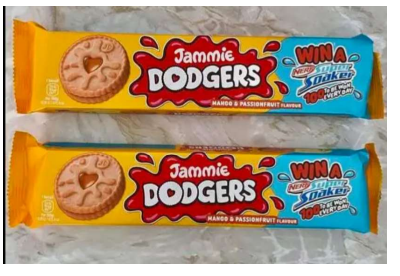
The flavour is mango and passionfruit. Credit: Facebook
A photo of the mango and passionfruit Jammie Dodgers was shared to the Newfoods UK social media pages where reactions where mixed.
"Wish they would just stick to original!!!! More jam!!!!!!!!" wrote one person.
Another added: "Oh yum."
A third commented: "Tasteless."
And a fourth reacted: "We need to get these."
A spokesperson for Fox Burton's which makes Jammie Dodgers said they expect the new flavours to fly off the shelf.
"We are very excited about these new flavours and expect them to do well in market," the spokesperson told The Sun.
Another of the unique flavours available at supermarkets is cherry, apple and blackcurrant, and strawberry Jammie Dodgers.
Last year, the brand raised eyebrows when shoppers found a re-released banana version of Jammie Dodgers.
The banana flavouring replaces the classic jam filling that Brits have grown to love over the years.
The yellow-flavoured biscuits were first launched in the UK in July 2022 inspired by the Minions film, The Rise of Gru.
It was not the first new flavour the biscuit company has tried - other tempting flavours have been launched such as cherry and apple.
https://www.thesun.co.uk/money/35361009/jammie-dodgers-unveils-new-flavour-exotic-twist/
O texto seguinte servirá de base para responder à questão.
DODGER DILEMMA
Jammie Dodgers unveils new flavour with an 'exotic twist'... and fans are divided
Biscuit lovers had mixed reactions upon learning there was a new Mango and Passionfruit flavour available to buy at supermarkets.
The 140g packet of biccies is 90p at Sainsbury's and just one of a range of new flavours of the iconic brand.
The flavour is mango and passionfruit. Credit: Facebook
A photo of the mango and passionfruit Jammie Dodgers was shared to the Newfoods UK social media pages where reactions where mixed.
"Wish they would just stick to original!!!! More jam!!!!!!!!" wrote one person.
Another added: "Oh yum."
A third commented: "Tasteless."
And a fourth reacted: "We need to get these."
A spokesperson for Fox Burton's which makes Jammie Dodgers said they expect the new flavours to fly off the shelf.
"We are very excited about these new flavours and expect them to do well in market," the spokesperson told The Sun.
Another of the unique flavours available at supermarkets is cherry, apple and blackcurrant, and strawberry Jammie Dodgers.
Last year, the brand raised eyebrows when shoppers found a re-released banana version of Jammie Dodgers.
The banana flavouring replaces the classic jam filling that Brits have grown to love over the years.
The yellow-flavoured biscuits were first launched in the UK in July 2022 inspired by the Minions film, The Rise of Gru.
It was not the first new flavour the biscuit company has tried - other tempting flavours have been launched such as cherry and apple.
https://www.thesun.co.uk/money/35361009/jammie-dodgers-unveils-new-flavour-exotic-twist/
O texto seguinte servirá de base para responder à questão.
DODGER DILEMMA
Jammie Dodgers unveils new flavour with an 'exotic twist'... and fans are divided
Biscuit lovers had mixed reactions upon learning there was a new Mango and Passionfruit flavour available to buy at supermarkets.
The 140g packet of biccies is 90p at Sainsbury's and just one of a range of new flavours of the iconic brand.
The flavour is mango and passionfruit. Credit: Facebook
A photo of the mango and passionfruit Jammie Dodgers was shared to the Newfoods UK social media pages where reactions where mixed.
"Wish they would just stick to original!!!! More jam!!!!!!!!" wrote one person.
Another added: "Oh yum."
A third commented: "Tasteless."
And a fourth reacted: "We need to get these."
A spokesperson for Fox Burton's which makes Jammie Dodgers said they expect the new flavours to fly off the shelf.
"We are very excited about these new flavours and expect them to do well in market," the spokesperson told The Sun.
Another of the unique flavours available at supermarkets is cherry, apple and blackcurrant, and strawberry Jammie Dodgers.
Last year, the brand raised eyebrows when shoppers found a re-released banana version of Jammie Dodgers.
The banana flavouring replaces the classic jam filling that Brits have grown to love over the years.
The yellow-flavoured biscuits were first launched in the UK in July 2022 inspired by the Minions film, The Rise of Gru.
It was not the first new flavour the biscuit company has tried - other tempting flavours have been launched such as cherry and apple.
https://www.thesun.co.uk/money/35361009/jammie-dodgers-unveils-new-flavour-exotic-twist/
O texto seguinte servirá de base para responder à questão.
DODGER DILEMMA
Jammie Dodgers unveils new flavour with an 'exotic twist'... and fans are divided
Biscuit lovers had mixed reactions upon learning there was a new Mango and Passionfruit flavour available to buy at supermarkets.
The 140g packet of biccies is 90p at Sainsbury's and just one of a range of new flavours of the iconic brand.
The flavour is mango and passionfruit. Credit: Facebook
A photo of the mango and passionfruit Jammie Dodgers was shared to the Newfoods UK social media pages where reactions where mixed.
"Wish they would just stick to original!!!! More jam!!!!!!!!" wrote one person.
Another added: "Oh yum."
A third commented: "Tasteless."
And a fourth reacted: "We need to get these."
A spokesperson for Fox Burton's which makes Jammie Dodgers said they expect the new flavours to fly off the shelf.
"We are very excited about these new flavours and expect them to do well in market," the spokesperson told The Sun.
Another of the unique flavours available at supermarkets is cherry, apple and blackcurrant, and strawberry Jammie Dodgers.
Last year, the brand raised eyebrows when shoppers found a re-released banana version of Jammie Dodgers.
The banana flavouring replaces the classic jam filling that Brits have grown to love over the years.
The yellow-flavoured biscuits were first launched in the UK in July 2022 inspired by the Minions film, The Rise of Gru.
It was not the first new flavour the biscuit company has tried - other tempting flavours have been launched such as cherry and apple.
https://www.thesun.co.uk/money/35361009/jammie-dodgers-unveils-new-flavour-exotic-twist/
O texto seguinte servirá de base para responder à questão.
DODGER DILEMMA
Jammie Dodgers unveils new flavour with an 'exotic twist'... and fans are divided
Biscuit lovers had mixed reactions upon learning there was a new Mango and Passionfruit flavour available to buy at supermarkets.
The 140g packet of biccies is 90p at Sainsbury's and just one of a range of new flavours of the iconic brand.
The flavour is mango and passionfruit. Credit: Facebook
A photo of the mango and passionfruit Jammie Dodgers was shared to the Newfoods UK social media pages where reactions where mixed.
"Wish they would just stick to original!!!! More jam!!!!!!!!" wrote one person.
Another added: "Oh yum."
A third commented: "Tasteless."
And a fourth reacted: "We need to get these."
A spokesperson for Fox Burton's which makes Jammie Dodgers said they expect the new flavours to fly off the shelf.
"We are very excited about these new flavours and expect them to do well in market," the spokesperson told The Sun.
Another of the unique flavours available at supermarkets is cherry, apple and blackcurrant, and strawberry Jammie Dodgers.
Last year, the brand raised eyebrows when shoppers found a re-released banana version of Jammie Dodgers.
The banana flavouring replaces the classic jam filling that Brits have grown to love over the years.
The yellow-flavoured biscuits were first launched in the UK in July 2022 inspired by the Minions film, The Rise of Gru.
It was not the first new flavour the biscuit company has tried - other tempting flavours have been launched such as cherry and apple.
https://www.thesun.co.uk/money/35361009/jammie-dodgers-unveils-new-flavour-exotic-twist/

 Conheça nossos planos