Questões de Concurso Sobre inglês
Foram encontradas 26.001 questões


Leia a tira.
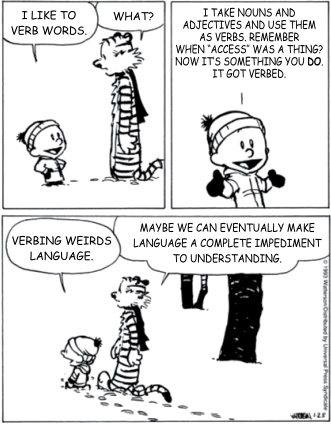
(https://www.gocomics.com/calvinandhobbes/1993/01/25)
No diálogo entre os personagens, o primeiro uso de um substantivo como verbo é:
Read the text to answer question.
The last century of language teaching history, operating within this theory-practice, researcher teacher dichotomy, has not been completely devoid of dialogue between the two sides. We moved in and out of paradigms (Kuhn, 1970) as inadequacies of the old ways of doing things were replaced by better ways. These trends in language teaching were partly the result of teachers and researchers communicating with each other.
The custom of leaving theory to researchers and practice to teachers has become, in Clarke’s (1994) words, “dysfunctional”. What is becoming clearer in this profession now is the importance of viewing the process of language instruction as a cooperative dialog among many technicians, each endowed with special skills, such as program developing, textbook writing, measuring variables of acquisition, designing experiments, and the list goes on.
We are all practitioners and we are all theorists. Whenever that understanding calls for putting together diverse bits and pieces of knowledge, you are doing some theory building. Or, if you have observed some learners in classrooms and you discern common threads of process among them, you have created a theory. And whenever you, in the role of a teacher, ask pertinent questions about Second Language Acquisition (SLA), you are beginning the process of research that can lead to a theoretical statement.
(Brown, H.D. 2006. Adaptado)
Read the text to answer question.
The last century of language teaching history, operating within this theory-practice, researcher teacher dichotomy, has not been completely devoid of dialogue between the two sides. We moved in and out of paradigms (Kuhn, 1970) as inadequacies of the old ways of doing things were replaced by better ways. These trends in language teaching were partly the result of teachers and researchers communicating with each other.
The custom of leaving theory to researchers and practice to teachers has become, in Clarke’s (1994) words, “dysfunctional”. What is becoming clearer in this profession now is the importance of viewing the process of language instruction as a cooperative dialog among many technicians, each endowed with special skills, such as program developing, textbook writing, measuring variables of acquisition, designing experiments, and the list goes on.
We are all practitioners and we are all theorists. Whenever that understanding calls for putting together diverse bits and pieces of knowledge, you are doing some theory building. Or, if you have observed some learners in classrooms and you discern common threads of process among them, you have created a theory. And whenever you, in the role of a teacher, ask pertinent questions about Second Language Acquisition (SLA), you are beginning the process of research that can lead to a theoretical statement.
(Brown, H.D. 2006. Adaptado)
Read the text to answer question.
Robots are writing more of what we read on the internet. And artificial intelligence (AI) writing tools are becoming freely available for anyone, including students, to use.
In a period of rapid change, there are enormous ethical implications for post-human authorship — in which humans and machines collaborate. The study of AI ethics needs to be central to education as we increasingly use machinegenerated content to communicate with others.
AI robot writers, such as GPT-3 (Generative Pre-trained Transformer) take seconds to create text that seems like it was written by humans. In September, 2020 GPT-3 wrote an entire essay in The Guardian to convince people not to fear artificial intelligence. As recently as 2019, this kind of technology seemed a long way off. But today, it is readily available.
Of course, there’s the issue of cheating on essays and other assignments. School and university leaders need to have difficult conversations about what constitutes “authorship” and “editorship” in the post-human age. We are all (already) writing with technological devices, even just via spelling and grammar checkers.
(https://theconversation.com. Adaptado)
Read the text to answer question.
Robots are writing more of what we read on the internet. And artificial intelligence (AI) writing tools are becoming freely available for anyone, including students, to use.
In a period of rapid change, there are enormous ethical implications for post-human authorship — in which humans and machines collaborate. The study of AI ethics needs to be central to education as we increasingly use machinegenerated content to communicate with others.
AI robot writers, such as GPT-3 (Generative Pre-trained Transformer) take seconds to create text that seems like it was written by humans. In September, 2020 GPT-3 wrote an entire essay in The Guardian to convince people not to fear artificial intelligence. As recently as 2019, this kind of technology seemed a long way off. But today, it is readily available.
Of course, there’s the issue of cheating on essays and other assignments. School and university leaders need to have difficult conversations about what constitutes “authorship” and “editorship” in the post-human age. We are all (already) writing with technological devices, even just via spelling and grammar checkers.
(https://theconversation.com. Adaptado)
Read the text to answer question.
Robots are writing more of what we read on the internet. And artificial intelligence (AI) writing tools are becoming freely available for anyone, including students, to use.
In a period of rapid change, there are enormous ethical implications for post-human authorship — in which humans and machines collaborate. The study of AI ethics needs to be central to education as we increasingly use machinegenerated content to communicate with others.
AI robot writers, such as GPT-3 (Generative Pre-trained Transformer) take seconds to create text that seems like it was written by humans. In September, 2020 GPT-3 wrote an entire essay in The Guardian to convince people not to fear artificial intelligence. As recently as 2019, this kind of technology seemed a long way off. But today, it is readily available.
Of course, there’s the issue of cheating on essays and other assignments. School and university leaders need to have difficult conversations about what constitutes “authorship” and “editorship” in the post-human age. We are all (already) writing with technological devices, even just via spelling and grammar checkers.
(https://theconversation.com. Adaptado)
Read the text to answer question.
Robots are writing more of what we read on the internet. And artificial intelligence (AI) writing tools are becoming freely available for anyone, including students, to use.
In a period of rapid change, there are enormous ethical implications for post-human authorship — in which humans and machines collaborate. The study of AI ethics needs to be central to education as we increasingly use machinegenerated content to communicate with others.
AI robot writers, such as GPT-3 (Generative Pre-trained Transformer) take seconds to create text that seems like it was written by humans. In September, 2020 GPT-3 wrote an entire essay in The Guardian to convince people not to fear artificial intelligence. As recently as 2019, this kind of technology seemed a long way off. But today, it is readily available.
Of course, there’s the issue of cheating on essays and other assignments. School and university leaders need to have difficult conversations about what constitutes “authorship” and “editorship” in the post-human age. We are all (already) writing with technological devices, even just via spelling and grammar checkers.
(https://theconversation.com. Adaptado)
Leia o texto para responder à questão.
Segundo Kramasch (2024), o conceito de competência intercultural recebeu um novo significado por meio do uso de comunicação mediada por computadores (CMC), com o objetivo de promover a interação na L2 entre falantes nativos e não nativos da língua e entre falantes não nativos, e de capacitá-los a ter acesso a e manipular ambientes culturais não nacionais.
O acesso direto a falantes da L2 e a imersão cultural promovida pela CMC realçam a ilusão do imediatismo semiótico e a autenticidade cultural. Entretanto, não conduziu, necessariamente, a uma exploração profunda de diferenças culturais. A comunicação intercultural online enfatizou a participação em comunidades online, a colaboração, a solução conjunta de problemas e o desenvolvimento de identidades híbridas que tanto independem das coações sociais do mundo real, quanto ficam sujeitas às pressões sociais e às coações coletivas das comunidades online. Não é à toa que há um número crescente de linguistas aplicados que estão ávidos a trazer a história, a memória e os aspectos subjetivos da aprendizagem de línguas de volta à sala de aula, bem como uma reflexão sobre o significado de operar entre línguas, a partir do background cultural do próprio indivíduo.
(Kramasch, C. 2024. Adaptado)
Later a family member comes to the desk asking for the Dr, my coworker says “oh he’s down that way, he’s the one with the big heart on”…
(https://www.reddit.com)
The misunderstanding by the family member may have happened because
Read the text by Brown to answer question.
The question of whether or not to distinguish between native and nonnative speakers in the teaching profession has grown into a common and productive topic of research in the last decade. For many decades the English language teaching profession assumed that native English-speaking teachers, by virtue of their superior model of oral production, comprised the ideal English language teacher. Then, Medgyes (1994), among others, showed in his research that nonnative English speaking teachers offered as many if not more inherent advantages. Other authors concur by noting not only that multiple varieties of English are now considered legitimate and acceptable, but also that teachers who have actually gone through the process of learning English possess distinct advantages over native speakers.
As we move into a new paradigm in which the concepts of native and nonnative “speaker” become less relevant, it is perhaps more appropriate to think in terms of the proficiency level of a user of a language. Speaking is one of four skills and may not deserve in all contexts to be elevated to the sole criterion for proficiency. So, the profession is better served by considering a person’s communicative proficiency across the four skills. Teachers of any language, regardless of their own variety of English, can then be judged accordingly, and in turn, their pedagogical training and experience can occupy focal attention.
(Brown, 2006. Adaptado)
Read the text by Brown to answer question.
The question of whether or not to distinguish between native and nonnative speakers in the teaching profession has grown into a common and productive topic of research in the last decade. For many decades the English language teaching profession assumed that native English-speaking teachers, by virtue of their superior model of oral production, comprised the ideal English language teacher. Then, Medgyes (1994), among others, showed in his research that nonnative English speaking teachers offered as many if not more inherent advantages. Other authors concur by noting not only that multiple varieties of English are now considered legitimate and acceptable, but also that teachers who have actually gone through the process of learning English possess distinct advantages over native speakers.
As we move into a new paradigm in which the concepts of native and nonnative “speaker” become less relevant, it is perhaps more appropriate to think in terms of the proficiency level of a user of a language. Speaking is one of four skills and may not deserve in all contexts to be elevated to the sole criterion for proficiency. So, the profession is better served by considering a person’s communicative proficiency across the four skills. Teachers of any language, regardless of their own variety of English, can then be judged accordingly, and in turn, their pedagogical training and experience can occupy focal attention.
(Brown, 2006. Adaptado)
Read the text by Brown to answer question.
The question of whether or not to distinguish between native and nonnative speakers in the teaching profession has grown into a common and productive topic of research in the last decade. For many decades the English language teaching profession assumed that native English-speaking teachers, by virtue of their superior model of oral production, comprised the ideal English language teacher. Then, Medgyes (1994), among others, showed in his research that nonnative English speaking teachers offered as many if not more inherent advantages. Other authors concur by noting not only that multiple varieties of English are now considered legitimate and acceptable, but also that teachers who have actually gone through the process of learning English possess distinct advantages over native speakers.
As we move into a new paradigm in which the concepts of native and nonnative “speaker” become less relevant, it is perhaps more appropriate to think in terms of the proficiency level of a user of a language. Speaking is one of four skills and may not deserve in all contexts to be elevated to the sole criterion for proficiency. So, the profession is better served by considering a person’s communicative proficiency across the four skills. Teachers of any language, regardless of their own variety of English, can then be judged accordingly, and in turn, their pedagogical training and experience can occupy focal attention.
(Brown, 2006. Adaptado)
Read the text by Brown to answer question.
The question of whether or not to distinguish between native and nonnative speakers in the teaching profession has grown into a common and productive topic of research in the last decade. For many decades the English language teaching profession assumed that native English-speaking teachers, by virtue of their superior model of oral production, comprised the ideal English language teacher. Then, Medgyes (1994), among others, showed in his research that nonnative English speaking teachers offered as many if not more inherent advantages. Other authors concur by noting not only that multiple varieties of English are now considered legitimate and acceptable, but also that teachers who have actually gone through the process of learning English possess distinct advantages over native speakers.
As we move into a new paradigm in which the concepts of native and nonnative “speaker” become less relevant, it is perhaps more appropriate to think in terms of the proficiency level of a user of a language. Speaking is one of four skills and may not deserve in all contexts to be elevated to the sole criterion for proficiency. So, the profession is better served by considering a person’s communicative proficiency across the four skills. Teachers of any language, regardless of their own variety of English, can then be judged accordingly, and in turn, their pedagogical training and experience can occupy focal attention.
(Brown, 2006. Adaptado)

 Conheça nossos planos