Questões de Concurso Sobre inglês
Foram encontradas 25.999 questões


Ano: 2025
Banca:
UECE-CEV
Órgão:
UECE
Prova:
UECE-CEV - 2025 - UECE - Língua Inglesa - 2ª Fase - 1º Dia (2º Semestre de 2025) |
Q3902508
Inglês
Texto associado

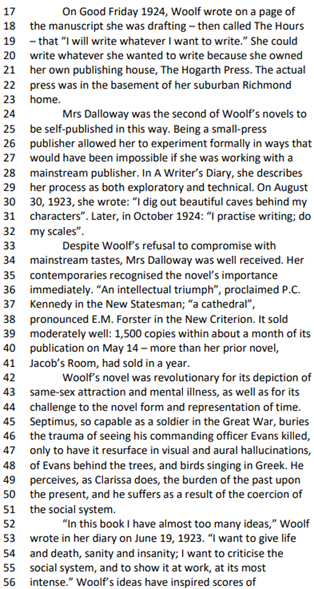
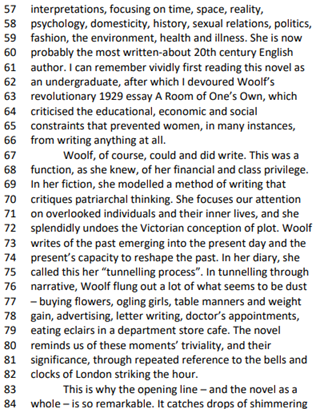

Seize the day – Virginia Woolf’s Mrs Dalloway at 100
Adapted from: https://theconversation/jan.30.2025
The sentences “She could write whatever she wanted…” and
“Her metaphor shows that Woolf’s thinking about time also had a
spatial dimension.” contain, respectively, a/an
Ano: 2025
Banca:
UECE-CEV
Órgão:
UECE
Prova:
UECE-CEV - 2025 - UECE - Língua Inglesa - 2ª Fase - 1º Dia (2º Semestre de 2025) |
Q3902507
Inglês
Texto associado
Seize the day – Virginia Woolf’s Mrs Dalloway at 100
Adapted from: https://theconversation/jan.30.2025
The sentence “Characters pass each other on the street,
muse on a shared past, or witness the same event from different
vantage points and through different filters of personality and
psyche.” is
Ano: 2025
Banca:
UECE-CEV
Órgão:
UECE
Prova:
UECE-CEV - 2025 - UECE - Língua Inglesa - 2ª Fase - 1º Dia (2º Semestre de 2025) |
Q3902506
Inglês
Texto associado
Seize the day – Virginia Woolf’s Mrs Dalloway at 100
Adapted from: https://theconversation/jan.30.2025
The sentence “Woolf’s novel was revolutionary for its
depiction of same-sex attraction and mental illness, as well as for
its challenge to the novel form and representation of time.” is
Ano: 2025
Banca:
UECE-CEV
Órgão:
UECE
Prova:
UECE-CEV - 2025 - UECE - Língua Inglesa - 2ª Fase - 1º Dia (2º Semestre de 2025) |
Q3902505
Inglês
Texto associado
Seize the day – Virginia Woolf’s Mrs Dalloway at 100
Adapted from: https://theconversation/jan.30.2025
The sentence “The iconic status of the line is demonstrated
by the number of online parodies it inspires…” contains clauses
that are, respectively, in
Ano: 2025
Banca:
UECE-CEV
Órgão:
UECE
Prova:
UECE-CEV - 2025 - UECE - Língua Inglesa - 2ª Fase - 1º Dia (2º Semestre de 2025) |
Q3902504
Inglês
Texto associado
Seize the day – Virginia Woolf’s Mrs Dalloway at 100
Adapted from: https://theconversation/jan.30.2025
The text states that since its publication, the novel “Mrs.
Dalloway” has been very influential and mentions some works that
it has inspired, including Michael Cunningham’s novel “The Hours”,
which has been adapted into a/an
Ano: 2025
Banca:
UECE-CEV
Órgão:
UECE
Prova:
UECE-CEV - 2025 - UECE - Língua Inglesa - 2ª Fase - 1º Dia (2º Semestre de 2025) |
Q3902503
Inglês
Texto associado
Seize the day – Virginia Woolf’s Mrs Dalloway at 100
Adapted from: https://theconversation/jan.30.2025
According to the text, Virginia Woolf could write whatever
she wanted because she
Ano: 2025
Banca:
UECE-CEV
Órgão:
UECE
Prova:
UECE-CEV - 2025 - UECE - Língua Inglesa - 2ª Fase - 1º Dia (2º Semestre de 2025) |
Q3902502
Inglês
Texto associado
Seize the day – Virginia Woolf’s Mrs Dalloway at 100
Adapted from: https://theconversation/jan.30.2025
Woolf was critical of the many constraints that prevented
women from
Ano: 2025
Banca:
UECE-CEV
Órgão:
UECE
Prova:
UECE-CEV - 2025 - UECE - Língua Inglesa - 2ª Fase - 1º Dia (2º Semestre de 2025) |
Q3902501
Inglês
Texto associado
Seize the day – Virginia Woolf’s Mrs Dalloway at 100
Adapted from: https://theconversation/jan.30.2025
“Mrs. Dalloway” is considered a revolutionary novel for many
reasons. The text mentions the way that it
Ano: 2025
Banca:
UECE-CEV
Órgão:
UECE
Prova:
UECE-CEV - 2025 - UECE - Língua Inglesa - 2ª Fase - 1º Dia (2º Semestre de 2025) |
Q3902500
Inglês
Texto associado
Seize the day – Virginia Woolf’s Mrs Dalloway at 100
Adapted from: https://theconversation/jan.30.2025
Among the many positive aspects of “Mrs. Dalloway”, the
text mentions the way the author
Ano: 2025
Banca:
UECE-CEV
Órgão:
UECE
Prova:
UECE-CEV - 2025 - UECE - Língua Inglesa - 2ª Fase - 1º Dia (2º Semestre de 2025) |
Q3902499
Inglês
Texto associado
Seize the day – Virginia Woolf’s Mrs Dalloway at 100
Adapted from: https://theconversation/jan.30.2025
The opening sentence of the novel is considered
Ano: 2025
Banca:
UECE-CEV
Órgão:
UECE
Prova:
UECE-CEV - 2025 - UECE - Língua Inglesa - 2ª Fase - 1º Dia (2º Semestre de 2025) |
Q3902498
Inglês
Texto associado
Seize the day – Virginia Woolf’s Mrs Dalloway at 100
Adapted from: https://theconversation/jan.30.2025
As to “Mrs. Dalloway”, among other things, the article states
that it was
Ano: 2025
Banca:
UECE-CEV
Órgão:
UECE
Prova:
UECE-CEV - 2025 - UECE - Língua Inglesa - 2ª Fase - 1º Dia (2º Semestre de 2025) |
Q3902497
Inglês
Texto associado
Seize the day – Virginia Woolf’s Mrs Dalloway at 100
Adapted from: https://theconversation/jan.30.2025
In her work “A writer’s Diary”, Virginia Woolf, describing her
writing process, said that it was
Ano: 2025
Banca:
UECE-CEV
Órgão:
UECE
Prova:
UECE-CEV - 2025 - UECE - Prova de Conhecimentos Gerais - 1ª Fase (2º Semestre de 2025) |
Q3902481
Inglês
Texto associado
Here’s One More Reason to Try to Exercise
Next time you’re feeling the burn during a workout, it might
give you a boost to know that exercise can also be a balm: Research
suggests it is one of the best tools for fighting chronic
inflammation.
Inflammation has emerged as a looming health concern in
recent years — experts say it can be both a cause and a sign of
disease. And while there’s still a lot we don’t know about its
significance, most experts agree that the less chronically inflamed
we are, the healthier we are.
The scientific evidence is also clear that people who are
sedentary tend to have higher levels of inflammation compared to
people who exercise regularly. And when sedentary people start
moving consistently, their inflammation levels generally decline.
Some researchers believe that exercise’s power to fight
inflammation may even be at the heart of why physical activity is so
effective at protecting us against cardiovascular disease, diabetes,
dementia and other chronic diseases.
The growing understanding that exercise and inflammation
are linked has been relatively recent, and this has spurred a boom
of research into the connection, said Dr. Robert Shmerling, a rheumatologist and a medical editor at Harvard Health Publishing.
Here’s what we know — and what it means for you.
While inflammation may seem like a menace, it serves a
vital function in keeping you healthy. For example, after a paper cut
or an ankle sprain, immune cells flood the area, which causes the
surrounding tissue to swell and turn red — this kind of acute
inflammation usually resolves in a few days. A similar process
happens when you get an infection, like a cold or the flu.
But chronic inflammation is a low-grade condition that can
simmer for years. It can begin with an infection or injury, but then
morph into a lingering state, in which the immune system starts
attacking healthy tissue, Dr. Shmerling said. Chronic inflammation
can also be linked to diet, stress, smoking, obesity, sleep quality
and your level of physical activity. And it increases as you age (a
process that researchers call “inflammaging”).
Experts suspect this prolonged immune response may put
you at greater risk for disease, and in some cases, make you feel
fatigued, depressed or foggy. A doctor can usually detect chronic
inflammation through blood tests that measure specific chemicals,
or biomarkers, released by your immune system.
Research suggests that consistent, moderate exercise can
fight inflammation by tamping down on the release of
inflammatory chemicals, and ramping up the release of chemicals
that fight it. Exercise can also lower inflammation indirectly, for
example, by improving sleep quality and lowering stress.
For people who are sedentary, exercise is especially
effective at counteracting inflammation, experts said. Certain kinds
of fat cells have been shown to release chemicals into the blood
that cause low-grade inflammation. When someone who has been
sedentary starts working out consistently, not only does their fat
tissue often shrink, but studies also suggest that the physical
activity might alter their fat cells so they produce fewer
inflammatory substances, Dr. Shmerling said.
Regardless, there’s no downside to someone taking up
exercise, Dr. Shmerling added. “They may get healthier in a hurry,
and it might have nothing to do with inflammation,” he said. “The
outcome is still a positive one.”
While research hasn’t yet given us a prescription for exactly
what kind and how much exercise is most effective for fighting
inflammation, experts share tips for making the most of exercise’s
potential impact on it.
Most moderate-intensity exercise seems to reduce
inflammation in the short term, and the more consistently you
work out, the more you keep chronic inflammation at bay, said Suzi
Hong, a professor at the University of California San Diego’s School
of Public Health. Dr. Hong and her team found that a single,
moderate, 20-minute treadmill workout, such as a brisk walk or jog,
sparked a temporary anti-inflammatory response. If you’re
breathing harder than usual to keep up the pace, and you feel like
you’re putting in moderate effort, she said, you’re probably fighting
inflammation. For lasting benefits, though, you have to make it a
habit.
For starters, resistance training helps to reduce
inflammation-causing fat cells, particularly when combined with
regular aerobic exercise. People with chronic inflammation tend to lose muscle mass more rapidly as they age than those with less
inflammation, so strength training may be especially important for
them to remain mobile and independent. The Centers for Disease
Control and Prevention recommend that adults make time for at
least two strength-training sessions per week.
Chronic stress is another contributor to inflammation, so
finding a workout you enjoy may offer greater anti-inflammatory
benefits by helping to relieve stress. If you’re looking for a place to
start, a large body of research suggests that yoga can help to calm
the nervous system, lower inflammatory markers and lessen
symptoms of diseases associated with chronic inflammation. Avoid
overtraining, since repeated intense workouts without appropriate
recovery can heighten your levels of inflammation and weaken
your immune system.
As with many other aspects of health, moderation and
consistency are keys to getting and staying fit — and to fighting
inflammation for the long haul.
Adapted from: https://www.nytimes.com/2025/03/19/
Another recommendation presented in the text as to types of
exercises to reduce chronic inflammation is yoga. Among the
reasons for that suggestion, the text mentions the advantage of
Ano: 2025
Banca:
UECE-CEV
Órgão:
UECE
Prova:
UECE-CEV - 2025 - UECE - Prova de Conhecimentos Gerais - 1ª Fase (2º Semestre de 2025) |
Q3902480
Inglês
Texto associado
Here’s One More Reason to Try to Exercise
Next time you’re feeling the burn during a workout, it might
give you a boost to know that exercise can also be a balm: Research
suggests it is one of the best tools for fighting chronic
inflammation.
Inflammation has emerged as a looming health concern in
recent years — experts say it can be both a cause and a sign of
disease. And while there’s still a lot we don’t know about its
significance, most experts agree that the less chronically inflamed
we are, the healthier we are.
The scientific evidence is also clear that people who are
sedentary tend to have higher levels of inflammation compared to
people who exercise regularly. And when sedentary people start
moving consistently, their inflammation levels generally decline.
Some researchers believe that exercise’s power to fight
inflammation may even be at the heart of why physical activity is so
effective at protecting us against cardiovascular disease, diabetes,
dementia and other chronic diseases.
The growing understanding that exercise and inflammation
are linked has been relatively recent, and this has spurred a boom
of research into the connection, said Dr. Robert Shmerling, a rheumatologist and a medical editor at Harvard Health Publishing.
Here’s what we know — and what it means for you.
While inflammation may seem like a menace, it serves a
vital function in keeping you healthy. For example, after a paper cut
or an ankle sprain, immune cells flood the area, which causes the
surrounding tissue to swell and turn red — this kind of acute
inflammation usually resolves in a few days. A similar process
happens when you get an infection, like a cold or the flu.
But chronic inflammation is a low-grade condition that can
simmer for years. It can begin with an infection or injury, but then
morph into a lingering state, in which the immune system starts
attacking healthy tissue, Dr. Shmerling said. Chronic inflammation
can also be linked to diet, stress, smoking, obesity, sleep quality
and your level of physical activity. And it increases as you age (a
process that researchers call “inflammaging”).
Experts suspect this prolonged immune response may put
you at greater risk for disease, and in some cases, make you feel
fatigued, depressed or foggy. A doctor can usually detect chronic
inflammation through blood tests that measure specific chemicals,
or biomarkers, released by your immune system.
Research suggests that consistent, moderate exercise can
fight inflammation by tamping down on the release of
inflammatory chemicals, and ramping up the release of chemicals
that fight it. Exercise can also lower inflammation indirectly, for
example, by improving sleep quality and lowering stress.
For people who are sedentary, exercise is especially
effective at counteracting inflammation, experts said. Certain kinds
of fat cells have been shown to release chemicals into the blood
that cause low-grade inflammation. When someone who has been
sedentary starts working out consistently, not only does their fat
tissue often shrink, but studies also suggest that the physical
activity might alter their fat cells so they produce fewer
inflammatory substances, Dr. Shmerling said.
Regardless, there’s no downside to someone taking up
exercise, Dr. Shmerling added. “They may get healthier in a hurry,
and it might have nothing to do with inflammation,” he said. “The
outcome is still a positive one.”
While research hasn’t yet given us a prescription for exactly
what kind and how much exercise is most effective for fighting
inflammation, experts share tips for making the most of exercise’s
potential impact on it.
Most moderate-intensity exercise seems to reduce
inflammation in the short term, and the more consistently you
work out, the more you keep chronic inflammation at bay, said Suzi
Hong, a professor at the University of California San Diego’s School
of Public Health. Dr. Hong and her team found that a single,
moderate, 20-minute treadmill workout, such as a brisk walk or jog,
sparked a temporary anti-inflammatory response. If you’re
breathing harder than usual to keep up the pace, and you feel like
you’re putting in moderate effort, she said, you’re probably fighting
inflammation. For lasting benefits, though, you have to make it a
habit.
For starters, resistance training helps to reduce
inflammation-causing fat cells, particularly when combined with
regular aerobic exercise. People with chronic inflammation tend to lose muscle mass more rapidly as they age than those with less
inflammation, so strength training may be especially important for
them to remain mobile and independent. The Centers for Disease
Control and Prevention recommend that adults make time for at
least two strength-training sessions per week.
Chronic stress is another contributor to inflammation, so
finding a workout you enjoy may offer greater anti-inflammatory
benefits by helping to relieve stress. If you’re looking for a place to
start, a large body of research suggests that yoga can help to calm
the nervous system, lower inflammatory markers and lessen
symptoms of diseases associated with chronic inflammation. Avoid
overtraining, since repeated intense workouts without appropriate
recovery can heighten your levels of inflammation and weaken
your immune system.
As with many other aspects of health, moderation and
consistency are keys to getting and staying fit — and to fighting
inflammation for the long haul.
Adapted from: https://www.nytimes.com/2025/03/19/
As to recommendations of types of exercises to reduce
chronic inflammation, the text suggests resistance/strength
training specially to people who are losing muscle mass in the
process of aging because this type of exercise would contribute to
Ano: 2025
Banca:
UECE-CEV
Órgão:
UECE
Prova:
UECE-CEV - 2025 - UECE - Prova de Conhecimentos Gerais - 1ª Fase (2º Semestre de 2025) |
Q3902479
Inglês
Texto associado
Here’s One More Reason to Try to Exercise
Next time you’re feeling the burn during a workout, it might
give you a boost to know that exercise can also be a balm: Research
suggests it is one of the best tools for fighting chronic
inflammation.
Inflammation has emerged as a looming health concern in
recent years — experts say it can be both a cause and a sign of
disease. And while there’s still a lot we don’t know about its
significance, most experts agree that the less chronically inflamed
we are, the healthier we are.
The scientific evidence is also clear that people who are
sedentary tend to have higher levels of inflammation compared to
people who exercise regularly. And when sedentary people start
moving consistently, their inflammation levels generally decline.
Some researchers believe that exercise’s power to fight
inflammation may even be at the heart of why physical activity is so
effective at protecting us against cardiovascular disease, diabetes,
dementia and other chronic diseases.
The growing understanding that exercise and inflammation
are linked has been relatively recent, and this has spurred a boom
of research into the connection, said Dr. Robert Shmerling, a rheumatologist and a medical editor at Harvard Health Publishing.
Here’s what we know — and what it means for you.
While inflammation may seem like a menace, it serves a
vital function in keeping you healthy. For example, after a paper cut
or an ankle sprain, immune cells flood the area, which causes the
surrounding tissue to swell and turn red — this kind of acute
inflammation usually resolves in a few days. A similar process
happens when you get an infection, like a cold or the flu.
But chronic inflammation is a low-grade condition that can
simmer for years. It can begin with an infection or injury, but then
morph into a lingering state, in which the immune system starts
attacking healthy tissue, Dr. Shmerling said. Chronic inflammation
can also be linked to diet, stress, smoking, obesity, sleep quality
and your level of physical activity. And it increases as you age (a
process that researchers call “inflammaging”).
Experts suspect this prolonged immune response may put
you at greater risk for disease, and in some cases, make you feel
fatigued, depressed or foggy. A doctor can usually detect chronic
inflammation through blood tests that measure specific chemicals,
or biomarkers, released by your immune system.
Research suggests that consistent, moderate exercise can
fight inflammation by tamping down on the release of
inflammatory chemicals, and ramping up the release of chemicals
that fight it. Exercise can also lower inflammation indirectly, for
example, by improving sleep quality and lowering stress.
For people who are sedentary, exercise is especially
effective at counteracting inflammation, experts said. Certain kinds
of fat cells have been shown to release chemicals into the blood
that cause low-grade inflammation. When someone who has been
sedentary starts working out consistently, not only does their fat
tissue often shrink, but studies also suggest that the physical
activity might alter their fat cells so they produce fewer
inflammatory substances, Dr. Shmerling said.
Regardless, there’s no downside to someone taking up
exercise, Dr. Shmerling added. “They may get healthier in a hurry,
and it might have nothing to do with inflammation,” he said. “The
outcome is still a positive one.”
While research hasn’t yet given us a prescription for exactly
what kind and how much exercise is most effective for fighting
inflammation, experts share tips for making the most of exercise’s
potential impact on it.
Most moderate-intensity exercise seems to reduce
inflammation in the short term, and the more consistently you
work out, the more you keep chronic inflammation at bay, said Suzi
Hong, a professor at the University of California San Diego’s School
of Public Health. Dr. Hong and her team found that a single,
moderate, 20-minute treadmill workout, such as a brisk walk or jog,
sparked a temporary anti-inflammatory response. If you’re
breathing harder than usual to keep up the pace, and you feel like
you’re putting in moderate effort, she said, you’re probably fighting
inflammation. For lasting benefits, though, you have to make it a
habit.
For starters, resistance training helps to reduce
inflammation-causing fat cells, particularly when combined with
regular aerobic exercise. People with chronic inflammation tend to lose muscle mass more rapidly as they age than those with less
inflammation, so strength training may be especially important for
them to remain mobile and independent. The Centers for Disease
Control and Prevention recommend that adults make time for at
least two strength-training sessions per week.
Chronic stress is another contributor to inflammation, so
finding a workout you enjoy may offer greater anti-inflammatory
benefits by helping to relieve stress. If you’re looking for a place to
start, a large body of research suggests that yoga can help to calm
the nervous system, lower inflammatory markers and lessen
symptoms of diseases associated with chronic inflammation. Avoid
overtraining, since repeated intense workouts without appropriate
recovery can heighten your levels of inflammation and weaken
your immune system.
As with many other aspects of health, moderation and
consistency are keys to getting and staying fit — and to fighting
inflammation for the long haul.
Adapted from: https://www.nytimes.com/2025/03/19/
Among the signs related to chronic inflammation, the text
mentions
Ano: 2025
Banca:
UECE-CEV
Órgão:
UECE
Prova:
UECE-CEV - 2025 - UECE - Prova de Conhecimentos Gerais - 1ª Fase (2º Semestre de 2025) |
Q3902478
Inglês
Texto associado
Here’s One More Reason to Try to Exercise
Next time you’re feeling the burn during a workout, it might
give you a boost to know that exercise can also be a balm: Research
suggests it is one of the best tools for fighting chronic
inflammation.
Inflammation has emerged as a looming health concern in
recent years — experts say it can be both a cause and a sign of
disease. And while there’s still a lot we don’t know about its
significance, most experts agree that the less chronically inflamed
we are, the healthier we are.
The scientific evidence is also clear that people who are
sedentary tend to have higher levels of inflammation compared to
people who exercise regularly. And when sedentary people start
moving consistently, their inflammation levels generally decline.
Some researchers believe that exercise’s power to fight
inflammation may even be at the heart of why physical activity is so
effective at protecting us against cardiovascular disease, diabetes,
dementia and other chronic diseases.
The growing understanding that exercise and inflammation
are linked has been relatively recent, and this has spurred a boom
of research into the connection, said Dr. Robert Shmerling, a rheumatologist and a medical editor at Harvard Health Publishing.
Here’s what we know — and what it means for you.
While inflammation may seem like a menace, it serves a
vital function in keeping you healthy. For example, after a paper cut
or an ankle sprain, immune cells flood the area, which causes the
surrounding tissue to swell and turn red — this kind of acute
inflammation usually resolves in a few days. A similar process
happens when you get an infection, like a cold or the flu.
But chronic inflammation is a low-grade condition that can
simmer for years. It can begin with an infection or injury, but then
morph into a lingering state, in which the immune system starts
attacking healthy tissue, Dr. Shmerling said. Chronic inflammation
can also be linked to diet, stress, smoking, obesity, sleep quality
and your level of physical activity. And it increases as you age (a
process that researchers call “inflammaging”).
Experts suspect this prolonged immune response may put
you at greater risk for disease, and in some cases, make you feel
fatigued, depressed or foggy. A doctor can usually detect chronic
inflammation through blood tests that measure specific chemicals,
or biomarkers, released by your immune system.
Research suggests that consistent, moderate exercise can
fight inflammation by tamping down on the release of
inflammatory chemicals, and ramping up the release of chemicals
that fight it. Exercise can also lower inflammation indirectly, for
example, by improving sleep quality and lowering stress.
For people who are sedentary, exercise is especially
effective at counteracting inflammation, experts said. Certain kinds
of fat cells have been shown to release chemicals into the blood
that cause low-grade inflammation. When someone who has been
sedentary starts working out consistently, not only does their fat
tissue often shrink, but studies also suggest that the physical
activity might alter their fat cells so they produce fewer
inflammatory substances, Dr. Shmerling said.
Regardless, there’s no downside to someone taking up
exercise, Dr. Shmerling added. “They may get healthier in a hurry,
and it might have nothing to do with inflammation,” he said. “The
outcome is still a positive one.”
While research hasn’t yet given us a prescription for exactly
what kind and how much exercise is most effective for fighting
inflammation, experts share tips for making the most of exercise’s
potential impact on it.
Most moderate-intensity exercise seems to reduce
inflammation in the short term, and the more consistently you
work out, the more you keep chronic inflammation at bay, said Suzi
Hong, a professor at the University of California San Diego’s School
of Public Health. Dr. Hong and her team found that a single,
moderate, 20-minute treadmill workout, such as a brisk walk or jog,
sparked a temporary anti-inflammatory response. If you’re
breathing harder than usual to keep up the pace, and you feel like
you’re putting in moderate effort, she said, you’re probably fighting
inflammation. For lasting benefits, though, you have to make it a
habit.
For starters, resistance training helps to reduce
inflammation-causing fat cells, particularly when combined with
regular aerobic exercise. People with chronic inflammation tend to lose muscle mass more rapidly as they age than those with less
inflammation, so strength training may be especially important for
them to remain mobile and independent. The Centers for Disease
Control and Prevention recommend that adults make time for at
least two strength-training sessions per week.
Chronic stress is another contributor to inflammation, so
finding a workout you enjoy may offer greater anti-inflammatory
benefits by helping to relieve stress. If you’re looking for a place to
start, a large body of research suggests that yoga can help to calm
the nervous system, lower inflammatory markers and lessen
symptoms of diseases associated with chronic inflammation. Avoid
overtraining, since repeated intense workouts without appropriate
recovery can heighten your levels of inflammation and weaken
your immune system.
As with many other aspects of health, moderation and
consistency are keys to getting and staying fit — and to fighting
inflammation for the long haul.
Adapted from: https://www.nytimes.com/2025/03/19/
The process referred to by researchers as ‘inflammaging’ is
related to
Ano: 2025
Banca:
UECE-CEV
Órgão:
UECE
Prova:
UECE-CEV - 2025 - UECE - Prova de Conhecimentos Gerais - 1ª Fase (2º Semestre de 2025) |
Q3902477
Inglês
Texto associado
Here’s One More Reason to Try to Exercise
Next time you’re feeling the burn during a workout, it might
give you a boost to know that exercise can also be a balm: Research
suggests it is one of the best tools for fighting chronic
inflammation.
Inflammation has emerged as a looming health concern in
recent years — experts say it can be both a cause and a sign of
disease. And while there’s still a lot we don’t know about its
significance, most experts agree that the less chronically inflamed
we are, the healthier we are.
The scientific evidence is also clear that people who are
sedentary tend to have higher levels of inflammation compared to
people who exercise regularly. And when sedentary people start
moving consistently, their inflammation levels generally decline.
Some researchers believe that exercise’s power to fight
inflammation may even be at the heart of why physical activity is so
effective at protecting us against cardiovascular disease, diabetes,
dementia and other chronic diseases.
The growing understanding that exercise and inflammation
are linked has been relatively recent, and this has spurred a boom
of research into the connection, said Dr. Robert Shmerling, a rheumatologist and a medical editor at Harvard Health Publishing.
Here’s what we know — and what it means for you.
While inflammation may seem like a menace, it serves a
vital function in keeping you healthy. For example, after a paper cut
or an ankle sprain, immune cells flood the area, which causes the
surrounding tissue to swell and turn red — this kind of acute
inflammation usually resolves in a few days. A similar process
happens when you get an infection, like a cold or the flu.
But chronic inflammation is a low-grade condition that can
simmer for years. It can begin with an infection or injury, but then
morph into a lingering state, in which the immune system starts
attacking healthy tissue, Dr. Shmerling said. Chronic inflammation
can also be linked to diet, stress, smoking, obesity, sleep quality
and your level of physical activity. And it increases as you age (a
process that researchers call “inflammaging”).
Experts suspect this prolonged immune response may put
you at greater risk for disease, and in some cases, make you feel
fatigued, depressed or foggy. A doctor can usually detect chronic
inflammation through blood tests that measure specific chemicals,
or biomarkers, released by your immune system.
Research suggests that consistent, moderate exercise can
fight inflammation by tamping down on the release of
inflammatory chemicals, and ramping up the release of chemicals
that fight it. Exercise can also lower inflammation indirectly, for
example, by improving sleep quality and lowering stress.
For people who are sedentary, exercise is especially
effective at counteracting inflammation, experts said. Certain kinds
of fat cells have been shown to release chemicals into the blood
that cause low-grade inflammation. When someone who has been
sedentary starts working out consistently, not only does their fat
tissue often shrink, but studies also suggest that the physical
activity might alter their fat cells so they produce fewer
inflammatory substances, Dr. Shmerling said.
Regardless, there’s no downside to someone taking up
exercise, Dr. Shmerling added. “They may get healthier in a hurry,
and it might have nothing to do with inflammation,” he said. “The
outcome is still a positive one.”
While research hasn’t yet given us a prescription for exactly
what kind and how much exercise is most effective for fighting
inflammation, experts share tips for making the most of exercise’s
potential impact on it.
Most moderate-intensity exercise seems to reduce
inflammation in the short term, and the more consistently you
work out, the more you keep chronic inflammation at bay, said Suzi
Hong, a professor at the University of California San Diego’s School
of Public Health. Dr. Hong and her team found that a single,
moderate, 20-minute treadmill workout, such as a brisk walk or jog,
sparked a temporary anti-inflammatory response. If you’re
breathing harder than usual to keep up the pace, and you feel like
you’re putting in moderate effort, she said, you’re probably fighting
inflammation. For lasting benefits, though, you have to make it a
habit.
For starters, resistance training helps to reduce
inflammation-causing fat cells, particularly when combined with
regular aerobic exercise. People with chronic inflammation tend to lose muscle mass more rapidly as they age than those with less
inflammation, so strength training may be especially important for
them to remain mobile and independent. The Centers for Disease
Control and Prevention recommend that adults make time for at
least two strength-training sessions per week.
Chronic stress is another contributor to inflammation, so
finding a workout you enjoy may offer greater anti-inflammatory
benefits by helping to relieve stress. If you’re looking for a place to
start, a large body of research suggests that yoga can help to calm
the nervous system, lower inflammatory markers and lessen
symptoms of diseases associated with chronic inflammation. Avoid
overtraining, since repeated intense workouts without appropriate
recovery can heighten your levels of inflammation and weaken
your immune system.
As with many other aspects of health, moderation and
consistency are keys to getting and staying fit — and to fighting
inflammation for the long haul.
Adapted from: https://www.nytimes.com/2025/03/19/
Dr. Shmerling explains that chronic inflammation is a
condition that remains active for years, leading the immune system
to attack healthy cells/tissues. Its appearance can be associated,
among other factors, to
Ano: 2025
Banca:
UECE-CEV
Órgão:
UECE
Prova:
UECE-CEV - 2025 - UECE - Prova de Conhecimentos Gerais - 1ª Fase (2º Semestre de 2025) |
Q3902476
Inglês
Texto associado
Here’s One More Reason to Try to Exercise
Next time you’re feeling the burn during a workout, it might
give you a boost to know that exercise can also be a balm: Research
suggests it is one of the best tools for fighting chronic
inflammation.
Inflammation has emerged as a looming health concern in
recent years — experts say it can be both a cause and a sign of
disease. And while there’s still a lot we don’t know about its
significance, most experts agree that the less chronically inflamed
we are, the healthier we are.
The scientific evidence is also clear that people who are
sedentary tend to have higher levels of inflammation compared to
people who exercise regularly. And when sedentary people start
moving consistently, their inflammation levels generally decline.
Some researchers believe that exercise’s power to fight
inflammation may even be at the heart of why physical activity is so
effective at protecting us against cardiovascular disease, diabetes,
dementia and other chronic diseases.
The growing understanding that exercise and inflammation
are linked has been relatively recent, and this has spurred a boom
of research into the connection, said Dr. Robert Shmerling, a rheumatologist and a medical editor at Harvard Health Publishing.
Here’s what we know — and what it means for you.
While inflammation may seem like a menace, it serves a
vital function in keeping you healthy. For example, after a paper cut
or an ankle sprain, immune cells flood the area, which causes the
surrounding tissue to swell and turn red — this kind of acute
inflammation usually resolves in a few days. A similar process
happens when you get an infection, like a cold or the flu.
But chronic inflammation is a low-grade condition that can
simmer for years. It can begin with an infection or injury, but then
morph into a lingering state, in which the immune system starts
attacking healthy tissue, Dr. Shmerling said. Chronic inflammation
can also be linked to diet, stress, smoking, obesity, sleep quality
and your level of physical activity. And it increases as you age (a
process that researchers call “inflammaging”).
Experts suspect this prolonged immune response may put
you at greater risk for disease, and in some cases, make you feel
fatigued, depressed or foggy. A doctor can usually detect chronic
inflammation through blood tests that measure specific chemicals,
or biomarkers, released by your immune system.
Research suggests that consistent, moderate exercise can
fight inflammation by tamping down on the release of
inflammatory chemicals, and ramping up the release of chemicals
that fight it. Exercise can also lower inflammation indirectly, for
example, by improving sleep quality and lowering stress.
For people who are sedentary, exercise is especially
effective at counteracting inflammation, experts said. Certain kinds
of fat cells have been shown to release chemicals into the blood
that cause low-grade inflammation. When someone who has been
sedentary starts working out consistently, not only does their fat
tissue often shrink, but studies also suggest that the physical
activity might alter their fat cells so they produce fewer
inflammatory substances, Dr. Shmerling said.
Regardless, there’s no downside to someone taking up
exercise, Dr. Shmerling added. “They may get healthier in a hurry,
and it might have nothing to do with inflammation,” he said. “The
outcome is still a positive one.”
While research hasn’t yet given us a prescription for exactly
what kind and how much exercise is most effective for fighting
inflammation, experts share tips for making the most of exercise’s
potential impact on it.
Most moderate-intensity exercise seems to reduce
inflammation in the short term, and the more consistently you
work out, the more you keep chronic inflammation at bay, said Suzi
Hong, a professor at the University of California San Diego’s School
of Public Health. Dr. Hong and her team found that a single,
moderate, 20-minute treadmill workout, such as a brisk walk or jog,
sparked a temporary anti-inflammatory response. If you’re
breathing harder than usual to keep up the pace, and you feel like
you’re putting in moderate effort, she said, you’re probably fighting
inflammation. For lasting benefits, though, you have to make it a
habit.
For starters, resistance training helps to reduce
inflammation-causing fat cells, particularly when combined with
regular aerobic exercise. People with chronic inflammation tend to lose muscle mass more rapidly as they age than those with less
inflammation, so strength training may be especially important for
them to remain mobile and independent. The Centers for Disease
Control and Prevention recommend that adults make time for at
least two strength-training sessions per week.
Chronic stress is another contributor to inflammation, so
finding a workout you enjoy may offer greater anti-inflammatory
benefits by helping to relieve stress. If you’re looking for a place to
start, a large body of research suggests that yoga can help to calm
the nervous system, lower inflammatory markers and lessen
symptoms of diseases associated with chronic inflammation. Avoid
overtraining, since repeated intense workouts without appropriate
recovery can heighten your levels of inflammation and weaken
your immune system.
As with many other aspects of health, moderation and
consistency are keys to getting and staying fit — and to fighting
inflammation for the long haul.
Adapted from: https://www.nytimes.com/2025/03/19/
Some researchers consider that exercise’s power to combat
inflammation may be a key aspect related to the importance of
physical activity to shield us from health problems like, for
example,
Ano: 2025
Banca:
UECE-CEV
Órgão:
UECE
Prova:
UECE-CEV - 2025 - UECE - Prova de Conhecimentos Gerais - 1ª Fase (2º Semestre de 2025) |
Q3902475
Inglês
Texto associado
Here’s One More Reason to Try to Exercise
Next time you’re feeling the burn during a workout, it might
give you a boost to know that exercise can also be a balm: Research
suggests it is one of the best tools for fighting chronic
inflammation.
Inflammation has emerged as a looming health concern in
recent years — experts say it can be both a cause and a sign of
disease. And while there’s still a lot we don’t know about its
significance, most experts agree that the less chronically inflamed
we are, the healthier we are.
The scientific evidence is also clear that people who are
sedentary tend to have higher levels of inflammation compared to
people who exercise regularly. And when sedentary people start
moving consistently, their inflammation levels generally decline.
Some researchers believe that exercise’s power to fight
inflammation may even be at the heart of why physical activity is so
effective at protecting us against cardiovascular disease, diabetes,
dementia and other chronic diseases.
The growing understanding that exercise and inflammation
are linked has been relatively recent, and this has spurred a boom
of research into the connection, said Dr. Robert Shmerling, a rheumatologist and a medical editor at Harvard Health Publishing.
Here’s what we know — and what it means for you.
While inflammation may seem like a menace, it serves a
vital function in keeping you healthy. For example, after a paper cut
or an ankle sprain, immune cells flood the area, which causes the
surrounding tissue to swell and turn red — this kind of acute
inflammation usually resolves in a few days. A similar process
happens when you get an infection, like a cold or the flu.
But chronic inflammation is a low-grade condition that can
simmer for years. It can begin with an infection or injury, but then
morph into a lingering state, in which the immune system starts
attacking healthy tissue, Dr. Shmerling said. Chronic inflammation
can also be linked to diet, stress, smoking, obesity, sleep quality
and your level of physical activity. And it increases as you age (a
process that researchers call “inflammaging”).
Experts suspect this prolonged immune response may put
you at greater risk for disease, and in some cases, make you feel
fatigued, depressed or foggy. A doctor can usually detect chronic
inflammation through blood tests that measure specific chemicals,
or biomarkers, released by your immune system.
Research suggests that consistent, moderate exercise can
fight inflammation by tamping down on the release of
inflammatory chemicals, and ramping up the release of chemicals
that fight it. Exercise can also lower inflammation indirectly, for
example, by improving sleep quality and lowering stress.
For people who are sedentary, exercise is especially
effective at counteracting inflammation, experts said. Certain kinds
of fat cells have been shown to release chemicals into the blood
that cause low-grade inflammation. When someone who has been
sedentary starts working out consistently, not only does their fat
tissue often shrink, but studies also suggest that the physical
activity might alter their fat cells so they produce fewer
inflammatory substances, Dr. Shmerling said.
Regardless, there’s no downside to someone taking up
exercise, Dr. Shmerling added. “They may get healthier in a hurry,
and it might have nothing to do with inflammation,” he said. “The
outcome is still a positive one.”
While research hasn’t yet given us a prescription for exactly
what kind and how much exercise is most effective for fighting
inflammation, experts share tips for making the most of exercise’s
potential impact on it.
Most moderate-intensity exercise seems to reduce
inflammation in the short term, and the more consistently you
work out, the more you keep chronic inflammation at bay, said Suzi
Hong, a professor at the University of California San Diego’s School
of Public Health. Dr. Hong and her team found that a single,
moderate, 20-minute treadmill workout, such as a brisk walk or jog,
sparked a temporary anti-inflammatory response. If you’re
breathing harder than usual to keep up the pace, and you feel like
you’re putting in moderate effort, she said, you’re probably fighting
inflammation. For lasting benefits, though, you have to make it a
habit.
For starters, resistance training helps to reduce
inflammation-causing fat cells, particularly when combined with
regular aerobic exercise. People with chronic inflammation tend to lose muscle mass more rapidly as they age than those with less
inflammation, so strength training may be especially important for
them to remain mobile and independent. The Centers for Disease
Control and Prevention recommend that adults make time for at
least two strength-training sessions per week.
Chronic stress is another contributor to inflammation, so
finding a workout you enjoy may offer greater anti-inflammatory
benefits by helping to relieve stress. If you’re looking for a place to
start, a large body of research suggests that yoga can help to calm
the nervous system, lower inflammatory markers and lessen
symptoms of diseases associated with chronic inflammation. Avoid
overtraining, since repeated intense workouts without appropriate
recovery can heighten your levels of inflammation and weaken
your immune system.
As with many other aspects of health, moderation and
consistency are keys to getting and staying fit — and to fighting
inflammation for the long haul.
Adapted from: https://www.nytimes.com/2025/03/19/
As researchers explore in their studies the link between
sedentarism and inflammation, it has been revealed that
Ano: 2025
Banca:
UECE-CEV
Órgão:
UECE
Prova:
UECE-CEV - 2025 - UECE - Prova de Conhecimentos Gerais - 1ª Fase (2º Semestre de 2025) |
Q3902474
Inglês
Texto associado
Here’s One More Reason to Try to Exercise
Next time you’re feeling the burn during a workout, it might
give you a boost to know that exercise can also be a balm: Research
suggests it is one of the best tools for fighting chronic
inflammation.
Inflammation has emerged as a looming health concern in
recent years — experts say it can be both a cause and a sign of
disease. And while there’s still a lot we don’t know about its
significance, most experts agree that the less chronically inflamed
we are, the healthier we are.
The scientific evidence is also clear that people who are
sedentary tend to have higher levels of inflammation compared to
people who exercise regularly. And when sedentary people start
moving consistently, their inflammation levels generally decline.
Some researchers believe that exercise’s power to fight
inflammation may even be at the heart of why physical activity is so
effective at protecting us against cardiovascular disease, diabetes,
dementia and other chronic diseases.
The growing understanding that exercise and inflammation
are linked has been relatively recent, and this has spurred a boom
of research into the connection, said Dr. Robert Shmerling, a rheumatologist and a medical editor at Harvard Health Publishing.
Here’s what we know — and what it means for you.
While inflammation may seem like a menace, it serves a
vital function in keeping you healthy. For example, after a paper cut
or an ankle sprain, immune cells flood the area, which causes the
surrounding tissue to swell and turn red — this kind of acute
inflammation usually resolves in a few days. A similar process
happens when you get an infection, like a cold or the flu.
But chronic inflammation is a low-grade condition that can
simmer for years. It can begin with an infection or injury, but then
morph into a lingering state, in which the immune system starts
attacking healthy tissue, Dr. Shmerling said. Chronic inflammation
can also be linked to diet, stress, smoking, obesity, sleep quality
and your level of physical activity. And it increases as you age (a
process that researchers call “inflammaging”).
Experts suspect this prolonged immune response may put
you at greater risk for disease, and in some cases, make you feel
fatigued, depressed or foggy. A doctor can usually detect chronic
inflammation through blood tests that measure specific chemicals,
or biomarkers, released by your immune system.
Research suggests that consistent, moderate exercise can
fight inflammation by tamping down on the release of
inflammatory chemicals, and ramping up the release of chemicals
that fight it. Exercise can also lower inflammation indirectly, for
example, by improving sleep quality and lowering stress.
For people who are sedentary, exercise is especially
effective at counteracting inflammation, experts said. Certain kinds
of fat cells have been shown to release chemicals into the blood
that cause low-grade inflammation. When someone who has been
sedentary starts working out consistently, not only does their fat
tissue often shrink, but studies also suggest that the physical
activity might alter their fat cells so they produce fewer
inflammatory substances, Dr. Shmerling said.
Regardless, there’s no downside to someone taking up
exercise, Dr. Shmerling added. “They may get healthier in a hurry,
and it might have nothing to do with inflammation,” he said. “The
outcome is still a positive one.”
While research hasn’t yet given us a prescription for exactly
what kind and how much exercise is most effective for fighting
inflammation, experts share tips for making the most of exercise’s
potential impact on it.
Most moderate-intensity exercise seems to reduce
inflammation in the short term, and the more consistently you
work out, the more you keep chronic inflammation at bay, said Suzi
Hong, a professor at the University of California San Diego’s School
of Public Health. Dr. Hong and her team found that a single,
moderate, 20-minute treadmill workout, such as a brisk walk or jog,
sparked a temporary anti-inflammatory response. If you’re
breathing harder than usual to keep up the pace, and you feel like
you’re putting in moderate effort, she said, you’re probably fighting
inflammation. For lasting benefits, though, you have to make it a
habit.
For starters, resistance training helps to reduce
inflammation-causing fat cells, particularly when combined with
regular aerobic exercise. People with chronic inflammation tend to lose muscle mass more rapidly as they age than those with less
inflammation, so strength training may be especially important for
them to remain mobile and independent. The Centers for Disease
Control and Prevention recommend that adults make time for at
least two strength-training sessions per week.
Chronic stress is another contributor to inflammation, so
finding a workout you enjoy may offer greater anti-inflammatory
benefits by helping to relieve stress. If you’re looking for a place to
start, a large body of research suggests that yoga can help to calm
the nervous system, lower inflammatory markers and lessen
symptoms of diseases associated with chronic inflammation. Avoid
overtraining, since repeated intense workouts without appropriate
recovery can heighten your levels of inflammation and weaken
your immune system.
As with many other aspects of health, moderation and
consistency are keys to getting and staying fit — and to fighting
inflammation for the long haul.
Adapted from: https://www.nytimes.com/2025/03/19/
According to the text, the connection between exercise and
inflammation is in fact an issue that researchers have approached
and acknowledged

 Conheça nossos planos