Questões de Concurso Sobre inglês
Foram encontradas 25.431 questões


Ano: 2008
Banca:
CESPE / CEBRASPE
Órgão:
Instituto Rio Branco
Prova:
CESPE - 2008 - Instituto Rio Branco - Diplomata - 2ª Etapa NORTE |
Q10423
Inglês
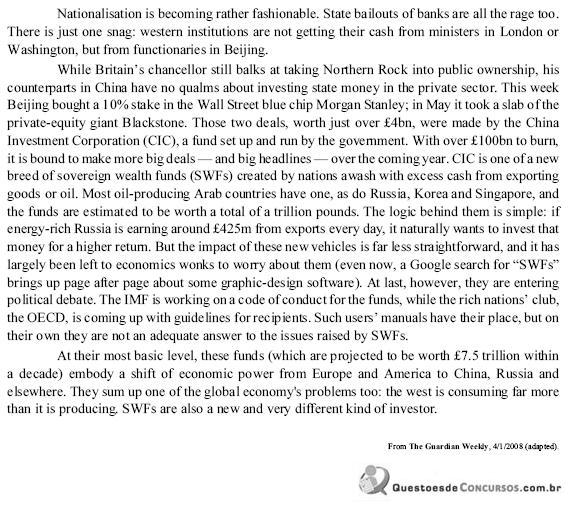
A suitable title for this text can be
Ano: 2008
Banca:
CESPE / CEBRASPE
Órgão:
Instituto Rio Branco
Prova:
CESPE - 2008 - Instituto Rio Branco - Diplomata - 2ª Etapa NORTE |
Q10422
Inglês
Taking the text into consideration, it can be deduced that
Ano: 2008
Banca:
CESPE / CEBRASPE
Órgão:
Instituto Rio Branco
Prova:
CESPE - 2008 - Instituto Rio Branco - Diplomata - 2ª Etapa NORTE |
Q10421
Inglês
According to the text, it can be said that
Ano: 2008
Banca:
CESPE / CEBRASPE
Órgão:
Instituto Rio Branco
Prova:
CESPE - 2008 - Instituto Rio Branco - Diplomata - 2ª Etapa NORTE |
Q10420
Inglês
Texto associado

Based on the text, it can be deduced that
Based on the text, it can be deduced that
the word "clashed" (l.16) is synonymous with fought, in the context.
Ano: 2008
Banca:
CESPE / CEBRASPE
Órgão:
Instituto Rio Branco
Prova:
CESPE - 2008 - Instituto Rio Branco - Diplomata - 2ª Etapa NORTE |
Q10419
Inglês
Texto associado
Based on the text, it can be deduced that
Based on the text, it can be deduced that
a possible title for this article could be: Back to abnormal.
Ano: 2008
Banca:
CESPE / CEBRASPE
Órgão:
Instituto Rio Branco
Prova:
CESPE - 2008 - Instituto Rio Branco - Diplomata - 2ª Etapa NORTE |
Q10418
Inglês
Texto associado
Based on the text, it can be deduced that
Based on the text, it can be deduced that
the border between the Gaza strip and Egypt is about 12 km in length.
Ano: 2008
Banca:
CESPE / CEBRASPE
Órgão:
Instituto Rio Branco
Prova:
CESPE - 2008 - Instituto Rio Branco - Diplomata - 2ª Etapa NORTE |
Q10417
Inglês
Texto associado
Based on the text, it can be deduced that
Based on the text, it can be deduced that
the Egyptian authorities and Hamas forces both have the same position regarding Egyptian people who want to cross the border to go to Gaza strip.
Ano: 2008
Banca:
CESPE / CEBRASPE
Órgão:
Instituto Rio Branco
Prova:
CESPE - 2008 - Instituto Rio Branco - Diplomata - 2ª Etapa NORTE |
Q10416
Inglês
Texto associado
In accordance with the text, judge - right (C) or wrong (E) - the items below.
In accordance with the text, judge - right (C) or wrong (E) - the items below.
In the text, "besieged" (l.4) means surrounded.
Ano: 2008
Banca:
CESPE / CEBRASPE
Órgão:
Instituto Rio Branco
Prova:
CESPE - 2008 - Instituto Rio Branco - Diplomata - 2ª Etapa NORTE |
Q10415
Inglês
Texto associado
In accordance with the text, judge - right (C) or wrong (E) - the items below.
In accordance with the text, judge - right (C) or wrong (E) - the items below.
After a fortnight period the situation in Gaza Strip seems to have become what can be considered as normal.
Ano: 2008
Banca:
CESPE / CEBRASPE
Órgão:
Instituto Rio Branco
Prova:
CESPE - 2008 - Instituto Rio Branco - Diplomata - 2ª Etapa NORTE |
Q10414
Inglês
Texto associado
In accordance with the text, judge - right (C) or wrong (E) - the items below.
In accordance with the text, judge - right (C) or wrong (E) - the items below.
It took Israel a lot of time to launch a counterattack which killed nine Hamas militants.
Ano: 2008
Banca:
CESPE / CEBRASPE
Órgão:
Instituto Rio Branco
Prova:
CESPE - 2008 - Instituto Rio Branco - Diplomata - 2ª Etapa NORTE |
Q10413
Inglês
Texto associado
In accordance with the text, judge - right (C) or wrong (E) - the items below.
In accordance with the text, judge - right (C) or wrong (E) - the items below.
The two suicide bombers were kept in ordinary prisons.
Ano: 2008
Banca:
CESPE / CEBRASPE
Órgão:
Instituto Rio Branco
Prova:
CESPE - 2008 - Instituto Rio Branco - Diplomata - 2ª Etapa NORTE |
Q10412
Inglês
Texto associado
According to the text, judge - right (C) or wrong (E) - the following items.
According to the text, judge - right (C) or wrong (E) - the following items.
The word "harbinger" (l.8) means: a sign that something will happen soon, often something bad.
Ano: 2008
Banca:
CESPE / CEBRASPE
Órgão:
Instituto Rio Branco
Prova:
CESPE - 2008 - Instituto Rio Branco - Diplomata - 2ª Etapa NORTE |
Q10411
Inglês
Texto associado
According to the text, judge - right (C) or wrong (E) - the following items.
According to the text, judge - right (C) or wrong (E) - the following items.
The most recent Hamas suicide operation resulted in the blowing up of two buses.
Ano: 2008
Banca:
CESPE / CEBRASPE
Órgão:
Instituto Rio Branco
Prova:
CESPE - 2008 - Instituto Rio Branco - Diplomata - 2ª Etapa NORTE |
Q10410
Inglês
Texto associado
According to the text, judge - right (C) or wrong (E) - the following items.
According to the text, judge - right (C) or wrong (E) - the following items.
The Hamas militants joined the Fatah rivals to fire rockets and mortars into Israeli urban and rural areas.
Ano: 2008
Banca:
CESPE / CEBRASPE
Órgão:
Instituto Rio Branco
Prova:
CESPE - 2008 - Instituto Rio Branco - Diplomata - 2ª Etapa NORTE |
Q10409
Inglês
Texto associado
According to the text, judge - right (C) or wrong (E) - the following items.
According to the text, judge - right (C) or wrong (E) - the following items.
Gaza's inhabitants can only have access to basic foods which come from abroad.
Ano: 2008
Banca:
CESPE / CEBRASPE
Órgão:
Instituto Rio Branco
Prova:
CESPE - 2008 - Instituto Rio Branco - Diplomata - 2ª Etapa NORTE |
Q10408
Inglês
Texto associado

Based on the text, judge - right (C) or wrong (E) - the following items.
Based on the text, judge - right (C) or wrong (E) - the following items.
In the text, "need not cost" (l.18) can be correctly replaced by does not need to cost.
Ano: 2008
Banca:
CESPE / CEBRASPE
Órgão:
Instituto Rio Branco
Prova:
CESPE - 2008 - Instituto Rio Branco - Diplomata - 2ª Etapa NORTE |
Q10407
Inglês
Texto associado
Based on the text, judge - right (C) or wrong (E) - the following items.
Based on the text, judge - right (C) or wrong (E) - the following items.
The highest polluting offices will have to dismiss their employees.
Ano: 2008
Banca:
CESPE / CEBRASPE
Órgão:
Instituto Rio Branco
Prova:
CESPE - 2008 - Instituto Rio Branco - Diplomata - 2ª Etapa NORTE |
Q10406
Inglês
Texto associado
Based on the text, judge - right (C) or wrong (E) - the following items.
Based on the text, judge - right (C) or wrong (E) - the following items.
The cost of inaction is ten times as high as the expenses arisen from the climatic control.
Ano: 2008
Banca:
CESPE / CEBRASPE
Órgão:
Instituto Rio Branco
Prova:
CESPE - 2008 - Instituto Rio Branco - Diplomata - 2ª Etapa NORTE |
Q10405
Inglês
Texto associado
Based on the text, judge - right (C) or wrong (E) - the following items.
Based on the text, judge - right (C) or wrong (E) - the following items.
The problem with renewables is the same as that of greenhouse gases.
Ano: 2008
Banca:
CESPE / CEBRASPE
Órgão:
Instituto Rio Branco
Prova:
CESPE - 2008 - Instituto Rio Branco - Diplomata - 2ª Etapa NORTE |
Q10404
Inglês
Texto associado
Considering the text above, judge - right (C) or wrong (E) - the items below.
Considering the text above, judge - right (C) or wrong (E) - the items below.
The word "Cue" (l.7) means queue.

 Conheça nossos planos