Questões de Concurso Sobre inglês
Foram encontradas 25.431 questões


Ano: 2014
Banca:
CESGRANRIO
Órgão:
EPE
Prova:
CESGRANRIO - 2014 - EPE - Assistente Administrativo - Apoio Administrativo |
Q389535
Inglês

According to the 2nd paragraph of Text II, it is clear that
Ano: 2014
Banca:
CESGRANRIO
Órgão:
EPE
Prova:
CESGRANRIO - 2014 - EPE - Assistente Administrativo - Apoio Administrativo |
Q389534
Inglês
The main purpose of Text II is to
Ano: 2014
Banca:
CESGRANRIO
Órgão:
EPE
Prova:
CESGRANRIO - 2014 - EPE - Assistente Administrativo - Apoio Administrativo |
Q389533
Inglês
Texto associado
Texto I

The meaning of groundbreaking new programs (line 40) in Text I can be replaced, without change in meaning, by programs that
Ano: 2014
Banca:
CESGRANRIO
Órgão:
EPE
Prova:
CESGRANRIO - 2014 - EPE - Assistente Administrativo - Apoio Administrativo |
Q389532
Inglês
Texto associado
Texto I
The meaning of to pursue renewable energy (line 37) in Text I can be replaced, without change in meaning, by to
Ano: 2014
Banca:
CESGRANRIO
Órgão:
EPE
Prova:
CESGRANRIO - 2014 - EPE - Assistente Administrativo - Apoio Administrativo |
Q389531
Inglês
Texto associado
Texto I
In Text I, the meaning of the boldfaced fragment in: “require constructing a new 1,200 mile-long transmission line that would potentially expose and disrupt untouched wilderness in 17 national parks and reserves” (lines 14-
Ano: 2014
Banca:
CESGRANRIO
Órgão:
EPE
Prova:
CESGRANRIO - 2014 - EPE - Assistente Administrativo - Apoio Administrativo |
Q389530
Inglês
Texto associado
Texto I
In Text I, the meaning of southernmost tip (line 1) is best understood as the
Ano: 2014
Banca:
CESGRANRIO
Órgão:
EPE
Prova:
CESGRANRIO - 2014 - EPE - Assistente Administrativo - Apoio Administrativo |
Q389529
Inglês
Texto associado
Texto I
The main purpose of Text I is to
Ano: 2014
Banca:
CESPE / CEBRASPE
Órgão:
TJ-CE
Prova:
CESPE - 2014 - TJ-CE - Analista Judiciário - Ciências Computação |
Q386559
Inglês

According to the text, the
Ano: 2014
Banca:
CESPE / CEBRASPE
Órgão:
TJ-CE
Prova:
CESPE - 2014 - TJ-CE - Analista Judiciário - Ciências Computação |
Q386558
Inglês
According to the text, the Action Plan 2011-2015
Ano: 2014
Banca:
CESPE / CEBRASPE
Órgão:
TJ-CE
Prova:
CESPE - 2014 - TJ-CE - Analista Judiciário - Ciências Computação |
Q386557
Inglês
The expression “regardless of” in “regardless of their country of origin” (l.12) can be correctly replaced by
Ano: 2014
Banca:
CESPE / CEBRASPE
Órgão:
TJ-CE
Prova:
CESPE - 2014 - TJ-CE - Analista Judiciário - Ciências Computação |
Q386556
Inglês
The pronoun “which” in “which promotes interoperability” (l.13 and 14) refers to:
Ano: 2014
Banca:
CESPE / CEBRASPE
Órgão:
TJ-CE
Prova:
CESPE - 2014 - TJ-CE - Analista Judiciário - Ciências Computação |
Q386555
Inglês
The Word “seamless” in “collaborative seamless eGovernment services” (l.8) can be correctly replaced by
Ano: 2014
Banca:
CESPE / CEBRASPE
Órgão:
TJ-CE
Prova:
CESPE - 2014 - TJ-CE - Analista Judiciário - Ciências Computação |
Q386554
Inglês
According to the text, it is correct to state that
Ano: 2014
Banca:
FUMARC
Órgão:
AL-MG
Provas:
FUMARC - 2014 - AL-MG - Analista de Sistemas - Desenvolvimento
|
FUMARC - 2014 - AL-MG - Analista de Sistemas - Administração de Rede |
Q383671
Inglês
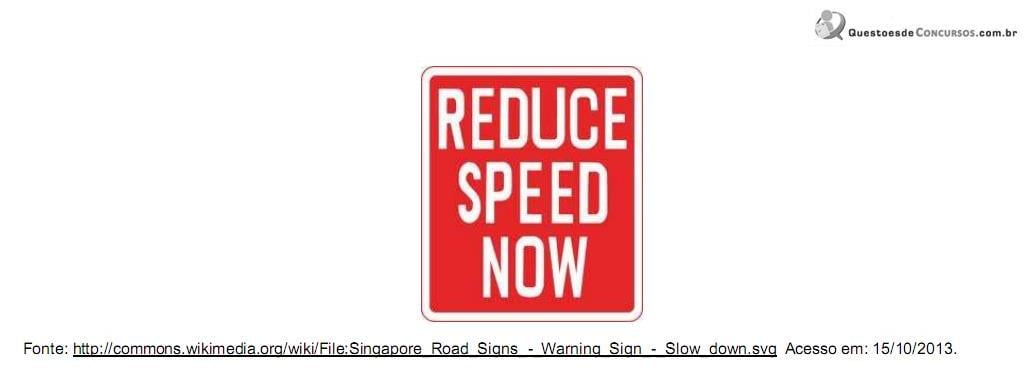
The road sign above means that you _____ reduce speed.
Ano: 2014
Banca:
FUMARC
Órgão:
AL-MG
Provas:
FUMARC - 2014 - AL-MG - Analista de Sistemas - Desenvolvimento
|
FUMARC - 2014 - AL-MG - Analista de Sistemas - Administração de Rede |
Q383670
Inglês
Texto associado
TEXT 2
Food Engineering
MAKE A DIFFERENCE BE A FOOD ENGINEER
Food engineering is the application of engineering principles to the storage, processing and distribution of food materials and _____ bio-products. It requires a sound engineering education, as well as fundamental training in chemistry and food science.
Food Engineers can make valuable contributions in various capacities of food chain such as design of processing, handling, packaging and storage equipment and systems; scale-up of prototype food processes, machinery, and equipment; product/process research and development; regulation and protection of the public health; and engineering and technical Sales.
Fonte: http://baen.tamu.edu/foodengineering/FEngr/FEngr.html Acesso em: 15/10/2013.
Food Engineering
MAKE A DIFFERENCE BE A FOOD ENGINEER
Food engineering is the application of engineering principles to the storage, processing and distribution of food materials and _____ bio-products. It requires a sound engineering education, as well as fundamental training in chemistry and food science.
Food Engineers can make valuable contributions in various capacities of food chain such as design of processing, handling, packaging and storage equipment and systems; scale-up of prototype food processes, machinery, and equipment; product/process research and development; regulation and protection of the public health; and engineering and technical Sales.
Fonte: http://baen.tamu.edu/foodengineering/FEngr/FEngr.html Acesso em: 15/10/2013.
The passive voice of the sentence “It requires a sound engineering education,” is
Ano: 2014
Banca:
FUMARC
Órgão:
AL-MG
Prova:
FUMARC - 2014 - AL-MG - Analista de Sistemas - Desenvolvimento |
Q383669
Inglês
Texto associado
TEXT 2
Food Engineering
MAKE A DIFFERENCE BE A FOOD ENGINEER
Food engineering is the application of engineering principles to the storage, processing and distribution of food materials and _____ bio-products. It requires a sound engineering education, as well as fundamental training in chemistry and food science.
Food Engineers can make valuable contributions in various capacities of food chain such as design of processing, handling, packaging and storage equipment and systems; scale-up of prototype food processes, machinery, and equipment; product/process research and development; regulation and protection of the public health; and engineering and technical Sales.
Fonte: http://baen.tamu.edu/foodengineering/FEngr/FEngr.html Acesso em: 15/10/2013.
Food Engineering
MAKE A DIFFERENCE BE A FOOD ENGINEER
Food engineering is the application of engineering principles to the storage, processing and distribution of food materials and _____ bio-products. It requires a sound engineering education, as well as fundamental training in chemistry and food science.
Food Engineers can make valuable contributions in various capacities of food chain such as design of processing, handling, packaging and storage equipment and systems; scale-up of prototype food processes, machinery, and equipment; product/process research and development; regulation and protection of the public health; and engineering and technical Sales.
Fonte: http://baen.tamu.edu/foodengineering/FEngr/FEngr.html Acesso em: 15/10/2013.
The expression such as in “in various capacities of food chain such as” indicates that some important elements
Ano: 2014
Banca:
FUMARC
Órgão:
AL-MG
Provas:
FUMARC - 2014 - AL-MG - Analista de Sistemas - Desenvolvimento
|
FUMARC - 2014 - AL-MG - Analista de Sistemas - Administração de Rede |
Q383668
Inglês
Texto associado
TEXT 2
Food Engineering
MAKE A DIFFERENCE BE A FOOD ENGINEER
Food engineering is the application of engineering principles to the storage, processing and distribution of food materials and _____ bio-products. It requires a sound engineering education, as well as fundamental training in chemistry and food science.
Food Engineers can make valuable contributions in various capacities of food chain such as design of processing, handling, packaging and storage equipment and systems; scale-up of prototype food processes, machinery, and equipment; product/process research and development; regulation and protection of the public health; and engineering and technical Sales.
Fonte: http://baen.tamu.edu/foodengineering/FEngr/FEngr.html Acesso em: 15/10/2013.
Food Engineering
MAKE A DIFFERENCE BE A FOOD ENGINEER
Food engineering is the application of engineering principles to the storage, processing and distribution of food materials and _____ bio-products. It requires a sound engineering education, as well as fundamental training in chemistry and food science.
Food Engineers can make valuable contributions in various capacities of food chain such as design of processing, handling, packaging and storage equipment and systems; scale-up of prototype food processes, machinery, and equipment; product/process research and development; regulation and protection of the public health; and engineering and technical Sales.
Fonte: http://baen.tamu.edu/foodengineering/FEngr/FEngr.html Acesso em: 15/10/2013.
The correct word to fill in the space provided in “food materials and ____ bio-products.” from text 2 is
Ano: 2014
Banca:
FUMARC
Órgão:
AL-MG
Provas:
FUMARC - 2014 - AL-MG - Analista de Sistemas - Desenvolvimento
|
FUMARC - 2014 - AL-MG - Analista de Sistemas - Administração de Rede |
Q383667
Inglês
Texto associado
TEXT 1
When was the first computer unvented?
The word "computer" was first recorded as being used in 1613 and was originally used to describe a human who performed calculations or computations. The definition of a computer remained the same until the end of the 19th century when people began to realize machines never get tired and can perform calculations much faster and more accurately than any team of human computers ever could.
In 1822, Charles Babbage began developing the Difference Engine, which was considered to be the first automatic computing engine. It was capable of computing several sets of numbers and making hard copies of the results. Unfortunately, because of funding he was never able to complete a full-scale functional version of this machine. In June of 1991, the London Science Museum completed the Difference Engine Nº 2 for the bicentenni- al year of Babbage's birth and later completed the printing mechanism in 2000.
Fonte: http://www.computerhope.com/issues/ch000984.htm Acesso em: 15/10/2013
When was the first computer unvented?
The word "computer" was first recorded as being used in 1613 and was originally used to describe a human who performed calculations or computations. The definition of a computer remained the same until the end of the 19th century when people began to realize machines never get tired and can perform calculations much faster and more accurately than any team of human computers ever could.
In 1822, Charles Babbage began developing the Difference Engine, which was considered to be the first automatic computing engine. It was capable of computing several sets of numbers and making hard copies of the results. Unfortunately, because of funding he was never able to complete a full-scale functional version of this machine. In June of 1991, the London Science Museum completed the Difference Engine Nº 2 for the bicentenni- al year of Babbage's birth and later completed the printing mechanism in 2000.
Fonte: http://www.computerhope.com/issues/ch000984.htm Acesso em: 15/10/2013
The word it in “It was capable of computing several sets of numbers” refers to
Ano: 2014
Banca:
FUMARC
Órgão:
AL-MG
Prova:
FUMARC - 2014 - AL-MG - Analista de Sistemas - Desenvolvimento |
Q383666
Inglês
Texto associado
TEXT 1
When was the first computer unvented?
The word "computer" was first recorded as being used in 1613 and was originally used to describe a human who performed calculations or computations. The definition of a computer remained the same until the end of the 19th century when people began to realize machines never get tired and can perform calculations much faster and more accurately than any team of human computers ever could.
In 1822, Charles Babbage began developing the Difference Engine, which was considered to be the first automatic computing engine. It was capable of computing several sets of numbers and making hard copies of the results. Unfortunately, because of funding he was never able to complete a full-scale functional version of this machine. In June of 1991, the London Science Museum completed the Difference Engine Nº 2 for the bicentenni- al year of Babbage's birth and later completed the printing mechanism in 2000.
Fonte: http://www.computerhope.com/issues/ch000984.htm Acesso em: 15/10/2013
When was the first computer unvented?
The word "computer" was first recorded as being used in 1613 and was originally used to describe a human who performed calculations or computations. The definition of a computer remained the same until the end of the 19th century when people began to realize machines never get tired and can perform calculations much faster and more accurately than any team of human computers ever could.
In 1822, Charles Babbage began developing the Difference Engine, which was considered to be the first automatic computing engine. It was capable of computing several sets of numbers and making hard copies of the results. Unfortunately, because of funding he was never able to complete a full-scale functional version of this machine. In June of 1991, the London Science Museum completed the Difference Engine Nº 2 for the bicentenni- al year of Babbage's birth and later completed the printing mechanism in 2000.
Fonte: http://www.computerhope.com/issues/ch000984.htm Acesso em: 15/10/2013
Write True (T) or False (N).
( ) The meaning of a computer changed a lot from 1613 to the 19th century.
( ) Only after the 19th century it was understood people calculate less quickly than machines.
( ) An updated version of the first automatic computer can be found at the London Science Museum.
( ) The meaning of a computer changed a lot from 1613 to the 19th century.
( ) Only after the 19th century it was understood people calculate less quickly than machines.
( ) An updated version of the first automatic computer can be found at the London Science Museum.
Ano: 2014
Banca:
FUMARC
Órgão:
AL-MG
Provas:
FUMARC - 2014 - AL-MG - Analista de Sistemas - Desenvolvimento
|
FUMARC - 2014 - AL-MG - Analista de Sistemas - Administração de Rede |
Q383665
Inglês
Texto associado
TEXT 1
When was the first computer unvented?
The word "computer" was first recorded as being used in 1613 and was originally used to describe a human who performed calculations or computations. The definition of a computer remained the same until the end of the 19th century when people began to realize machines never get tired and can perform calculations much faster and more accurately than any team of human computers ever could.
In 1822, Charles Babbage began developing the Difference Engine, which was considered to be the first automatic computing engine. It was capable of computing several sets of numbers and making hard copies of the results. Unfortunately, because of funding he was never able to complete a full-scale functional version of this machine. In June of 1991, the London Science Museum completed the Difference Engine Nº 2 for the bicentenni- al year of Babbage's birth and later completed the printing mechanism in 2000.
Fonte: http://www.computerhope.com/issues/ch000984.htm Acesso em: 15/10/2013
When was the first computer unvented?
The word "computer" was first recorded as being used in 1613 and was originally used to describe a human who performed calculations or computations. The definition of a computer remained the same until the end of the 19th century when people began to realize machines never get tired and can perform calculations much faster and more accurately than any team of human computers ever could.
In 1822, Charles Babbage began developing the Difference Engine, which was considered to be the first automatic computing engine. It was capable of computing several sets of numbers and making hard copies of the results. Unfortunately, because of funding he was never able to complete a full-scale functional version of this machine. In June of 1991, the London Science Museum completed the Difference Engine Nº 2 for the bicentenni- al year of Babbage's birth and later completed the printing mechanism in 2000.
Fonte: http://www.computerhope.com/issues/ch000984.htm Acesso em: 15/10/2013
The word “computer” was first used in the ___ century.

 Conheça nossos planos