Questões de Concurso Sobre inglês
Foram encontradas 25.431 questões


Leia o texto para responder às questões de números 56 a 60.
Communication Skills
There’s a great deal of talk about the need to be a good communicator in today’s workplace. But what exactly does that mean? Which among the broad set of communication skills do managers need most in their employees? And what can you do to transition from being a good communicator to a great one?
Communication: A case history
As an administrative professional, you’ve always held a highly visible role in the workplace. You have been — and continue to be — the first point of contact for outside parties, such as potential clients, investors, customers and job candidates. All of these people are likely to get their first impression of the company through their interactions with you.
What’s changed? You’re still that vital first point of contact. But increasingly, you are the “go-to” person from beginning to end for a wide range of internal and external contacts. You follow through on tasks ranging from simple information requests to complex research projects. Your wider scope of responsibility and knowledge enables you to handle a constantly growing workload. You may communicate as much in writing as you do verbally, with e-mail communication being a prominent tool.
(www.iaap-hq.org. Adaptado)
A palavra you que ocorre ao longo do texto refere-se a um leitor ideal, que é um
Leia o texto para responder às questões de números 56 a 60.
Communication Skills
There’s a great deal of talk about the need to be a good communicator in today’s workplace. But what exactly does that mean? Which among the broad set of communication skills do managers need most in their employees? And what can you do to transition from being a good communicator to a great one?
Communication: A case history
As an administrative professional, you’ve always held a highly visible role in the workplace. You have been — and continue to be — the first point of contact for outside parties, such as potential clients, investors, customers and job candidates. All of these people are likely to get their first impression of the company through their interactions with you.
What’s changed? You’re still that vital first point of contact. But increasingly, you are the “go-to” person from beginning to end for a wide range of internal and external contacts. You follow through on tasks ranging from simple information requests to complex research projects. Your wider scope of responsibility and knowledge enables you to handle a constantly growing workload. You may communicate as much in writing as you do verbally, with e-mail communication being a prominent tool.
(www.iaap-hq.org. Adaptado)
No segundo parágrafo, as seguintes pessoas mencionadas – potential clients, investors, customers and job candidates – são
Leia o texto para responder às questões de números 56 a 60.
Communication Skills
There’s a great deal of talk about the need to be a good communicator in today’s workplace. But what exactly does that mean? Which among the broad set of communication skills do managers need most in their employees? And what can you do to transition from being a good communicator to a great one?
Communication: A case history
As an administrative professional, you’ve always held a highly visible role in the workplace. You have been — and continue to be — the first point of contact for outside parties, such as potential clients, investors, customers and job candidates. All of these people are likely to get their first impression of the company through their interactions with you.
What’s changed? You’re still that vital first point of contact. But increasingly, you are the “go-to” person from beginning to end for a wide range of internal and external contacts. You follow through on tasks ranging from simple information requests to complex research projects. Your wider scope of responsibility and knowledge enables you to handle a constantly growing workload. You may communicate as much in writing as you do verbally, with e-mail communication being a prominent tool.
(www.iaap-hq.org. Adaptado)
Os profissionais administrativos
No trecho do último parágrafo – For large databases, DBA functions will in fact require the full time services of a team of many people. – a expressão in fact indica
Segundo o texto, uma das tarefas do Database Administrator (DBA) é
No trecho do último parágrafo – … protecting and maintaining the integrity of all data while addressing the interests of different present and future user communities. – a palavra while indica uma ideia de
Segundo o texto, em bancos de dados centralizados de grandes organizações, uma arquitetura adequada deve proporcionar, entre outras qualidades,
No trecho final do segundo parágrafo – … a good database architecture should provide … – a palavra should pode ser corretamente substituída, sem alteração de sentido, por
No trecho do segundo parágrafo – …efficiency in meeting user requirements. – considerando-se o contexto, a palavra meeting equivale, em português, a
The figure shows
O trecho do primeiro parágrafo – Since a database system is basically a software system (albeit complex), it too possesses an architecture. – pode ser reescrito, sem alteração de sentido, da seguinte forma:
No trecho do primeiro parágrafo – The former describes identifiable components and how they relate to one another structurally … – a expressão the former refere-se, no texto, a
According to the text,
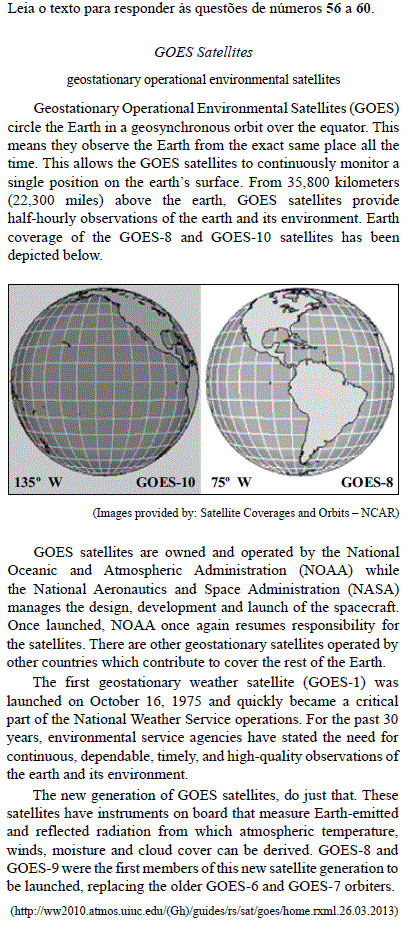
A sentença no primeiro parágrafo – This means they observe the Earth from the exact same place all the time. –
No segundo parágrafo, o termo while em – GOES satellites are owned and operated by the National Oceanic and Atmospheric Administration (NOAA) while the National Aeronautics and Space Administration (NASA) manages the design, development and launch of the spacecraft. – é corretamente substituído por
In the fourth paragraph, the term that in – The new generation of GOES satellites, do just that. – refers to the
GOES-8 and GOES-10
According to the text, GOES supply
Analise o texto a seguir:
The Internet has become such an integral part of our lives, with such powerful capabilities, that it is easy to forget that this technological marvel was created by the long, hard, dedicated efforts of human beings – folks who had a vision of what universal networking could become and worked to make it happen. The key people, projects, and organizations that helped create the Internet are described below, first in a top-level summary and then in sections in roughly chronological order.
(Extraído de: Internet History. http://www.livinginternet.com/i/ii.htm)
Baseando-se no texto apresentado, é correto afirmar que
Considere o texto a seguir:
We should point out here that the focal point of any operating system is its ‘kernel’. Without going into great detail, the kernel is what tells the big chip that controls your computer to do what you want the program that you’re using to do. To use a metaphor, if you go to your favorite Italian restaurant and order ‘Spaghetti alla Bolognese’, this dish is like your operating system. There are a lot of things that go into making that dish like pasta, tomato sauce, meatballs and cheese. Well, the kernel is like the pasta. Without pasta, that dish doesn’t exist. You might as well find some bread and make a sandwich. A plate of just pasta is fairly unappetizing.
Without a kernel, an operating system doesn’t exist. Without programs, a kernel is useless.
(Extraído de: Beginners Level Course: What is Linux? linux.org.
http://www.linux.org/threads/what-is-linux.4076/)
Segundo o texto, pode-se interpretar que

 Conheça nossos planos