Questões de Concurso Sobre inglês
Foram encontradas 25.999 questões


Ano: 2026
Banca:
Avança SP
Órgão:
Prefeitura de Jeriquara - SP
Prova:
Avança SP - 2026 - Prefeitura de Jeriquara - SP - Professor de Inglês |
Q3923401
Inglês
Texto associado
Read the text below and answer question based on the information provided.
“Research suggests that detecting false
information is difficult. When we encounter new
information, we tend to focus on understanding it
and deciding what to do next, rather than
evaluating it for accuracy. It takes effort to
compare new information with what we already
know; when new information is false but
plausible, we can learn it as fact. Several factors
may increase our susceptibility to
misinformation.
People are more likely to believe
misinformation if it comes from in-group sources
rather than out-group ones, or if they judge the
source as credible. The emotional content of
misinformation plays a role as well: People are more likely to believe false statements that
appeal to emotions such as fear and outrage.
They are also more likely to believe
misinformation that paints opponents in a
negative light than they are to believe
misinformation that is negative about their own
in-group. Finally, people are more likely to
believe repeated information, even when it
contradicts their prior knowledge. These findings
suggest that it is important to stop
misinformation early.
Susceptibility to misinformation shows
individual differences based on experience. For
example, educational attainment, analytical
reasoning, and numeracy skills can increase
resistance to misinformation, while anxiety
increases a person’s likelihood of believing it.
Older adults may be better at identifying
misinformation than younger adults, yet older
adults are also more likely to see and share false
information on social media.
Many of these effects are modest, and a
key conclusion from the existing literature is that
belief in misinformation does not always lead to
changes in a person’s attitudes, intentions, or
behaviors. In other words, what we believe does
not always translate into what we do.
Many of
these studies were conducted in laboratory and
other controlled settings, so more research is
needed in real-world contexts to determine the
full impact of misinformation on behavior and
health.”
Fonte: https://www.apa.org/topics/journalismfacts/misinformation-belief-action. Acesso em
05/01/2026 (adaptado).
How does in‑group membership influence belief
in misinformation?
Ano: 2026
Banca:
Avança SP
Órgão:
Prefeitura de Jeriquara - SP
Prova:
Avança SP - 2026 - Prefeitura de Jeriquara - SP - Professor de Inglês |
Q3923400
Inglês
Texto associado
Read the text below and answer question based on the information provided.
“Research suggests that detecting false
information is difficult. When we encounter new
information, we tend to focus on understanding it
and deciding what to do next, rather than
evaluating it for accuracy. It takes effort to
compare new information with what we already
know; when new information is false but
plausible, we can learn it as fact. Several factors
may increase our susceptibility to
misinformation.
People are more likely to believe
misinformation if it comes from in-group sources
rather than out-group ones, or if they judge the
source as credible. The emotional content of
misinformation plays a role as well: People are more likely to believe false statements that
appeal to emotions such as fear and outrage.
They are also more likely to believe
misinformation that paints opponents in a
negative light than they are to believe
misinformation that is negative about their own
in-group. Finally, people are more likely to
believe repeated information, even when it
contradicts their prior knowledge. These findings
suggest that it is important to stop
misinformation early.
Susceptibility to misinformation shows
individual differences based on experience. For
example, educational attainment, analytical
reasoning, and numeracy skills can increase
resistance to misinformation, while anxiety
increases a person’s likelihood of believing it.
Older adults may be better at identifying
misinformation than younger adults, yet older
adults are also more likely to see and share false
information on social media.
Many of these effects are modest, and a
key conclusion from the existing literature is that
belief in misinformation does not always lead to
changes in a person’s attitudes, intentions, or
behaviors. In other words, what we believe does
not always translate into what we do.
Many of
these studies were conducted in laboratory and
other controlled settings, so more research is
needed in real-world contexts to determine the
full impact of misinformation on behavior and
health.”
Fonte: https://www.apa.org/topics/journalismfacts/misinformation-belief-action. Acesso em
05/01/2026 (adaptado).
In the sentence from the text “Older adults may
be better at identifying misinformation…”, the
modal verb may is expressing…
Ano: 2026
Banca:
Avança SP
Órgão:
Prefeitura de Jeriquara - SP
Prova:
Avança SP - 2026 - Prefeitura de Jeriquara - SP - Professor de Inglês |
Q3923399
Inglês
Texto associado
Read the text below and answer question based on the information provided.
“Research suggests that detecting false
information is difficult. When we encounter new
information, we tend to focus on understanding it
and deciding what to do next, rather than
evaluating it for accuracy. It takes effort to
compare new information with what we already
know; when new information is false but
plausible, we can learn it as fact. Several factors
may increase our susceptibility to
misinformation.
People are more likely to believe
misinformation if it comes from in-group sources
rather than out-group ones, or if they judge the
source as credible. The emotional content of
misinformation plays a role as well: People are more likely to believe false statements that
appeal to emotions such as fear and outrage.
They are also more likely to believe
misinformation that paints opponents in a
negative light than they are to believe
misinformation that is negative about their own
in-group. Finally, people are more likely to
believe repeated information, even when it
contradicts their prior knowledge. These findings
suggest that it is important to stop
misinformation early.
Susceptibility to misinformation shows
individual differences based on experience. For
example, educational attainment, analytical
reasoning, and numeracy skills can increase
resistance to misinformation, while anxiety
increases a person’s likelihood of believing it.
Older adults may be better at identifying
misinformation than younger adults, yet older
adults are also more likely to see and share false
information on social media.
Many of these effects are modest, and a
key conclusion from the existing literature is that
belief in misinformation does not always lead to
changes in a person’s attitudes, intentions, or
behaviors. In other words, what we believe does
not always translate into what we do.
Many of
these studies were conducted in laboratory and
other controlled settings, so more research is
needed in real-world contexts to determine the
full impact of misinformation on behavior and
health.”
Fonte: https://www.apa.org/topics/journalismfacts/misinformation-belief-action. Acesso em
05/01/2026 (adaptado).
In the excerpt “People are more likely to believe
repeated information…”, the word more is used
to form which type of structure?
Ano: 2026
Banca:
Avança SP
Órgão:
Prefeitura de Jeriquara - SP
Prova:
Avança SP - 2026 - Prefeitura de Jeriquara - SP - Professor de Inglês |
Q3923398
Inglês
Texto associado
Read the text below and answer question based on the information provided.
“Research suggests that detecting false
information is difficult. When we encounter new
information, we tend to focus on understanding it
and deciding what to do next, rather than
evaluating it for accuracy. It takes effort to
compare new information with what we already
know; when new information is false but
plausible, we can learn it as fact. Several factors
may increase our susceptibility to
misinformation.
People are more likely to believe
misinformation if it comes from in-group sources
rather than out-group ones, or if they judge the
source as credible. The emotional content of
misinformation plays a role as well: People are more likely to believe false statements that
appeal to emotions such as fear and outrage.
They are also more likely to believe
misinformation that paints opponents in a
negative light than they are to believe
misinformation that is negative about their own
in-group. Finally, people are more likely to
believe repeated information, even when it
contradicts their prior knowledge. These findings
suggest that it is important to stop
misinformation early.
Susceptibility to misinformation shows
individual differences based on experience. For
example, educational attainment, analytical
reasoning, and numeracy skills can increase
resistance to misinformation, while anxiety
increases a person’s likelihood of believing it.
Older adults may be better at identifying
misinformation than younger adults, yet older
adults are also more likely to see and share false
information on social media.
Many of these effects are modest, and a
key conclusion from the existing literature is that
belief in misinformation does not always lead to
changes in a person’s attitudes, intentions, or
behaviors. In other words, what we believe does
not always translate into what we do.
Many of
these studies were conducted in laboratory and
other controlled settings, so more research is
needed in real-world contexts to determine the
full impact of misinformation on behavior and
health.”
Fonte: https://www.apa.org/topics/journalismfacts/misinformation-belief-action. Acesso em
05/01/2026 (adaptado).
Among the options below, what emotional factor
increases the likelihood of believing
misinformation?
Ano: 2026
Banca:
Avança SP
Órgão:
Prefeitura de Jeriquara - SP
Prova:
Avança SP - 2026 - Prefeitura de Jeriquara - SP - Professor de Inglês |
Q3923397
Inglês
Texto associado
Read the text below and answer question based on the information provided.
“Research suggests that detecting false
information is difficult. When we encounter new
information, we tend to focus on understanding it
and deciding what to do next, rather than
evaluating it for accuracy. It takes effort to
compare new information with what we already
know; when new information is false but
plausible, we can learn it as fact. Several factors
may increase our susceptibility to
misinformation.
People are more likely to believe
misinformation if it comes from in-group sources
rather than out-group ones, or if they judge the
source as credible. The emotional content of
misinformation plays a role as well: People are more likely to believe false statements that
appeal to emotions such as fear and outrage.
They are also more likely to believe
misinformation that paints opponents in a
negative light than they are to believe
misinformation that is negative about their own
in-group. Finally, people are more likely to
believe repeated information, even when it
contradicts their prior knowledge. These findings
suggest that it is important to stop
misinformation early.
Susceptibility to misinformation shows
individual differences based on experience. For
example, educational attainment, analytical
reasoning, and numeracy skills can increase
resistance to misinformation, while anxiety
increases a person’s likelihood of believing it.
Older adults may be better at identifying
misinformation than younger adults, yet older
adults are also more likely to see and share false
information on social media.
Many of these effects are modest, and a
key conclusion from the existing literature is that
belief in misinformation does not always lead to
changes in a person’s attitudes, intentions, or
behaviors. In other words, what we believe does
not always translate into what we do.
Many of
these studies were conducted in laboratory and
other controlled settings, so more research is
needed in real-world contexts to determine the
full impact of misinformation on behavior and
health.”
Fonte: https://www.apa.org/topics/journalismfacts/misinformation-belief-action. Acesso em
05/01/2026 (adaptado).
Based on the details provided, detecting false
information is often difficult because…
Ano: 2026
Banca:
Avança SP
Órgão:
Prefeitura de Jeriquara - SP
Prova:
Avança SP - 2026 - Prefeitura de Jeriquara - SP - Professor de Inglês |
Q3923396
Inglês
Texto associado
Read the text below and answer question based on the information provided.
“Research suggests that detecting false
information is difficult. When we encounter new
information, we tend to focus on understanding it
and deciding what to do next, rather than
evaluating it for accuracy. It takes effort to
compare new information with what we already
know; when new information is false but
plausible, we can learn it as fact. Several factors
may increase our susceptibility to
misinformation.
People are more likely to believe
misinformation if it comes from in-group sources
rather than out-group ones, or if they judge the
source as credible. The emotional content of
misinformation plays a role as well: People are more likely to believe false statements that
appeal to emotions such as fear and outrage.
They are also more likely to believe
misinformation that paints opponents in a
negative light than they are to believe
misinformation that is negative about their own
in-group. Finally, people are more likely to
believe repeated information, even when it
contradicts their prior knowledge. These findings
suggest that it is important to stop
misinformation early.
Susceptibility to misinformation shows
individual differences based on experience. For
example, educational attainment, analytical
reasoning, and numeracy skills can increase
resistance to misinformation, while anxiety
increases a person’s likelihood of believing it.
Older adults may be better at identifying
misinformation than younger adults, yet older
adults are also more likely to see and share false
information on social media.
Many of these effects are modest, and a
key conclusion from the existing literature is that
belief in misinformation does not always lead to
changes in a person’s attitudes, intentions, or
behaviors. In other words, what we believe does
not always translate into what we do.
Many of
these studies were conducted in laboratory and
other controlled settings, so more research is
needed in real-world contexts to determine the
full impact of misinformation on behavior and
health.”
Fonte: https://www.apa.org/topics/journalismfacts/misinformation-belief-action. Acesso em
05/01/2026 (adaptado).
According to the text, which of the elements
mentioned below can increase resistance to
misinformation?
Ano: 2026
Banca:
Instituto Fênix
Órgão:
Prefeitura de Rio dos Índios - RS
Prova:
Instituto Fênix - 2026 - Prefeitura de Rio dos Índios - RS - Professor de Inglês |
Q3921665
Inglês
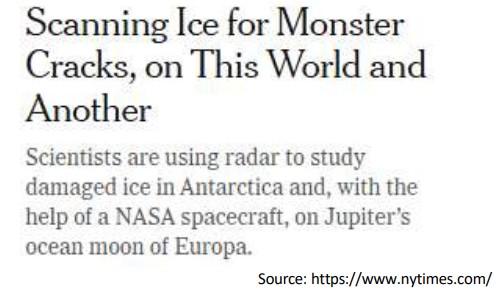
In the headline, the word “cracks” can be translated into
Portuguese as:
Ano: 2026
Banca:
Instituto Fênix
Órgão:
Prefeitura de Rio dos Índios - RS
Prova:
Instituto Fênix - 2026 - Prefeitura de Rio dos Índios - RS - Professor de Inglês |
Q3921664
Inglês
In the phrase “on this world and another”, the preposition
“on” expresses:
Ano: 2026
Banca:
Instituto Fênix
Órgão:
Prefeitura de Rio dos Índios - RS
Prova:
Instituto Fênix - 2026 - Prefeitura de Rio dos Índios - RS - Professor de Inglês |
Q3921663
Inglês
In the expression “monster cracks”, the word “monster” is
used to indicate:
Ano: 2026
Banca:
Instituto Fênix
Órgão:
Prefeitura de Rio dos Índios - RS
Prova:
Instituto Fênix - 2026 - Prefeitura de Rio dos Índios - RS - Professor de Inglês |
Q3921662
Inglês
In the headline, the word “scanning” most closely means:
Ano: 2026
Banca:
Gama Consult
Órgão:
Prefeitura de Dracena - SP
Prova:
Gama Consult - 2026 - Prefeitura de Dracena - SP - PEB II - Professor de Educação Básica II - Área de Inglês |
Q3917964
Inglês
An English teacher identified that a Brazilian student
consistently misused the word "actually" as a direct
translation of the Portuguese "atualmente," producing
sentences such as "Actually, the unemployment rate has
increased significantly," when intending to express the idea
of "at the present time." The teacher clarified that
"actually" is a false cognate meaning "in fact" or "in reality"
— used to correct or emphasize information — and that the correct English adverb to convey the temporal meaning of
"atualmente" is:
Ano: 2026
Banca:
Gama Consult
Órgão:
Prefeitura de Dracena - SP
Prova:
Gama Consult - 2026 - Prefeitura de Dracena - SP - PEB II - Professor de Educação Básica II - Área de Inglês |
Q3917963
Inglês
During a lesson on phrasal verbs, an English teacher
presented four sentences and asked students to identify
the one in which the phrasal verb is used intransitively —
that is, without a direct object following the verb-particle
combination: (I) "Don't give up — the situation might
improve"; (II) "She handed the forms in at the reception
desk"; (III) "They turned the offer down without
hesitation"; (IV) "She gave away all her old books last
week." The sentence containing an intransitive phrasal
verb is:
Ano: 2026
Banca:
Gama Consult
Órgão:
Prefeitura de Dracena - SP
Prova:
Gama Consult - 2026 - Prefeitura de Dracena - SP - PEB II - Professor de Educação Básica II - Área de Inglês |
Q3917962
Inglês
An English teacher was reviewing conditional structures
with her 3rd-year high school students when she presented
the sentence: "If I had studied medicine, I would be working
in a hospital now." She asked students to identify what type
of situation this structure describes, noting that the verb
form in the conditional clause refers to an unreal past event
while the result clause expresses a present consequence
that differs from reality. This conditional structure
expresses:
Ano: 2026
Banca:
Gama Consult
Órgão:
Prefeitura de Dracena - SP
Prova:
Gama Consult - 2026 - Prefeitura de Dracena - SP - PEB II - Professor de Educação Básica II - Área de Inglês |
Q3917961
Inglês
During a grammar lesson, an English teacher corrected
recurring errors in students' written compositions,
explaining that certain English nouns — among them
information, furniture, advice, equipment and news — are
systematically misused by Brazilian learners who add plural
inflections or precede them with the indefinite article,
mirroring patterns from Portuguese. She clarified that
these nouns have no plural form, cannot be counted
directly, and require expressions such as "a piece of" when
quantity must be specified. These nouns belong to the
grammatical category of:
Ano: 2026
Banca:
Gama Consult
Órgão:
Prefeitura de Dracena - SP
Prova:
Gama Consult - 2026 - Prefeitura de Dracena - SP - PEB II - Professor de Educação Básica II - Área de Inglês |
Q3917960
Inglês
During a lesson on clause combinations, an English teacher
explained that coordinators join two independent clauses
of equal grammatical status, while subordinators establish
a hierarchical relationship between a main clause and a
dependent one. She wrote: "Although she was exhausted,
she finished the project on time" and asked why "although"
cannot be replaced by "but" without altering the
grammatical relationship between the clauses. The teacher
explained that "although" functions as a subordinator
because it:
Ano: 2026
Banca:
Gama Consult
Órgão:
Prefeitura de Dracena - SP
Prova:
Gama Consult - 2026 - Prefeitura de Dracena - SP - PEB II - Professor de Educação Básica II - Área de Inglês |
Q3917959
Inglês
During a grammar lesson, an English teacher presented two
sentences to contrast defining and non-defining relative
clauses: (1) "The students who passed the exam celebrated
together" and (2) "My professor, who has published several
books, retired last year." She explained that in one
sentence the relative clause provides essential information
to identify the antecedent, while in the other it adds
supplementary information about an already-identified
noun — a distinction signaled by punctuation. The
sentence containing a non-defining relative clause
requiring commas is:
Ano: 2026
Banca:
Gama Consult
Órgão:
Prefeitura de Dracena - SP
Prova:
Gama Consult - 2026 - Prefeitura de Dracena - SP - PEB II - Professor de Educação Básica II - Área de Inglês |
Q3917958
Inglês
An English teacher was reviewing embedded clauses with
her advanced class when she wrote the sentence: "What
the committee decided remains confidential." She asked
students to analyze the underlined clause, noting that it
cannot stand alone as a complete sentence, that it occupies
the position typically filled by a noun phrase, and that
"what" functions here not as an interrogative pronoun but
as a clause introducer subordinating the entire embedded
clause to the main verb "remains." Students correctly
identified the syntactic function of this clause as:
Ano: 2026
Banca:
Gama Consult
Órgão:
Prefeitura de Dracena - SP
Prova:
Gama Consult - 2026 - Prefeitura de Dracena - SP - PEB II - Professor de Educação Básica II - Área de Inglês |
Q3917957
Inglês
Read the excerpt and answer the question: "Research on
bilingual education consistently demonstrates that
students who develop strong literacy skills in their first
language acquire a second language more efficiently, a
phenomenon linguists refer to as cross-linguistic transfer.
Contrary to popular assumptions, maintaining and
strengthening the mother tongue does not hinder foreign
language acquisition; rather, it provides cognitive
scaffolding upon which new linguistic knowledge is
systematically built. Policies that disregard first-language
literacy in favor of exclusive second-language immersion
may therefore undermine the bilingual development they
seek to promote." The passage's central argument is that
first-language literacy:
Ano: 2026
Banca:
FCC
Órgão:
SEFAZ-SP
Prova:
FCC - 2026 - SEFAZ-SP - Auditor Fiscal da Receita Estadual - AFRE - Tecnologia da Informação e Comunicação - Conhecimentos Gerais (P1) |
Q3916803
Inglês
Texto associado
Atenção: Considere o texto abaixo para responder à questão.
Big Techs
When tax bills are in the millions or even billions, some individuals will go to any lengths to avoid paying up
RS, HMRC, FTS or CRA: whatever you like to call him, there's no hiding from the taxman. No individual or institution is immune from
the annual tax deadline, although many aim to reduce what they pay as much as possible through regulatory loopholes and profit
redistribution schemes.
When that tips over into illegal territory, though, it becomes a major problem. The International Monetary Fund (IMF) estimates that
over $600bn is lost every year due to tax avoidance, with the US, China and Japan named as the greatest culprits.
Multinational technology companies including Google, Apple and Amazon have been slapped with multiple allegations in recent years
regarding non-payment of taxes in Europe. In 2016, Apple was ordered to pay $15.4bn in back taxes to Ireland after it was revealed
that the company paid just one percent tax on its European profits in 2003, down to 0.005 percent in 2014. That same year Google was
accused of using two regulatory loopholes, nicknamed the 'double Irish', allowing it to pay just six percent corporation tax rather than
the required 19.3 percent.
The Double Irish arrangement was a base erosion and profit shifting (BEPS) corporate tax avoidance tool used mainly by United States
multinationals since the late 1980s to avoid corporate taxation on non-US profits. (The US was one of a small number of countries that
did not use a "territorial" tax system, and taxed corporations on all profits, no matter whether the profit was made outside the US or not,
in contrast to "territorial" tax systems which tax only profits made within that country.) It was the largest tax avoidance tool in history. By
2010, it was shielding US$100 billion annually in US multinational foreign profits from taxation, and was the main tool by which US
multinationals built up untaxed offshore reserves of US$1 trillion from 2004 to 2018.
Despite US knowledge of the Double Irish for a decade, it was the European Commission that in October 2014 forced Ireland to close
the scheme, starting in January 2015. However, users of existing schemes, such as Apple, Google, Facebook and Pfizer, were given
until January 2020 to close them.
At the announcement of the closure, it was known that multinationals had replacement BEPS tools in Ireland, the Single Malt (2014),
and Capital Allowances for Intangible Assets (CAIA) (2009):
-Single malt is almost identical to the Double Irish, and was identified with Microsoft (Linkedln), and Allergan in 2017;
-CAIA can provide up to twice the tax shield of Single Malt, or Double Irish, and was identified with Apple in the 2015 leprechaun
economics affair, i.e., a huge statistical distortion in Ireland's GDP caused by Apple's tax restructuring. The company transferred
intangible assets to its Irish subsidiary, which artificially inflated the country's GDP by more than 26.3% in a single year (later
revised to 24.6%), an absurd leap for a relatively small economy. This growth did not reflect real production, but rather Apple's tax
inversion of about US$ 300 billion of its intangible assets (mainly intellectual property) to Ireland.
(Adapted from https://www.worldfinance.com/wealth-management/top-5-tax-scandals)
Segundo o texto, a principal finalidade do Double Irish era
Ano: 2026
Banca:
FCC
Órgão:
SEFAZ-SP
Prova:
FCC - 2026 - SEFAZ-SP - Auditor Fiscal da Receita Estadual - AFRE - Tecnologia da Informação e Comunicação - Conhecimentos Gerais (P1) |
Q3916802
Inglês
Texto associado
Atenção: Considere o texto abaixo para responder à questão.
Big Techs
When tax bills are in the millions or even billions, some individuals will go to any lengths to avoid paying up
RS, HMRC, FTS or CRA: whatever you like to call him, there's no hiding from the taxman. No individual or institution is immune from
the annual tax deadline, although many aim to reduce what they pay as much as possible through regulatory loopholes and profit
redistribution schemes.
When that tips over into illegal territory, though, it becomes a major problem. The International Monetary Fund (IMF) estimates that
over $600bn is lost every year due to tax avoidance, with the US, China and Japan named as the greatest culprits.
Multinational technology companies including Google, Apple and Amazon have been slapped with multiple allegations in recent years
regarding non-payment of taxes in Europe. In 2016, Apple was ordered to pay $15.4bn in back taxes to Ireland after it was revealed
that the company paid just one percent tax on its European profits in 2003, down to 0.005 percent in 2014. That same year Google was
accused of using two regulatory loopholes, nicknamed the 'double Irish', allowing it to pay just six percent corporation tax rather than
the required 19.3 percent.
The Double Irish arrangement was a base erosion and profit shifting (BEPS) corporate tax avoidance tool used mainly by United States
multinationals since the late 1980s to avoid corporate taxation on non-US profits. (The US was one of a small number of countries that
did not use a "territorial" tax system, and taxed corporations on all profits, no matter whether the profit was made outside the US or not,
in contrast to "territorial" tax systems which tax only profits made within that country.) It was the largest tax avoidance tool in history. By
2010, it was shielding US$100 billion annually in US multinational foreign profits from taxation, and was the main tool by which US
multinationals built up untaxed offshore reserves of US$1 trillion from 2004 to 2018.
Despite US knowledge of the Double Irish for a decade, it was the European Commission that in October 2014 forced Ireland to close
the scheme, starting in January 2015. However, users of existing schemes, such as Apple, Google, Facebook and Pfizer, were given
until January 2020 to close them.
At the announcement of the closure, it was known that multinationals had replacement BEPS tools in Ireland, the Single Malt (2014),
and Capital Allowances for Intangible Assets (CAIA) (2009):
-Single malt is almost identical to the Double Irish, and was identified with Microsoft (Linkedln), and Allergan in 2017;
-CAIA can provide up to twice the tax shield of Single Malt, or Double Irish, and was identified with Apple in the 2015 leprechaun
economics affair, i.e., a huge statistical distortion in Ireland's GDP caused by Apple's tax restructuring. The company transferred
intangible assets to its Irish subsidiary, which artificially inflated the country's GDP by more than 26.3% in a single year (later
revised to 24.6%), an absurd leap for a relatively small economy. This growth did not reflect real production, but rather Apple's tax
inversion of about US$ 300 billion of its intangible assets (mainly intellectual property) to Ireland.
(Adapted from https://www.worldfinance.com/wealth-management/top-5-tax-scandals)
Segundo o texto,

 Conheça nossos planos