Questões de Concurso Comentadas sobre inglês
Foram encontradas 19.377 questões


Ano: 2011
Banca:
CESGRANRIO
Órgão:
Transpetro
Provas:
CESGRANRIO - 2011 - Transpetro - Administrador Júnior
|
CESGRANRIO - 2011 - Transpetro - Analista de Sistemas Júnior |
CESGRANRIO - 2011 - Transpetro - Contador Júnior - Contábil |
CESGRANRIO - 2011 - Transpetro - Contador Júnior - Auditoria Interna |
CESGRANRIO - 2011 - Transpetro - Economista Júnior |
CESGRANRIO - 2011 - Transpetro - Engenheiro Júnior - Engenharia de Produção |
CESGRANRIO - 2011 - Transpetro - Médico do trabalho |
CESGRANRIO - 2011 - Transpetro - Engenheiro Júnior - Análise de Projetos de Inverstimentos |
CESGRANRIO - 2011 - Transpetro - Engenheiro Júnior - Geotécnica |
CESGRANRIO - 2011 - Transpetro - Engenheiro Júnior - Elétrica |
CESGRANRIO - 2011 - Transpetro - Engenheiro Júnior - Mecânica |
CESGRANRIO - 2011 - Transpetro - Profissional de Meio Ambiente Júnior |
CESGRANRIO - 2011 - Transpetro - Engenheiro Júnior - Processamento |
CESGRANRIO - 2011 - Transpetro - Engenheiro Júnior - Segurança |
CESGRANRIO - 2011 - Transpetro - Engenheiro Júnior - Naval |
CESGRANRIO - 2011 - Transpetro - Químico de Petróleo Júnior |
CESGRANRIO - 2011 - Transpetro - Engenheiro Júnior - Automação |
Q154629
Inglês
Texto associado
Model copes with chaos to deliver relief
Computer program helps responders transport
supplies in tough conditions
By Rachel Ehrenberg Science News, Web edition: Monday, February 21st, 2011
WASHINGTON — Getting blood or other perishable supplies to an area that’s been struck by an earthquake or hurricane isn’t as simple as asking what brown can do for you. But a new model quickly determines the best routes and means for delivering humanitarian aid, even in situations where bridges are out or airport tarmacs are clogged with planes.
The research, presented February 18 at the annual meeting of the American Association for the Advancement of Science, could help get supplies to areas which have experienced natural disasters or help prepare for efficient distribution of vaccines when the flu hits.
Efficient supply chains have long been a goal of manufacturers, but transport in fragile networks — where supply, demand and delivery routes may be in extremely rapid flux — requires a different approach, said Anna Nagurney of the University of Massachusetts Amherst, who presented the new work. Rather than considering the shortest path from one place to another to maximize profit, her system aims for the cleanest path at minimum cost, while capturing factors such as the perishability of the product and the uncertainty of supply routes. ‘You don’t know where demand is, so it’s tricky,’ said Nagurney. ‘It’s a multicriteria decision-making problem.’
By calculating the total cost associated with each link in a network, accounting for congestion and incorporating penalties for time and products that are lost, the computer model calculates the best supply chain in situations where standard routes may be disrupted.
‘Mathematical tools are essential to develop formal means to predict, and to respond to, such critical perturbations,’ said Iain Couzin of Princeton University, who uses similar computational tools to study collective animal behavior. ‘This is particularly important where response must be rapid and effective, such as during disaster scenarios … or during epidemics or breaches of national security.
’ The work can be applied to immediate, pressing situations, such as getting blood, food or medication to a disaster site, or to longer-term problems such as determining the best locations for manufacturing flu vaccines. . Retrieved April 7th, 2011.
Nagurney's comment “'It's a multicriteria decision-making problem.'" (lines 25-26) refers to the fact that
Ano: 2011
Banca:
CESGRANRIO
Órgão:
Transpetro
Provas:
CESGRANRIO - 2011 - Transpetro - Administrador Júnior
|
CESGRANRIO - 2011 - Transpetro - Analista de Sistemas Júnior |
CESGRANRIO - 2011 - Transpetro - Contador Júnior - Contábil |
CESGRANRIO - 2011 - Transpetro - Contador Júnior - Auditoria Interna |
CESGRANRIO - 2011 - Transpetro - Economista Júnior |
CESGRANRIO - 2011 - Transpetro - Engenheiro Júnior - Engenharia de Produção |
CESGRANRIO - 2011 - Transpetro - Médico do trabalho |
CESGRANRIO - 2011 - Transpetro - Engenheiro Júnior - Análise de Projetos de Inverstimentos |
CESGRANRIO - 2011 - Transpetro - Engenheiro Júnior - Geotécnica |
CESGRANRIO - 2011 - Transpetro - Engenheiro Júnior - Elétrica |
CESGRANRIO - 2011 - Transpetro - Engenheiro Júnior - Mecânica |
CESGRANRIO - 2011 - Transpetro - Profissional de Meio Ambiente Júnior |
CESGRANRIO - 2011 - Transpetro - Engenheiro Júnior - Processamento |
CESGRANRIO - 2011 - Transpetro - Engenheiro Júnior - Segurança |
CESGRANRIO - 2011 - Transpetro - Engenheiro Júnior - Naval |
CESGRANRIO - 2011 - Transpetro - Químico de Petróleo Júnior |
CESGRANRIO - 2011 - Transpetro - Engenheiro Júnior - Automação |
Q154628
Inglês
Texto associado
Model copes with chaos to deliver relief
Computer program helps responders transport
supplies in tough conditions
By Rachel Ehrenberg Science News, Web edition: Monday, February 21st, 2011
WASHINGTON — Getting blood or other perishable supplies to an area that’s been struck by an earthquake or hurricane isn’t as simple as asking what brown can do for you. But a new model quickly determines the best routes and means for delivering humanitarian aid, even in situations where bridges are out or airport tarmacs are clogged with planes.
The research, presented February 18 at the annual meeting of the American Association for the Advancement of Science, could help get supplies to areas which have experienced natural disasters or help prepare for efficient distribution of vaccines when the flu hits.
Efficient supply chains have long been a goal of manufacturers, but transport in fragile networks — where supply, demand and delivery routes may be in extremely rapid flux — requires a different approach, said Anna Nagurney of the University of Massachusetts Amherst, who presented the new work. Rather than considering the shortest path from one place to another to maximize profit, her system aims for the cleanest path at minimum cost, while capturing factors such as the perishability of the product and the uncertainty of supply routes. ‘You don’t know where demand is, so it’s tricky,’ said Nagurney. ‘It’s a multicriteria decision-making problem.’
By calculating the total cost associated with each link in a network, accounting for congestion and incorporating penalties for time and products that are lost, the computer model calculates the best supply chain in situations where standard routes may be disrupted.
‘Mathematical tools are essential to develop formal means to predict, and to respond to, such critical perturbations,’ said Iain Couzin of Princeton University, who uses similar computational tools to study collective animal behavior. ‘This is particularly important where response must be rapid and effective, such as during disaster scenarios … or during epidemics or breaches of national security.
’ The work can be applied to immediate, pressing situations, such as getting blood, food or medication to a disaster site, or to longer-term problems such as determining the best locations for manufacturing flu vaccines. . Retrieved April 7th, 2011.
By Rachel Ehrenberg Science News, Web edition: Monday, February 21st, 2011
WASHINGTON — Getting blood or other perishable supplies to an area that’s been struck by an earthquake or hurricane isn’t as simple as asking what brown can do for you. But a new model quickly determines the best routes and means for delivering humanitarian aid, even in situations where bridges are out or airport tarmacs are clogged with planes.
The research, presented February 18 at the annual meeting of the American Association for the Advancement of Science, could help get supplies to areas which have experienced natural disasters or help prepare for efficient distribution of vaccines when the flu hits.
Efficient supply chains have long been a goal of manufacturers, but transport in fragile networks — where supply, demand and delivery routes may be in extremely rapid flux — requires a different approach, said Anna Nagurney of the University of Massachusetts Amherst, who presented the new work. Rather than considering the shortest path from one place to another to maximize profit, her system aims for the cleanest path at minimum cost, while capturing factors such as the perishability of the product and the uncertainty of supply routes. ‘You don’t know where demand is, so it’s tricky,’ said Nagurney. ‘It’s a multicriteria decision-making problem.’
By calculating the total cost associated with each link in a network, accounting for congestion and incorporating penalties for time and products that are lost, the computer model calculates the best supply chain in situations where standard routes may be disrupted.
‘Mathematical tools are essential to develop formal means to predict, and to respond to, such critical perturbations,’ said Iain Couzin of Princeton University, who uses similar computational tools to study collective animal behavior. ‘This is particularly important where response must be rapid and effective, such as during disaster scenarios … or during epidemics or breaches of national security.
’ The work can be applied to immediate, pressing situations, such as getting blood, food or medication to a disaster site, or to longer-term problems such as determining the best locations for manufacturing flu vaccines. . Retrieved April 7th, 2011.
According to Anna Nagurney, in paragraph 3 (lines 14-26), an efficient logistics system must consider the
Ano: 2011
Banca:
CESGRANRIO
Órgão:
Transpetro
Provas:
CESGRANRIO - 2011 - Transpetro - Administrador Júnior
|
CESGRANRIO - 2011 - Transpetro - Analista de Sistemas Júnior |
CESGRANRIO - 2011 - Transpetro - Contador Júnior - Contábil |
CESGRANRIO - 2011 - Transpetro - Contador Júnior - Auditoria Interna |
CESGRANRIO - 2011 - Transpetro - Economista Júnior |
CESGRANRIO - 2011 - Transpetro - Engenheiro Júnior - Engenharia de Produção |
CESGRANRIO - 2011 - Transpetro - Médico do trabalho |
CESGRANRIO - 2011 - Transpetro - Engenheiro Júnior - Análise de Projetos de Inverstimentos |
CESGRANRIO - 2011 - Transpetro - Engenheiro Júnior - Geotécnica |
CESGRANRIO - 2011 - Transpetro - Engenheiro Júnior - Elétrica |
CESGRANRIO - 2011 - Transpetro - Engenheiro Júnior - Mecânica |
CESGRANRIO - 2011 - Transpetro - Profissional de Meio Ambiente Júnior |
CESGRANRIO - 2011 - Transpetro - Engenheiro Júnior - Processamento |
CESGRANRIO - 2011 - Transpetro - Engenheiro Júnior - Segurança |
CESGRANRIO - 2011 - Transpetro - Engenheiro Júnior - Naval |
CESGRANRIO - 2011 - Transpetro - Químico de Petróleo Júnior |
CESGRANRIO - 2011 - Transpetro - Engenheiro Júnior - Automação |
Q154627
Inglês
Texto associado
Model copes with chaos to deliver relief
Computer program helps responders transport
supplies in tough conditions
By Rachel Ehrenberg Science News, Web edition: Monday, February 21st, 2011
WASHINGTON — Getting blood or other perishable supplies to an area that’s been struck by an earthquake or hurricane isn’t as simple as asking what brown can do for you. But a new model quickly determines the best routes and means for delivering humanitarian aid, even in situations where bridges are out or airport tarmacs are clogged with planes.
The research, presented February 18 at the annual meeting of the American Association for the Advancement of Science, could help get supplies to areas which have experienced natural disasters or help prepare for efficient distribution of vaccines when the flu hits.
Efficient supply chains have long been a goal of manufacturers, but transport in fragile networks — where supply, demand and delivery routes may be in extremely rapid flux — requires a different approach, said Anna Nagurney of the University of Massachusetts Amherst, who presented the new work. Rather than considering the shortest path from one place to another to maximize profit, her system aims for the cleanest path at minimum cost, while capturing factors such as the perishability of the product and the uncertainty of supply routes. ‘You don’t know where demand is, so it’s tricky,’ said Nagurney. ‘It’s a multicriteria decision-making problem.’
By calculating the total cost associated with each link in a network, accounting for congestion and incorporating penalties for time and products that are lost, the computer model calculates the best supply chain in situations where standard routes may be disrupted.
‘Mathematical tools are essential to develop formal means to predict, and to respond to, such critical perturbations,’ said Iain Couzin of Princeton University, who uses similar computational tools to study collective animal behavior. ‘This is particularly important where response must be rapid and effective, such as during disaster scenarios … or during epidemics or breaches of national security.
’ The work can be applied to immediate, pressing situations, such as getting blood, food or medication to a disaster site, or to longer-term problems such as determining the best locations for manufacturing flu vaccines. . Retrieved April 7th, 2011.
By Rachel Ehrenberg Science News, Web edition: Monday, February 21st, 2011
WASHINGTON — Getting blood or other perishable supplies to an area that’s been struck by an earthquake or hurricane isn’t as simple as asking what brown can do for you. But a new model quickly determines the best routes and means for delivering humanitarian aid, even in situations where bridges are out or airport tarmacs are clogged with planes.
The research, presented February 18 at the annual meeting of the American Association for the Advancement of Science, could help get supplies to areas which have experienced natural disasters or help prepare for efficient distribution of vaccines when the flu hits.
Efficient supply chains have long been a goal of manufacturers, but transport in fragile networks — where supply, demand and delivery routes may be in extremely rapid flux — requires a different approach, said Anna Nagurney of the University of Massachusetts Amherst, who presented the new work. Rather than considering the shortest path from one place to another to maximize profit, her system aims for the cleanest path at minimum cost, while capturing factors such as the perishability of the product and the uncertainty of supply routes. ‘You don’t know where demand is, so it’s tricky,’ said Nagurney. ‘It’s a multicriteria decision-making problem.’
By calculating the total cost associated with each link in a network, accounting for congestion and incorporating penalties for time and products that are lost, the computer model calculates the best supply chain in situations where standard routes may be disrupted.
‘Mathematical tools are essential to develop formal means to predict, and to respond to, such critical perturbations,’ said Iain Couzin of Princeton University, who uses similar computational tools to study collective animal behavior. ‘This is particularly important where response must be rapid and effective, such as during disaster scenarios … or during epidemics or breaches of national security.
’ The work can be applied to immediate, pressing situations, such as getting blood, food or medication to a disaster site, or to longer-term problems such as determining the best locations for manufacturing flu vaccines. . Retrieved April 7th, 2011.
The communicative intention of the article is to
Ano: 2011
Banca:
CESPE / CEBRASPE
Órgão:
Instituto Rio Branco
Prova:
CESPE - 2011 - Instituto Rio Branco - Diplomata 2ª Etapa |
Q127653
Inglês

Still in the fields of semantics and grammar of the text, judge if the items below are right (C) or wrong (E).
In the fragment “All the problems of the now are forever shaped by the experiences of a then” (l.18-19), the words “now” and “then” can be replaced respectively by here and there without effecting changes in the meaning and the grammatical correction of the passage.
In the fragment “All the problems of the now are forever shaped by the experiences of a then” (l.18-19), the words “now” and “then” can be replaced respectively by here and there without effecting changes in the meaning and the grammatical correction of the passage.
Ano: 2011
Banca:
CESPE / CEBRASPE
Órgão:
Instituto Rio Branco
Prova:
CESPE - 2011 - Instituto Rio Branco - Diplomata 2ª Etapa |
Q127632
Inglês

Based on the text, judge if the items below are right (C) or wrong (E).
The basic concepts behind Wikipedia are inconsistent with the usefulness of unhindered access to the Internet.
The basic concepts behind Wikipedia are inconsistent with the usefulness of unhindered access to the Internet.
Ano: 2011
Banca:
FCC
Órgão:
TRT - 14ª Região (RO e AC)
Prova:
FCC - 2011 - TRT - 14ª Região (RO e AC) - Técnico Judiciário - Tecnologia da Informação |
Q111557
Inglês

Word 2010’s feature described above
Ano: 2011
Banca:
FCC
Órgão:
TRT - 14ª Região (RO e AC)
Prova:
FCC - 2011 - TRT - 14ª Região (RO e AC) - Técnico Judiciário - Tecnologia da Informação |
Q111553
Inglês
As questões de números 16 a 20 referem-se ao texto.
A palavra que preenche corretamente a lacuna é
A palavra que preenche corretamente a lacuna
é
Q105420
Inglês
Texto associado
Technology and legal pressure have changed
spammers’ terms of trade. They long relied on sending
more e-mails from more computers, knowing that some
will get through. But it is hard to send 100m e-mails
without someone noticing. In 2008 researchers from the
University of California at Berkeley and San Diego posed
as spammers, infiltrated a botnet and measured its
success rate. The investigation confirmed only 28 “sales”
on 350m e-mail messages sent, a conversion rate
under .00001%. Since then the numbers have got worse.
But spammers are a creative bunch.
 of tricking
consumers into a purchase, they are stealing their money
directly. Links used to direct the gullible to a site selling
counterfeits. Now they install “Trojan” software that
ransacks hard drives for bank details and the like.
Spammers also have become more sophisticated
about exploiting trust. In few places is it granted more
readily than on social-networking sites. Twitter, a forum for
short, telegram-like messages, estimates that only 1% of
its traffic is spam. But researchers from the University of
California at Berkeley and the University of Illinois at
Champaign-Urbana show that 8% of links published were
shady, with
 of them leading to scams and the rest to
Trojans. Links in Twitter messages, they found, are over
20 times more likely to get clicked than those in e-mail
spam.
Nor is Facebook as safe as it seems. As an
experiment, BitDefender, an online-security firm, set up
fake profiles on the social network and asked strangers to
enter into a digital friendship. They were able to create as
many as 100 new friends a day. Offering a profile picture,
particularly of a pretty woman, increased their odds. When
the firm’s researchers expanded their requests to strangers
who shared even one mutual friend, almost half accepted.
Worse, a quarter of BitDefender’s new friends clicked on
links posted by the firm, even when the destination was
obscured.
(Adapted from http://www.economist.com/node/17519964)
Technology and legal pressure have changed
spammers’ terms of trade. They long relied on sending
more e-mails from more computers, knowing that some
will get through. But it is hard to send 100m e-mails
without someone noticing. In 2008 researchers from the
University of California at Berkeley and San Diego posed
as spammers, infiltrated a botnet and measured its
success rate. The investigation confirmed only 28 “sales”
on 350m e-mail messages sent, a conversion rate
under .00001%. Since then the numbers have got worse.
But spammers are a creative bunch.
of tricking consumers into a purchase, they are stealing their money
directly. Links used to direct the gullible to a site selling
counterfeits. Now they install “Trojan” software that
ransacks hard drives for bank details and the like.
Spammers also have become more sophisticated
about exploiting trust. In few places is it granted more
readily than on social-networking sites. Twitter, a forum for
short, telegram-like messages, estimates that only 1% of
its traffic is spam. But researchers from the University of
California at Berkeley and the University of Illinois at
Champaign-Urbana show that 8% of links published were
shady, with
of them leading to scams and the rest to Trojans. Links in Twitter messages, they found, are over
20 times more likely to get clicked than those in e-mail
spam.
Nor is Facebook as safe as it seems. As an
experiment, BitDefender, an online-security firm, set up
fake profiles on the social network and asked strangers to
enter into a digital friendship. They were able to create as
many as 100 new friends a day. Offering a profile picture,
particularly of a pretty woman, increased their odds. When
the firm’s researchers expanded their requests to strangers
who shared even one mutual friend, almost half accepted.
Worse, a quarter of BitDefender’s new friends clicked on
links posted by the firm, even when the destination was
obscured.
(Adapted from http://www.economist.com/node/17519964)
A alternativa que preenche corretamente a lacuna  é
é
Q105418
Inglês
Texto associado
Technology and legal pressure have changed
spammers’ terms of trade. They long relied on sending
more e-mails from more computers, knowing that some
will get through. But it is hard to send 100m e-mails
without someone noticing. In 2008 researchers from the
University of California at Berkeley and San Diego posed
as spammers, infiltrated a botnet and measured its
success rate. The investigation confirmed only 28 “sales”
on 350m e-mail messages sent, a conversion rate
under .00001%. Since then the numbers have got worse.
But spammers are a creative bunch.
of tricking
consumers into a purchase, they are stealing their money
directly. Links used to direct the gullible to a site selling
counterfeits. Now they install “Trojan” software that
ransacks hard drives for bank details and the like.
Spammers also have become more sophisticated
about exploiting trust. In few places is it granted more
readily than on social-networking sites. Twitter, a forum for
short, telegram-like messages, estimates that only 1% of
its traffic is spam. But researchers from the University of
California at Berkeley and the University of Illinois at
Champaign-Urbana show that 8% of links published were
shady, with
of them leading to scams and the rest to
Trojans. Links in Twitter messages, they found, are over
20 times more likely to get clicked than those in e-mail
spam.
Nor is Facebook as safe as it seems. As an
experiment, BitDefender, an online-security firm, set up
fake profiles on the social network and asked strangers to
enter into a digital friendship. They were able to create as
many as 100 new friends a day. Offering a profile picture,
particularly of a pretty woman, increased their odds. When
the firm’s researchers expanded their requests to strangers
who shared even one mutual friend, almost half accepted.
Worse, a quarter of BitDefender’s new friends clicked on
links posted by the firm, even when the destination was
obscured.
(Adapted from http://www.economist.com/node/17519964)
Technology and legal pressure have changed
spammers’ terms of trade. They long relied on sending
more e-mails from more computers, knowing that some
will get through. But it is hard to send 100m e-mails
without someone noticing. In 2008 researchers from the
University of California at Berkeley and San Diego posed
as spammers, infiltrated a botnet and measured its
success rate. The investigation confirmed only 28 “sales”
on 350m e-mail messages sent, a conversion rate
under .00001%. Since then the numbers have got worse.
But spammers are a creative bunch.
of tricking consumers into a purchase, they are stealing their money
directly. Links used to direct the gullible to a site selling
counterfeits. Now they install “Trojan” software that
ransacks hard drives for bank details and the like.
Spammers also have become more sophisticated
about exploiting trust. In few places is it granted more
readily than on social-networking sites. Twitter, a forum for
short, telegram-like messages, estimates that only 1% of
its traffic is spam. But researchers from the University of
California at Berkeley and the University of Illinois at
Champaign-Urbana show that 8% of links published were
shady, with
of them leading to scams and the rest to Trojans. Links in Twitter messages, they found, are over
20 times more likely to get clicked than those in e-mail
spam.
Nor is Facebook as safe as it seems. As an
experiment, BitDefender, an online-security firm, set up
fake profiles on the social network and asked strangers to
enter into a digital friendship. They were able to create as
many as 100 new friends a day. Offering a profile picture,
particularly of a pretty woman, increased their odds. When
the firm’s researchers expanded their requests to strangers
who shared even one mutual friend, almost half accepted.
Worse, a quarter of BitDefender’s new friends clicked on
links posted by the firm, even when the destination was
obscured.
(Adapted from http://www.economist.com/node/17519964)
A alternativa que preenche corretamente a lacuna  é
é
Ano: 2011
Banca:
FCC
Órgão:
TRE-RN
Prova:
FCC - 2011 - TRE-RN - Analista Judiciário - Análise de Sistemas |
Q105200
Inglês


A alternativa que preenche corretamente a lacuna  é
é
Ano: 2011
Banca:
FCC
Órgão:
TRE-RN
Prova:
FCC - 2011 - TRE-RN - Analista Judiciário - Análise de Sistemas |
Q105199
Inglês
A alternativa que preenche corretamente a lacuna  é
é
Ano: 2011
Banca:
FCC
Órgão:
TRT - 14ª Região (RO e AC)
Prova:
FCC - 2011 - TRT - 14ª Região (RO e AC) - Analista Judiciário - Tecnologia da Informação |
Q103917
Inglês
Texto associado
Ten Tips for Microsoft Word and Excel
Our latest tips tell you how to make Microsoft Office 2010's word
processor and spreadsheet apps perform some handy tricks that
Microsoft has documented poorly.
By Edward Mendelson
PCMag.com's Microsoft Office 2010 tips collection
continues, this time with ten tips for Word and Excel users. Most
of these tips are fairly straightforward, and most apply to the
most recent versions of Office. Some of them, however, offer
new twists for the latest version of Office. Expert users will be
familiar with some of these ten tips, but we hope that any user
will find at least a few of these to be useful.
What kind of tips am I talking about this time? Finding
ways to perform poorly documented functions in Word and
Excel. One of these tips, for example, tells you what to do when
Word inserts a horizontal line across the page when you only
wanted to type a few dashes. In the past few months, everyone
in my family has tried and failed to wrestle an unwanted
horizontal line out of a Word document. It might not sound like a
big issue, but once you've got it in your document, good luck
finding help from Microsoft on how to get rid of it.
Some software vendors, like Adobe, continue to provide
help systems that work like improved versions of traditional
software manuals. In those apps, every menu item, every
toolbar icon, is carefully explained, and with a little patience you
can find all the information you need. Microsoft, provides
you with a kind of information supermarket, with huge essays
about topics you don't care about, dozens of selections when
you only need one, and no consistent way to find the information
you want.
Combine Portrait and Landscape Pages in a Word Document
Microsoft Word expects you to organize your documents
in a highly-structured but not very intuitive way. If you want to
format most of a document in portrait mode, but one or two
pages in landscape, you simply change the orientation
of the current page. Instead you need to insert a section break
before and after the text you want to format in landscape mode,
and then apply landscape orientation to the section that you
created. Place the insertion point at the point where you want
landscape orientation to begin. On the Page Layout tab, choose
Breaks, then, under Section Breaks, choose New Page. Then
move the insertion point to the end of the text you want to format
in landscape, and insert the same kind of break. Then put the
insertion point anywhere between the two breaks; return to the
Page Layout tab, and click the down-pointing arrow at the lower
right of the Page Setup group. In the Page Setup dialog, on the
Margins tab, select Landscape orientation, then go to the "Apply
to" dropdown and select This Section.
(Adapted from http://www.pcmag.com/article2/0,2817,
2379207,00.asp#)
Our latest tips tell you how to make Microsoft Office 2010's word
processor and spreadsheet apps perform some handy tricks that
Microsoft has documented poorly.
By Edward Mendelson
PCMag.com's Microsoft Office 2010 tips collection
continues, this time with ten tips for Word and Excel users. Most
of these tips are fairly straightforward, and most apply to the
most recent versions of Office. Some of them, however, offer
new twists for the latest version of Office. Expert users will be
familiar with some of these ten tips, but we hope that any user
will find at least a few of these to be useful.
What kind of tips am I talking about this time? Finding
ways to perform poorly documented functions in Word and
Excel. One of these tips, for example, tells you what to do when
Word inserts a horizontal line across the page when you only
wanted to type a few dashes. In the past few months, everyone
in my family has tried and failed to wrestle an unwanted
horizontal line out of a Word document. It might not sound like a
big issue, but once you've got it in your document, good luck
finding help from Microsoft on how to get rid of it.
Some software vendors, like Adobe, continue to provide
help systems that work like improved versions of traditional
software manuals. In those apps, every menu item, every
toolbar icon, is carefully explained, and with a little patience you
can find all the information you need. Microsoft,
provides you with a kind of information supermarket, with huge essays
about topics you don't care about, dozens of selections when
you only need one, and no consistent way to find the information
you want.
Combine Portrait and Landscape Pages in a Word Document
Microsoft Word expects you to organize your documents
in a highly-structured but not very intuitive way. If you want to
format most of a document in portrait mode, but one or two
pages in landscape, you
simply change the orientation of the current page. Instead you need to insert a section break
before and after the text you want to format in landscape mode,
and then apply landscape orientation to the section that you
created. Place the insertion point at the point where you want
landscape orientation to begin. On the Page Layout tab, choose
Breaks, then, under Section Breaks, choose New Page. Then
move the insertion point to the end of the text you want to format
in landscape, and insert the same kind of break. Then put the
insertion point anywhere between the two breaks; return to the
Page Layout tab, and click the down-pointing arrow at the lower
right of the Page Setup group. In the Page Setup dialog, on the
Margins tab, select Landscape orientation, then go to the "Apply
to" dropdown and select This Section.
(Adapted from http://www.pcmag.com/article2/0,2817,
2379207,00.asp#)
A expressão que preenche a lacuna  corretamente é
Ano: 2011
Banca:
CESGRANRIO
Órgão:
Petrobras
Provas:
CESGRANRIO - 2011 - Petrobras - Administrador Júnior
|
CESGRANRIO - 2011 - Petrobrás - Auditor Júnior |
CESGRANRIO - 2011 - Petrobrás - Contador Júnior |
CESGRANRIO - 2011 - Petrobrás - Químico de Petróleo Júnior |
CESGRANRIO - 2011 - Petrobrás - Engenheiro Civil Júnior |
CESGRANRIO - 2011 - Petrobrás - Enfermeiro do Trabalho Júnior |
CESGRANRIO - 2011 - Petrobras - Engenheiro de Equipamento Júnior - Mecânica |
CESGRANRIO - 2011 - Petrobras - Engenheiro de Equipamento Júnior - Inspeção |
CESGRANRIO - 2011 - Petrobras - Engenheiro de Equipamento Júnior - Elétrica |
CESGRANRIO - 2011 - Petrobras - Engenheiro de Equipamento Júnior - Terminais e Dutos |
CESGRANRIO - 2011 - Petrobras - Engenheiro de Equipamento Júnior - Eletrônica |
CESGRANRIO - 2011 - Petrobras - Engenheiro de Produção Júnior |
CESGRANRIO - 2011 - Petrobras - Engenheiro de Meio Ambiente Júnior |
CESGRANRIO - 2011 - Petrobras - Engenheiro de Telecomunicações Júnior |
CESGRANRIO - 2011 - Petrobrás - Engenheiro de Segurança do Trabalho |
CESGRANRIO - 2011 - Petrobras - Engenheiro Naval Júnior |
CESGRANRIO - 2011 - Petrobras - Engenheiro de Petróleo Júnior |
CESGRANRIO - 2011 - Petrobras - Geólogo Júnior |
CESGRANRIO - 2011 - Petrobras - Médico do trabalho |
CESGRANRIO - 2011 - Petrobras - Profissional de Comunicação Júnior - Publicidade e Propaganda |
CESGRANRIO - 2011 - Petrobrás - Profissional de Comunicação Júnior - Jornalismo |
CESGRANRIO - 2011 - Petrobras - Geofísico Júnior - Geologia |
CESGRANRIO - 2011 - Petrobrás - Engenheiro de Processamento Júnior |
CESGRANRIO - 2011 - Petrobrás - Geofísico Júnior - Física |
Q87999
Inglês
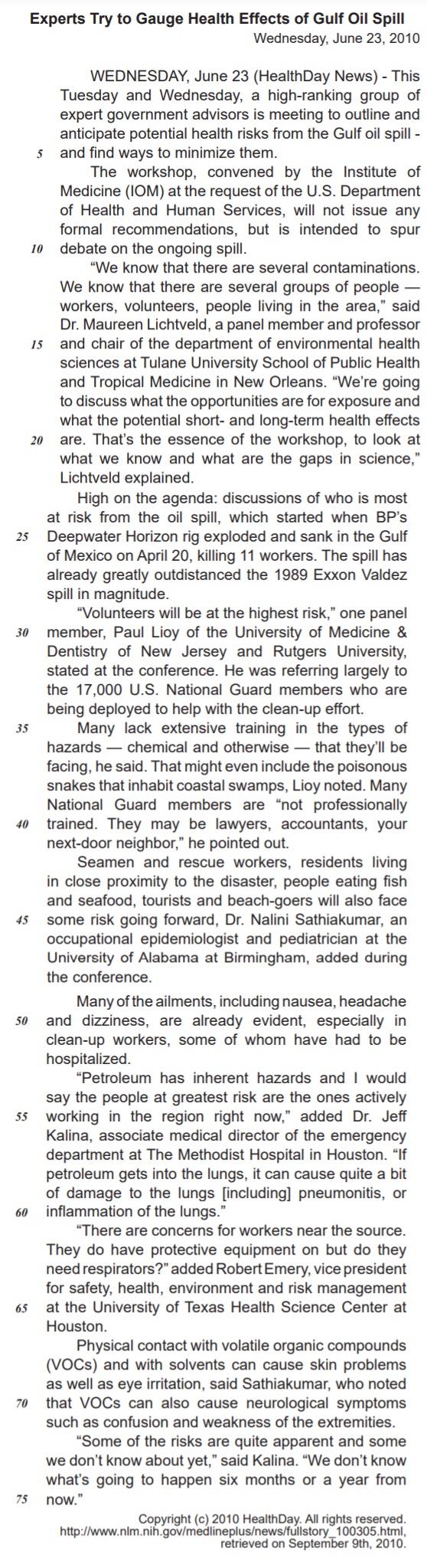
In the fragments “to look at what we know and what are the gaps in science," (lines 20-21) and “'They may be lawyers, accountants, your next-door neighbor', he pointed out." (lines 40-41), the expressions look at and pointed out mean, respectively,
Ano: 2011
Banca:
CESGRANRIO
Órgão:
Petrobras
Provas:
CESGRANRIO - 2011 - Petrobras - Administrador Júnior
|
CESGRANRIO - 2011 - Petrobrás - Auditor Júnior |
CESGRANRIO - 2011 - Petrobrás - Contador Júnior |
CESGRANRIO - 2011 - Petrobrás - Químico de Petróleo Júnior |
CESGRANRIO - 2011 - Petrobrás - Engenheiro Civil Júnior |
CESGRANRIO - 2011 - Petrobrás - Enfermeiro do Trabalho Júnior |
CESGRANRIO - 2011 - Petrobras - Engenheiro de Equipamento Júnior - Mecânica |
CESGRANRIO - 2011 - Petrobras - Engenheiro de Equipamento Júnior - Inspeção |
CESGRANRIO - 2011 - Petrobras - Engenheiro de Equipamento Júnior - Elétrica |
CESGRANRIO - 2011 - Petrobras - Engenheiro de Equipamento Júnior - Terminais e Dutos |
CESGRANRIO - 2011 - Petrobras - Engenheiro de Equipamento Júnior - Eletrônica |
CESGRANRIO - 2011 - Petrobras - Engenheiro de Produção Júnior |
CESGRANRIO - 2011 - Petrobras - Engenheiro de Meio Ambiente Júnior |
CESGRANRIO - 2011 - Petrobras - Engenheiro de Telecomunicações Júnior |
CESGRANRIO - 2011 - Petrobrás - Engenheiro de Segurança do Trabalho |
CESGRANRIO - 2011 - Petrobras - Engenheiro Naval Júnior |
CESGRANRIO - 2011 - Petrobras - Engenheiro de Petróleo Júnior |
CESGRANRIO - 2011 - Petrobras - Geólogo Júnior |
CESGRANRIO - 2011 - Petrobras - Médico do trabalho |
CESGRANRIO - 2011 - Petrobras - Profissional de Comunicação Júnior - Publicidade e Propaganda |
CESGRANRIO - 2011 - Petrobrás - Profissional de Comunicação Júnior - Jornalismo |
CESGRANRIO - 2011 - Petrobras - Geofísico Júnior - Geologia |
CESGRANRIO - 2011 - Petrobrás - Engenheiro de Processamento Júnior |
CESGRANRIO - 2011 - Petrobrás - Geofísico Júnior - Física |
Q87929
Inglês
In replacing the word “if" in the sentence “If petroleum gets into the lungs, it can cause quite a bit of damage to the lungs [including] pneumonitis, or inflammation of the lungs." (lines 57-60), the linking element that would significantly change the meaning expressed in the original is
Ano: 2011
Banca:
CESGRANRIO
Órgão:
Petrobras
Provas:
CESGRANRIO - 2011 - Petrobras - Administrador Júnior
|
CESGRANRIO - 2011 - Petrobrás - Auditor Júnior |
CESGRANRIO - 2011 - Petrobrás - Contador Júnior |
CESGRANRIO - 2011 - Petrobrás - Químico de Petróleo Júnior |
CESGRANRIO - 2011 - Petrobrás - Engenheiro Civil Júnior |
CESGRANRIO - 2011 - Petrobrás - Enfermeiro do Trabalho Júnior |
CESGRANRIO - 2011 - Petrobras - Engenheiro de Equipamento Júnior - Mecânica |
CESGRANRIO - 2011 - Petrobras - Engenheiro de Equipamento Júnior - Inspeção |
CESGRANRIO - 2011 - Petrobras - Engenheiro de Equipamento Júnior - Elétrica |
CESGRANRIO - 2011 - Petrobras - Engenheiro de Equipamento Júnior - Terminais e Dutos |
CESGRANRIO - 2011 - Petrobras - Engenheiro de Equipamento Júnior - Eletrônica |
CESGRANRIO - 2011 - Petrobras - Engenheiro de Produção Júnior |
CESGRANRIO - 2011 - Petrobras - Engenheiro de Meio Ambiente Júnior |
CESGRANRIO - 2011 - Petrobras - Engenheiro de Telecomunicações Júnior |
CESGRANRIO - 2011 - Petrobrás - Engenheiro de Segurança do Trabalho |
CESGRANRIO - 2011 - Petrobras - Engenheiro Naval Júnior |
CESGRANRIO - 2011 - Petrobras - Engenheiro de Petróleo Júnior |
CESGRANRIO - 2011 - Petrobras - Geólogo Júnior |
CESGRANRIO - 2011 - Petrobras - Médico do trabalho |
CESGRANRIO - 2011 - Petrobras - Profissional de Comunicação Júnior - Publicidade e Propaganda |
CESGRANRIO - 2011 - Petrobrás - Profissional de Comunicação Júnior - Jornalismo |
CESGRANRIO - 2011 - Petrobras - Geofísico Júnior - Geologia |
CESGRANRIO - 2011 - Petrobrás - Engenheiro de Processamento Júnior |
CESGRANRIO - 2011 - Petrobrás - Geofísico Júnior - Física |
Q87925
Inglês
Based on the meanings in the text,
Ano: 2011
Banca:
CESGRANRIO
Órgão:
Petrobras
Provas:
CESGRANRIO - 2011 - Petrobras - Administrador Júnior
|
CESGRANRIO - 2011 - Petrobrás - Auditor Júnior |
CESGRANRIO - 2011 - Petrobrás - Contador Júnior |
CESGRANRIO - 2011 - Petrobrás - Químico de Petróleo Júnior |
CESGRANRIO - 2011 - Petrobrás - Engenheiro Civil Júnior |
CESGRANRIO - 2011 - Petrobrás - Enfermeiro do Trabalho Júnior |
CESGRANRIO - 2011 - Petrobras - Engenheiro de Equipamento Júnior - Mecânica |
CESGRANRIO - 2011 - Petrobras - Engenheiro de Equipamento Júnior - Inspeção |
CESGRANRIO - 2011 - Petrobras - Engenheiro de Equipamento Júnior - Elétrica |
CESGRANRIO - 2011 - Petrobras - Engenheiro de Equipamento Júnior - Terminais e Dutos |
CESGRANRIO - 2011 - Petrobras - Engenheiro de Equipamento Júnior - Eletrônica |
CESGRANRIO - 2011 - Petrobras - Engenheiro de Produção Júnior |
CESGRANRIO - 2011 - Petrobras - Engenheiro de Meio Ambiente Júnior |
CESGRANRIO - 2011 - Petrobras - Engenheiro de Telecomunicações Júnior |
CESGRANRIO - 2011 - Petrobrás - Engenheiro de Segurança do Trabalho |
CESGRANRIO - 2011 - Petrobras - Engenheiro Naval Júnior |
CESGRANRIO - 2011 - Petrobras - Engenheiro de Petróleo Júnior |
CESGRANRIO - 2011 - Petrobras - Geólogo Júnior |
CESGRANRIO - 2011 - Petrobras - Médico do trabalho |
CESGRANRIO - 2011 - Petrobras - Profissional de Comunicação Júnior - Publicidade e Propaganda |
CESGRANRIO - 2011 - Petrobrás - Profissional de Comunicação Júnior - Jornalismo |
CESGRANRIO - 2011 - Petrobras - Geofísico Júnior - Geologia |
CESGRANRIO - 2011 - Petrobrás - Engenheiro de Processamento Júnior |
CESGRANRIO - 2011 - Petrobrás - Geofísico Júnior - Física |
Q87923
Inglês
According to the text, all the examples below are illnesses directly associated with the recent oil spill in the Gulf of Mexico, EXCEPT
Ano: 2011
Banca:
CESGRANRIO
Órgão:
Petrobras
Provas:
CESGRANRIO - 2011 - Petrobras - Administrador Júnior
|
CESGRANRIO - 2011 - Petrobrás - Auditor Júnior |
CESGRANRIO - 2011 - Petrobrás - Contador Júnior |
CESGRANRIO - 2011 - Petrobrás - Químico de Petróleo Júnior |
CESGRANRIO - 2011 - Petrobrás - Engenheiro Civil Júnior |
CESGRANRIO - 2011 - Petrobrás - Enfermeiro do Trabalho Júnior |
CESGRANRIO - 2011 - Petrobras - Engenheiro de Equipamento Júnior - Mecânica |
CESGRANRIO - 2011 - Petrobras - Engenheiro de Equipamento Júnior - Inspeção |
CESGRANRIO - 2011 - Petrobras - Engenheiro de Equipamento Júnior - Elétrica |
CESGRANRIO - 2011 - Petrobras - Engenheiro de Equipamento Júnior - Terminais e Dutos |
CESGRANRIO - 2011 - Petrobras - Engenheiro de Equipamento Júnior - Eletrônica |
CESGRANRIO - 2011 - Petrobras - Engenheiro de Produção Júnior |
CESGRANRIO - 2011 - Petrobras - Engenheiro de Meio Ambiente Júnior |
CESGRANRIO - 2011 - Petrobras - Engenheiro de Telecomunicações Júnior |
CESGRANRIO - 2011 - Petrobrás - Engenheiro de Segurança do Trabalho |
CESGRANRIO - 2011 - Petrobras - Engenheiro Naval Júnior |
CESGRANRIO - 2011 - Petrobras - Engenheiro de Petróleo Júnior |
CESGRANRIO - 2011 - Petrobras - Geólogo Júnior |
CESGRANRIO - 2011 - Petrobras - Médico do trabalho |
CESGRANRIO - 2011 - Petrobras - Profissional de Comunicação Júnior - Publicidade e Propaganda |
CESGRANRIO - 2011 - Petrobrás - Profissional de Comunicação Júnior - Jornalismo |
CESGRANRIO - 2011 - Petrobras - Geofísico Júnior - Geologia |
CESGRANRIO - 2011 - Petrobrás - Engenheiro de Processamento Júnior |
CESGRANRIO - 2011 - Petrobrás - Geofísico Júnior - Física |
Q87922
Inglês
The main purpose of the article is to
Ano: 2011
Banca:
COPEVE-UFAL
Órgão:
UFAL
Provas:
COPEVE-UFAL - 2011 - UFAL - Secretário Executivo
|
COPEVE-UFAL - 2011 - UFAL - Analista de Tecnologia da Informação |
Q87751
Inglês
Cada opção abaixo revela uma mensagem eletrônica que um aluno universitário enviou para uma universidade americana solicitando informações sobre os cursos de pós-graduação. Qual é a única opção que apresenta a mensagem gramaticalmente correta?
Ano: 2011
Banca:
COPEVE-UFAL
Órgão:
UFAL
Provas:
COPEVE-UFAL - 2011 - UFAL - Secretário Executivo
|
COPEVE-UFAL - 2011 - UFAL - Analista de Tecnologia da Informação |
Q87750
Inglês
Dados os procedimentos abaixo que se referem ao processo de organizar um evento (pré-evento, evento propriamente dito e pós evento),
I. One procedure the person in charge should do is to gather essential information (contact information, checklist, logistical details, etc) that will be referred to on a continuous basis throughout the event planning process and organize it into a userfriendly system.
II. After organizing reference information, the person responsible for the event has to establish communication with the team. It is important to develop a support network and preventing duplication of efforts. The first meeting should bring all participants to the same page.
III. In order to follow up, it is important to have some sort of follow up in form of document for the purpose of evaluating the planned activities and determining whether the projected goals of the event were met.
IV. If the big day has arrived, make sure that you have checked and double checked to verify that all items. The best way to do this may be by using a checklist.
verifica-se que
Ano: 2011
Banca:
COPEVE-UFAL
Órgão:
UFAL
Provas:
COPEVE-UFAL - 2011 - UFAL - Secretário Executivo
|
COPEVE-UFAL - 2011 - UFAL - Analista de Tecnologia da Informação |
Q87749
Inglês
Cada item abaixo é uma definição de uma etapa de um projeto.
I. A multilevel, multi-sectored package of measures, requiring multilevel planning and structuring, leading towards an overall goal.
II. One or more processes in which an individual or group takes part in specific decision-making and action, and over which they may exercise specific controls.
III. Result of a project relative to its objective that are sufficient and necessary to achieve the objective and are generated by its respective partner’s output.
IV. The intended physical, financial, institutional, social, environmental, educational or other goals which a project is expected to achieve and which lies in its own sphere of influence.
Associe cada definição com um substantivo que a sinteza:

 Conheça nossos planos