Questões de Concurso Sobre pronúncia e som | pronunciation and sound em inglês

Foram encontradas 186 questões

Q1719855 Inglês
        Ba-room, ba-room, ba-room, baripity, baripity, baripity, baripity. Good. His dad had the pickup going. He could get up now. Jess slid out of bed and into his overalls. He didn't worry about a shirt because once he began running he would be hot as popping grease even if the morning air was chill, or shoes because the bottoms of his feet were by now as tough as his worn-out sneakers.
        "Where you going, Jess?" May Belle lifted herself up sleepily from the double bed where she and Joyce Ann slept.
        "Sh." He warned. The walls were thin. Momma would he mad as flies in a fruit jar if they woke her up this time of day.
        He patted May Belle's hair and yanked the twisted sheet up to her small chin. "Just over the cow field," he whispered. May Belle smiled and snuggled down under the sheet.
        "Gonna run?"
        "Maybe."
        Of course he was going to run. He had gotten up early every day all summer to run. He figured if he worked at it – and Lord, had he worked – he could be the fastest runner in the fifth grade when school opened up. He had to be the fastest – not one of the fastest or next to the fastest, but the fastest. The very best.


(Excerpt from Bridge to Terabithia, by Katherine Paterson. Available on https://www.e-reading.club/bookreader.php/135126/Patterson_- _Bridge_to_Terabithia.pdf)
“Not one of the fastest, but the fastest.” The word THE is pronounced differently depending on the context. Choose the option that shows the right pronunciation of each underlined word.
Alternativas
Q1625011 Inglês
The English language is full of words whose written form can be deceptive. Different from Portuguese, in English we rarely sound out all the letters that we see. Due to the history of the language, there are a lot of silent letters in English. Analyze the following statements and identify the correct ones:
I- The b is silent in doubt, comb and bomb. In the word tomb, the b is pronounced.
II- The p is silent in the following words: psychology, raspberry, receipt, cupboard
III- The l is silent in talk, walk, chalk, would, half.
IV- The h is silent in heir, hour, honor, honest, helicopter.
V- The t is silent in listen, Christmas, castle, whistle.
Choose the alternative with the correct answer: 
Alternativas
Q1625010 Inglês
In relation to the sounds of the English language, classify the assertions below into true (T) or false (F):
( ) The words thanks, thought, and teeth are produced with the voiceless “th”, while the words they, those and then are produced with the voiced “th”.
( ) The nasal /m/ doesn’t occur in final position in Portuguese at all. In English, it occurs in words such as aim, them and system. In both languages, lips don’t touch.
( ) The words cough and coffee are pronounced the same way. Both have one syllable.
( ) The words two and chew are pronounced the same way.
( ) Umbrella and uniform start with the same letter, but we say an umbrella and a uniform. Umbrella starts with a vowel sound but uniform starts with a semivowel sound.
Choose the alternative with the correct sequence:
Alternativas
Q1607904 Inglês
A minimal pair is a pair of words that have different meanings and are pronounced the same, except for one sound, for example; take and tape. This can be studied in:
Alternativas
Q1607899 Inglês
Phonology, also known as phonemics, is the study of the particular sound units (phonemes) in languages. It can be compared to phonetics, which is the study of human speech in general, and includes the articulation and perception of sounds. About this area it is correct to affirm that it includes:
Alternativas
Q1607897 Inglês
When teaching my daughter how to drive, I told her if she didn't hit the brake in time she would break the car's side mirror. In brake and break we can clearly see an example of
Alternativas
Q1374290 Inglês

Leia o texto e responda à questão.


    For years attention has been paid to so-called communicative tests – usually implying tests dealing with speaking. More recently, efforts have been made to design truly communicative tests of other language skills as well, such as reading comprehension.

    Canale (1984) points out that a good test is not just one which is valid, reliable, and practical in terms of test administration and scoring, but rather one that is accepted as fair, important and interesting by test takers (the teachers) and test users (the students). Also, a good test has feedback potential, rewarding both teachers and students with clear, rich, relevant, and generalizable information. Canale suggests that acceptability and feedback potential have often been accorded low priority, thus explaining the curious phenomenon of multiple-choice tests claiming to assess oral interaction skills.

    One example of a communicative test has been referred to as a “storyline” test. In such a test, a common theme runs throughout in order to assess the effects of context. The basis for such an approach is that the respondents learn as they read on, that they check previous content, and that the ability to use language in conversation or writing depends in large measure on the skill of picking up information from past discussion and using it in formulating new strategies.

    Swain (1984), for example, developed a storyline test of French as a foreign language for high school French immersion students. The test consisted of six tasks around a common theme, “finding summer employment”. There were four writing tasks (a letter, a note, a composition, a technical exercise) and two speaking tasks (a group discussion and a job interview). The test was designed so that the topic would be motivating to the students and so that there would be enough information provided in order to give the tasks credibility. There was access to dictionaries and reference material, and opportunity for students to review and revise their work. Swain’s main concern was to “bias for best” in the construction of the test – to make every effort to support the respondent in doing their best on the test.


(Andrew D.Cohen. Second Language Assessment. IN: Marianne Celce-Murcia(ed). Teaching English as a second or foreign language. Boston, Massachusstes: Heinle&Heinle. 2nd edition. 2001. Adaptado)

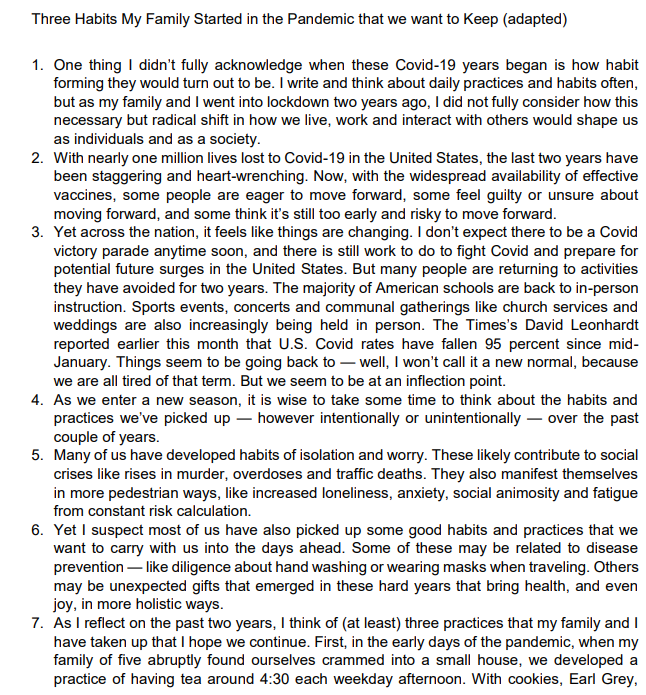
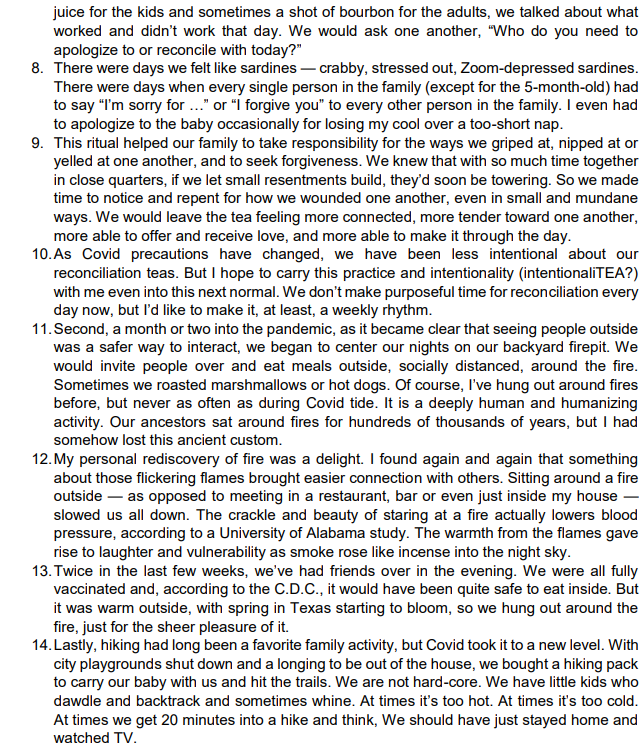
A letra g não é pronunciada em muitas palavras na língua inglesa. Das palavras a seguir, retiradas do texto, assinale aquela em que a letra g é pronunciada.
Alternativas
Q1304461 Inglês

Instruction: answer the question based one the following text.


Consider the expression “iH8You69” (line 43) and the following sentences:


I. It plays with the sound of the word ‘eight’ and ‘hate’.

II. It is a slang commonly used in texting.

III. It is an abbreviation.


Which ones are correct?

Alternativas
Q1159387 Inglês

Leia o texto e responda à questão.


      In a research project at the University of Illinois, US, Savignon (1972) adopted the term ‘communicative competence’ to characterize the ability of classroom language learners to interact with other speakers, to make meaning, as distinct from their ability to recite dialogs or perform on discrete-point tests of grammatical knowledge.

      At a time when pattern practice and error avoidance were the rule in language teaching, this study of classroom acquisition of language looked at the effect of practice on the use of coping strategies as part of an instructional program. By encouraging students to ask for information, to seek out clarification, or to use whatever linguistic or nonlinguistic resources they could gather to negotiate meaning and stick to the communicative task at hand, teachers were invariably leading learners to take risks and speak in other than memorized patterns.

      Test results at the end of the instructional period showed conclusively that learners who practiced communication in place of laboratory pattern drills performed with no less accuracy on discrete-points tests of grammatical structure. On the other hand, their communicative competence as measured in terms of fluency, comprehensibility, effort and amount of communication in unrehearsed oral communication tasks significantly surpassed that of learners who had had no such practice. Learners’ reactions to the test formats added further support to the view that even beginners respond well to activities that let them focus on meaning rather than formal features.

(Sandra J. Savignon. Communicative language teaching for the twenty-first century. In: Marianne Celce-Murcia. Teaching English as a second or foreign language. Adaptado)

Assinale a alternativa que apresenta a palavra em que o -ed final é pronunciado como uma sílaba extra, da mesma forma que em “adopted”.
Alternativas
Q2002592 Inglês
Levando em consideração a fonologia da língua inglesa, escolha a asserção correta quanto aos fonemas encontrados nas palavras retiradas do texto.
Alternativas
Q1798478 Inglês

QUESTION


https://br.pinterest.com/pin/413979390740412979/?lp= true Accessed on: 22/06/2018

(Concurso Milagres/2018) In the word listen, the letter T is silent. Silent letters are not pronounced but they appear in the spelling form of a word. Check the alternative in which all the words contain a silent letter, as in listen:
Alternativas
Q1798474 Inglês
Using authentic material from the real world to teach English
STEFFANIE ZAZULAK

   There are lots of resources available to English language teachers today: from textbooks to online teaching tools, they can all aid and enrich English lessons. Many teachers also introduce authentic English material into their lessons to expose learners to the language as it is spoken in the real world.
   Authentic material is any material written in English that was not created for intentional use in the English language classroom. Using this content to teach the English language can make the learning process even more engaging, imaginative and motivating for students. It can also be useful to elicit genuine responses from learners.
   The great thing about using authentic material is that it is everywhere, which makes it easy to find, and simple for learners to practice English in their own time. Remember that it isn‟t limited to articles from newspapers and magazines. Songs, TV programs and films, radio and podcasts, leaflets, menus – anything written in English constitutes authentic material. (…)
Source: https://www.english.com/blog/authenticmaterial/ Accessed on: 18/06/2018.
(Concurso Milagres/2018) The word limited (3rd paragraph) is constituted by three syllables with the first one being stressed, as represented by the phonetic transcription: /ˈlɪm.ɪ.tɪd/. Check the alternative in which the words follow the same number of syllables and the same stress pattern of the word limited
Alternativas
Q1798467 Inglês
TEACHING GRAMMAR IN THE POST COMMUNICATIVE APPROACH ERA
D I A N A B A U D U C C O

   Grammar. To teach or not to teach? This has been the question that language teachers have asked themselves for ages. It has been a matter of debate for teachers, linguists and second language acquisition experts.
   Historically, language teaching approaches and methods have moved from one extreme of the spectrum to another as regards the explicit teaching of grammar. Long before our times, grammar was at the centre of language teaching, as it was believed that the study of the grammar of X‟s language was the best way to its mastery. So, from medieval times till around the 1970s, the fixation of language teaching on the study and description of structures manifested in approaches such as the Grammar Translation and the Audio Lingual method, with short interludes of the other approaches such as the Direct Method, Total Physical Response and the Silent way which although claiming to differ still based their syllabus on grammar points.
   From the Grammar-dominated end of the spectrum, we moved to the Absolutely-noGrammar end. Grammar based approaches proved inadequate in that students were unable to communicate outside the classroom. Based mainly on Hymes‟ “communicative competence” and Krashen‟s models of language acquisition, the Communicative Approach emerged as the meaning-focused alternative to the formfocused approaches of the past. Strong versions of the approach emphasized the teaching of functions and absolutely discouraged the teaching of grammar structures arguing that communication – and not language description- was the aim of language teaching.
   However, the studies of the last 30 years have proved that the lack of grammar instruction has not encouraged language acquisition. On the contrary, more recent studies show that grammar instruction and explicit knowledge of the target language do have positive effects on language acquisition. So, how should we approach the teaching of Grammar in the Post- CommunicativeApproach Era?

Source: https://www.eflmagazine.com/teachinggrammar-post-communicative-approach-era/ Accessed on 17/06/2018
(Concurso Milagres/2018) Check the alternative which contains the sound of the – ed in the verbs: moved, emphasized and proved:
Alternativas
Q1309434 Inglês
All the set of words contain the same phonetic symbol / sound, EXCEPT one. Choose the INCORRECT answer.
Alternativas
Q1301941 Inglês

Answer the question based on the following text.

Source: adapted from https://www.theguardian.com/books/2018/sep/19/oed-appeals-to-teenagers-to-help-itunderstand-slang-dictionary
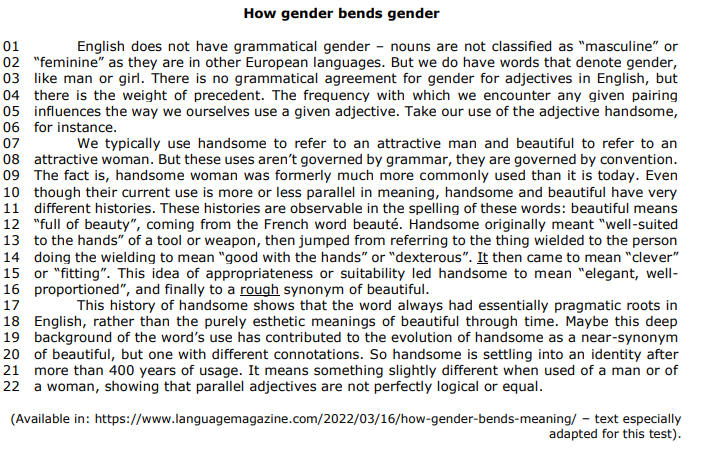
Mark the word in which the ending ‘-ed’ have the same sound as in ‘created’ (l.17).
Alternativas
Q1300101 Inglês

A questão refere-se ao texto abaixo.


Fonte: Angelou, M., & Broun, H. H. (1994). And still I rise. Jeffrey Norton Publishers.
Consider the words from the text; then analyse the statements that follow.
sassiness (l.05) haughtiness (l.17) hatefulness (l.23) sexiness (l.25)
I. All words follow the same speling rule. II. All words are nouns. III. The suffix –ness changes adjectives into nouns.
Which ones are INCORRECT? 
Alternativas
Q1300094 Inglês

A questão refere-se ao texto abaixo.

Fonte: adaptado de http://www.oprah.com/omagazine/oprah-interviews-maya-angelou/all#ixzz5BhXsFcyH 

Mark the word that has the same sound as the underlined letter in “chide” (l.13).
Alternativas
Ano: 2018 Banca: IMA Órgão: Prefeitura de Pastos Bons - MA
Q1186995 Inglês
The (IPA) International Phonetic Association was founded in 1886. This association’s mission is to “promote the scientific study of phonetics”. The terms: /hjuːmən/ - /ʧɔklət/ - /ɪnʤəri/ - /mɔɪsʧə/ are the phonetic transcriptions of the respectively words:
Alternativas
Q1094247 Inglês

Text for the question.


Higher life expectancy worldwide 


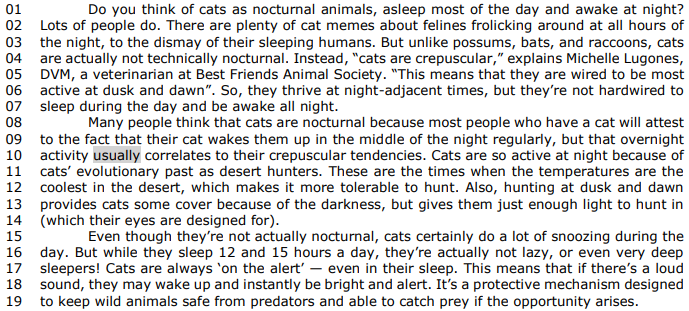
In which word does the letter “s” sound as the “s” in “This” at the beginning of line 16?
Alternativas
Q1094243 Inglês

Text for the question.


Higher life expectancy worldwide 


Identify the word in which “ough” is pronounced in the same way as the “ough” in “Even though” (line 12).
Alternativas
Respostas
161: A
162: A
163: C
164: B
165: A
166: A
167: E
168: D
169: A
170: D
171: C
172: D
173: B
174: B
175: B
176: A
177: C
178: B
179: C
180: D