Questões de Concurso
Sobre pronúncia e som | pronunciation and sound em inglês
Foram encontradas 232 questões


( )Written English is more complex grammatically than spoken English, with longer and more complex sentences, fewer contractions, and more subordinate clauses.
( ) Spoken English is more likely to be face-to-face communication, while written English is more likely to be communication through the written word.
( ) Spoken English is more fixed and stable than written English, which is more fleeting.
( ) Spoken English is usually more organized and carefully formulated than written English.
( ) Written English is typically more structured and forms a monologue rather than a dialogue, while spoken English is more likely to be a dialogue.
( ) Written English communicates across time and space for as long as the medium exists and the language is understood. Spoken English is more immediate.
( ) Spoken English normally uses a generally acceptable standard variety of the language, whereas written English may sometimes be in a regional or other limited-context dialect.
( ) In Spoken English, the content is presented much more densely. In written English, the information is “diluted” and conveyed through many more words: there are a lot of repetitions, glosses, “fillers”, producing a text is noticeably longer and with more redundant passages.
( A ) GRAMMAR-TRANSLATION METHOD ( B ) DIRECT METHOD ( C ) ORAL APPROACH ( D) AUDIOLINGUALISM METHOD
( ) Grammatical rules are not presented formally and the texts used for reading and writing activities are no longer literary since this method is based on certain principles, such as: selection, gradation and presentation.
( ) Learning is associated with syntactic, morphological and phonological structures which are learned from a system of stimulus, response and reinforcement.
( ) In this method, the writing skill is also developed, but not with a communicative purpose.
( ) Adopting the monolingual principle, this method involves the use of objects, gestures and images to explain the meanings of words, since the students' native language is prohibited from being used.
( ) Language learning would be associated with the formation of readers and the intellectual development of students.
( ) This method involves automatic correction and immediate assessment of students' mistakes by teachers in order to prevent the students from forming or acquiring bad habits and behaviors during the learning process.
( ) As a theoretical systematization of foreign language teaching, its objective would be the development of students' oral skills as the vocabulary and grammatical structures they have learned would be controlled in terms of frequency of occurrence.
( ) In this method, learning must be directly connected to the target language without going through the process of translation into the students' native language.
( ) The language to be taught is the spoken language and the new elements of the language are practiced situationally as the grammatical items are proposed gradually, that is, from the simplest to the most complex forms.
( ) In this method, language is both seen and considered as a behavior, for it is a means of oral communication.
Not all stressed syllables are of equal importance. Some stressed syllables have greater prominence than others, and form the nucleus, or focal point, of an intonation pattern. We may describe a nucleus as a strongly stressed syllable which marks a major change of pitch direction, i.e. where the pitch goes up or down.
LEECH, G.; SVARTVIK, J., 2012, p. 36.
So, it is very important
Crazy Horse
Crazy Horse (Tasunke Witko, 1840-1877) was an Oglala Lakota Sioux warrior and warband leader considered among the greatest defenders of Sioux lands against the forces of the US government in the 19th century. He is one of the most famous Native American figures in history and among the Sioux's most honored heroes. Although he is often referred to as a "chief", Crazy Horse was actually a "Shirt Wearer" – a kind of "subchief" – who carried out the decisions of the council and also served as a war chief of a given band of warriors. Even so, Crazy Horse inspired such devotion in his followers that he was regarded as a "chief" and is referenced as such by others.
His name, Tasunke Witko (Crazy Horse), is accurately translated as "His Crazy Horse" or "His Horse is Crazy" and was his father's and grandfather's name, seemingly referencing a horse that behaved erratically. According to Black Elk, however, the name correlated to Crazy Horse's famous vision in which he saw his horse dancing as though "made only of shadow" in a strange or "crazy" way.
Crazy Horse dedicated himself to opposing the US military as early as 1854 following the Grattan Fight (Grattan Massacre) and the subsequent massacre of Little Thunder's camp in 1855 by Colonel William S. Harney. He continued his resistance over the next eleven years and was named a "Shirt Wearer" in 1865. He fought in the Battle of Plate River Bridge (1865), Red Cloud's War (1866-1868), the Battle of the Rosebud (1876), and the Battle of the Little Bighorn (1876). His last full-scale engagement with US forces was the Battle of Wolf Mountain in January 1877.
World History Encyclopedia. Adaptation.
Action 1: Teacher has students repeat pronunciation of specific words in a text. Action 2: Teacher asks students about their favorite sports after reading a text on rugby. Action 3: Teacher uses a well-known short story to present the simple past. Action 4: Teacher plays the corresponding audio to a text presented in class.
I have 12 years old. - I goed to school yesterday. - I am with a headache. - She work in the morning.
Corrected – worked – seemed – studied
Sheep –ship – Cheap – Chip
The vowel sounds present in the words below correspond to the minimal pair:
Heat – hit
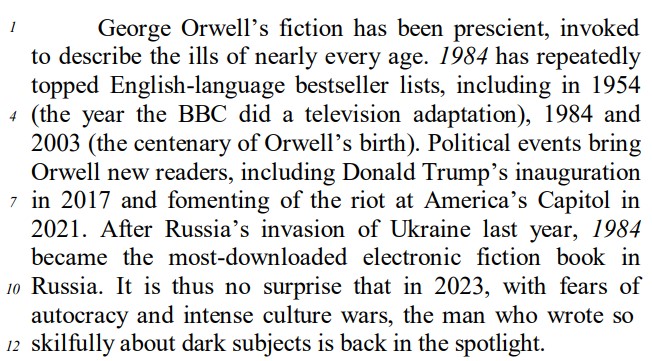
Interest in George Orwell and his dystopian fiction is high. The Economist. August 4th 2023. https://www.economist.com/culture/2023/08/04/interest-in-george-orwelland-his-dystopian-fiction-is-high
Based on the text and considering phonological aspects of the English language, judge the following item.
Interest in George Orwell and his dystopian fiction is high. The Economist. August 4th 2023. https://www.economist.com/culture/2023/08/04/interest-in-george-orwelland-his-dystopian-fiction-is-high
Based on the text and considering phonological aspects of the English language, judge the following item.
Interest in George Orwell and his dystopian fiction is high. The Economist. August 4th 2023. https://www.economist.com/culture/2023/08/04/interest-in-george-orwelland-his-dystopian-fiction-is-high
Based on the text and considering phonological aspects of the English language, judge the following item.
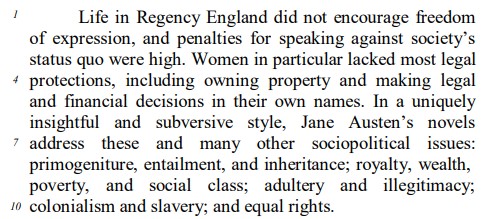
JORDÁN, Miguel Ángel. Jane Austen never wed, but she knew how to play the marriage game. National Geographic. November 17th, 2022. https://www.nationalgeographic.com/history/history-magazine/article/janeausten-never-wed-but-she-knew-the-rules-of-the-marriage-game. [adapted]
Based on the text, judge the following item.

 Conheça nossos planos