Questões de Concurso
Sobre pronomes | pronouns em inglês
Foram encontradas 1.068 questões


Based on the text, judge the following items.
The singular form of “these” (line 11) can be this or that.

Based on the text, judge the following items.
The relative pronoun that can be used instead of “who”
in “with parents who can check” (lines 8 and 9).
INSTRUÇÃO: Leia o texto a seguir e responda à questão.

Read the text about Nobel Prize for the question.
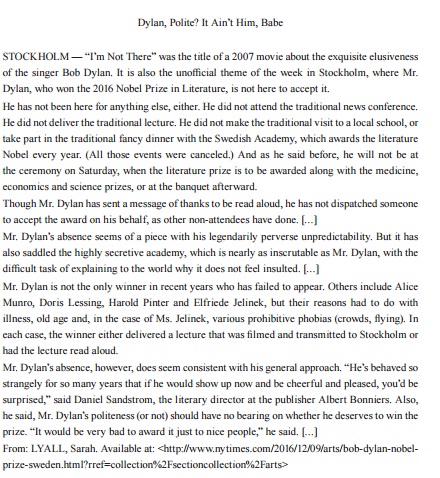
Read the text about Nobel Prize for the question.
Based on the article, it is correct to affirm that the pronouns “it” (l.2), “it” (l.14), and “he” (l.23), RESPECTIVELY, refer to:
Based on text 2, an adapted forum discussion, answer question below.
Teaching with no books
Dianne Bell
I have started teaching in a language school suggesting no books to teach except for some magazines. These show the framework what should be worked on, for example, countability and that’s it. When it was offered I accepted the job easily because it seemed challenging and at the same time simple but now I’m out of reliable materials. Please help me out in what ways I can find materials for all the suggested frameworks.
Comments

Mila Junior and Senior Teacher
Posted on 02/22/2015
What exactly are you supposed to be teaching (i.e., conversation, grammar, business English, etc.)? Can you give more examples of the “frameworks”? If there are no books or resources, it sounds like the school wants you to do conversation classes. These can be easy to prepare if you tell the students to come prepared with a topic to discuss. Then, you can assist them with keeping a conversation going, asking questions, giving opinions, etc.

Flore
Secondary Teacher
Posted on 01/07/2015
Hi, I think it really does depend on the students and the level you are teaching to. I have found a lot of online resources are useful, especially news articles. If you just type in “Free online English lessons” or something similar you are bound to find resources. I had to teach like that once. They give you a book with a list of what you should be teaching in each lesson but nothing else. The teacher has to make the lesson up out of thin air each time, and it’s pretty time-consuming.

Jake
Science Educator
Posted on 11/22/2015
There are so many other resources out there for teachers to use, online and off, that teaching without textbooks is becoming more and more acceptable including websites, iPod lectures and field trips — that will encourage you to toss out your textbooks. Before you can toss out the textbook and replace it with technology tools, you’ll need to understand how your students — whatever their age — respond to and work with technology.
(Adapted from https://www.englishclub.com/)
Based on text 2, an adapted forum discussion, answer question below.
Teaching with no books
Dianne Bell
I have started teaching in a language school suggesting no books to teach except for some magazines. These show the framework what should be worked on, for example, countability and that’s it. When it was offered I accepted the job easily because it seemed challenging and at the same time simple but now I’m out of reliable materials. Please help me out in what ways I can find materials for all the suggested frameworks.
Comments
Mila Junior and Senior Teacher
Posted on 02/22/2015
What exactly are you supposed to be teaching (i.e., conversation, grammar, business English, etc.)? Can you give more examples of the “frameworks”? If there are no books or resources, it sounds like the school wants you to do conversation classes. These can be easy to prepare if you tell the students to come prepared with a topic to discuss. Then, you can assist them with keeping a conversation going, asking questions, giving opinions, etc.
Flore
Secondary Teacher
Posted on 01/07/2015
Hi, I think it really does depend on the students and the level you are teaching to. I have found a lot of online resources are useful, especially news articles. If you just type in “Free online English lessons” or something similar you are bound to find resources. I had to teach like that once. They give you a book with a list of what you should be teaching in each lesson but nothing else. The teacher has to make the lesson up out of thin air each time, and it’s pretty time-consuming.
Jake
Science Educator
Posted on 11/22/2015
There are so many other resources out there for teachers to use, online and off, that teaching without textbooks is becoming more and more acceptable including websites, iPod lectures and field trips — that will encourage you to toss out your textbooks. Before you can toss out the textbook and replace it with technology tools, you’ll need to understand how your students — whatever their age — respond to and work with technology.
(Adapted from https://www.englishclub.com/)
Read the following article and answer question based on the text.
Faced with the unprecedented stream of migrants fleeing war and trauma in the Middle East and North Africa, Europe needs to take clear-sighted action.
For its part, the UK has agreed to take 20,000 refugees, a significant portion of whom will likely be children and orphans according to report. One key aspect in ensuring their smooth settlement in the UK will be providing these refugees with language training.
Many Syrians are well-educated and many speak fluent English. Others, however, do not speak English well enough to function professionally within the UK. The issue of language is so fundamental to our lives that we often overlook it. Several multi-million pound training contracts have failed to be delivered on account of not addressing the language barrier. All the goodwill, financial backing, and technical expertise to deliver needed medical, economic, military,engineering, or navigational training may be present; but unless there is a shared language in which to impart that knowledge, little will be accomplished.
One of the biggest misconceptions about language is that if you “just go to the country,” you’ll pick it up. Many people believe that immersion will guarantee fluency; yet you may well know several immigrants who have been in this country for years and still only speak broken English. You might also know dozens of expats in various countries across the world who have failed to pick up the local languages of their host countries. Training and effort are both necessary.
Though not a guarantee of fluency, immersion is a wonderful opportunity. The first issue we need to address with respect to refugees is ensuring that those who come will actually be immersed. That is, that they will be welcomed as part of larger communities, and not simply join communities of other refugees. On the other hand, immersion is just an opportunity, and in order to take full advantage of it, training and education are required. In terms of refugees, we need to consider options for the provision of language training, whether by self-study, classroom instruction, private tuition, or some combination of the three.
The array of needs is staggering. In truth, every language learner has a different set of learning objectives, and will require different training to meet those objectives. Coordinating the actual needs with providers in different regions and accounting for different personal schedules and start dates is a significant challenge. It is, however, a challenge that must be addressed immediately, as proficiency in English will be a key enabler of success for refugees in this country.
(Adapted from Aaron Ralby http://www.blogs.jbs.cam.ac.uk/ socialinnovation/2015/11/16/)
Please, read the following text in order to answer questions 21 to 25.
Are scientists leaving the net?
The scientists who helped create the Internet may be leaving it for less crowded cyberspaces. Having been on the Internet longer than the rest of us, scientists use it differently.
Premier researchers use the Internet to test projects like real-time, 3D models of colliding galaxies or rampaging tornadoes. For tasks like that, the Internet is no longer fast enough or reliable enough. And some scientists are frustrated. For them, the information superhighway is full of bumper-to-bumper traffic.
Visionary engineers at the National Science Foundation, fortunately, have long foreseen such congestion. As an alternative, they created the very high-speed Backbone Network Service (VBNS). It links a handful of government and university labs at speed of 155,000,000 bits per second, or 10,000 times faster than a standard modem. By the year 2000, a new generation of equipment and another round of research could give scientists data pipes 12 times faster than that. Among other tricks, these new high bandwidth networks will allow scientists to manipulate huge computer files so unwieldy they are now shipped by four-wheeled means. “Never underestimate the bandwidth of a pick-up truck full of data”, jokes Daniel Sandin of the University of Illinois.
Sandin and his team in Chicago will use the VBNS to immerse goggled humans at different locations into the same type of jaw-dropping virtual reality simulation generated by a supercomputer. “You could not do that on the Internet,” says Thomas Defanti, Sandin’s colleague. “The Internet is so congested that for any kind of highbandwidth use, it is essentially rendered useless.”
“Simply adding lanes is not going to work,” adds Beth Gaston of the National Science Foundation. “Our role is to spur the technology forward” – Mark Uheling.
(Popular Science, September 1996, p.60)
The pronoun THEY in “...they are now shipped by four-wheeled means” (paragraph 3) refers to:
TEXT III
Important reasons for teaching kindness in schools
Most people have heard the phrase random acts of kindness, which refers to a selfless act of giving
resulting in the happiness of another person. Terms like this are increasing in popularity around the
world, as more people identify a deficiency in their lives that can only be fulfilled by altruism.
It seems we just can't get enough of those addictive feel good emotions and with good reason.
5 Scientific studies have shown that kindness has a great number of physical and emotional benefits,
and that children require a healthy dose of the warm and fuzzies in order to flourish as health, happy,
well-rounded individuals.
Patty O'Grady, PhD, is an expert in the area of neuroscience, emotional learning, and positive
psychology with special attention to the educational arena. She believes that kindness changes the brain
10 by the experience of kindness. Children and adolescents do not learn kindness by only thinking about it and
talking about it. Kindness is best learned by feeling it so that they can reproduce it. Kindness is an emotion that
students feel and empathy is a strength that they share.
A great number of benefits have been reported to support the theory of teaching kindness in schools:
1. Happy Children
15 Science explains that the good feelings we experience when being kind are produced by endorphins
that activate areas of the brain that are associated with pleasure, social connection and trust, and it's
proven that these feelings of joyfulness are contagious, encouraging more kind behaviour by the giver
and recipient.
2. Increased Peer Acceptance
20 Research on the subject has determined that kindness increases our ability to form meaningful
connections with others. Studies show that kind, happy children enjoy greater peer acceptance
because they are well-liked and that better than average mental health is reported in classrooms that
practice more inclusive behaviour due to an even distribution of popularity.
3. Improved Health and Less Stress
25 It's widely documented that being kind can trigger a release of the hormone oxytocin which has a
number of physical and mental health benefits as it can significantly increase a person's level of
happiness and reduce stress. More recently though, it's been found it plays a significant role in the
cardiovascular system, helping protect the heart by lowering blood pressure and reducing free
radicals and inflammation, which incidentally speed up the aging process.
30 4. Greater Sense of Belonging and Improved Self Esteem
Studies show that people experience a 'helpers high' when they do a good deed, a rush of endorphins
that creates a lasting sense of pride, wellbeing and an enriched sense of belonging. Even small acts of
kindness are reported to heighten our sense of wellbeing, increase energy and give a wonderful
feeling of optimism and self worth.
35 5. Increased Feelings of Gratitude
When children are part of projects that help others less fortunate than themselves, it provides them
with a real sense of perspective and helps them appreciate the good things in their own lives.
6. Better Concentration and Improved Results
As it increases serotonin, which plays an important part in learning, memory, mood, sleep, health and
40 digestion, kindness is a key ingredient that helps children feel good. Having a positive outlook allows
them greater attentions spans and enables more creative thinking to produce better results at school.
7. Less Bullying
Two Penn State Harrisburg faculty researchers, Shanetia Clark and Barbara Marinak say, unlike
previous generations, today's adolescents are victimizing each other at alarming rates. They argue adolescent
45 bullying and youth violence can be confronted through in-school programs that integrate kindness the
antithesis of victimization.
Many traditional anti-bullying programs focus on the negative actions that cause children anxiety and
often with little impact. Teaching kindness and compassion in schools, not only fosters the positive
behaviour that creates warm and inclusive school environments, but helps children feel that they
50 belong. It's documented that the effects of bullying can be significantly reduced by integrating
kindness based programs in schools.
8. Reduced Depression
Dr. Wayne Dyer, internationally renowned author and speaker, says research has discovered that an
act of kindness increases levels of serotonin (a natural chemical responsible for improving mood) in
55 the brain. It's also found that serotonin levels are increased in both the giver and receiver of an act of
kindness, as well as anyone who witnesses that kindness, making it a wonderful natural
antidepressant.
Maurice Elias, a professor at Rutgers University Psychology Department says that as a citizen,
grandparent, father, and professional, it is clear to me that the mission of schools must include teaching kindness.
60 Without it, communities, families, schools, and classrooms become places of incivility where lasting learning is
unlikely to take place.
We need to be prepared to teach kindness, because it can be delayed due to maltreatment early in life. It can be
smothered under the weight of poverty, and it can be derailed by victimization later in life. Yet despite these and
other travails, the receipt of kindness and the ability to show kindness through service are both growth enhancing
65 and soul cleansing.
Kindness can be taught, and it is a defining aspect of civilized human life. It belongs in every home, school,
neighborhood, and society.
It's become quite clear that modern education must encompass more than just academics, that in order
for children to develop into happy, confident, well-rounded individuals, matters of the heart must be
70 taken seriously and nurtured as a matter of priority.
Disponível em: <http://edarticle.com/8-important-reasons-for-teaching-kindness-in-schools/>. Acesso em: 15 set. 2016.
Without it, communities, families, schools, and classrooms become places of incivility where lasting learning is unlikely to take place.(l. 60-61)
The phrasal verb take place means
TEXT III
Important reasons for teaching kindness in schools
Most people have heard the phrase random acts of kindness, which refers to a selfless act of giving
resulting in the happiness of another person. Terms like this are increasing in popularity around the
world, as more people identify a deficiency in their lives that can only be fulfilled by altruism.
It seems we just can't get enough of those addictive feel good emotions and with good reason.
5 Scientific studies have shown that kindness has a great number of physical and emotional benefits,
and that children require a healthy dose of the warm and fuzzies in order to flourish as health, happy,
well-rounded individuals.
Patty O'Grady, PhD, is an expert in the area of neuroscience, emotional learning, and positive
psychology with special attention to the educational arena. She believes that kindness changes the brain
10 by the experience of kindness. Children and adolescents do not learn kindness by only thinking about it and
talking about it. Kindness is best learned by feeling it so that they can reproduce it. Kindness is an emotion that
students feel and empathy is a strength that they share.
A great number of benefits have been reported to support the theory of teaching kindness in schools:
1. Happy Children
15 Science explains that the good feelings we experience when being kind are produced by endorphins
that activate areas of the brain that are associated with pleasure, social connection and trust, and it's
proven that these feelings of joyfulness are contagious, encouraging more kind behaviour by the giver
and recipient.
2. Increased Peer Acceptance
20 Research on the subject has determined that kindness increases our ability to form meaningful
connections with others. Studies show that kind, happy children enjoy greater peer acceptance
because they are well-liked and that better than average mental health is reported in classrooms that
practice more inclusive behaviour due to an even distribution of popularity.
3. Improved Health and Less Stress
25 It's widely documented that being kind can trigger a release of the hormone oxytocin which has a
number of physical and mental health benefits as it can significantly increase a person's level of
happiness and reduce stress. More recently though, it's been found it plays a significant role in the
cardiovascular system, helping protect the heart by lowering blood pressure and reducing free
radicals and inflammation, which incidentally speed up the aging process.
30 4. Greater Sense of Belonging and Improved Self Esteem
Studies show that people experience a 'helpers high' when they do a good deed, a rush of endorphins
that creates a lasting sense of pride, wellbeing and an enriched sense of belonging. Even small acts of
kindness are reported to heighten our sense of wellbeing, increase energy and give a wonderful
feeling of optimism and self worth.
35 5. Increased Feelings of Gratitude
When children are part of projects that help others less fortunate than themselves, it provides them
with a real sense of perspective and helps them appreciate the good things in their own lives.
6. Better Concentration and Improved Results
As it increases serotonin, which plays an important part in learning, memory, mood, sleep, health and
40 digestion, kindness is a key ingredient that helps children feel good. Having a positive outlook allows
them greater attentions spans and enables more creative thinking to produce better results at school.
7. Less Bullying
Two Penn State Harrisburg faculty researchers, Shanetia Clark and Barbara Marinak say, unlike
previous generations, today's adolescents are victimizing each other at alarming rates. They argue adolescent
45 bullying and youth violence can be confronted through in-school programs that integrate kindness the
antithesis of victimization.
Many traditional anti-bullying programs focus on the negative actions that cause children anxiety and
often with little impact. Teaching kindness and compassion in schools, not only fosters the positive
behaviour that creates warm and inclusive school environments, but helps children feel that they
50 belong. It's documented that the effects of bullying can be significantly reduced by integrating
kindness based programs in schools.
8. Reduced Depression
Dr. Wayne Dyer, internationally renowned author and speaker, says research has discovered that an
act of kindness increases levels of serotonin (a natural chemical responsible for improving mood) in
55 the brain. It's also found that serotonin levels are increased in both the giver and receiver of an act of
kindness, as well as anyone who witnesses that kindness, making it a wonderful natural
antidepressant.
Maurice Elias, a professor at Rutgers University Psychology Department says that as a citizen,
grandparent, father, and professional, it is clear to me that the mission of schools must include teaching kindness.
60 Without it, communities, families, schools, and classrooms become places of incivility where lasting learning is
unlikely to take place.
We need to be prepared to teach kindness, because it can be delayed due to maltreatment early in life. It can be
smothered under the weight of poverty, and it can be derailed by victimization later in life. Yet despite these and
other travails, the receipt of kindness and the ability to show kindness through service are both growth enhancing
65 and soul cleansing.
Kindness can be taught, and it is a defining aspect of civilized human life. It belongs in every home, school,
neighborhood, and society.
It's become quite clear that modern education must encompass more than just academics, that in order
for children to develop into happy, confident, well-rounded individuals, matters of the heart must be
70 taken seriously and nurtured as a matter of priority.
Disponível em: <http://edarticle.com/8-important-reasons-for-teaching-kindness-in-schools/>. Acesso em: 15 set. 2016.
It´s widely documented that being kind can trigger a release of the hormone oxytocin which has a number of physical and mental health benefits as it can significantly increase a person´s level of happiness and reduce stress. More recently though, it's been found it plays a significant role in the cardiovascular system […](l. 25-28)
The pronoun it refers to
TEXT
August 24, 2016 / By Digestive Health Team
Are You Pooping All Wrong?
5 tips to keep your bowels healthy
When it comes to our bowels — and their movements — we may not give them much thought. Of course, when things are not going well, we notice.
However, bowel movements don’t just tell us about the health of our digestive system. This may sound strange, but signs of everything from diseases to stress may show up in your bathroom habits. The key is knowing what to look for — and what the signs may mean.
Here are five tips to encourage healthy bowels:
1. Don’t ignore rectal bleeding
The first thing most people worry about when they have minor rectal bleeding is that they have a cancer. Of course, colon cancer is also a concern. But it’s the cause of rectal bleeding only 1 to 2 percent of the time.
Two problems are usually responsible for blood on the paper, on the stool or in the toilet: hemorrhoids and anal fissures. The good news is that both problems are usually easy to fix.
2. Be careful not to be overzealous when you wipe
A lot of people assume they have hemorrhoids. May their bottoms itch and they feel extra skin down there as they wipe. Must be hemorrhoids, right?
So they treat themselves with medicated wipes or cream. And yet the “hemorrhoids” don’t go away — they itch even more.
Often, the problem is, ironically, being too clean. What happens is a circular process. Filled with good intentions, you try to keep yourself scrupulously clean by using flushable wipes. But the unexpected result is that this leads to itching and the feeling that you have hemorrhoids.
3. Don’t treat the bathroom like a library
Think of your time in the bathroom as a necessity, not an extended escape. If your toilet has stacks of magazines or books on the water tank, consider moving them to another room.
Why? The more time you spend on the toilet, the more likely you will strain for bowel movements. Also, the seated position puts extra stress on your anal blood vessels. Both of these factors boost your risk of hemorrhoids.
4. Get enough fiber in your diet
The goal is to eat 25 to 35 grams of fiber each day. The lack of fiber in the American diet is perhaps the major problem that leads to issues with constipation.
One of the challenges is that not all natural sources are equal in the amounts of fiber they contain, so you don’t always get a consistent amount of fiber intake every day, depending on what you eat. One day a bowl of oatmeal may do it. Another day a serving of broccoli may not.
Of course, each person’s needs are different, too, so you have to find what works best for your body.
5. Avoid dehydration if you have diarrhea
The biggest danger with a short bout of diarrhea is dehydration, or the loss of water and nutrients from the body’s tissues. You could become dehydrated if you have diarrhea more than three times a day and are not drinking enough fluids. Dehydration can cause serious complications if it is not treated. The best way to guard against dehydration is to drink liquids that contain both salt and sugar.
(Source: https://health.clevelandclinic.org/2016/08/poop/)
I – Pronouns are words we use in the place of a full sentence. II – We use he/him to refer to men, and she/her to refer to women. When we are not sure if we are talking about a man or a woman we use they/them. III – English clauses Always have a subject. If there is no other subject we use it or there. We cal this a dummy subject.
How many items are correct?
With Brazil in Turmoil, Rio Counts Down to Olympics
By REBECCAR. RUIZAPRIL27, 2016
RIO DE JANEIRO- Brazil's president is facing impeachment. The country's economy is in sharp decline. Bodies of water that will be used for Olympic competitions are polluted, and global public health officials are trying to tamp down the Zika virus epidemic.
With less than 100 days before the Olympic Games come to South Amarica for the first time, Rio de Janeiro faces more than the usual challenges that bedevil host cities, like delayed stadium construction and transportation concerns. (Rio has those, too.) The mood here, however, is hardly one of panic. Officials in charge of executing the Summer Games say they feel insulated from Brazil's turmoil at this late stage. The Olympics, after all, tend to exist in their own bubble, elaborately coordinated to ensure that the multibillion-dollar operation goes off smoothly. "The machine is in place, and it's relatively stable," Ricardo Leyser, Brazil's sports minister, said in an interview this week. "My biggest concern isn't any individual issue. lt's the small demands that all come at once."
Local organizers are beginning to lay colorful comforters patterned with the silhouettes of cartoon cyclists, fencers and swimmers - on the twin beds in the athletes' village. They are monitoring the growth of 14-month-old grass that will be transplanted to Maracanã, the storied soccer stadium that will also be used for the opening and closing ceremonies. They are pulling trash from Guanabara Bay, where the Games' sailing events will be held; mopping up standing water to minimize mosquito breeding; and ramping up a round-the-clock security operation - all while publicly expressing little worry about the unrest encircling them.
On Wednesday, with the handoff of the Olympic flame in Greece and the start of a journey that in little more than a week will bring it to Brazil, the official countdown to the Aug. 5 opening ceremony began.
ln Rio, the race to be ready is intensifying, with construction workers here still laboring on mass transit projects that were key promises seven years ago in the city's bid to host the Games. Costing several billion dollars, those projects include a new subway line and express bus lanes that connect the Olympic Park in Barra da Tijuca to the rest of the city, which is expected to swell with more than half a million visitors.
As the value ofthe Brazilian real has drastically declined overthe last year, some have expressed doubt that the transit projects will materialize beyond the sleek, modernist weather shelters that have been built at various stations. At a news conference Wednesday, the city's secretary of transportation said the new routes would be ready i n ti me but did not specify when. To the vast majority of people watching the Games on television, however, such infrastructure may not matter.
The permanent venues for competitions here are mostly complete - all but those for tennis and track cycling - and athletes from around the world have competed in dozens of test events in Rio in recent months. "lt's about the filling of the cake," Mr. Leyser said. "lt's not about the stadiums; it's about the scoreboards."
As ofthe latest counts, 62 percent ofthe 5.7 million tickets on the market had been sold - roughly half of the total tickets for the Olympics - and 24 percent of tickets available for the Paralympics had been sold. But compareci with past Olympics, the buyers of those tickets may be disproportionately international, saidAndrew Parsons, the presidentofthe Brazilian Paralympic Committee.
For some Brazilians, the country's political and economic crises have cast a shadow on the celebration. President Dilma Rousseff's ouster looks increasingly likely amid a sweeping graft scandal, and those in line to succeed her have their own controversies hanging overthem.
Questions of corruption have extended to Olympics planning, particularly after a businessman who worked on many Olympic projects in Rio was convicted of corruption and money laundering related to separata contracts. Mr. Leyser said that the questions centered on irregularities at the Deodoro event site and that no publicofficial had been accused ofwrongdoing. "lt's more an administrativa issue than a corruption scheme," he said. "lt's basically a question ofthe numbers." Mr. Leyser called the devaluation of Brazil's currency an opportunity because it increases the buying power of foreign money coming into Brazil forthe Games.
But not everyone sees the event as a boon to the country. Shirlei Alves, who lives in the Santa Marta favela of Rio, criticized the government for spending on the Olympics in the face of Brazil's problems.
"The world is just getting worse here," Ms. Alves said, noting that she was without medication and electricity. "The government is making a mistake. l'd like if they'd take a better look at the poor people and not help people who are already rich." Eduardo Paes, the mayor of Rio, said Wednesday that the city had a "comfortable financial situation" and had spent on stadium construction 1 percent ofwhat it spent on health education. "I know people are skeptical," Mr. Paes said, citing the "huge deliverables" for the Olympics. "Of course the situation here has been difficult. But there is a commitment of the Brazilian state to deliverthe Olympics."
Perhaps the most vexing issue for local organizers-the one that may stir anxiety among athletes and spectators - is the mosquito-borne Zika virus, which has been linked to birth defects and temporary paralysis. Zika is of greater concern outside Rio, in the far north part of Brazil, but the World Health Organization has declared the virus a global public health emergency and has advised pregnant women notto travei anywhere in Brazil.
"The Olympics is a pretty effective way of taking whatever disease is local and making it global," said Ashish K. Jha, director ofthe Global Health lnstitute at Harvard.
Some scientists have suggested that by the time the Olympics start in August - wintertime in Brazil, when mosquitoes are less numerous - the virus might be more prevalent in the southern United States.
"Zika's been spreading effectively on its own, but there's very good reason to think the Olympics will accelerate the spread," Dr. Jhasaid.
But the virus poses a unique problem because it isso far beyond the contrai of local organizing officials, and so many questions about it remain unanswered. Few athletes have publicly expressed concern, but it is unclear how many might withdraw as the Games draw closer.
"At this point you just keep going," David Wallechinsky, an Olympics historian, said. "You have to continue as if everything's going to be fine. These are real concerns - Zika, the water quality. But even if Dilma is forced out of office, it's not going to stop the Olympics."
Com base na Leitura do texto "With Brazil in Turmoil, Rio Counts Down to Olympics", responda a questão:
Brazil lmpeachment: The Process for Removing the President
ByTHE NEW YORKTIMES UPDATED May 12, 2016
Dilma Rousseff, the beleaguered president of Brazil, has been confronting an effort to remove her from office, accused of violating fiscal laws by using funds from state banks to cover budget shortfalls.
Her opponents claim this strategy eroded confidence among investors, raising the government's borrowing costs and disregarding measures designed to prevent a return of high inflation.
The president's supporters contend that Ms. Rousseff was seeking to maintain popular antipoverty projects, and that impeachment over the issue is politically motivated because Ms. Rousseff's predecessors carried out similar policies.
Here is a guide to the complicated process for impeaching and removing a president from office:
Step1
Congressional Panei Debates Charges
The process prescribed in Brazil's Constitution, adopted in 1988, shares similarities with impeachment proceedings in the United States.
First, the speaker of the lower chamber of Congress, Eduardo Cunha, a political opponent of Ms. Rousseff, had to accept a petition for impeachment.
Mr. Cunha then formed a 65-member congressional committee to investigate the accusations and decide if removal was warranted. The political composition of the committee was largely stacked against the president.
The committee was created in December, but its work was soon stopped by a court arder. Work resumed in March.
Jovair Arantes, the legislator in charge of preparing the committee report on the fate of Ms. Rousseff and an ally of Mr. Cunha, recommended on April 6 that proceedings move forward to remove her from office.
The full committee, in a 38-27 vote on April 11, agreed, clearing the way for a vote on her impeachment in Brazil's Chamber of Deputies.
Step2
Chamber of Deputies Votes
On April 17, the lower chamber voted for impeachment. At least two-thirds ofthe 513 deputies had to vote for impeachment forthe motion to pass. The decisiva 342nd vote was cast about five-anda-half hours afterthe floorvote started.
ln early May, Brazil's top court, the Supreme Federal Tribunal, removed Mr. Cunha from his speaker role on charges of obstructing a corruption investigation.
Step3
The Role ofthe Senate and Vice President
After the lower chamber vote, the process then moved to the Senate, which had to decide, with a sim pie majority vote, whether to accept the charges.
On May 12, the Senate voted 55 to 22 to begin the triai, resulting in Ms. Rousseff's suspension. The vice president then took over, with the authority to appoint ministers and enact policy.
Michel Temer, the vice president who assumed the president's office, is a member of the Brazilian Democratic Movement Party. His party had been a crucial part of Ms. Rousseff's governing coalition, but it recently voted to split with her Workers' Party, which significantly increased the odds of Ms. Rousseff's impeachment.
Mr. Temer, 75, was himself under scrutiny over claims that he was involved in an illegal ethanol purchasing scheme.
Step4
Removal or Reinstatement
The Senate triai will be overseen by the chief justice of the Suprema Federal Tribunal, Ricardo Lewandowski. Two-thirds of the 81 senators must vote in favor of removing the president from office. lf that happens, Mr. Temer would serve as president for the remainder of Ms. Rousseff's term through the end of 2018.
lf no decision is reached within 180 days, the suspension of the president ends.
Asked in a recent interview with The New York Times whether she would accept a vote to impeach her, Ms. Rousseff, 68, said, "We will appeal with every legal method available."
She has that option: "She can appeal at any moment she finds something legally questionable occurring in the process," said Brasílio Sallum Jr., a professor of sociology at the University of São Paulo and an expert in Brazil's political processes.
Com base na Leitura do texto "Brazil lmpeachment: The Process for Removing the President", responda a questão.
“The research found that people who spoke more than one language made fewer errors in their driving.”
This sentence presents an example of a possessive determiner. In general, determiners can assume the form of a pronoun. In this case, the possessive determiner “their” would have the following form as a possessive pronoun:
INSTRUCTIONS: Read the following text and answer question.
It has been estimated that some 60 percent of today’sworld population is multilingual. Both from a contemporary and a historical perspective, bilingualism or multilingualism is the norm rather than the exception. It is fair, then, to say that throughout history foreign language learning has always been an important practical concern. Whereas today English is the world’s most widely studied foreign language, five hundred years ago it was Latin, for it was the dominant language of education, commerce, religion, and government in the Western world. In the sixteenth century, however, French, Italian, and English gained in importance as a result of political changes in Europe, and Latin gradually became displaced as a language of spoken and written communication.
As the status of Latin diminished from that of a living language to that of an “occasional” subject in the school curriculum, the study of Latin took on a different function. The study of classical Latin (the Latin in which the classical works of Virgil, Ovid, and Cicero were written) and an analysis of its grammar and rhetoric became the model for foreign language study from the seventeenth to the nineteenth centuries. Children entering “grammar school” in the sixteenth, seventeenth, and eighteenth centuries in England were initially given a rigorous introduction to Latin grammar, which was taught through rote learning of grammar rules, study of declensions and conjugations, translation, and practice in writing sample sentences, sometimes with the use of parallel bilingual texts and dialogue (Kelly 1969; Howatt 1984). Once basic proficiency was established, students were introduced to the advanced study of grammar and rhetoric. School learning must have been a deadening experience for children, for lapses in knowledge were often met with brutal punishment. There were occasional attempts to promote alternative approaches to education; Roger Ascham and Montaigne in the sixteenth century and Comenius and John Locke in the seventeenth century, for example, had made specific proposals for curriculum reform and for changes in the way Latin was taught (Kelly 1969; Howatt 1984), but since Latin (and, to a lesser extent, Greek) had for so long been regarded as the classical and therefore most ideal form of language, it was not surprising that ideas about the role of language study in the curriculum reflected the long-established status of Latin.
The decline of Latin also brought with it a new justification for teaching Latin. Latin was said to develop intellectual abilities, and the study of Latin grammar became an end in itself.
Source: RICHARDS, J.C.; RODGERS, T. S. Approaches
and Methods in Language Teaching. Cambridge: Cambridge
University Press, 1999 (1st edition 1986). pp. 1-2.
Analyze the following sentence from the text:
Children entering “grammar school” in the sixteenth, seventeenth, and eighteenth centuries in England were initially given a rigorous introduction to Latin grammar, which was taught through rote learning of grammar rules, study of declensions and conjugations, translation, and practice in writing sample sentences, sometimes with the use of parallel bilingual texts and dialogue (Kelly 1969; Howatt 1984).
In this example, the word “which” is a relative pronoun. It links a noun phrase to a relative clause. Choose the following alternative that presents the noun phrase linked by “which” to a relative clause.

 Conheça nossos planos