Questões de Concurso
Sobre pronome relativo | relative clauses em inglês
Foram encontradas 170 questões


Read the text and answer to the question.
Cultural diversity and cultural identity in globalization

INSTRUCTION: Read the abstract and answer to the question.
Abstract
Scientists know greenhouse gas emissions cause climate change, but what causes greenhouse gas emissions in the first place? We assessed how many greenhouse gases are released to support the lifestyles of people living in different parts of Europe – in other words, we figured out people’s carbon footprint. We found that different lifestyle choices resulted in very different carbon footprints. In general, people with higher incomes (_____ bought more things and traveled more) had much higher carbon footprints than people ______ lived more modestly.
Understanding how our purchases affect greenhouse gas emissions is an important step to designing policies and guidelines for cutting emissions and addressing climate change.
Available at: <http://www.sciencejournalforkids.org/ uploads/5/4/2/8/54289603/footprint_article.pdf>.
Accessed on: Dec 7th, 2017.
The Operations Function
Although somewhat ‘invisible’ to the marketplace the operations function in a typical company accounts for well over half the employment and well over half the physical assets. That, in itself, makes the operations function important. In a company’s organization chart, operations often enjoys parity with the other major business functions: marketing, sales, product engineering, finance control (accounting), and human resources (personnel, labor relations). Sometimes, the operations function is organized as a single entity which stretches out across the entire company, but more often it is embedded in the district, typically product-defined divisions into which most major companies are organized.
In many service businesses, the operations function is typically more visible. Service businesses are often organized into many branches, often with geographic responsibilities – field offices, retail outlets. In such tiers of the organization, operations are paramount.
The operations function itself is, often divided
.................two major groupings .................tasks:
line management and support services. Line management generally refers.................those managers directly concerned................the manufacture of the product or the delivery of the service. They are the ones who are typically close enough to the product or service that they can ‘touch’ it. Line management supervises the hourly, blue-collar workforce. In a manufacturing company, line management frequently extends to the stockroom (where material, parts, and semi-finished products – termed ‘work-in-process inventory – are stored), materials handling, the tool room, maintenance, the warehouse (where finished goods are stored), and distribution, as well as the so-called ‘factory floor’. In a service operation, what is considered line management can broaden considerably. Often, order-taking roles, in addition to orderfilling roles, are supervised by service line managers.
Support services for line management’s operations can be numerous. Within a manufacturing environment, support services carry titles such as quality control, production planning and scheduling, purchasing, inventory control, production control (which determines the status of jobs in the factory and what to do about jobs that may have fallen behind schedule), industrial engineering (which is work methods oriented), manufacturing engineering (which is hardware-oriented), on-going product engineering, and field service. In a service environment, some of the same roles are played but sometimes under vastly different names.
Thus, the managers for whom operational issues are central can hold a variety of titles. In manufacturing, the titles can range from vice-president – manufacturing, works manager, plant manager, and similar titles at the top of the hierarchy, through such titles as manufacturing or production manager, general superintendent, department manager, materials manager, director of quality control, and down to general foreman or foreman. Within service businesses, ‘operations manager’ is sometimes used but frequently the title is more general – business manager, branch manager, retail manager, and so on.
SCHMENNER, Roger W. Production/Operations Management.
5th Edition. Prentice-Hall, 1993.
Instruction: Answer question based on the following text.
Fake news: improved critical literacy skills are key to telling fact from fiction
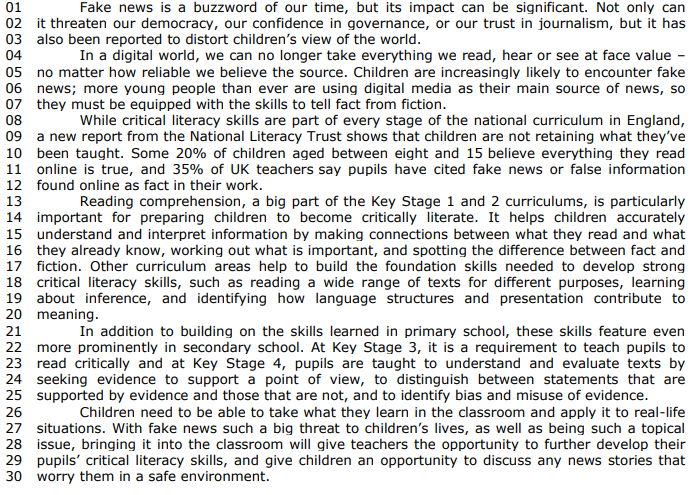
Adapted from https://www.theguardian.com/teacher-network/2017/oct/17/fake-news-improved-criticalliteracy-skills-teaching-young-people
Look at the picture and choose the CORRECT alternative.
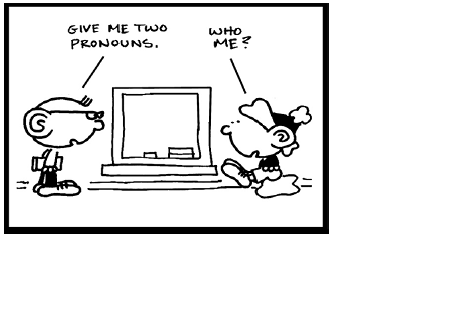

Considering the grammatical and semantic aspects of text I, decide whether the following items are right (C) or wrong (E).
The excerpt “that you get from diplomats” (l. 7 and 8) could be
correctly replaced by which one gets from diplomats without
this changing the meaning of the text.

Judge the following item, concerning the ideas and linguistic aspects of text 19A1AAA.
Palmer was hired by the Berlitz corporation in Belgium.
Judge the following item, concerning the ideas and linguistic aspects of text 19A1AAA.
As in the phrase “a language school in Verviers, Belgium run
on Berlitz lines” (l. 2 and 3), the relative pronoun and the
auxiliary verb which forms the passive voice have been
omitted, the excerpt “run on Berlitz lines” could be correctly
replaced with which was run on Berlitz lines.

Based on the text, judge the following items.
The relative pronoun that can be used instead of “who”
in “with parents who can check” (lines 8 and 9).
INSTRUÇÃO: Leia o texto a seguir e responda à questão.

Based on text 2, an adapted forum discussion, answer question below.
Teaching with no books
Dianne Bell
I have started teaching in a language school suggesting no books to teach except for some magazines. These show the framework what should be worked on, for example, countability and that’s it. When it was offered I accepted the job easily because it seemed challenging and at the same time simple but now I’m out of reliable materials. Please help me out in what ways I can find materials for all the suggested frameworks.
Comments

Mila Junior and Senior Teacher
Posted on 02/22/2015
What exactly are you supposed to be teaching (i.e., conversation, grammar, business English, etc.)? Can you give more examples of the “frameworks”? If there are no books or resources, it sounds like the school wants you to do conversation classes. These can be easy to prepare if you tell the students to come prepared with a topic to discuss. Then, you can assist them with keeping a conversation going, asking questions, giving opinions, etc.

Flore
Secondary Teacher
Posted on 01/07/2015
Hi, I think it really does depend on the students and the level you are teaching to. I have found a lot of online resources are useful, especially news articles. If you just type in “Free online English lessons” or something similar you are bound to find resources. I had to teach like that once. They give you a book with a list of what you should be teaching in each lesson but nothing else. The teacher has to make the lesson up out of thin air each time, and it’s pretty time-consuming.

Jake
Science Educator
Posted on 11/22/2015
There are so many other resources out there for teachers to use, online and off, that teaching without textbooks is becoming more and more acceptable including websites, iPod lectures and field trips — that will encourage you to toss out your textbooks. Before you can toss out the textbook and replace it with technology tools, you’ll need to understand how your students — whatever their age — respond to and work with technology.
(Adapted from https://www.englishclub.com/)
Read the following article and answer question based on the text.
Faced with the unprecedented stream of migrants fleeing war and trauma in the Middle East and North Africa, Europe needs to take clear-sighted action.
For its part, the UK has agreed to take 20,000 refugees, a significant portion of whom will likely be children and orphans according to report. One key aspect in ensuring their smooth settlement in the UK will be providing these refugees with language training.
Many Syrians are well-educated and many speak fluent English. Others, however, do not speak English well enough to function professionally within the UK. The issue of language is so fundamental to our lives that we often overlook it. Several multi-million pound training contracts have failed to be delivered on account of not addressing the language barrier. All the goodwill, financial backing, and technical expertise to deliver needed medical, economic, military,engineering, or navigational training may be present; but unless there is a shared language in which to impart that knowledge, little will be accomplished.
One of the biggest misconceptions about language is that if you “just go to the country,” you’ll pick it up. Many people believe that immersion will guarantee fluency; yet you may well know several immigrants who have been in this country for years and still only speak broken English. You might also know dozens of expats in various countries across the world who have failed to pick up the local languages of their host countries. Training and effort are both necessary.
Though not a guarantee of fluency, immersion is a wonderful opportunity. The first issue we need to address with respect to refugees is ensuring that those who come will actually be immersed. That is, that they will be welcomed as part of larger communities, and not simply join communities of other refugees. On the other hand, immersion is just an opportunity, and in order to take full advantage of it, training and education are required. In terms of refugees, we need to consider options for the provision of language training, whether by self-study, classroom instruction, private tuition, or some combination of the three.
The array of needs is staggering. In truth, every language learner has a different set of learning objectives, and will require different training to meet those objectives. Coordinating the actual needs with providers in different regions and accounting for different personal schedules and start dates is a significant challenge. It is, however, a challenge that must be addressed immediately, as proficiency in English will be a key enabler of success for refugees in this country.
(Adapted from Aaron Ralby http://www.blogs.jbs.cam.ac.uk/ socialinnovation/2015/11/16/)
INSTRUCTIONS: Read the following text and answer question.
It has been estimated that some 60 percent of today’sworld population is multilingual. Both from a contemporary and a historical perspective, bilingualism or multilingualism is the norm rather than the exception. It is fair, then, to say that throughout history foreign language learning has always been an important practical concern. Whereas today English is the world’s most widely studied foreign language, five hundred years ago it was Latin, for it was the dominant language of education, commerce, religion, and government in the Western world. In the sixteenth century, however, French, Italian, and English gained in importance as a result of political changes in Europe, and Latin gradually became displaced as a language of spoken and written communication.
As the status of Latin diminished from that of a living language to that of an “occasional” subject in the school curriculum, the study of Latin took on a different function. The study of classical Latin (the Latin in which the classical works of Virgil, Ovid, and Cicero were written) and an analysis of its grammar and rhetoric became the model for foreign language study from the seventeenth to the nineteenth centuries. Children entering “grammar school” in the sixteenth, seventeenth, and eighteenth centuries in England were initially given a rigorous introduction to Latin grammar, which was taught through rote learning of grammar rules, study of declensions and conjugations, translation, and practice in writing sample sentences, sometimes with the use of parallel bilingual texts and dialogue (Kelly 1969; Howatt 1984). Once basic proficiency was established, students were introduced to the advanced study of grammar and rhetoric. School learning must have been a deadening experience for children, for lapses in knowledge were often met with brutal punishment. There were occasional attempts to promote alternative approaches to education; Roger Ascham and Montaigne in the sixteenth century and Comenius and John Locke in the seventeenth century, for example, had made specific proposals for curriculum reform and for changes in the way Latin was taught (Kelly 1969; Howatt 1984), but since Latin (and, to a lesser extent, Greek) had for so long been regarded as the classical and therefore most ideal form of language, it was not surprising that ideas about the role of language study in the curriculum reflected the long-established status of Latin.
The decline of Latin also brought with it a new justification for teaching Latin. Latin was said to develop intellectual abilities, and the study of Latin grammar became an end in itself.
Source: RICHARDS, J.C.; RODGERS, T. S. Approaches
and Methods in Language Teaching. Cambridge: Cambridge
University Press, 1999 (1st edition 1986). pp. 1-2.
Analyze the following sentence from the text:
Children entering “grammar school” in the sixteenth, seventeenth, and eighteenth centuries in England were initially given a rigorous introduction to Latin grammar, which was taught through rote learning of grammar rules, study of declensions and conjugations, translation, and practice in writing sample sentences, sometimes with the use of parallel bilingual texts and dialogue (Kelly 1969; Howatt 1984).
In this example, the word “which” is a relative pronoun. It links a noun phrase to a relative clause. Choose the following alternative that presents the noun phrase linked by “which” to a relative clause.
TEXT 1
WHY MILLENIALS WILL SAVE US ALL
By Joel Stein
I am about to do what old people have done throughout history: call those younger than me lazy, entitled, selfish and shallow. But I have studies! I have statistics! I have quotes from respected academics! Unlike my parents, my grandparents and my great-grandparents, I have proof.
Here’s the code, hard data: the incident of narcissistic personality disorder in nearly three times as high for people in their 20s as for the generation that’s now 65 or older, according to the National Institutes of Health; 58% more college students scored higher on a narcissism scale in 2009 than in 1982. Millennials got so many participation trophies growing up that a recent study showed that 40% believe they should be promoted every two years, regardless of performance. They are fame obsessed: three times as many middle school girls want to grow up to be a personal assistant to a famous person as want to be a senator, according to a 2007 survey; four time as many would pick the assistant job over CEO of a major corporation. They’re so convinced of their own greatness that the National Study of Youth and Religion found the guiding morality of 60% of millennials in any situation as that they’ll just be able to feel what’s right. Their development is stunted: more people ages 18 to 29 live with their parents than with a spouse, according to the 2012 Clarck University Poll of Emerging Adults. And they are lazy. In 1992, the non-profit Families and Work Institute reported that 80% of people under 23 wanted to one day have a job with greater responsibility; 10 years later, only 60% did.
Millennials consist, depending on whom you ask, of people born from 1980 to 2000. To put it more simply for them, since they grew up not having to do a lot of math in their heads, thanks to computers, the group is made up mostly of teens and 20-somethings. At 80 million strong, they are the biggest age grouping in American history. Each country’s millennials are different, but because of globalization, social media, the export of Western culture and the speed of change, millennials worldwide are more similar to one another than to old generations within their nations. Even in China, where family history is more important than any individual, the internet, urbanization and the onechild policy have created a generation as overconfident and self-involved as the Western one. And these aren’t just rich-kid problems: poor millennials have even higher rates of narcissism, materialism and technology addiction in their ghetto-fabulous lives.
They are the most threatening and exciting generation since the baby boomers brought about social revolution, not because they’re trying to take over the Establishment but because they’re growing up without one. The Industrial Revolution made individuals far more powerful - they could move to a city, start a business, read and form organizations. The information revolution has further empowered individuals by handing them the technology to compete against huge organizations: hackers vs. corporations, bloggers vs. newspapers, terrorists vs. Nation-states, YouTube directors vs. studios, app-makers vs. entire industries. Millennials don’t need us. That’s why we’re scared of them.
In the U.S, millennials are the children of baby boomers, who are also known as the Me Generation, who then produced the Me Me Me Generation, whose selfishness technology has only exarcebated. Whereas in the 1950s families displayed a wedding photo, a school photo and maybe a military photo in their homes, the average middle-class American family today walks amid 85 pictures of themselves and their pets. Millennials have come of age in the era of the quantified self, recording their daily steps on FitBit, their whereabouts every hour of every day on PlaceMe and their genetic data on 23 and Me. They have less civic engagement and lower political participation than any previous group. This is a generation that would have made Walt Whitman wonder if maybe they should try singing a song of someone else.
They got this way partly because in the 1970s, people wanted to improve kids’ chances of success by instilling self-esteem. It turns out that self-esteem is great for getting a job or hooking up at a bar but not so great for keeping a job or a relationship. “It was an honest mistake,” says Roy Baumeister, a psychology professor at Florida State University and the editor of Self-Esteem: The puzzle of Low Self-Regard. “The early findings showed that, indeed, kids with high self-esteem did better in school and were less likely to be in various kinds of trouble. It’s just that we’ve learned latter that self-esteem is a result, not a cause.” The problem is that when people try to boost self-esteem, they accidentally boost narcissism instead. “Just tell your kids you love them. It’s a better message,” says Jean Twenge, a psychology professor at San Diego State University, who wrote Generation Me and The Narcissism Epidemic. “When they’re little it seems cute to tell them they’re special or a princess or a rock star or whatever their T-shirt says. When they’re 14 it’s no longer cute.” All that self-esteem leads them to be disappointed when the world refuses to affirm how great they know they are. “This generation has the highest likelihood of having unmet expectations with respect to their careers and the lowest levels of satisfaction with their careers at the stage that they’re at,” says Sean Lyons, co-editor of Managing the New Workforce: International Perspectives on the Millennial Generation. “It is sort of a crisis of unmet expectations.”
What millennials are most famous for, besides narcissism is its effect: entitlement. If you want to sell seminars to middle managers, make them about how to deal with young employees who email the CEO directly and beg off projects they find boring. English teacher David McCullough Jr.’s address last year to Wellesley High School’s graduating class, a 12-minute reality check titled “You Are Not Special,” has nearly 2 million hits on YouTube. “Climb the mountain so you can see the world, not so the world can see you,” McCullough told the graduates. He says nearly all the response to the video has been positive, especially from millennials themselves; the video has 57 likes for every dislike. Though they’re cocky about their place in the world, millennials are also stunted, having prolonged a life stage between teenager and adult that this magazine once called twixters and will now use once again in an attempt to get that term to catch on. The idea of the teenager started in the 1920s; in 1910, only a tiny percentage of kids went to high school, so most people’s social interactions were with adults in their families or in the workplace. Now that cell phones allow kids to socialize at every hour – they send and receive an average of 88 texts a day, according to Pew – they’re living under the constant influence of their friends. “Peer pressure is anti-intellectual. It is anti-historical. It is anti-eloquence,” says Mark Bauerlein, an English professor at Emory, who wrote The Dumbest Generation: How the Digital Age Stupefies Young Americans and Jeopardizes Our Future (or, Don’t Trust Anyone Under 30). “Never before in history have people been able to grow up and reach age 23 so dominated by peers. To develop intellectually you’ve got to relate to older people, older things: 17-year-olds never grow up if they’re just hanging around other 17-year-olds.” Of all the objections to Obamacare, not a lot of people argued against parents’ need to cover their kids’ health insurance until they’re 26.
Millennials are interacting all day but almost entirely through a screen. You’ve seen them at bars, sitting next to one another and texting. They might look calm, but they’re deeply anxious about missing out on something better. Seventy percent of them check their phones every hour, and many experience phantom pocket-vibration syndrome. “They’re doing a behavior to reduce their anxiety,” says Larry Rosen, a psychology professor at California State University at Dominguez Hills and the author of iDisorder. That constant search of a hit of dopamine (“Someone liked my status update!”) reduces creativity. From 1966, when the Torrance Tests of Creativity Thinking were first administered, through the mid-1980s, creativity scores in children increased. Then they dropped, falling sharply in 1998. Scores on tests of empathy similarly fell sharply, starting in 2000, likely because of both a lack to face-to-face time and higher degrees of narcissism. Not do only millennials lack the kind of empathy that allows them to feel concerned for others, but they also have trouble even intellectually understanding others’ points of view.
So, yes, we have all that data about narcissism and laziness and entitlement. But a generation’s greatness isn’t determined by data; it’s determined by how they react to the challenges that befall them. And, just as important, by how we react to them. Whether you think millennials are the new greatest generation of optimistic entrepreneurs or a group of 80 million people about to implode in a dwarf star of tears when their expectations are unmet depends largely on how you view change. Me, I choose to believe in the children. God knows they do.
Source: Time. Available at http://time.com/247/millennials-the-me-me-me-generation/
Accessed on October 24, 2016.



 Conheça nossos planos