Questões de Concurso
Sobre presente simples | simple present em inglês
Foram encontradas 342 questões


Read the sentences below:
I. John study engineering at my university.
II. Helene is going to live in London last year.
III. Pedro wishes he can read more this month.
IV. When I grew up, I want to be a jazz singer.
Choose the best alternative to replace the words underlined in the sentences above:
Mark the correct alternative.
There’s_____________________at the door. Can you open it, please?
Sure! But I went there two minutes ago and there was ___________there.
The sequence of phrasal verbs that completes the sentences correctly is:
I. My daughter _________________ all her friends.
II. My son _____________________ by himself every weekend.
III. My friend Lucy _________________ from every boring meeting.
Leia o cartum abaixo e marque a alternativa correta.
O verbo modal que pode substituir “ought to” no texto, sem alteração de significado, é:
Read the text below and answer questions 28 and 29.
Which pair best completes the blanks in the text?
Read the text and answer questions 22 to 25.
Which words complete the conclusion correctly.
Read the text and answer questions 22 to 25.
Which verbal tense best completes the sentence” The Middle English quotation in last week’s column ________ the point for some readers”
Check the sequence that matches correctly the verb tenses with the following sentences:
I. I am writing an essay about global warming.
II. His father likes to watch football games.
III. He was a lovely grandfather
Choose the correct answer for each gap below:
He ______ so many languages fluently.
I think you ______ quit smoking.
She ______ me that she would be here by now.
“Disease and malnutrition are closely linked”.
What is hunger?
Acute hunger or starvation are often highlighted on TV screens: hungry mothers too weak to breastfeed their children in drought-hit Ethiopia, refugees in war-torn Syria queuing for food rations, helicopters airlifting high energy biscuits to earthquake victims in Haiti or Pakistan.
These situations are the result of high profile crises like war or natural disasters, which starve a population of food. Yet emergencies account for less than eight percent of hunger's victims.
Daily undernourishment is a less visible form of hunger – but it affects many more people, from the shanty towns of Jakarta in Indonesia and the Cambodian capital Phnom Penh to the mountain villages of Bolivia and Nepal. In these places, hunger is much more than an empty stomach.
For weeks, even months, its victims must live on significantly less than the recommended 2,100 kilocalories that the average person needs to lead a healthy life.
The body compensates for the lack of energy by slowing down its physical and mental activities. A hungry mind cannot concentrate, a hungry body does not take initiative, a hungry child loses all desire to play and study.
Hunger also weakens the immune system. Deprived of the right nutrition, hungry children are especially vulnerable and become too weak to fight off disease and may die from common infections like measles and diarrhea. Each year, almost 7 million children die before reaching the age of five; malnutrition is a key factor in over a third of these deaths
(Source: Levels and Trends in Child Mortality, IGME, 2012 in http://www.wfp.org).
Choose the alternative that presents the interrogative form of the sentence below.
“[_] it affects many more people from the shanty towns [_]”.
In 1998, Dr. Philip A. Starr started putting electrodes in people’s brains. A neurosurgeon at the University of California, San Francisco, Dr. Starr was treating people with Parkinson’s disease, which slowly destroys essential bits of brain tissue, robbing people of control of their bodies. At first, drugs had given his patients some relief, but now they needed more help. After the surgery, Dr. Starr closed up his patients’ skulls and switched on the electrodes, releasing a steady buzz of electric pulses in their brains. For many patients, the effect was immediate. “We have people who, when they’re not taking their meds, can be frozen,” said Dr. Starr. “When we turn on the stimulator, they start walking.” First developed in the early 1990s, deep brain stimulation, or D.B.S., was approved by the Food and Drug Administration for treating Parkinson’s disease in 2002. Since its invention, about 100,000 people have received implants. While D.B.S. doesn’t halt Parkinson’s, it can turn back the clock a few years for many patients. Yet despite its clear effectiveness, scientists like Dr. Starr have struggled to understand what D.B.S. actually does to the brain. “We do D.B.S. because it works,” said Dr. Starr, “but we don’t really know how.” In a recent experiment, Dr. Starr and his colleagues believe they found a clue. D.B.S. may counter Parkinson’s disease by liberating the brain from a devastating electrical lock-step.
http://www.nytimes.com/2015/04/16/science/ (adapted)
I- Do you know I’m working at Macy’s now?
Oh, really? What do you do there?
I work part-time as a cashier.
II- Are you studying French this semester?
Yes, I am enjoying the course so much!
How often do you have classes?
Twice a week.
III- Where are you having lunch today?
At Laguna’s. Are you usually going there?
Yes, almost every day.
IV- What do you do in your free time?
I often go to the seaside.
Are you going there this weekend?
No, because I think it’s raining on Saturday.
Choose the only possible option, according to the correct use of simple present and/or present continuous tense in the dialogues above:
Read text III and answer questions 60 to 70:
Text III
The use of music and songs in the EFL classroom
There are quite a lot of positive sides of learning English via
the medium music. First of all it is a very positive way of
learning English. Music is a part of our everyday life and
especially young people are very familiar with music. If the
5 teacher provides the possibility of a positive access to a new
topic, the kids will learn the new things easier and with more
fun and readiness. I am sure that the one or the other pupil
turns out to be a little “music-expert”. This can strengthen the
self-consciousness of students who are not so good at other
10 areas because now they have the opportunity to show what
they know about a special artist or band. Another pro of
teaching language by using songs and music is that it is
something different for the students – it is an alternation to
the common methods of language learning, because it is not
15 only interested in input. Learning with music speaks more than
other language-learning-methods to the audio-channel of the
learner, which has the positive effect of training listening and
comprehending language which is modified in terms of
intonation, pronunciation and articulation. Music in the
20 classroom can also be arranged in corporation with teachers of
other subjects, so that kids have the opportunity to use and
practise the new knowledge in more than one subject.
Teachers of English could not only work together with teachers
of music, but also with teachers of German, religion, ethics and
25 history. There is a variety of different thematic blocks which
can be taught with the help of songs, for example cultural or
social studies, to name only two areas.
However, using music and songs as a method of language
teaching can also have negative effects. Not every student likes
30 singing, acting or working with music and songs. Some find it
embarrassing and childish, especially older students. If the
majority of a class consists of students who feel like that about
working with music and songs in the classroom, the teacher
should be aware of the problem that it will be hard to motivate
35 the pupils. It can also be that some pupils protest and even
refuse to do several activities given by the teacher. […] Another
problem for teachers is the question of the right choice of
songs. Nowadays the kids are crazy about music which is called
“Death Metal”, “Hip Hop” or “Acid House”. So, many teachers
40 think that it is hard to fill the pupils of today with enthusiasm
by using Oldies.
Despite the fact that there are more positive effects of
learning a second language with songs and music than negative
ones, most teachers look at this method with mixed emotions.
45 Some are of the opinion that this is no real teaching and a
waste of time with some senseless activities. This is not true, of
course. Out of my own pupil-experience I can say that I have
learned quite a lot with the help of songs. I have acquired not
only a plenty of new words and vocabulary, but also several
50 idioms and many ways to express feelings.
(From http://www.grin.com/en/e-book/122444/the-use-of-music-and-songs-in-theefl-classroom)
The modal verb in “Teachers of English could not only work together with teachers of music” (lines 23 and 24) implies
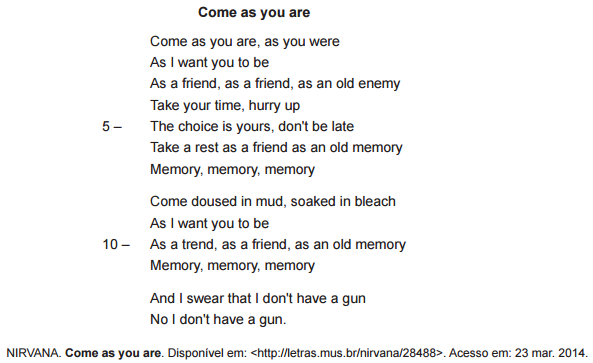
Marque C,se a proposição é verdadeira; E,se a proposição é falsa.
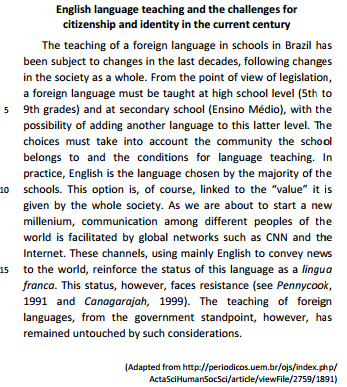
As formas verbais “are” (v.1) e “were” (v.1) descrevem, respectivamente, a oposição de tempo presente e de tempo passado.

Read text I and answer the question.
Analise o texto acima, e julgue o item .
As formas verbais “are” (v.1) e “were” (v.1) descrevem, respectivamente, a oposição de tempo presente
e de tempo passado.

 Conheça nossos planos