Questões de Concurso
Sobre presente simples | simple present em inglês
Foram encontradas 342 questões


Column A
( 1 ) This fact relates to a gap in foreign language teaching policy documents.
( 2 ) […] and it is treating it as a tool for citizenship.
( 3 ) A recent reform in 2017 has added that English […]
( 4 ) Previous versions of LDB, however, did not mandate the teaching of English […]
Column B
( ) Present Perfect
( ) Present Continuous
( ) Present Simple
( ) Past Simple
Which declarative counterpart preserves the basic proposition expressed by the question?
Para responder à questão, leia o texto abaixo.
How Will You Get from How Things Are to How Things "Should" Be?
A lot of people get fixated on things that they think "should" happen, but fail to address substantial obstacles in the way. I may even agree with them about what I think "should" happen. But that doesn't mean that it's going to happen. If you're thinking that there is also a danger in being overly cautious or waiting to work out the perfect plan, you're right. That can become a form of procrastination. Acting on an imperfect plan is usually better than waiting until you've worked out every last detail. But at least have some kind of plan that doesn't require a miracle to happen.
The plan that works will also probably not be the plan you started with. You will have to update the plan as you proceed and the situation evolves.
A good model for this process is John Boyd's OODA decision making loop. OODA stands for Observe, Orient, Decide, Act. Actions produce responses that provide new information. New information requires reorientation and new decisions will have to be made that lead to new actions, and the loop repeats.
No big changes happened because a bunch of people sat around complaining about how things "should be."
That's like saying "l should be a millionaire." You could be, but you're going to need some kind of plan to get there that realistically acknowledges the obstacles in your way.
Many of the problems we face today took years to create.
We have inherited a big mess. A lot of things happened that "should not" have happened. Mistakes were made.
But that's life. It's going to throw all kinds of things at you that are sub-optimal. Things you didn't "deserve" or ask for. Cleaning up messes you didn't create is as normal as dealing with bad weather.
Some messes only require a dustpan.
But if you want to clean up a really big mess, you're going to need a plan.
Fonte: https://mrjackdonovan.substack.com/p/the-flow-chart
Analyze the sentence below
Once an action ________, it _________feedback that ________ the next deciston.
Regarding this, select the sequence that CORRECTLY fills the blanks in this OODA loop description.
"Jefferies' Andrew Tsai estimates BPL-003 could generate sales of more than $1 billion to $2 billion if it succeeds in late-stage trials."
Consider the statements:
I. The modal verb could expresses a projected commercial possibility rather than a guaranteed result.
II. The clause introduced by if establishes a condition for the estimated sales performance.
III. The simple present form succeeds refers to a habitual event repeatedly observed in previous trials.
Mark the alternative that presents only the CORRECT statements.

According to the rules of standard grammar, to rephrase this question in the simple present, the teacher should choose
Recognize the correct question form:
_____ you like coffee?
Select the correct option to complete the sentence:
He _____ to the church every Sunday.
"Millions of people use the internet every day."
California is Free of Drought for The First Time in 25 Years
By Clara Harter
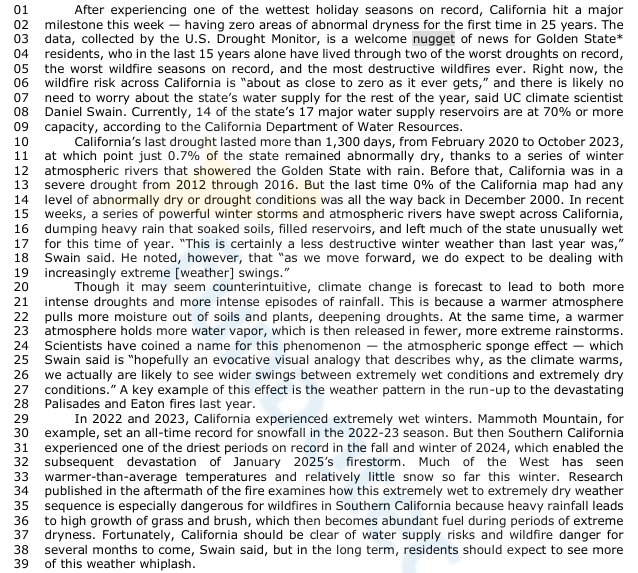
*California can be referred to as “The Golden State”.
(Available at: https://www.latimes.com/california/story/2026-01-09/california-has-no-areas-of-dryness-first- time-in-25-years – text specially adapted for this test).
English verb tenses are used to express actions that occur at different times and under different circumstances. Understanding the structure and function of each tense is essential for accurate communication and for teaching English effectively. Analyze the sentences in Column 01 and correlate them with the appropriate verb tense descriptions in Column 02.
Column 01
( )She loves classical music and attends concerts regularly.
(_)They are studying for their final exams at the moment.
( )He had finished the report before the manager arrived.
( )We will be traveling across Europe this time next month.
(__)She has lived in this city for more than ten years.
Column 02
I.Present Perfect Simple
II.Future Continuous
III.Simple Present
IV.Past Perfect Simple
V.Present Continuous
Correlate the columns according to the verb tense used in each sentence. Then, choose the alternative with the correct sequence.

 Conheça nossos planos