Questões de Concurso
Sobre passado simples | simple past em inglês
Foram encontradas 347 questões


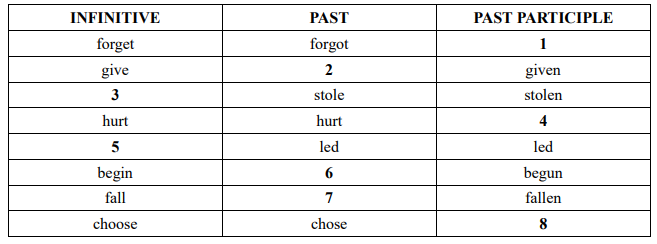
Assinale a alternativa que completa a tabela abaixo com a forma verbal correta:
I – Julia goes to the gym three times a week, but she hates it. II – The baby slept very well last night, after he was breastfed. III – I am going to move to another town after I retire. IV – I have already seen this movie. Let’s choose another one.
“By seven o’clock the orchestra _______________, no thin five-piece affair, but a whole pitful of oboes and trombones and saxophones and viols and cornets and piccolos, and low and high drums. The last swimmers ______________ in from the beach now and _______________ up-stairs; the cars from New York _______________ five deep in the drive […]” (FITZGERALD, 2011, p. 32-33).
Source: https://www.wsfcs.k12.nc.us/cms/lib/NC01001395/Centricity/Domain/7935/Gatsby_PDF_FullText.pdf Access on March, 20th 2023
Julgue o item subsequente.
“Separatist fighters in Indonesia’s restive Papua region have captured a pilot from New Zealand and are holding him hostage after setting fire to his plane, the group said in a statement.”
“This time it was Edgardo Greco, 63, who was apprehended in Saint-Etienne, France, where he was working under the alias Paolo Dimitrio as a pizzaiolo at the Caffe Rossini Italian restaurant.”
“We have six kids that have been transported into different hospitals in Montreal and Laval, but unfortunately we have two other kids that died as a result of the accident,”

I. Its past form is “could”. II. It could be replaced by “must” with no significative changes in meaning. III. It expresses permission.
Which statements are correct?
Jane! I shouted... Where are you dear?
I am here, near the gas station… she replied.
The verbs “shouted” and “replied” underlined in the text refer to:
I. Arthur has asked me to help him at the store. II. I was planning to get married in the autumn. III. On May 4th I arrived at a little town called Bistritz. IV. She had just left the room when the police arrived..
( ) Past Simple ( ) Past Continuous ( ) Past Perfect ( ) Present Perfect
I. I had read at least 50 books by the end of the semester. II. Jhon was looking for his wallet everywhere this morning. III. I have worked in this area for about 7 years now. IV. Last night she called me like a thousand times, that’s crazy.
( ) Past Simple ( ) Past Continuous ( ) Past Perfect ( ) Present Perfect
‘‘I hate doing the laundry. Last week I ________ 5 loads of laundry.’’
O texto seguinte servirá de base para responder à questão.
(1º§) The Maya are probably the best-known of the classical civilizations of Mesoamerica. Originating in the Yucatán around 2600 B.C., they rose to prominence around A.D. 250 in present-day southern Mexico, Guatemala, northern Belize and western Honduras. Building on the inherited inventions and ideas of earlier civilizations such as the Olmec, the Maya developed astronomy, calendrical systems and hieroglyphic writing. The Maya were noted as well for elaborate and highly decorated ceremonial architecture, including temple-pyramids, palaces and observatories, all built without metal tools. They were also skilled farmers, clearing large sections of tropical rain forest and, where groundwater was scarce, building sizeable underground reservoirs for the storage of rainwater. The Maya were equally skilled as weavers and potters, and cleared routes through jungles and swamps to foster extensive trade networks with distant peoples.
(2º§) Around 300 B.C., the Maya adopted a hierarchical system of government with rule by nobles and kings. This civilization developed into highly structured kingdoms during the Classic period, A.D. 200-900. Their society consisted of many independent states, each with a rural farming community and large urban sites built around ceremonial centres. It started to decline around A.D. 900 when - for reasons which are still largely a mystery - the southern Maya abandoned their cities. When the northern Maya were integrated into the Toltec society by A.D. 1200, the Maya dynasty finally came to a close, although some peripheral centres continued to thrive until the Spanish Conquest in the early sixteenth century.
(3º§) Maya history can be characterized as cycles of rise and fall: city-states rose in prominence and fell into decline, only to be replaced by others. It could also be described as one of continuity and change, guided by a religion that remains the foundation of their culture. For those who follow the ancient Maya traditions, the belief in the influence of the cosmos on human lives and the necessity of paying homage to the gods through rituals continues to find expression in a modern hybrid Christian-Maya faith.
https://www.historymuseum.ca/cmc/exhibitions/civil/maya/mmc01eng.html
Consider the first paragraph of the text and the following assertives:
I."Inherited inventions" could be translated as "invenções criadas".
II.The word "rose" is an irregular verb.
III.The word "weavers" could be replaced by "joiners".
Which one(s) is(are) CORRECT?
Choose the right option that best completes the sentences:
I.The boy ___________ to be another person.
II.The school ___________ are very strict.
This is an example of an irregular verb that takes the same verb form in the Simple Past and Past Participle:
It is regular verb form in the simple past:

 Conheça nossos planos