Questões de Concurso
Sobre passado simples | simple past em inglês
Foram encontradas 329 questões


"Emma _____ (to visit) several national parks during her trip."
'Wilbur was lonely. The sheep were asleep. His stomach was empty.'
What is the correct form of the verb 'to be' used in these sentences and why?
John traveled to Paris last summer and visited the Eiffel Tower (1st part). The sun shines brightly in the clear blue sky (2nd part).
The sentence is:
I. “I will be there at nine o’clock” is in the immediate future.
II. “The Second War ended in 1945” is in the simple past.
III. “At this same time tomorrow, I’ll be travelling” is in future progressive.
IV. “How many symphonies did Mozart compose?” is in the simple present.
V. “She hasn’t seen that film yet” is in the present perfect progressive.
Which ones are correct?

I. “Oprah has joined forces with Steven Spielberg, Quincy Jones, and Scott Sanders to bring The Color Purple musical”
II. "In 1985, Oprah made her acting debut as Sofia in Spielberg’s adaptation of Alice Walker’s novel—and earned an Academy Award nomination. "
III. “Celie, the protagonist of The Color Purple, endures the unimaginable while growing up in rural Georgia—and triumphs, thanks in part to the support of the book’s other women protagonists, Sofia and Shug Avery.”
• Get enough sleep. Good sleep improves your brain performance, mood and overall health. Consistently poor sleep is associated with anxiety, depression, and other mental health conditions.
• Get enough sleep. Good sleep improves your brain performance, mood and overall health. Consistently poor sleep is associated with anxiety, depression, and other mental health conditions.
I. The structure “there are new tools” is in the Simple Past Tense.
II. The structure “evidence-based treatments”is a nominal group connected to “social support systems that help people feel better” and the headnoun is “systems”.
III. The word “pursue” can be replace by “seek”.
IV. In the expression “that help people feel better” it refers to “social support systems”, “evidence-based treatments” and “new tools”.
Which ones are correct?
Read the text and answer the following question.
Do you assess your students or do you just test them?
[01] Assessment, evaluation, measurement, grades, tests, marks and so on. Different words to talk about the same issue. But, should they be used as synonyms?
[02] There are some terms that we often use synonymously, but actually they are not. When you assess your students, regardless of whether you use a test or not, you evaluate all the information in order to measure it and grade them.
[03] Let´s make it clear:
-Assessment implies gathering information and observing progress. We can document attitudes, knowledge and skills.
-Evaluation is the organisation of the data obtained during the assessment; for instance, using grids, checklist or diaries.
-Measurement is the scale we decide to use in order to measure the evaluation. We measure by marks, ranks or scores, among others.
-Grade is the number obtained in the measurement.
-Testing is a measuring tool. We can use a test, an examination or a quiz to challenge the student´s ability or knowledge.
[04] If you really want to assess your students and make it an active part of their own learning, promoting autonomy and metacognition, they have to know, from the very beginning, about the assessment, evaluation and grading criteria, as well as about the examinations, if there are going to be some.
[05] Assessment should be a continuous process, gathering information in every lesson and getting to know our students more and more each day, both their personal and academic profile. In order to evaluate this data, we can use simple checklists, a classroom diary, grids or similar instruments, as well as the activities themselves.
[06] When dealing with all of these tools you have to think carefully about how you are going to measure the information and how you are going to award the final grade. Moreover, you have to weigh up the benefits of testing your students with one or more quizzes and examinations.
[07] As we all know, changes are possible, and in many cases necessary, in order to adapt your theory to the actual development of the lessons. Nevertheless, all these aspects should be planned and clear from the very beginning, both for you and for your students. It could also be interesting to make them clear to the families, for instance using a classroom blog in which you can publish your evaluation methods and criteria.
[08] This could be a general example:
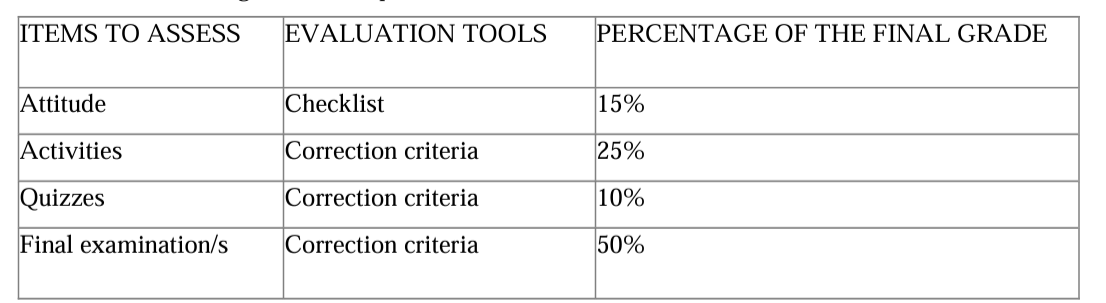
[09] From this general proposal, we would develop a checklist with items relating to attitude: participation, collaboration, deadline accomplishment, attendance, and so on. This is a progressive assessment.
[10] The activities should be corrected using different tools, depending on their nature. For example, it is not the same correcting a writing or a speaking activity (we can create grids for those, alone or with our students) than correcting a grammar exercise or a listening one (we can correct them using more traditional measuring scales or we could use peer evaluation). We would have to make all those criteria clear to our students before using them.
[11] Quizzes can be used in order to prepare our students for the final examination. We can use new technologies in order to introduce them, with tools such as Kahoot, Mentimeter, Socrative or Google Forms, among many others. They can create their own quizzes and games, in groups or individually in order to challenge their classmates.
[12] The final examination could be made up of more than one paper, for instance, we could divide it in two, or even in more items, in order to give them the opportunity to practise and avoid risking their final grade on just one exam.
[13] Apart from the possibility of dividing the final examination in two parts, another option would be to divide it according to different skills, for example, on the one hand, a test having to do with grammar, vocabulary, reading and writing and, on the other hand, another having to do with speaking and listening. Flipgrid could be a very useful tool to carry out your oral examinations in a less stressful way.
[14] Before I finish, although we haven´t given specific solutions to the complex problem of assessment, I would like to sum up with some general tips about the issue: -Necessity of an objective and continuous assessment.
-Necessity of an objective and continuous assessment.
-Use a variety of evaluation tools, not only for the exams, but also for the process: different types of activities, exams and corrections, to respond to every single student. That will make it less subjective.
-Make the evaluation and marking criteria clear to your students. You can make them part of the process, for example creating grids or checklists together.
-Introduce peer evaluation and self-asessment.
-Be prepared to adapt your planning when necessary.
[15] And remember, try to point out the positive aspects of your students´ achievements, don´t give them only feedback about their weak points, tell them about their strong points too and try to be quick in giving them back their exercises or exams results, otherwise they will have completely forgotten what they have written.
[16] The more you get to know your students, the more accurate your assessments will be, enabling them to obtain higher marks in your evaluations, tests, activities or examinations.
(Available at: https://www.teachingenglish.org.uk/professional-development/teachers/assessinglearners/magazine/do-you-assess-your-students-or-do-you Access on September 08, 2023)
Paragraph 14.
The passage below presents a _____________ tense structure.
“[...] we haven´t given specific solutions to the complex problem of assessment[...]”
Concerning the past simple, analyze the sentence below:
He completed his project last week (1st part). She has visited Paris several times in her life (2nd part).
The sentence is:
“Jane _________ along the road when she _________ an old college friend.”

I went to the theatre last week (1st part). We see a good opera last week (2nd part).
The sentence is:

 Conheça nossos planos