Questões de Concurso
Sobre passado simples | simple past em inglês
Foram encontradas 347 questões


A new William Hope Hodgson blog
Welcome to Hodgsoniana, a new blog
about the life and works of author William Hope Hodgson (1877–1918). The aim
of this blog is to provide a home for articles and new research on Hodgson,
details of Hodgson-related happenings, and just generally act as an up-to-date
(hopefully) resource that’s open to anyone interested in this remarkable
literary figure. At time of writing, there is a lack of other active websites
covering this subject, which is why starting a blog seemed a worthwhile
endeavour. At the very least, it gives me a place to post some Hodgson-related
thoughts and findings I’ve been meaning to write up! My hope is that others may
be moved to contribute also.
Before going any further, I want to
recognise the work of the late Hodgson scholar Sam Gafford, and in particular
his excellent Hodgson blog williamhopehodgson.wordpress.com. I first stumbled
upon Sam’s blog back in 2016, and his work opened my eyes to the depths and
complexities of Hodgson’s history and writings. I entered into brief
correspondence with Sam at that time, and his enthusiasm and encouragement were
key factors in starting me on the path of pursuing my own Hodgson studies.
Sam Gafford sadly passed away in
2019, leaving his site dormant. It remains a valuable treasure trove of
information, and I will certainly aspire to follow Sam’s example in exploring
and documenting all matters Hodgson.
2027 will see the 150th anniversary
of William Hope Hodgson’s birth. There is still much to discuss regarding his
work, and many areas of his life remain obscure and in need of further
investigation. I hope this site can help in encouraging and chronicling such
efforts.
Source: https://hodgsoniana.wordpress.com/2025/06/22/a-new-william-hope-hodgson-blog/
access on 28 february 2026.
"Alice had no idea what to do, and in despair she put her hand in her pocket, and pulled out a box of comfits, (luckily the salt water had not got into it,) and handed them round as prizes. There was exactly one a-piece, all round."
Which alternative below corresponds to a verb and a noun, respectively?
The unusually meticulous design of the prototype clearly ______ a level of foresight that was uncommon for the technological standards of the period.
“The company became synonymous with film photography because it controlled every stage of the process.”
Read the following excerpt of a book review:
Machado de Assis is one of Brazil’s most cherished writers. Born in 1839, he was the grandson of freed slaves. ________ was not abolished in Brazil until 1888, when Machado de Assis was already 49 years old, a fact I learned after being _____ surprised by the casual mention of slaves throughout this novel. In spite of his family’s poverty and lack of opportunity for education, Machado de Assis _____ through various bureaucratic positions until finally gaining prominence as a writer and poet. He taught himself French, English, German, and Greek, and eventually founded the Brazilian Academy of Letters. Nevertheless, he has never had a vast following among English-speaking readers, which is a shame.
Dom Casmurro is a simple tale about an aging man named Bento Santiago, who is one day moved to document the story of his life. His life is not all that extraordinary, to be honest. He falls in love with the girl next door, ______ with her and a close family friend to avoid being sent to the seminary, eventually marries and has a son, and then becomes jealous and suspicious. In his old age, where the novel begins, he has taken to living in a reproduction of his ________ home, suggesting a sort of Citizen Kane-type regret (rather, I guess Citizen Kane suggests a type of Dom Casmurrotype regret).
Source: https://cannonballread.com/2023/09/dom-casmurrokimmie/
Choose the option that best completes the gaps in the excerpt:
Leia o texto para responder à questão.
It has been common in second language teaching to stress the role of interference – that is, the interfering effects of the native language on the target (the second) language. It is of course not surprising that this process has been so singled out, for native language interference is surely the most immediately noticeable source of error among second language learners. The saliency of interference has been so strong that some have viewed second language learning as exclusively involving the overcoming of the effects of the native language. It is clear from learning theory that a person will use whatever previous experience he or she has had with language to facilitate the second language learning process. The native language is an obvious set of prior experiences. For example, a French native speaker might say in English, “I am in New York since January,” a perfectly logical transfer of the comparable French sentence “Je suis a New York depuis Janvier.” Because of the negative transfer of the French verb form to English, the French system has, in this case, interfered with the person’s production of a correct English form.
(Brown, D. 1994. Principles of Language
Learning and Teaching. Adaptado)
Yesterday at work, I ___ (send) an important email to my manager, ___ (speak) with two clients on the phone, ___ (find) a mistake in the report, ___ (make) the necessary corrections, and ___ (tell) my team about the changes.
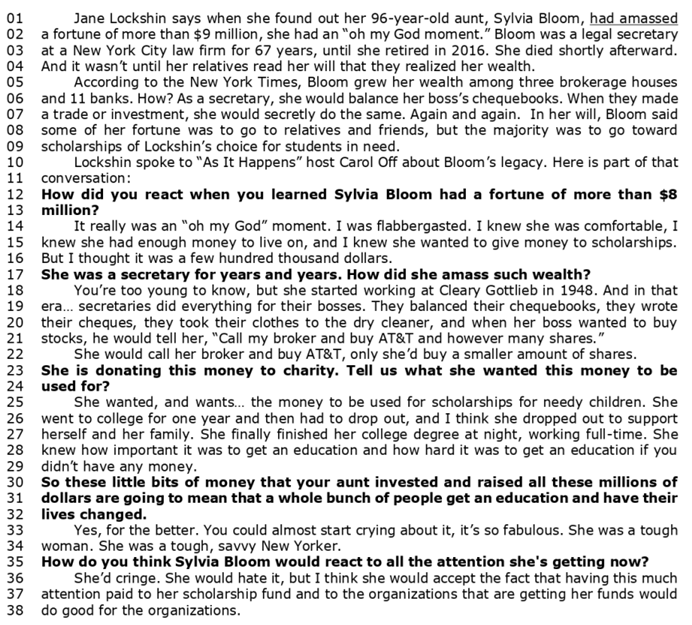
Question must be answered based on the following song.
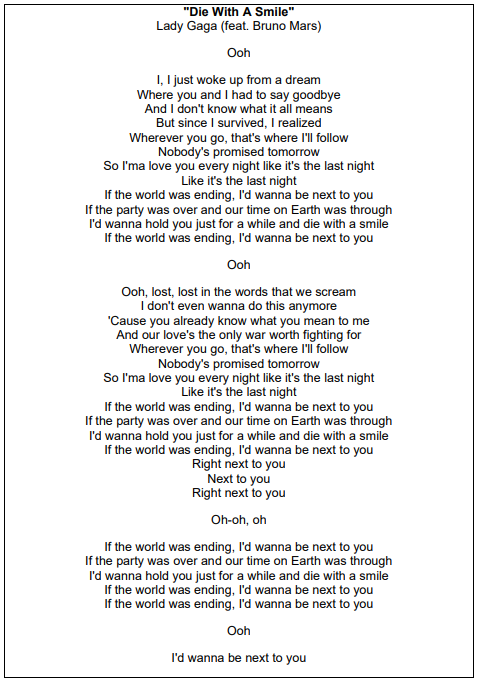
Available at: https://www.letras.mus.br/lady-gaga/die-with-a-smile-feat-bruno-mars/
Text 7A1-II
Two roads diverged in a yellow wood,
And sorry I could not travel both
And be one traveler, long I stood
And looked down one as far as I could
To where it bent in the undergrowth;
Then took the other, as just as fair,
And having perhaps the better claim,
Because it was grassy and wanted wear;
Though as for that the passing there
Had worn them really about the same,
And both that morning equally lay
In leaves no step had trodden black.
Oh, I kept the first for another day!
Yet knowing how way leads on to way,
I doubted if I should ever come back.
I shall be telling this with a sigh
Somewhere ages and ages hence:
Two roads diverged in a wood, and I—
I took the one less traveled by,
And that has made all the difference.
Robert Frost. The Road Not Taken. 1916 (adapted).
In text 7A1-II, the modal verb “should”, in “I doubted if I should ever come back.” (fifteenth verse), expresses
Text 7A1-II
Two roads diverged in a yellow wood,
And sorry I could not travel both
And be one traveler, long I stood
And looked down one as far as I could
To where it bent in the undergrowth;
Then took the other, as just as fair,
And having perhaps the better claim,
Because it was grassy and wanted wear;
Though as for that the passing there
Had worn them really about the same,
And both that morning equally lay
In leaves no step had trodden black.
Oh, I kept the first for another day!
Yet knowing how way leads on to way,
I doubted if I should ever come back.
I shall be telling this with a sigh
Somewhere ages and ages hence:
Two roads diverged in a wood, and I—
I took the one less traveled by,
And that has made all the difference.
Robert Frost. The Road Not Taken. 1916 (adapted).
In text 7A1-II, the verb “bent”, in “To where it bent in the undergrowth” (fifth verse), is correctly conjugated in the

From: https://schulzmuseum.org/wp-content/uploads/2020/11/1963-05-01_WEBscaled.jpg
The mysterious death of Alexander the Great
When Alexander the Great’s body seemingly remained unchanged for six days after his death in 323 BCE, his contemporaries could offer only one explanation. Alexander must have been a god. So… was he?
Alexander the Great first fell ill during a days-long series of parties, during one of which he collapsed, complaining of a searing pain in his back. After 10 days of intense fever, Alexander’s soldiers were brought in to see him one final time. As reported by the historian Arrian, at that point the king “could no longer speak… but he struggled to raise his head and gave each man a greeting with his eyes.”
When Alexander was declared dead on June 13, theories began forming. Had he been poisoned? Sabotaged? Had he been killed by drinking too much wine? Today we have an explanation for Alexander’s death and his period of bodily freshness that relies less on the supernatural and more on science. In 2018 Dr. Katherine Hall, a lecturer in New Zealand, proposed that Alexander the Great had Guillain-Barré syndrome, an acute autoimmune condition that results in muscle paralysis. In other words, Alexander may have been alive when he was declared dead—a mistake that could have been made when physicians mistook the shallow breathing of a coma patient for no breathing at all. If this was the case, Alexander may have been effectively murdered during embalming—a process that would have seen him disemboweled.
While we can’t travel back in time to confirm Hall’s theory, it is the only one that takes into account all the details of Alexander’s death—and his body’s mysterious life.
Encyclopaedia Britannica. Adaptation
The tense and aspect of the underlined verbs below are:
Alexander the Great first fell ill during a days-long series of parties, during one of which he collapsed, complaining of a searing pain in his back. After 10 days of intense fever, Alexander’s soldiers were brought in to see him one final time. As reported by the historian Arrian, at that point the king “could no longer speak… but he struggled to raise his head and gave each man a greeting with his eyes.”

 Conheça nossos planos