Questões de Concurso
Sobre interpretação de texto | reading comprehension em inglês
Foram encontradas 12.687 questões


“Millions of children, every year, start school excited about what they will learn, but quickly become disillusioned when they get the idea they are not as ‘smart’ as others,” writes Jo Boaler. That’s because parents and teachers inadvertently give out the message that talent is inborn — you either have it or you don’t.
“Millions of children, every year, start school excited about what they will learn, but quickly become disillusioned when they get the idea they are not as ‘smart’ as others,” writes Jo Boaler. That’s because parents and teachers inadvertently give out the message that talent is inborn — you either have it or you don’t.
For Stephen Krashen, the disruption to traditional education during Covid-19 may reveal some unexpected benefits. How teachers and parents can harness the opportunity to teach language — including heritage languages — during remote learning?
For Stephen Krashen, the disruption to traditional education during Covid-19 may reveal some unexpected benefits. How teachers and parents can harness the opportunity to teach language — including heritage languages — during remote learning?
For Stephen Krashen, the disruption to traditional education during Covid-19 may reveal some unexpected benefits. How teachers and parents can harness the opportunity to teach language — including heritage languages — during remote learning?
There is ample evidence that reading not only strengthens second language vocabulary, but also expands it as readers meet words, or the same word, in different contexts. After all, that is the way lexical vocabulary is acquired in real life, through hearing it in our first languages.
There is ample evidence that reading not only strengthens second language vocabulary, but also expands it as readers meet words, or the same word, in different contexts. After all, that is the way lexical vocabulary is acquired in real life, through hearing it in our first languages.
Text 3A1-I

Bill Watterson. Calvin and Hobbes. Internet: <https://www.gocomics.com>
Text 3A1-I
Bill Watterson. Calvin and Hobbes. Internet: <https://www.gocomics.com>
Text 3A1-I
Bill Watterson. Calvin and Hobbes. Internet: <https://www.gocomics.com>
CORONAVIRUS
Coronavirus is a newly discovered virus. It causes a disease called Covid-19. In some parts of the world, it has made lots ............ people sick. Corona is a Latin for crown, because ............. the microscope, these viruses look like a crown .............. spikes ending ............... little blobs.
A lot of symptoms are similar to the flu. You may have dry and itchy cough, fever, lots of sneezing and even hard to breathe. Most of people who has gotten sick with this coronavirus have had a mild case. It means you will not feel the disease. But, for people who are much older or who already have health problems are more likely to get sicker with coronavirus.
If anyone gets sick and feels like they may have coronavirus, they can immediately call their doctors and get help. If there is something we are not sure about the information, confused or worried about, don’t be afraid to ask someone we trust.
Here are some things you can do to protect yourself, family and friends from getting sick: 1) wash your hands often using soap and water. 2) Sneeze into your elbows. It is believed that coronavirus spread through little liquid from our lungs. If you sneeze into your elbows, you can prevent germs for going far into the air. 3) Avoid touching your face. Don’t pick your nose. Don’t touch your mouth. Don’t rub your eyes. They are the places where the virus enter our bodies.
Remember that this kind of virus can affect anybody. It
doesn’t matter where you come from or what country
you are from. Don’t forget, there are a lot of helpers
out there who are working to protect us from the virus.
We can take a part by keeping our health and stay at
home to stop the virus spread to others.
CORONAVIRUS
Coronavirus is a newly discovered virus. It causes a disease called Covid-19. In some parts of the world, it has made lots ............ people sick. Corona is a Latin for crown, because ............. the microscope, these viruses look like a crown .............. spikes ending ............... little blobs.
A lot of symptoms are similar to the flu. You may have dry and itchy cough, fever, lots of sneezing and even hard to breathe. Most of people who has gotten sick with this coronavirus have had a mild case. It means you will not feel the disease. But, for people who are much older or who already have health problems are more likely to get sicker with coronavirus.
If anyone gets sick and feels like they may have coronavirus, they can immediately call their doctors and get help. If there is something we are not sure about the information, confused or worried about, don’t be afraid to ask someone we trust.
Here are some things you can do to protect yourself, family and friends from getting sick: 1) wash your hands often using soap and water. 2) Sneeze into your elbows. It is believed that coronavirus spread through little liquid from our lungs. If you sneeze into your elbows, you can prevent germs for going far into the air. 3) Avoid touching your face. Don’t pick your nose. Don’t touch your mouth. Don’t rub your eyes. They are the places where the virus enter our bodies.
Remember that this kind of virus can affect anybody. It
doesn’t matter where you come from or what country
you are from. Don’t forget, there are a lot of helpers
out there who are working to protect us from the virus.
We can take a part by keeping our health and stay at
home to stop the virus spread to others.
According to the text, decide if the statements below are true ( T ) or false ( F ).
( ) We should not touch our faces to avoid the virus.
( ) It is enough to wash our hands only by water.
( ) Staying at home is our part to stop the virus.
( ) The virus only affect people in Asia.
( ) Nose, mouth and eyes are places where the virus can enter in our bodies.
Choose the alternative which presents the correct
sequence, from top to bottom.
CORONAVIRUS
Coronavirus is a newly discovered virus. It causes a disease called Covid-19. In some parts of the world, it has made lots ............ people sick. Corona is a Latin for crown, because ............. the microscope, these viruses look like a crown .............. spikes ending ............... little blobs.
A lot of symptoms are similar to the flu. You may have dry and itchy cough, fever, lots of sneezing and even hard to breathe. Most of people who has gotten sick with this coronavirus have had a mild case. It means you will not feel the disease. But, for people who are much older or who already have health problems are more likely to get sicker with coronavirus.
If anyone gets sick and feels like they may have coronavirus, they can immediately call their doctors and get help. If there is something we are not sure about the information, confused or worried about, don’t be afraid to ask someone we trust.
Here are some things you can do to protect yourself, family and friends from getting sick: 1) wash your hands often using soap and water. 2) Sneeze into your elbows. It is believed that coronavirus spread through little liquid from our lungs. If you sneeze into your elbows, you can prevent germs for going far into the air. 3) Avoid touching your face. Don’t pick your nose. Don’t touch your mouth. Don’t rub your eyes. They are the places where the virus enter our bodies.
Remember that this kind of virus can affect anybody. It
doesn’t matter where you come from or what country
you are from. Don’t forget, there are a lot of helpers
out there who are working to protect us from the virus.
We can take a part by keeping our health and stay at
home to stop the virus spread to others.
Analise a figura a seguir:
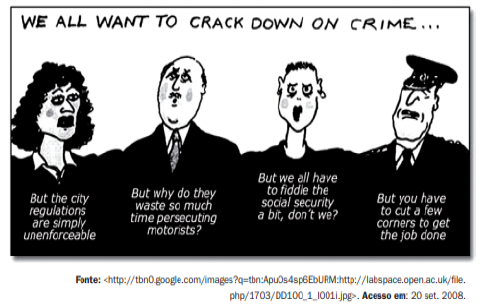
As pessoas, na figura, estão:
According to the text, how can be characterized the setting of the promotional pictures of Taylor Swift's album?
According to the text, what was the theme of the closing exhibition "States of Being"?

Internet: <thecomicstrips.com>.
We can infer from the comic strip that the man who wants to create the website is also good at using his credit card carelessly.
Internet: <thecomicstrips.com>.
The man on the right went away because he realized that his friend has a compulsive online shopping disorder.
Internet: <thecomicstrips.com>.
The website that the man on the left wants to create would be based on his personal knowledge about electronics.

 Conheça nossos planos