Questões de Concurso
Sobre interpretação de texto | reading comprehension em inglês
Foram encontradas 12.687 questões


Global Perspectives of Public Administration

From a global perspective, public administration still raises passionate debates. Many of us presume to know the virtues of a globalized world, where commerce flourishes without barriers, cultures intertwine with each other, communication and technologies connect distant places to local villages and even to one’s living room. We probably agree that globalization creates a sense of togetherness, a feeling that events on one side of the world concern people living on the other side and that democracy and good governance are globalized aspirations to which people of all nations are prime subscribers. We soon realize however that globalization carries within it an insatiable spirit of competition and greed. The idea that the fittest, the strongest ultimately destroys the weakest, is straight from the jungle. The notion that globalization facilitates the overhauling of established norms and values, for better or for worse, is very much practicable.
What are public administrators to do when globalization seems to threaten the very customs and values that glue their society together? […]
The notion that public administration is a global phenomenon, subject to universal principles of moralities and values is tantalizing but questionable. A particular form of governance seems to work well for societies with common cores principles and traditional heritage, while another form of practice seems to facilitate better the development and aspirations of citizens in other corners of the world. Public administrators are first and foremost responsible for the management of their constituent’s affairs. They should dedicate their time and energy to respond to the aspirations and desiderata of their people and within the established boundaries of their societies. Public administrators seem to be more effective when they are inspired by concrete societal goals and objectives rather than when they are driven by a subjective sense of universal morality and goodness toward mankind. Too often, we have witnessed senseless wars and targeted killings in the name of subjective greater goods and selfish interests. […]
Nevertheless, the world is interconnected and public administrators have to deal with internal as well as external issues outside of their national borders. International laws and regulations require that countries’ citizens behave in a certain manner toward fellow neighbors that certain principles of coexistence such as respect for diversity and basic understanding of human rights and dignity are undeniable. Public administrators in a globalized world have to focus on these ideas and create structures that essentially characterize these viewpoints.
(Adapted from https://patimes.org/global-perspectives-public-administration/
Retrieved June 28th, 2022.)
Based on the information provided by the text, mark the statements below as true (T) or false (F).
( ) Globalization has both pleasant and objectionable consequences.
( ) Viewed globally, forms of administration are alike.
( ) Public administrators must be aware of national and international laws.
The statements are, respectively,
For question choose the best option to fill in the blank.
Maria _________ home as soon as she_________ her work.
“Language learning, and therefore teaching, is also teaching learners ways of learning. Showing them how to learn independently of the teacher increases their belief in themselves. By doing some Learner Training in class, the teacher is contributing to develop learners’ autonomy.”
According to the passage, which of the alternatives below is NOT part of Learner Training?
After reading the following passage, choose the correct answers to the question.

After reading the following passage, choose the correct answers to the question.
After reading the following passage, choose the correct answers to the question.
After reading the following passage, choose the correct answers to the question.
The new water technologies that could save the planet


The new water technologies that could save the planet

Read the following paragraph and choose the correct option for the question that follows:
I‘ve got a young friend, he‘s only 25, but he fits the bill perfectly. He‘s single and he‘s hungry. He‘s willing to start from scratch and, best of all, he isn‘t afraid of putting his nose to the grindstone for those 80-hour weeks. He decided to take the bull by the horns by going starting up his own business. He found a software developer who knew the internet inside out. This young man was also very ambitious. He left his safe job at the drop of a hat. They were both reaching for pie in the sky, and they were ready. They also were lucky. They founded a startup and got into the whole social networking business.
Adapted from: https://www.thoughtco.com/young-and-free-prerequisite-for-success-1210197 (Accessed on 01.21.2022)
The underlined idioms in the paragraph mean, respectively
I‘m sorry for ______ such a long time to write back. I‘ve been so busy at work lately. I‘ve also not been studying very hard and my French exam is next month! To ______ you the truth, I‘m getting a bit nervous and will have to ______ some revision! The good news is I‘m going on holiday with my parents before the exam, so if I get the chance I‘m going to try to ______ an effort and work on my French. Anyway, the reason I‘m writing is to ask you if you would like to come to the UK. I know you haven't been here before and we could ______ sightseeing. Let me know what you think.
Adapted from: https://www.flo-joe.co.uk/preliminaryenglish/vocabulary/pet-collocations.htm (Accessed on 01.21.2022)
In the following picture, the punch line is related to
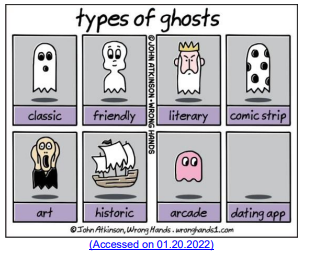
Read the text and choose the correct option for the question.
ENGLISH TEACHING AND LEARNING DURING THE COVID CRISIS: ONLINE CLASSES AND UPSKILLING TEACHERS
Since many countries have imposed a lockdown on movement, and many schools have subsequently closed their doors, vast numbers of previously tech-shy teachers are having to learn very quickly how to teach using online resources. This might be through delivering lessons using virtual classrooms or providing online self-study material for students, both of which may be new modes of lesson delivery for many.
Since the rise of the internet in the 1990s, English language (EL) teachers have had what might be described as a difficult relationship with technology. Initial teacher education has been slow to embrace digital ways of teaching and learning, meaning that many EL teachers feel that they have been poorly prepared to use technology in their teaching (Clark, 2018). Consequently, many EL teachers have been resistant to the digital wave which has revolutionised other areas of our lives. Understandably, there are a number of worries which teachers have regarding introducing technology into teaching. Three of the most common are:
• Technology is isolating – learner interaction is limited, and dissimilar to the kind of ways that they will be required to use language in the real world.
• Teachers are being deskilled, and the essence of teaching is being lost.
• The rise of technology, particularly Artificial Intelligence (AI), will soon mean that teachers are made redundant.
Is technology isolating for teachers?
In many situations, technology can actually facilitate interaction. We only need to think of how many of us now use our phones and social media such as WhatsApp or Facebook to communicate. This can be equally true of interaction in a virtual learning environment – if managed correctly, opportunities for language use can be optimised and students will have plenty of interaction with each other. And, whether we like it or not, these forms of interaction, mediated through digital channels, now account for a high percentage of interactions in the 'real world‘.
EL teaching has long since stopped being a static discipline, in which teachers are primarily conveyors of declarative knowledge, i.e. facts or information. Nowadays, English teachers are better conceptualised as facilitators of learning who provide learning opportunities for their students, and give feedback to support improvement. The essence of teaching is not therefore something fixed but rather dynamic, adapting to the context and situation in which each teacher finds themselves. The facilitation of learning through technology is a highly skilled endeavour, and in many contexts can offer a really useful support to the classroom, providing students with the chance to learn in new and interesting ways.
Artificial intelligence is a 21st century spectre which haunts many professions. However, a study into which jobs are likely to be replaced by AI in the future (Frey & Osborne, 2013) found that the chances of the profession of school teacher disappearing was around 0.007, i.e. very low indeed, especially when compared with jobs such as Library Assistants (0.95), Real Estate Brokers (0.97) and Telemarketers (0.99).
This is because teaching is a complex job, requiring a range of skills, such as subject knowledge, classroom management, motivational skills, delivering feedback, differentiating learning, problem solving, emotional intelligence, counselling, etc. – the list is almost endless.
This contrasts with the current state of AI, which can be described as 'domain specific‘, i.e. highly skilled but in one particular area, e.g. playing chess, driving a car, recognising human faces or speech. The 'domain general‘ skills which a teacher possesses, and the complex interaction between those, is not going to be matched by machines anytime soon.
Adapted from: https://www.cambridgeenglish.org/blog/english-teaching-and-learning-during-the-covid-crisis/ (Accessed on 01.23.2022)
Read the text and choose the correct option for the question.
ENGLISH TEACHING AND LEARNING DURING THE COVID CRISIS: ONLINE CLASSES AND UPSKILLING TEACHERS
Since many countries have imposed a lockdown on movement, and many schools have subsequently closed their doors, vast numbers of previously tech-shy teachers are having to learn very quickly how to teach using online resources. This might be through delivering lessons using virtual classrooms or providing online self-study material for students, both of which may be new modes of lesson delivery for many.
Since the rise of the internet in the 1990s, English language (EL) teachers have had what might be described as a difficult relationship with technology. Initial teacher education has been slow to embrace digital ways of teaching and learning, meaning that many EL teachers feel that they have been poorly prepared to use technology in their teaching (Clark, 2018). Consequently, many EL teachers have been resistant to the digital wave which has revolutionised other areas of our lives. Understandably, there are a number of worries which teachers have regarding introducing technology into teaching. Three of the most common are:
• Technology is isolating – learner interaction is limited, and dissimilar to the kind of ways that they will be required to use language in the real world.
• Teachers are being deskilled, and the essence of teaching is being lost.
• The rise of technology, particularly Artificial Intelligence (AI), will soon mean that teachers are made redundant.
Is technology isolating for teachers?
In many situations, technology can actually facilitate interaction. We only need to think of how many of us now use our phones and social media such as WhatsApp or Facebook to communicate. This can be equally true of interaction in a virtual learning environment – if managed correctly, opportunities for language use can be optimised and students will have plenty of interaction with each other. And, whether we like it or not, these forms of interaction, mediated through digital channels, now account for a high percentage of interactions in the 'real world‘.
EL teaching has long since stopped being a static discipline, in which teachers are primarily conveyors of declarative knowledge, i.e. facts or information. Nowadays, English teachers are better conceptualised as facilitators of learning who provide learning opportunities for their students, and give feedback to support improvement. The essence of teaching is not therefore something fixed but rather dynamic, adapting to the context and situation in which each teacher finds themselves. The facilitation of learning through technology is a highly skilled endeavour, and in many contexts can offer a really useful support to the classroom, providing students with the chance to learn in new and interesting ways.
Artificial intelligence is a 21st century spectre which haunts many professions. However, a study into which jobs are likely to be replaced by AI in the future (Frey & Osborne, 2013) found that the chances of the profession of school teacher disappearing was around 0.007, i.e. very low indeed, especially when compared with jobs such as Library Assistants (0.95), Real Estate Brokers (0.97) and Telemarketers (0.99).
This is because teaching is a complex job, requiring a range of skills, such as subject knowledge, classroom management, motivational skills, delivering feedback, differentiating learning, problem solving, emotional intelligence, counselling, etc. – the list is almost endless.
This contrasts with the current state of AI, which can be described as 'domain specific‘, i.e. highly skilled but in one particular area, e.g. playing chess, driving a car, recognising human faces or speech. The 'domain general‘ skills which a teacher possesses, and the complex interaction between those, is not going to be matched by machines anytime soon.
Adapted from: https://www.cambridgeenglish.org/blog/english-teaching-and-learning-during-the-covid-crisis/ (Accessed on 01.23.2022)
Read the text and choose the correct option for the question.
ENGLISH TEACHING AND LEARNING DURING THE COVID CRISIS: ONLINE CLASSES AND UPSKILLING TEACHERS
Since many countries have imposed a lockdown on movement, and many schools have subsequently closed their doors, vast numbers of previously tech-shy teachers are having to learn very quickly how to teach using online resources. This might be through delivering lessons using virtual classrooms or providing online self-study material for students, both of which may be new modes of lesson delivery for many.
Since the rise of the internet in the 1990s, English language (EL) teachers have had what might be described as a difficult relationship with technology. Initial teacher education has been slow to embrace digital ways of teaching and learning, meaning that many EL teachers feel that they have been poorly prepared to use technology in their teaching (Clark, 2018). Consequently, many EL teachers have been resistant to the digital wave which has revolutionised other areas of our lives. Understandably, there are a number of worries which teachers have regarding introducing technology into teaching. Three of the most common are:
• Technology is isolating – learner interaction is limited, and dissimilar to the kind of ways that they will be required to use language in the real world.
• Teachers are being deskilled, and the essence of teaching is being lost.
• The rise of technology, particularly Artificial Intelligence (AI), will soon mean that teachers are made redundant.
Is technology isolating for teachers?
In many situations, technology can actually facilitate interaction. We only need to think of how many of us now use our phones and social media such as WhatsApp or Facebook to communicate. This can be equally true of interaction in a virtual learning environment – if managed correctly, opportunities for language use can be optimised and students will have plenty of interaction with each other. And, whether we like it or not, these forms of interaction, mediated through digital channels, now account for a high percentage of interactions in the 'real world‘.
EL teaching has long since stopped being a static discipline, in which teachers are primarily conveyors of declarative knowledge, i.e. facts or information. Nowadays, English teachers are better conceptualised as facilitators of learning who provide learning opportunities for their students, and give feedback to support improvement. The essence of teaching is not therefore something fixed but rather dynamic, adapting to the context and situation in which each teacher finds themselves. The facilitation of learning through technology is a highly skilled endeavour, and in many contexts can offer a really useful support to the classroom, providing students with the chance to learn in new and interesting ways.
Artificial intelligence is a 21st century spectre which haunts many professions. However, a study into which jobs are likely to be replaced by AI in the future (Frey & Osborne, 2013) found that the chances of the profession of school teacher disappearing was around 0.007, i.e. very low indeed, especially when compared with jobs such as Library Assistants (0.95), Real Estate Brokers (0.97) and Telemarketers (0.99).
This is because teaching is a complex job, requiring a range of skills, such as subject knowledge, classroom management, motivational skills, delivering feedback, differentiating learning, problem solving, emotional intelligence, counselling, etc. – the list is almost endless.
This contrasts with the current state of AI, which can be described as 'domain specific‘, i.e. highly skilled but in one particular area, e.g. playing chess, driving a car, recognising human faces or speech. The 'domain general‘ skills which a teacher possesses, and the complex interaction between those, is not going to be matched by machines anytime soon.
Adapted from: https://www.cambridgeenglish.org/blog/english-teaching-and-learning-during-the-covid-crisis/ (Accessed on 01.23.2022)

 Conheça nossos planos