Questões de Concurso Sobre futuro simples | simple future em inglês

Foram encontradas 108 questões

Q1679409 Inglês

What is the verb tense underlined in the sentence below?


"The teacher thought we had understood the book."

Alternativas
Q1677693 Inglês
Thanksgiving Day: An American Tradition.

Thanksgiving is an American holiday that points back to the days of the pioneers and the colonization of the new country called the United States of America. History:
In the 1700s when the pioneers first arrived to the New World they were overwhelmed by disease, lack of food and shelter, and conflict with Native Americans. However, after a period of time they grew accustomed to these challenges and even managed to create a friendly relationship with the natives. There came a point where certain Native American groups helped the new Americans plant crops, raise animals, and build shelter.
The first Thanksgiving was a day during harvest time when the pioneers and the Native Americans joined together to enjoy a feast of the grains, vegetables, and meats that they had raised. It was a time of celebration for their survival up until that point as well as a bright future that lay ahead of them.

Disponível em: https://www.inglesnapontadalingua.com.br/2013/11/tha nksgiving.html Acesso em 05 jan. 2021. 
Thanksgiving is an American holiday that points back to the days of the pioneers and the colonization of the new country called the United States of America. Os tempos verbais utilizados no trecho acima são, respectivamente:
Alternativas
Q1676674 Inglês
Assinale a alternativa que contém uma frase que faz referência a um evento no futuro.
Alternativas
Q1792131 Inglês

Instructions: answer the question based on the following text.

Source (adapted): https://www.bbc.com/news/worldafrica-50800864

" Botswana has cancelled the licenses of two professional hunters who shot dead a research elephant.” (l.1-3) Which verb tense the sentence above is?
Alternativas
Q1773434 Inglês

What is blended learning and how does it work? 
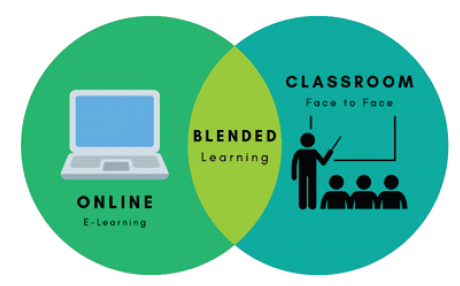

Image: https://www.tp.edu.sg/sii/individuals/blended-learning

Blended learning as an approach is not new. Indeed, the practice of combining (blending) different learning approaches and strategies is not new. Distance learning courses have long combined blended learning through a mix of self-access content (print/video/TV/ radio) and face-to-face/telephone support. 'Traditional' courses have always combined (and some still do) a variety of delivery modes that combine content such as lectures, seminars, tutorials, workshops and group work to give learners a range of learning opportunities. And of course, 'good teachers will always use more than one method or approach in their teaching, and good learners will always combine different strategies in their learning' (Marsh, 2012:3*).

So we could say that the term 'blended learning' refers to every time teachers mix different media (e.g. print, audio, and video) with classroom interaction, maximising authentic input in order to support learners' output and skills development. As such, blended learning has more or less always existed, although the term itself is a mere 15 years old at most, and is now understood to mean a rich, supportive learner-centred learning environment where the 'right blend' is synonymous with effective learning (and teaching).

 What is new is that today, technology combines all the different media within one environment: online. The online space facilitates learner–learner interaction, encourages incidental and exploratory learning and allows learners and teachers to stay connected outside the classroom, if they so wish. Learners can benefit from the fact that space and distance do not matter any more. Teachers and educationalists are now understanding more and more that, with the 'right blend', teachers can offer a much richer, supportive learning environment, learning opportunities increase, learning becomes more effective and the learning process becomes more enjoyable.

There are many definitions for blended learning, but they all have the following in common: they refer to two different learning environments — face-to-face (synchronous) and online (asynchronous); and they refer to combining those two learning environments in a complementary way to deliver a programme of study so that learners can be supported both within the classroom environment and outside of it. In other words, the term blended learning refers to any programme of study that is delivered by appropriately combining both synchronous interactive study (usually face-to-face) and asynchronous (individual) study (usually online).

We could go further and say, 'It's in the blend!' That is, the key to a successful blended learning approach is to use the strengths of each medium appropriately, combining the two different learning environments in an integrated way so that each medium complements one another: the classroom environment being used for what it does best, such as introducing new topics, explaining important language points or for meaningful communicative activities, and the online environment being used for what it does best, such as preparing for the next topic (by watching a video/reading a text, etc.), and/or practising and consolidating what has been learnt in class or for extra practice. Both modes of delivery put the learner at the centre of the learning process.
(…)

*Marsh, D. Blended Learning:Creating Learning Opportunities for Language Learners. Cambridge: Cambridge University Press, 2012.
(Adapted from: KING, A. Blended language learning: Part of the Cambridge Papers in ELTseries. [pdf] Cambridge: Cambridge University Press, 2016, p. 2.Available st at: http://languageresearch.cambridge.org/cambridge-papers-in-elt Accessed on October 31, 2019). 
In the first paragraph of the text, the verb tenses used are:
Alternativas
Q1757150 Inglês
Complete the sentence: If she __________at 11 a.m., she _________at home after midnight.
Alternativas
Q1735537 Inglês

Answers the question according to the text below.


Organ Donation and Transplant  


At this moment, more than 113,000 people in the U.S. are waiting for an organ. One more person is added to the national waiting list every 12 minutes. Each of these people is in desperate need of a kidney, liver, heart, or other organ. More than 6,500 people a year -- about 20 a day -- die before that organ ever becomes available.
Organ donors are always in short supply. There are far more people in need of a transplant than there are people willing to donate an organ. Most of the organs that are available come from deceased donors. When you fill out an organ donor card with your driver's license, you're agreeing to donate all or some of your organs if you die.
A smaller number of organs come from healthy people. More than 6,000 transplants from living donors are performed each year.
You might have wondered about donating an organ -- either to a friend or relative who needs an organ right now, or by filling out an organ donor card.
Just about anyone, at any age, can become an organ donor. Anyone younger than age18 needs to have the consent of a parent or guardian.
For organ donation after death, a medical assessment will be done to determine what organs can be donated. Certain conditions, such as having HIV, actively spreading cancer, or severe infection would exclude organ donation.
Having a serious condition like cancer, HIV, diabetes, kidney disease, or heart disease can prevent you from donating as a living donor. 

“For organ donation after death, a medical assessment WILL BE DONE to determine what organs can be donated.”. (lines 17-18). The highlighted expression is in the:
Alternativas
Q1694827 Inglês
Analyze the excerpts below regarding verb tenses respectively in the order they appear:
i. “[…] that’s how we’re going to meet those targets.” (line 12) ii. The Aichi biodiversity goals for 2020 included removing all incentives or subsidies harmful to nature (line 19, 20) iii. […] which will now be opened to signatories worldwide […] (line 24) iv. […] but the UK is not yet meeting the targets […] (lines 34, 35)

Alternativas
Q1694810 Inglês
The worldwide effort to combat critical levels of biodiversity loss will fail without far greater involvement from local communities, according to an international declaration. (lines 1, 2)
Which verb tense is seen in the excerpt?
Alternativas
Q1694634 Inglês

Analise as tabelas abaixo:


TABELA 1

I Water boils at 100°C.
II Mary heard the sound of a bell.
III I will drive the car tomorrow.


TABELA 2

A Passado
B Presente
C Futuro


Assinale a alternativa que relaciona a frase da “Tabela 1” ao tempo verbal correto da “Tabela 2”:


Alternativas
Q1620939 Inglês
Look at the picture. Based on what you can see, choose the CORRECT answer.
Imagem associada para resolução da questão

“He _________ his hand if he touches that hot pan.”
Alternativas
Q2026130 Inglês

“Fay, what are you going to do on your next vacation?

I'm going ...”

The verb that completes Fay's answer correctly is:

Alternativas
Q1738378 Inglês

Use of the Simple Future Tense


1. to talk about _______

________________________________

2. to ________/______________


Complete:

Alternativas
Q1738373 Inglês

Imagem associada para resolução da questão


This is a mind map about:

Alternativas
Q1729071 Inglês
The government __________ all very nervous about the report, which _________ published tomorrow. Identify the correct verb forms that completes the context:
Alternativas
Q1725578 Inglês
Read the news below.

The impact of the smoke will be minimized by burning under specific wind and atmospheric conditions, however __________________ times when large amounts of low-lying smoke will be present. At other stages in the operation, a very large smoke column protruding hundreds of feet into the atmosphere may be seen for many miles.

Identify the best alternative that completes the context.
Alternativas
Q1725017 Inglês

Considere the sentence below:


“Our classes begin at nine.”


The verb tense is:

Alternativas
Q1724861 Inglês
Look at the picture. Based on what you can see, choose the CORRECT answer.
Imagem associada para resolução da questão
“He ______ the ball.” 
Alternativas
Q1721803 Inglês

For the question, fill in the blanks with the correct alternative.


Adam: Are you _______________ go out of the town this weekend?

Tom: Yes, I am. I am going to visit my grandparents.

Alternativas
Q1640154 Inglês
Considering verb tenses for future, choose the CORRECT alternative:
Alternativas
Respostas
61: C
62: D
63: D
64: A
65: C
66: B
67: D
68: D
69: D
70: D
71: B
72: C
73: E
74: A
75: D
76: D
77: B
78: B
79: B
80: B