🎯 Saiba o que estudar

Avançado com Treinador a partir de R$ 0,76/dia

Questões de Concurso Sobre determinantes e quantificadores | determiners and quantifiers em inglês

Questões Discursivas

Foram encontradas 146 questões

Q2312060 Inglês
Complete the sentences. Use VERY LITTLE or VERY FEW.
I drink _________ coffee. I prefer tea. It is difficult to go to Maceió. There are ________ flights. Mark is very thin because he eats ________.
Choose the correct alternative:
Alternativas
Q2204963 Inglês
Text I

What is English as a Lingua Franca?

      ‘English’, as a language, has for some time been seen as a global phenomenon and, therefore, as no longer defined by fixed territorial, cultural and social functions. At the same time, people using English around the world have been shaping it and adapting it to their contexts of use and have made it relevant to their socio-cultural settings. English as a Lingua Franca, or ELF for short, is a field of research interest that was born out of this tension between the global and the local, and it originally began as a ramification of the World Englishes framework in order to address the international, or, rather, transnational perspective on English in the world. The field of ELF very quickly took on a nature of its own in its attempt to address the communication, attitudes, ideologies in transnational contexts, which go beyond the national categorisations of World Englishes (such as descriptions of Nigerian English, Malaysian English and other national varieties). ELF research, therefore, has built on World Englishes research by focusing on the diversity of English, albeit from more transnational, intercultural and multilingual perspectives.
      ELF is an intercultural medium of communication used among people from different socio-cultural and linguistic backgrounds, and usually among people from different first languages. Although it is possible that many people who use ELF have learnt it formally as a foreign language, at school or in an educational institution, the emphasis is on using rather than on learning. And this is a fundamental difference between ELF and English as a Foreign Language, or EFL, whereby people learn English to assimilate to or emulate native speakers. In ELF, instead, speakers are considered language users in their own right, and not failed native speakers or deficient learners of English. Some examples of typical ELF contexts may include communication among a group of neuroscientists, from, say, Belgium, Brazil and Russia, at an international conference on neuroscience, discussing their work in English, or an international call concerning a business project between Chinese and German business experts, or a group of migrants from Syria, Ethiopia and Iraq discussing their migration documents and requirements in English. The use of English will of course depend on the linguistic profile of the participants in these contexts, and they may have another common language at their disposal (other than English), but today ELF is the most common medium of intercultural communication, especially in transnational contexts.
        So, research in ELF pertains to roughly the same area of research as English as a contact language and English sociolinguistics. However, the initial impetus to conducting research in ELF originated from a pedagogical rationale – it seemed irrelevant and unrealistic to expect learners of English around the world to conform to native norms, British or American, or even to new English national varieties, which would be only suitable to certain socio-cultural and geographical locations. So, people from Brazil, France, Russia, Mozambique, or others around the world, would not need to acquire the norms originated and relevant to British or American English speakers, but could orientate themselves towards more appropriate and relevant ways of using English, or ELF. Researchers called for “closing a conceptual gap” between descriptions of native English varieties and new empirical and analytical approaches to English in the world. With the compilation of a number of corpora, ELF empirical research started to explore how English is developing, emerging and changing in its international uses around the world. Since the empirical corpus work started, research has expanded beyond the pedagogical aim, to include explorations of communication in different domains of expertise (professional, academic, etc.) and in relation to other concepts and research, such as culture, ideology and identity.

Adapted from https://www.gold.ac.uk/glits-e/ back-issues/english-as-a-lingua-franca/

The possessive determiner in “changing in its international uses” (3rd paragraph) refers to
Alternativas
Q2200710 Inglês
Why Easter is bad for ducks

      On Christmas Eve, two Pekin ducks were found frozen to a pond in Smithville, Ohio. They flapped their wings and squawked, fruitlessly struggling to free themselves until two locals, Maiara and Helder Bertolucci, spotted them. The pair slid on their stomachs over razor-thin ice and chiseled the animals free.
       The rescued ducks—later named Olaf and Elsa, after characters from Disney’s Frozen—were two of 109 domestic ducks abandoned in a pond outside of a restaurant. A local group ________ Good Sprout Rescue and Sanctuary rescued the animals; two died, but the rest were rehomed to sanctuaries or adopted. Every spring, the Barn Restaurant would buy a hundred new babies for its patrons to enjoy— but since this incident they’ve __________ not to do so again.
         Every year in springtime, particularly at Easter, many people “impulse buy” ducklings as gifts, often for their kids. But after the holiday, sometimes months later, animal rescuers routinely see an uptick in abandoned adult ducks in local parks and ponds, Di Leonardo says. There’s no ________ data on how often this happens, but he estimates tens of thousands of domestic ducks are dumped each year throughout the U.S. His organization rescues as many as 500 ducks per year in the New York City area alone.
Fonte: (National Geographic – adaptado.)
Concerning the parts of speech, the underlined word in “This was intentionally explained” is classified as a/an: 
Alternativas
Q2066013 Inglês
Classifique cada palavra da frase, a seguir, de acordo com suas respectivas categorias.
He might drive down my street. 
Alternativas
Q4225413 Inglês
Mark the correct alternative according to the quantifiers:
Alternativas
Q4225412 Inglês
Mark the correct alternative according to the definite and indefinite articles: 
Alternativas
Q4115373 Inglês
O adjetivo é uma palavra que serve para qualificar ou determinar o substantivo. Em inglês, o adjetivo não concorda em gênero e número com o substantivo; portanto, não sofre mudança alguma na terminação.

(CAMPOS, Giovana Teixeira. Manual compacto de gramática da língua inglesa. São Paulo: Rideel, 2010. p. 95.)

Analise as asserções a seguir e a relação proposta entre elas.

I - A função de um adjetivo é mudar um substantivo, ou seja, o adjetivo possessivo deve ser sempre acompanhado da palavra (substantivo): my book, his father, their mother; são chamados adjetivos, e não pronomes

PORQUE

II - são sempre seguidos de um substantivo, nunca aparecendo no lugar dele.

Sobre as asserções, é correto afirmar que
Alternativas
Q4017547 Inglês
Articles are words that define a noun as specific or unspecific. Choose the alternative that contains a definite article: 
Alternativas
Q2104972 Inglês

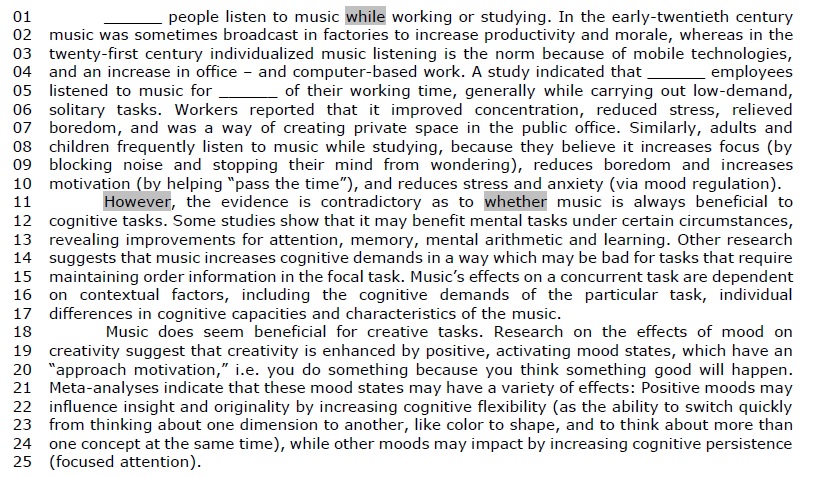
Music Enabling Cognitive Work


(Avaliable in: ASHLEY, R. and TIMMERS, R. (Editors) The Routledge Companion to Music Cognition. New York: Routledge, 2017 – text adapted specially for this test). 

The blanks in paragraph one should be completed with, in order:
Alternativas
Q4182189 Inglês

Instruction: answer the question based on the following text.


The Ultimate Packing List for Expatriates Moving Abroad
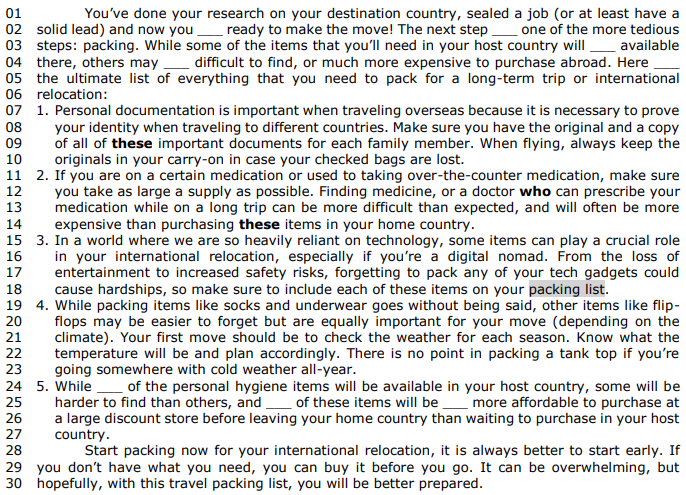

(Available in: https://www.internationalcitizens.com/moving-abroad/ultimate-packing-list.php – text specially adapted for this test).

Annalise the following statements about the blanks in item 5 (l. 24 – 27) and mark T, if true, or F, if false.

( ) Blank 1 should be filled with “much” because it is related to “personal hygiene”, which is uncountable.
( ) Blank 2 should be filled with “many” because it is related to “items”, which is countable.
( ) Blank 3 should be filled with “much” because it is related to “purchase”, which is uncountable.

The correct order of filling the parentheses, from top to bottom, is:

Alternativas
Q2012921 Inglês
Choose one of the alternatives below: How much water do we have?
Alternativas
Q1881617 Inglês

Instruction: answer question based on the following text.


(Avalaible in: https://dictionaryblog.cambridge.org/2013/07/01/janus-words-two-faced-english/#more-2382 – text especially adapted for this test).

Which of the alternatives below is NOT an option to substitute the highlighted expression “a number of” (l. 01–02) without significant changes to the meaning of the sentence?
Alternativas
Q1794201 Inglês
Complete sentences below using much, many, few and little 1. My mother did not have ______ money. 2. She only has ______ days left before retirement. 3. We still have ______ eggs. 4. He has ______ time, so she can?t stop by on her way to work. 
Alternativas
Q1676672 Inglês
Escolha a alternativa que completa correta e respectivamente a sentença abaixo.
“___________ people hunt wild animals for sport. _________ damage has been caused by this kind of hunting”. 
Alternativas
Q1773426 Inglês

TEXT II


Another Brick In The Wall (Pink Floyd)


We don't need no education

We don't need no thought control

No dark sarcasm in the classroom

Teachers, leave them kids alone

Hey! Teacher! Leave them kids alone!

All in all, it's just another brick in the wall

All in all, you're just another brick in the wall

(Adapted from: https://www.letras.mus.br/pink-floyd/64541/. Accessed on October 31 , 2019).

In Standard English, the verse “We don't need no education” is considered ungrammatical. Thus, without changing its meaning, the CORRECT version would be:
Alternativas
Q1732457 Inglês

Complete the sentences with some or any and choose the correct alternative.


I am not hungry. I’m not hungry _____.

I am going out. I am going out ____.

I haven’t been to China. ___________ .

Would you like ____ tea?

Alternativas
Q1719242 Inglês
Choose the correct determiner.
My son doesn’t like _____________ of his Math teachers.
Alternativas
Q1374299 Inglês

Leia o texto e responda à questão.


The birth of a nation


     The most memorable writing in eighteenth-century America was done by the founding fathers, the men who led the American Revolution of 1775-1783 and wrote the constitution of 1989. But none of them were writers of fiction. Rather, they were practical philosophers, and their most typical product was the political pamphlet. They shared the European Enlightenment belief that human reason could understand both nature and man. Unlike the Puritans – who saw man as a sinful failure – the Enlightenment men were sure man could improve himself. They wanted to create a happy society based on justice and freedom.

     The writings of Benjamin Franklin (1706 -1790) show the Enlightenment spirit in America at its best and most optimistic. His style is quite modern and, even today, his works are a joy to read. At the same time, there’s something “anti-literary” about Franklin. He had no liking for poetry and felt that writing should always have a practical purpose.

     Almanacs, containing much useful information for farmers and sailors (about the next year’s weather, sea tides, etc.), were a popular form of practical literature. Together with the Bible and the newspaper, they were the most-widely read and often the only reading matter in most Colonial households. Franklin made his Almanac interesting by creating the character “Little Richard”. Each new edition continued a simple but realist story about Richard, his wife and family. He also included many “sayings” about saving money and working hard. Some of those are known to most Americans today:

     Lost time is never found again.

     God helps those who help themselves.

     In 1757 Franklin collected together the best of his sayings and published The Way to Wealth. This little book became one of the best-sellers of the Western World and was translated into many languages.

(Peter High. Outline of American Literature . Essex, Longman. 1996. Adaptado)

Mark the sentence in which “most” is being used as a quantifier.
Alternativas
Q1250581 Inglês
Cocaine and alcohol a 'deadly combination'


“At least 13 "self-inflicted" deaths happened in a year in England among people who took the two substances, the Victoria Derbyshire programme found. _______, including two contestants on Love Island, took their own lives between April 2018 and March 2019. Coroners have reported seeing a rise in such cases”.
(Adapted from: https://www.bbc.com/news/health-49814269.)
The alternative that best completes the empty space found in the text is:
Alternativas
Q1218654 Inglês


Internet: <www.nationalgeographic.com>(adapted).

A respeito das ideias, dos aspectos gramaticais e do vocabulário do texto apresentado, julgue o item a seguir.


The word “few” (.8) can be correctly replaced by little without changing its meaning.

Alternativas
Respostas
101: A
102: C
103: B
104: A
105: E
106: D
107: D
108: D
109: B
110: D
111: C
112: B
113: C
114: B
115: B
116: B
117: C
118: E
119: B
120: E