Questões de Concurso
Sobre análise sintática | syntax parsing em inglês
Foram encontradas 610 questões


Read the text about Nobel Prize for the question.
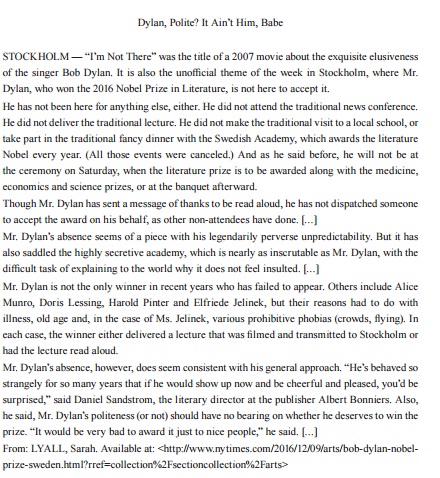
Read the text about Nobel Prize for the question.
Based on text 2, an adapted forum discussion, answer question below.
Teaching with no books
Dianne Bell
I have started teaching in a language school suggesting no books to teach except for some magazines. These show the framework what should be worked on, for example, countability and that’s it. When it was offered I accepted the job easily because it seemed challenging and at the same time simple but now I’m out of reliable materials. Please help me out in what ways I can find materials for all the suggested frameworks.
Comments

Mila Junior and Senior Teacher
Posted on 02/22/2015
What exactly are you supposed to be teaching (i.e., conversation, grammar, business English, etc.)? Can you give more examples of the “frameworks”? If there are no books or resources, it sounds like the school wants you to do conversation classes. These can be easy to prepare if you tell the students to come prepared with a topic to discuss. Then, you can assist them with keeping a conversation going, asking questions, giving opinions, etc.

Flore
Secondary Teacher
Posted on 01/07/2015
Hi, I think it really does depend on the students and the level you are teaching to. I have found a lot of online resources are useful, especially news articles. If you just type in “Free online English lessons” or something similar you are bound to find resources. I had to teach like that once. They give you a book with a list of what you should be teaching in each lesson but nothing else. The teacher has to make the lesson up out of thin air each time, and it’s pretty time-consuming.

Jake
Science Educator
Posted on 11/22/2015
There are so many other resources out there for teachers to use, online and off, that teaching without textbooks is becoming more and more acceptable including websites, iPod lectures and field trips — that will encourage you to toss out your textbooks. Before you can toss out the textbook and replace it with technology tools, you’ll need to understand how your students — whatever their age — respond to and work with technology.
(Adapted from https://www.englishclub.com/)
Based on text 2, an adapted forum discussion, answer question below.
Teaching with no books
Dianne Bell
I have started teaching in a language school suggesting no books to teach except for some magazines. These show the framework what should be worked on, for example, countability and that’s it. When it was offered I accepted the job easily because it seemed challenging and at the same time simple but now I’m out of reliable materials. Please help me out in what ways I can find materials for all the suggested frameworks.
Comments
Mila Junior and Senior Teacher
Posted on 02/22/2015
What exactly are you supposed to be teaching (i.e., conversation, grammar, business English, etc.)? Can you give more examples of the “frameworks”? If there are no books or resources, it sounds like the school wants you to do conversation classes. These can be easy to prepare if you tell the students to come prepared with a topic to discuss. Then, you can assist them with keeping a conversation going, asking questions, giving opinions, etc.
Flore
Secondary Teacher
Posted on 01/07/2015
Hi, I think it really does depend on the students and the level you are teaching to. I have found a lot of online resources are useful, especially news articles. If you just type in “Free online English lessons” or something similar you are bound to find resources. I had to teach like that once. They give you a book with a list of what you should be teaching in each lesson but nothing else. The teacher has to make the lesson up out of thin air each time, and it’s pretty time-consuming.
Jake
Science Educator
Posted on 11/22/2015
There are so many other resources out there for teachers to use, online and off, that teaching without textbooks is becoming more and more acceptable including websites, iPod lectures and field trips — that will encourage you to toss out your textbooks. Before you can toss out the textbook and replace it with technology tools, you’ll need to understand how your students — whatever their age — respond to and work with technology.
(Adapted from https://www.englishclub.com/)
Instructions: Question are based on the following text.
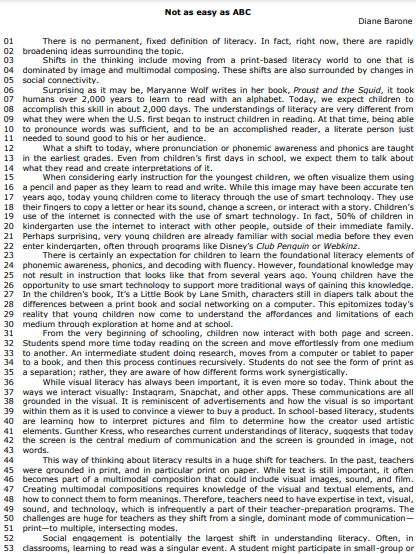
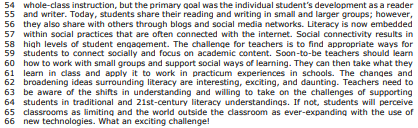
Source: http://languagemagazine.com/?page_id=124967

http://www.theguardian.com/news/2016/feb/10/weatherwatch-ravilious-global-warming-limit-climate-change-uneven- arctic-europe-us
I – Pronouns are words we use in the place of a full sentence. II – We use he/him to refer to men, and she/her to refer to women. When we are not sure if we are talking about a man or a woman we use they/them. III – English clauses Always have a subject. If there is no other subject we use it or there. We cal this a dummy subject.
How many items are correct?
Leia o texto a seguir para responder a questão.
Learning and Teaching
What is learning and what is teaching and how do they interact? Consider again some traditional definitions. A search in contemporary dictionaries reveals that learning is “acquiring or getting of knowledge of a subject or a skill by study, experience, or instruction.” A more specialized definition might read as follows: “Learning is a relatively permanent change in a behavioral tendency and is the result of reinforced practice” (Kimble and Garmezy 1963:133). Similarly, teaching, which is implied in the first definition of learning, may be defined as “showing or helping someone to learn how to do something, giving instructions, guiding in the study of something, providing with knowledge, causing to know or understand.” How awkward these definitions are! Isn’t it rather curious that learned lexicographers cannot devise more precise scientific definitions? More than perhaps anything else, such definitions reflect the difficulty of defining complex concepts like learning and teaching.
These concepts can also give way to a number of subfields within the discipline of psychology: acquisition processes, perception memory (storage) systems, recall, conscious and subconscious learning, learning styles and strategies, theories of forgetting, reinforcement, the role of practice. Very quickly the concept of learning becomes every bit as complex as the concept of language. Yet the second language learner brings all these and more variables into play in the learning of a second language.
Teaching cannot be defined apart from learning. Nathan Gage (1964:269) noted that “to satisfy the practical demands of education, theories of learning must be ‘stood on their head’ so as to yield theories of teaching.” Teaching is guiding and facilitating learning, enabling the learner to learn, setting the conditions for learning. Your understanding of how the learner learns will determine your philosophy of education, your teaching style, your approach, methods, and classroom techniques. If, like B. F. Skinner, you look at learning as a process of operant conditioning through a carefully paced program of reinforcement, you will teach accordingly. If you view second language learning basically as a deductive rather than an inductive process, you will probably choose to present copious rules and paradigms to your students rather than let them “discover” those rules inductively. An extended definition—or theory—of teaching will spell out governing principles for choosing certain methods and techniques. A theory of teaching, in harmony with your integrated understanding of the learner and of the subject matter to be learned, will point the way to successful procedures on a given day for given learners under the various constraints of the particular context of learning.
(Principles of language learning and teaching, H. Douglas Brown. Adaptado)
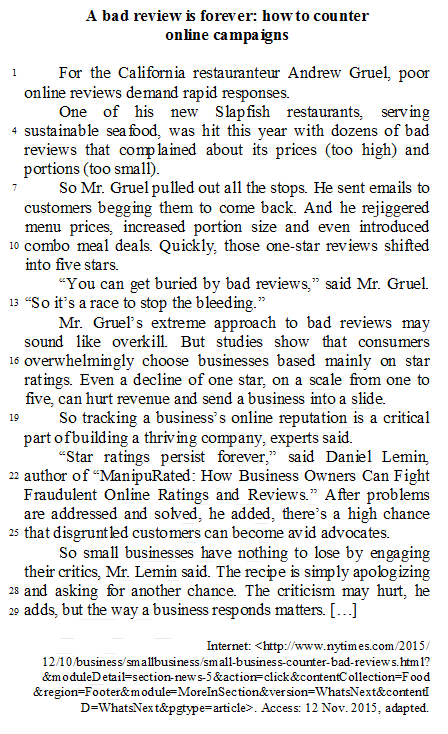
INSTRUCTIONS – Read the following text carefully and then choose the correct alternatives that answer the questions.
THE SADDEST TWEETERS LIVE IN TEXAS
Melody Kramer for National Geographic - Published May 29, 2013
Researchers analyzed ten million tweets to map happiness in the U.S.
Average word happiness for geotagged tweets in U.S. states collected in 2011. Redder states have higher averages and bluer states have lower averages.
Image courtesy Mitchell et al, PLoS ONE
The town of Beaumont is known as "Texas … with a little something extra." But the industrial town along the Gulf Coast now has a more dubious distinction: It's been named the saddest city in America—at least, if you're measuring sadness on Twitter.
That's according to a group of researchers at the Vermont Complex Systems Center, who analyzed over 80 million words from more than ten million geotagged tweets written throughout 2011. The results of their study, published Wednesday in the journal PLoS ONE, showed that the happiest tweeters in the U.S. live in Napa, California, and their sad counterparts live mostly in the Rust Belt and along the Gulf Coast border.
"You can infer a lot of information about an area based on what people are writing on Twitter," says Christopher Danforth, a mathematician and a co-author of the study.
Danforth explains how his team measured the emotional state of a tweet: They created a simple computer algorithm to analyze the words within the tweets themselves. Each word was measured on a happiness scale, which his team had previously created using paid workers from Amazon's Mechanical Turk service. The workers were asked to score more than 10,000 common English words on a happiness scale from 1 to 9. Words like "laughter," "love," "rainbow," and "smile" made the top of the list; at the very bottom—unsurprisingly—were words like "terrorist," "ugly," "cancer," "die," and "fatal."
A GEOGRAPHY OF HAPPINESS
Using that list, researchers then collected tweets from more than 300 separate cities and towns across the United States and created an algorithm to assess how frequently "happy" words occurred vs. how frequently "sad" words occurred in different places. For example, people in Napa were much more likely to tweet the word "hope" than were their counterparts living along the Gulf Coast.
"The differences in the words people used told us a lot about the cities themselves," says Lewis Mitchell, a mathematician and the study's lead author. "Essentially we were able to create a geography of happiness."
Many of the places at the very top of the list— Hawaii, Maine, and Napa—are also top vacation spots. A previous study by the same researchers indicated that people tend to use less-negative words when they're far away from home. But other places near the top of the list—like Green Bay, Wisconsin, and Spokane, Washington—aren't really tourist destinations.
The researchers say they plan to look at tourism's role in a future study. They also plan to analyze tweets in other languages. The current study looks only at tweets written in English, which could skew data in parts of the United States where many people tweet in Spanish.
In addition, the researchers plan to look at profanity more closely. Their current findings suggest that one of the major driving forces in a city's happiness—or lack thereof—is how frequently people use curse words in their tweets.
"People curse more and more as the day goes on," says Danforth, "but there are definitely places where profanity is more common. In the South, more people are cursing on Twitter. It's a tapestry of negative words."
TRENDING SADDER
He notes that many of the cities close to the bottom of their happiness list also rank low on other lists that measure factors like health outcomes and quality of life.
"The people at the bottom of our list live in states that are more socioeconomically depressed and where more natural disasters occur," he says."There are higher rates of poverty, and the median incomes are lower."
This might explain why places like Beaumont and Shreveport, Louisiana, have sadder tweets. But it doesn't explain one surprising finding: Tweets across the country are getting sadder, in general.
"If you go through all of the demographics since 2008, it's getting sadder everywhere," says Mitchell. "There's a strong downward trend. We don't know why this is."
He recently made a Twitter account— @geographyofhapp—that tracks the happiest and saddest cities on Twitter on a daily basis. But his own personal Twitter account—@dr_pyser— remains cheerfully optimistic.
"I try to be more conscious of what I'm talking about online and the way I talk about it," says Mitchell. "I try to put my best self out there."
http://news.nationalgeographic.com/news/2013/05/130529-saddest-happieststates-twitter-texas-maine-hawaii-california/y
Consider the following:
I - “Used to” expresses the idea of customary or habitual action in the past;
II - “Be to” is used to indicate plans, obligation, necessity or arrangements;
III - “Must” expresses unavoidable obligation or necessity;
IV - “Will” and “be going to” can always be used interchangeably.
INSTRUCTIONS – Read the following text carefully and then choose the correct alternatives that answer the questions.
THE SADDEST TWEETERS LIVE IN TEXAS
Melody Kramer for National Geographic - Published May 29, 2013
Researchers analyzed ten million tweets to map happiness in the U.S.
Average word happiness for geotagged tweets in U.S. states collected in 2011. Redder states have higher averages and bluer states have lower averages.
Image courtesy Mitchell et al, PLoS ONE
The town of Beaumont is known as "Texas … with a little something extra." But the industrial town along the Gulf Coast now has a more dubious distinction: It's been named the saddest city in America—at least, if you're measuring sadness on Twitter.
That's according to a group of researchers at the Vermont Complex Systems Center, who analyzed over 80 million words from more than ten million geotagged tweets written throughout 2011. The results of their study, published Wednesday in the journal PLoS ONE, showed that the happiest tweeters in the U.S. live in Napa, California, and their sad counterparts live mostly in the Rust Belt and along the Gulf Coast border.
"You can infer a lot of information about an area based on what people are writing on Twitter," says Christopher Danforth, a mathematician and a co-author of the study.
Danforth explains how his team measured the emotional state of a tweet: They created a simple computer algorithm to analyze the words within the tweets themselves. Each word was measured on a happiness scale, which his team had previously created using paid workers from Amazon's Mechanical Turk service. The workers were asked to score more than 10,000 common English words on a happiness scale from 1 to 9. Words like "laughter," "love," "rainbow," and "smile" made the top of the list; at the very bottom—unsurprisingly—were words like "terrorist," "ugly," "cancer," "die," and "fatal."
A GEOGRAPHY OF HAPPINESS
Using that list, researchers then collected tweets from more than 300 separate cities and towns across the United States and created an algorithm to assess how frequently "happy" words occurred vs. how frequently "sad" words occurred in different places. For example, people in Napa were much more likely to tweet the word "hope" than were their counterparts living along the Gulf Coast.
"The differences in the words people used told us a lot about the cities themselves," says Lewis Mitchell, a mathematician and the study's lead author. "Essentially we were able to create a geography of happiness."
Many of the places at the very top of the list— Hawaii, Maine, and Napa—are also top vacation spots. A previous study by the same researchers indicated that people tend to use less-negative words when they're far away from home. But other places near the top of the list—like Green Bay, Wisconsin, and Spokane, Washington—aren't really tourist destinations.
The researchers say they plan to look at tourism's role in a future study. They also plan to analyze tweets in other languages. The current study looks only at tweets written in English, which could skew data in parts of the United States where many people tweet in Spanish.
In addition, the researchers plan to look at profanity more closely. Their current findings suggest that one of the major driving forces in a city's happiness—or lack thereof—is how frequently people use curse words in their tweets.
"People curse more and more as the day goes on," says Danforth, "but there are definitely places where profanity is more common. In the South, more people are cursing on Twitter. It's a tapestry of negative words."
TRENDING SADDER
He notes that many of the cities close to the bottom of their happiness list also rank low on other lists that measure factors like health outcomes and quality of life.
"The people at the bottom of our list live in states that are more socioeconomically depressed and where more natural disasters occur," he says."There are higher rates of poverty, and the median incomes are lower."
This might explain why places like Beaumont and Shreveport, Louisiana, have sadder tweets. But it doesn't explain one surprising finding: Tweets across the country are getting sadder, in general.
"If you go through all of the demographics since 2008, it's getting sadder everywhere," says Mitchell. "There's a strong downward trend. We don't know why this is."
He recently made a Twitter account— @geographyofhapp—that tracks the happiest and saddest cities on Twitter on a daily basis. But his own personal Twitter account—@dr_pyser— remains cheerfully optimistic.
"I try to be more conscious of what I'm talking about online and the way I talk about it," says Mitchell. "I try to put my best self out there."
http://news.nationalgeographic.com/news/2013/05/130529-saddest-happieststates-twitter-texas-maine-hawaii-california/y
The words below belong to the same category, except:

Text III
Here are some of the conclusions of a study conducted by The British Council to examine the policy, perceptions and influencing factors of English in Brazil:
[…] Brazil does not have a policy that focuses solely on teaching and learning English. The National Education Guidelines identify English as one of many foreign languages offered to students in primary and secondary education. Various English language learning initiatives have emerged at the federal, state and municipal levels however many English initiatives have limited success due to unbalanced curriculums, limited class time, teachers lacking the linguistic and pedagogical knowledge to effectively guide students, and minimal resources.[…]
Those working in internationalised industries, especially in management roles, do need English for employment though they may use it sparingly. As FDI ("Foreign Direct Investment") and interaction with other countries grow, especially in localised sectors, the demand for English as a medium of communication will increase. Currently, Brazil‘s average level of education and lack of English are perceived by some as detrimental to its economic growth and investment.[…]
Perceptions of English language use are changing. Younger generations are more open to English and link it less to a political agenda and more with personal growth and opportunity. Although there seem to be deeply-rooted ideological barriers at a national level to prioritise English over other languages, at an individual level, the language is gaining increased value and influence.
(Source: British Council Education Intelligence. (2015). English in Brazil: An examination of policy, perceptions and
influencing factors. Retrieved and adapted from https://ei.britishcouncil.org/sites/default/files/latin-americaresearch/English%20in%20Brazil.pdf.)

Each of the fragments from the text presented below is followed by a suggestion of rewriting. Decide whether the suggestion given maintains the meaning, coherence and grammar correction of the text (C) or not (E).
“To showcase this phenomenon, however, is no to suggest
ossification” (R. 27 and 28): Highlighting this fact does not
amount to acknowledging stagnation.
Leia o texto para responder à questão.
The Research Assignment
Students today have access to so much information that they need to weigh the reliability of sources. Any resource – print, human, or electronic – used to support your research inquiry has to be evaluated for its credibility and reliability. In other words, you have to exercise some quality control over what you use. When you use the print and multimedia materials found in your college library, your evaluation task is not so complicated because librarians have already established the credibility and appropriateness of those materials for academic research. The marketplace forces publishers to be discriminating as well.
Data collected in interviews of persons whose reliability is not always clearly established should be carefully screened, especially if you present this material as expert opinion or as based on knowledge of your topic. And you may have even more difficulty establishing trustworthiness for electronic sources, especially Web and Internet sources.
Because the Internet and World Wide Web are easy to use and accessible, Web material is volatile – it changes, becomes outdated, or is deleted. Its lack of consistency and sometimes crude form make Web information suspect for people who use it for research. Because there is frequently no quality control over Web information, you must critically evaluate all the material you find there, text and graphics alike.
(http://www.umuc.edu/writingcenter/onlineguide/
chapter4-07.cfm-27.10.2013. Adaptado)
Cats are at a crucial point in their evolutionary journey as they transform from solitary hunters to domestic pets, a study by the BBC and the Royal Veterinary College has revealed.
Cats see the world in muted colours, making it easier for them to see movement without distractions. They also have large eyes for their size, allowing them to see well in low-level light.
However, they can’t focus on anything less than a foot away, so use their whiskers for detecting objects closer to their bodies.
TEXT 5:


Based on the text, judge the items from 111 to 120.

 Conheça nossos planos