Questões de Concurso
Sobre análise sintática | syntax parsing em inglês
Foram encontradas 610 questões


An interview with Paolo Kwan, 20, from Hong Kong, who is improving his English while studying Business Administration at Sierra College in northern California.
WHY DID YOU DECIDE TO STUDY IN THE USA?
It provides a nice education in a beautiful country. When I
was younger I used to watch American movies and I
wanted to visit the United States. They always talked about
the American dream, and I wanted to come and see it.
HOW DID YOU CHOOSE YOUR INTENSIVE ENGLISH PROGRAM?
Sierra College is one of the biggest community colleges in northern California. It is in a quiet location but has a beautiful campus.
The college has a good business program. I can study for two years at Sierra College and then two years at my transfer school to earn my degree.
WHAT DO YOU LIKE BEST?
I also enjoy the quality of the teaching at the college. There is a writing center where I can go at any time. The teachers can make suggestions to improve my essay, regarding grammar and my vocabulary. At the Math Center, they can explain in detail the problems.
WHAT DO YOU MISS MOST?
I miss the food and also my family.
WHAT WAS YOUR BIGGEST SURPRISE?
I was surprised by the cultural difference. The taste and style of food is very different. The amount of food is a lot larger. A small portion in the USA is a large portion in Hong Kong. When people from America find out that I am from another country they ask a lot of questions. They are very interested in you and finding out about Hong Kong.
... YOUR BIGGEST DISAPPOINTMENT?
I have not had any since I came here.
HOW HAVE YOU HANDLED:
... LANGUAGE DIFFERENCES?
It is important not to be shy, as that does not help you when you are trying to improve your language. I make sure that I study, practice and speak as often as I can—that is the only way to improve. ...
FINANCES?
I am being supported by my family.
... ADJUSTING TO A DIFFERENT EDUCATIONAL SYSTEM?
The American system is much more open. In Hong Kong you just learn what the teacher writes on the board. In America, you discuss the issues and focus more on ideas
WHAT ARE YOUR ACTIVITIES?
I am interested in traveling around the USA. I have been to San Francisco, which you can reach by train from Sierra College. In my free time I go out with friends.
HOW EASY OR DIFFICULT IS MAKING FRIENDS?
It has not been that hard to make friends in the USA. Other people at the college are friendly and want to make friends as well.
HOW IS YOUR U.S. EDUCATION RELEVANT TO YOUR PERSONAL GOALS AND TO THE NEEDS OF YOUR COUNTRY?
I think that the U.S. education system will provide me with
good resources and skills to be able to support myself in
order to get hired in my own country
WHAT IS YOUR ADVICE TO OTHER STUDENTS?
An awesome life experience is waiting for you in the future. You will learn so much more than you think. Nothing is impossible, so go ahead and give it a try.
Adapted from: https://www.studyusa.com
Text 1:
How being bilingual can boost your career
Whether you’re fresh out of college or a seasoned executive, insiders agree that fluency in a second language can not only help you stand out among prospective employers, it can also open doors to opportunities that those without foreign language skills might miss.
In today’s global economy, the ability to communicate in another language has become a significant advantage in the workforce. Research has found that people who speak at least one foreign language have an average annual household income that’s $10,000 higher than the household income of those who only speak English. And about 17 percent of those who speak at least one foreign language earn more than $100,000 a year.
A recent survey found that nearly 9 out of 10 headhunters in Europe, Latin America, and Asia say that being at least bilingual is critical for success in today’s business environment. And 66 percent of North American recruiters agreed that being bilingual will be increasingly important in the next 10 years.
“In today’s global economy you really have to understand the way business is done overseas to maximize your potential. A second language equips you for that,” says Alister Wellesley, managing partner of a Connecticut-based recruiting firm. “If you’re doing business overseas, or with someone from overseas, you obtain a certain degree of respect if you’re able to talk in their native language.”
Language skills can also be key for service industries. At the Willard InterContinental Washington, a luxury hotel a few blocks from the White House, a staff of about 570 represents 42 nations, speaking 19 languages. The Willard’s front-of-house employees such as the concierge speak at least two languages. Bilingualism is not an absolute requirement, but it is desirable, according to Wendi Colby, director of human resources.
Workers with skills in a second language may have an edge when it comes to climbing Willard’s professional ladder. “The individual that spoke more languages would have a better chance for a managerial role, whatever the next level would be,” Colby says. “They are able to deal with a wide array of clients, employees.”
So which languages can give you a leg up on the job market? Insiders agree the most popular – and marketable – languages are Spanish, German, French, Italian, Russian and Japanese, with a growing emphasis on Mandarin, given China’s booming economy. So let’s learn Mandarin!
“We see demand from a full range of industries,” says Wellesley. “Actually it depends on which company you’re working for and the country in which they’re located.”
Adapted from: LATHAM-KOENIG, Christina & OXENDEN,
Clive. American English File 5. 2nd edition. Oxford: OUP,
2018.
Which figure of speech is represented on the sentence:
"I think our country sinks beneath the yoke;
It weeps, it bleeds. IV. iii 39-40. (Macbeth, Shakespeare)
I- The United Nations was founded in 1945. II- Politics is a subject taught in all schools. III- A number of teenagers is playing on the playground. IV- The number of people who own cars is increasing. V- Neither his brother nor his sister work in the hospital.
First column: verb pattern 1- Verb followed by a direct object 2- Verb followed by a direct object and an indirect object 3- Verb with no object
Second column: sentence ( ) I would never have had that coffee if I’d known it would stop me sleeping. ( ) Her eyes shone in the darkness, reflecting the light from the candle. ( ) Ben quietly handed her the letter, looking rather nervous.
Check the correct alternative:
First column: function 1- Give a reason 2- Express condition 3- Show a result
Second column: sentence ( ) It was such an enjoyable party that I stayed longer than I’d planned. ( ) As it might rain at the weekend, I’ve rented a couple of DVDs. ( ) Provided you pay me back next week, I’ll lend you the money.
Check the correct alternative:
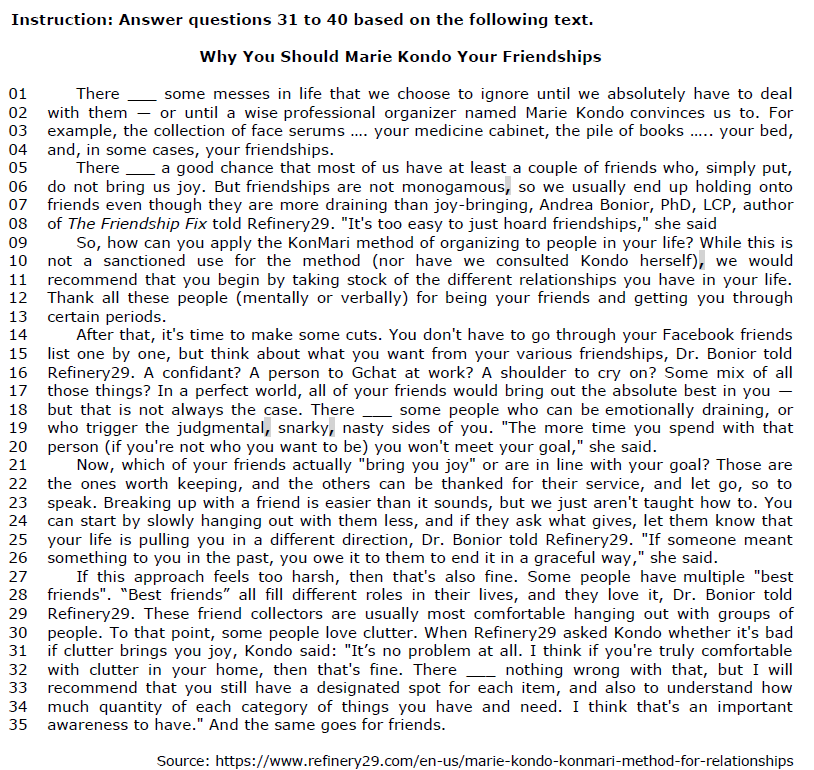
( ) Line 6. ( ) Line 10. ( ) Line 19.
The correct order of filling in the parenthesis, from the top to the bottom, is:

(Source: https://www.sciencedaily.com/releases/2019/11/191114141247.htm– Adapted)

Internet: <https://www.english‐online.at>
According to the text, judge the following items.
In “They do not have the money to afford imported food” (lines 17 and 18), “to afford” can be correctly replaced by to
withdraw.
Towards a fairer distribution

Towards a fairer distribution. Available at: <www.economist.com>.
Retrieved on: Aug. 15. 2019, with adaptations.
The word “former” (line 5) refers to someone who created the Treaty.

Nicolson, H. (1963) (3rd edition) Diplomacy.
Oxford: OUP, with adaptations.
In the fragment “to its achievement” (line 17), the underlined pronoun refers to “religious intensity” (line 16).
TEXT 4
“It must be fairly obvious from the discussion in the foregoing paragraphs that the very concept of ‘World Englishes’ throws a number of challenges at all those of us who are in one way or another involved in it. For ELT professionals all over the world, it means, among other things, having to take a fresh look at many of the things that have been taken for granted for long.
Consider, for instance, the following. World English is not the mother-tongue of anyone – and this includes even those who used to rejoice in their status as the ‘native-speakers’ of their own varieties of English. This is so because World English is a language that is in the making and, from the looks of it is bound to remain so for the foreseeable future. Incidentally, any temptation to consider World English a pidgin would be totally misguided in that it is not a make-shift language, nor one that is progressing towards a full-fledged language in its own right. Nor, for that matter, is it gathering a new generation of native speakers. Rather, it is resistant to the very terminology that the linguists resort to in describing conventional ‘natural’ languages.”
RAJAGOPALAN, K. The identity of "World English”: New Challenges in Language and Literature. Belo Horizonte: FALE/UFMG, 2009, p.104.
TEXT 3
“Despite the contemporary calling of the speech/textual genre conceptions to deal with privations in the educational system (ROJO, 2008), the treatment given to genre, especially in theories operating with the notion of textual genre, has mainly focused on genre’s stable characteristics and on the development of competencies/capacities that lead to the comprehension and production of the oral and written genres circulating in the social world.
One of the implications of this kind of treatment for the literacy practices at school has considerably often been the genre displacement from micro and macrolinguistic contexts that interact in meaning construction to abstractly focus on the stable characteristics defining news, comics, recipes, editorial, blogs etc. Another, and maybe more serious, unfolding is that since it doesn’t look at how genres mingle and hybridize with other genres and semiosis in processes of constant (re)designing meanings, such a treatment can end up contributing to the mere (re)production of genres legitimized by school, leaving little or no space at all for the innovations and destabilization that mingling and transgression processes print to texts in contemporaneity and, as a consequence, for a critical position in relation to meanings constructed in the margins of what school validates as acceptable literacy practices.”
OLIVEIRA, M. B. F.; SZUNDI, P. T. C. Multiliteracies Practices at School: for a responsive education to contemporaneity.
Bakhtiniana, São Paulo, v. 9, n. 2, Jul./Dec. 2014, p. 206,207.
Consider the excerpt “It’s to the organization’s credit that it’s saying that it shouldn’t be tolerated”.
The subjunctive mood has been correctly used to rephrase it in all the sentences, EXCEPT
Leia a tira em quadrinhos e analise as afirmativas abaixo.
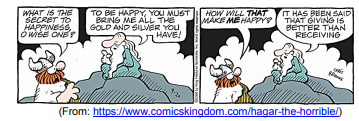
I. No primeiro quadrinho Hagar consultou o velho sábio para saber sobre o segredo da felicidade.
II. No segundo quadrinho as palavras that e me se referem, respectivamente, ao “velho sábio” e a “Hagar”.
III. As palavras do velho sábio no último quadrinho são de que é melhor dar que receber.
Assinale a alternativa correta.
Observe the sentences below.
I. An one-year-old child died in the hospital after falling into a pool on Tuesday;
II. We stay as a united group and we don't have any differences within the community;
III. He placed an wheel and tire in an old Russian sedan;
IV. No bond can match up the equation of a sister and a brother.
Observing the bold articles, identify the correct alternative.
Observe the dialogue below.
A: We don't have central heating, but we have coal fires. You have central heating, __?
B: Yes, we do. But coal fires are nice, __? More comforting than a radiator.
Identify the best alternative that completes the context.
If you want to study French, you should start learn it right now.
The bold item should be corrected as:

Consider the following sentences from the text:
I. “Its a clever service that makes use of Netflix’s massive catalogue” (l.05).
II. “there’s only a limited amount of learning materials available” (l.10-11).
III. “Hopefully, the service can make it’s way beyond browsers soon” (l.26-27).
Which ones DON’T have grammar mistakes?

 Conheça nossos planos