Questões de Concurso
Sobre advérbios e conjunções | adverbs and conjunctions em inglês
Foram encontradas 791 questões


Yesterday afternoon, a group of people marched towards the Government Palace____________ talk to the governor about some problems that have been taking place in the region of backlands. ____________, hundreds of protesters got together in front of the palace due to their dissatisfaction about the low salaries and lack of wage raise. ____________ receiving some of the protesters who were outside the palace, the governor gave the opportunity to only the representatives of the rural growers to talk about their demands and complaints. _____________, there have been more serious problems ____________ not only in the entire state, ____________ in the capital such as: the high level of crimes, lack of basic sanitation, mainly in the city outskirts, the pollution of the most touristic beaches ___________ the bad quality of the public transportation which has been a lot to be desired for so many years. ____________, when all was said and done, the governor decided to give in their demandings by promising he would do as best as he could to improve and solve all the drastical situation. _____________, they set up a middle-term deadline so that the governor could fulfil all their needs.
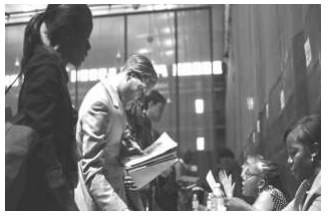
Like many homeless people in America, Derek Forter’s story is not one of crime or bad choices. Instead, he was a casualty of the economic recession.
"One day my company laid off half its employees. Soon I was behind on my rent, and before I knew it I’d lost my apartment.”
Imagem: https://www.foxbusiness.com/markets/
To make matters worse, Derek could not secure employment and thinks he knows why.
“I would show up in my cleanest pants and shirt, but I knew I didn’t represent myself well – the other applicants all looked so much more professional. It really affected my self-esteem.”
Luckily, through a local agency, Derek got in touch with Look the Part, a non-profit organization dedicated to helping homeless people join the workforce. Their motto: Look the part.
“They were phenomenal, giving me a complete makeover inside and out. Not only did they get me a haircut too. Then, they helped with my resume, and we practiced mock interviews. I was more confident than ever, and I nailed my next interview. I’ve been working ever since, and I couldn’t be more grateful.”
Unfortunately, the demand for services like those provided by Look the Part far outweighs their current capabilities. And even though there are other similar organizations, like JobReady and First Impressions, there are many people still struggling to find employment.
In: American Inside Out Evolution. Student’s book Advanced B. KAY, Sue et all. Macmillan Publishers, São Paulo: 2028. Adaptado
Read the following text and answer the next five question.
The implications of a rapidly changing information ecosystem on how governments communicate
Public communication does not happen in a vacuum: the context in which it occurs is core to understanding the challenges and opportunities it faces. Indeed, the analysis of its role for policy and governance mechanisms is made urgent by shifts in the information ecosystem that have transformed the function over the past decade and raised important implications for democracy. The technological revolution that has connected the world through social media has given rise to online social movements and simplified the creation and sharing of content and data. Such changes have also facilitated, however, the spread of mis- and disinformation, contributed to undermining the role of traditional information gatekeepers, and have fundamentally changed how governments communicate. Whereas until the early 2000s a so-called “one-to-many” model of communication prevailed, this has shifted today to a “many-to-many” model. Anyone can be both a producer and a consumer of information, and anybody with an internet connection has the potential to engage with and influence public debates.
Traditionally, governments had largely relied on traditional media to amplify official messages to reach citizens. With the advent of digital channels, this approach has gradually lost its primacy to direct institution-to-individual communication via online platforms that bypass traditional media. This shift has also enabled a broader scope for governments to communicate about more diverse policy issues targeted to more specific audiences, as traditional media tend to concentrate on “newsworthy” subjects and political affairs, often under-reporting less mainstream issues. The unprecedented volumes of data that promise to make communication ever more precise, combined with the direct, unmediated access to vast and diverse publics, are some of the opportunities and challenges that have emerged.
At the same time, digital platforms have altered patterns in eople’s consumption of information and raised demands on their attention. The latter has become a resource that technology companies sell to advertisers. In turn, the design of online platforms and their algorithms, and the massive increase in the volume of information served to increase competition for what content people pay attention to, while making focus more superficial. As governments compete with all other information sources for the public’s attention, cognitive and psychological factors such as information overload can undermine the efficacy of even well-crafted content.
Online and social media have also heightened the pace at which information travels, accelerated the news cycle, and enabled a wider range of actors to drive discussions on policy issues. Taken together, digital technologies have produced a complex information ecosystem that has made it more challenging for official messages to “cut through the noise”. Cumulatively, these changes require considerable adjustments to practices, public officials’ skills, and even to how communication is organised, if governments are to make the most of the digital transformation and ensure it can promote better governance. […]
The ability for governments to use the communication function to promote constructive democratic spaces is critically threatened by widespread mis- and disinformation. When falsehoods spread extensively and rapidly on issues of public policy, official messages are drowned out, creating significant challenges for public communicators to get key information out to all groups in society. Whether in the context of elections, health crises, migration or climate change, mis- and disinformation cast evidence and facts into doubt, sow distrust, and work against policy goals.
Adapted from: https://www.oecd.org/content/dam/oecd/en/publications/ reports/2021/12/oecd-report-on-public-communication_b74311bc/22f8031c-en.pdf
“Indeed” in “Indeed, the analysis of its role for policy and governance mechanisms is made urgent” (1st paragraph) indicates:
Read the following sentence carefully:
“Despite the heavy rain, Sarah continued her lecture with remarkable clarity and confidence. Her students, however, seemed distracted and tired.”
Sign the best explanation about the grammatical and discourse functions in the excerpt:
I. Fronting negative adverbials like "Under no circumstances" or "Seldom" requires subject-auxiliary inversion (e.g., "should you go").
II. Adverbials of frequency always trigger inversion when placed at the beginning of the sentence (e.g., "Sometimes go I").
III. "Little did he know" is a fixed phrase exemplifying negative inversion used for dramatic or emphatic effect.
Select the correct analysis:
(__) "Much" and "far" are grammatically correct intensifiers for comparative adjectives (e.g., "much better").
(__) "Very" can modify strong or ungradable adjectives like "exhausted" or "freezing".
(__) "Hardly" is an adverb of manner meaning "with a lot of effort" or "energetically".
(__) The adverb "enough" must always follow the adjective or adverb it modifies (e.g., "good enough").
The correct sequence, from top to bottom, is:
texto seguinte servirá de base para responder à questão.
CNN Health Exhausted? The reason may be how you're using technology
Analysis by Kara Alaimo
Oct 7, 2025
Kara Alaimo is a professor of communication at Fairleigh Dickinson University. Her book "Over the Influence: Why Social Media Is Toxic for Women and Girls — And How We Can Take It Back" was published in 2024 by Alcove Press.
You may think you're exhausted because, like me, you have too many things on your plate. But there's another reason, according to a new book.
Case in point: While | was writing this piece, | responded to dozens of emails from colleagues and students, got a huge medical bill, replied to a text about a home repair, and learned that my older daughter needs to wear white to school next Monday while the younger one is supposed to wear the colors of fall.
This relentless barrage of interruptions and switching between thoughts and technology platforms is leaving us utterly exhausted, says Paul Leonardi, department chair and Duca Family Professor of Technology Management | at the University of California, Santa Barbara.
He explains how this happens in his new book, "Digital Exhaustion: Simple Rules for Reclaiming Your Life."
| spoke to Leonardi about what's making us all so tired | and what we can do about it.
CNN: You say one reason we're so exhausted is that we keep switching between platforms. How does that make us exhausted?
Paul Leonardi: Every tool we use requires some amount of cognitive focus. We have to learn the tool we're enmeshed in. When we switch, we have to disengage | and reengage in another area of focus, and we also have to switch how we're using that tool. Our brains do not do a good job of switching that quickly. The main issue is that we haven't evolved to make the switches as quickly as we do today. It leaves us feeling exhausted.
CNN: You found that we often don't realize we're getting exhausted from all this digital switching. Why?
Leonardi: It comes back to the way our bodies have evolved over time. We have good sensory feedback to show us when we're physically tired. Otherwise, we could collapse, and that's dangerous. So, our body knows to send signals to our brain to say stop. But we didn't evolve to sit in an office in front of a computer, so our brain doesn't know to tell itself it's tired. We can just keep taxing ourselves, but that residue builds up over time. Then we feel like we've been hit by a semitruck
CNN: What can we do to address that exhaustion?
Leonardi: Think about reducing the kinds of switches we make throughout the day.
In the book | talk about three kinds of switches. Switching between modalities is switching across tools. Think about the different videoconferencing platforms you use. You might use Zoom and then switch to Microsoft Teams. They seem like they're roughly the same. But how many times have you been in a meeting and thought, "I need to share my screen. How do | do that on this platform?" And those little changes are enough to really wear us out when they accumulate over time
The second type is what | call switches between domains, and that's when we're working on one task, get interrupted and then switch to a different task. The unplugging and then re-plugging into the other task take quite a bit of effort. It's a tremendous tax that we pay.
The third type is switching between different areas of life. How many times in your day are you getting a quick text from your kid's school? Or the plumber calls to tell you they're going to be late and wants to talk about the problem in your house. Those switches across really big domains are even more exhausting because they pull us completely out of our thought process in one area, and then we have to get back.
CNN: You say social media is the most exhausting type of platform to use. Why?
Leonardi: | talk about three forces that exhaust us. One is attention. On social media we're constantly switching between things because apps are pushing us different notifications. First somebody liked something, and then there's an ad. The second force of exhaustion is making inferences. We get a snippet of data, and it's not quite enough to tell us the whole picture. So, we have to fill in the blanks, and that takes effort. On social media we're constantly different apps and making inferences. We see somebody is on a trip, and we're like, they must have a lot of money. And they're having the time of their life. We're filling in the blanks.
The last is emotion. When our emotions get piqued, whether for good or for bad, that's also exhausting. On social media we do social comparisons, so we get jealous that somebody else is doing something we wish we were doing. Or we get annoyed that we see a bunch of friends hanging out and we're not part of the group.
Social media is so exhausting because it maximizes all three of these forces.
CNN: You say it's especially hard for people who work from home to avoid this kind of exhaustion. Why is that? Leonardi: One of the big reasons remote workers experience exhaustion even more than people in the office — or it feels more acute — is that it's very difficult to create separation between work and home. They're constantly trying to manage that boundary, and that's so exhausting.
They also are more dependent on tools for everything, so they don't get a break. If you're in the office and you have an in-person meeting, you don't have to switch onto your Zoom platform. You actually get a break for a little bit when you're talking to somebody in the hallway. You don't get that on these tools.
You're also managing your presence when you're working from home. You need to make sure people know you're available because it matters for people's perception of your work performance. So, you're putting on a sort of act that's also exhausting
CNN: You recommend turning off the video of ourselves in meetings. Why?
Leonardi: | think it's a good idea sometimes. We tend to fixate on ourselves, and doing that creates a feeling of self-consciousness. It also creates more effort for us to manage our presentation to others.
Imagine if you were talking to friends, or you're in a meeting, and you have a mirror in front of your face the entire time. You're like, oh my gosh, how do | look right now? There are bags under my eyes, and | can't believe | made that stupid facial expression. We don't do that in regular life.
These extra little activities accumulate to wear us out over time.
Communicating in person instead of texting, when possible, can reduce digital exhaustion and create richer relationships.
CNN: What's your best advice for parents who are exhausted from keeping up with endless group chats about car pools and soccer games?
Leonardi: | never intended to write about that in my book, but it came up so often in the interviews | did.
One strategy | heard that was quite effective was calculating whether a car pool is actually worth the time you're putting into coordinating it. If you add up all the time you're spending texting with other people, sometimes it adds up to the same amount of time it would take to just drive your kid yourself.
Another strategy people used was reducing those communications by trying to coordinate in person. When they see each other at the soccer game, they have a long conversation about the plan for the next week. A lot of folks find they're developing richer relationships because that discussion about the car pool is just the entrée to a deeper conversation. Those are much more fulfiling relationships than the transactions taking place via text
CNN
I."Only I tasted the wine" implies that no one else tasted it.
II."I only tasted the wine" implies that I did nothing else with the wine (e.g., I didn't drink it all).
III."I tasted only the wine" implies that I tasted nothing else but the wine.
Choose the alternative that indicates the correct interpretation(s).

 Conheça nossos planos