Questões de Concurso
Sobre advérbios e conjunções | adverbs and conjunctions em inglês
Foram encontradas 791 questões


Mark the item that CORRECTLY fills in the blank below.
I managed to download the song __________.

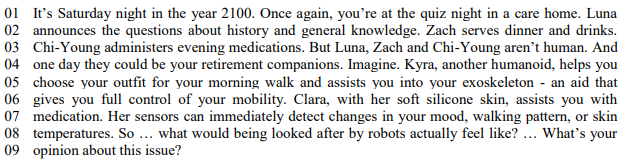
( ) The text uses the adverb genuinely, in the fifth paragraph, to modify the adjective positive, and it correctly employs the preposition at when referring to the specific location where the Tara Brooch was discovered.
( ) The phrase cater for, in the first paragraph, Íunctions as a phrasal verb, and the text uses the coordinating conjunction and to link two distinct noun phrases.
( ) The word accommodate is a synonym for cater for, in the first paragraph. In the context, as it actually refers to a type of seaside transportation rather than the process of providing housing or space for the commuters mentioned.
( ) The word order in the sentence The eight century Tara Brooch is incorrect. According to standard English syntax, the noun must always precede the subject in passive constructions.
Which alternative CORRECTLY fills in the parentheses above, from top to bottom?
During the class, they visited the library to research famous writers and read an interesting article about Shakespeare. The teacher asked the students to compare the old translations with the newer ones, noticing that some versions were better than others, because modern language is often more accessible. Fortunately, the students worked carefully and completed the activity successfully.
TEXT
Adapted from: BBC Ideas and The Open University (2026) Would you want to be cared for by a robot when you are older? [video]. Instagram. Available at: https://www.instagram.com/reel/DX_03WVle-- /?igsh=MXhhdHJ4NzlpeGE5dA%3D%3D. (Accessed: May 31, 2026).
ANSWER QUESTION ACCORDING TO THE TEXT ABOVE.
Adverbs of manner in English, regularly formed by adding the suffix "-ly" to an adjective, characterize the way in which a verbal action occurs. Consider the sentence: "He drives ___ on the highway, which worries his family." Choose the alternative that presents the adverb of manner that appropriately fills the gap.
Conjunctions in English establish different relations between clauses, such as addition, contrast, cause, and consequence. Consider the sentence: "She studied hard for the exam, ___ she got a low grade." Choose the alternative that presents the conjunction that appropriately fills the gap, establishing a relation of contrast between the two clauses.
Match the sentences according to the function of the words in bold:
Function:
1.Highlight key points or critical details.
2.Express information regarding location.
3.Express information regarding time.
Sentences:
A.You must not enter the forest. I'm being serious, you shouldn't enter it under any circumstance, because it is dangerous, John.
B.It is a bit too early for us to have breakfast at the office, is it not?
C.I didn't think he would be able to fit in there. The cave entrance is too narrow.
(__) Advérbios de modo derivados de adjetivos terminados em -ic, como "tragic" ou "economic", exigem a inserção da sílaba intermediária -al- antes da adição do sufixo -ly, resultando em formas como "tragically".
(__) Advérbios de frequência indeterminada, como "seldom" e "often", ocupam majoritariamente a posição final da frase quando o verbo principal está no tempo presente simples, para evitar a fragmentação do sintagma verbal.
(__) O termo "hardly" funciona como um advérbio de intensidade com carga semântica negativa, não guardando relação de significado com o advérbio de modo "hard", que descreve a aplicação de esforço ou força.
(__) Advérbios conectivos (conjunctive adverbs), como "nonetheless" e "furthermore", exigem o uso de ponto e vírgula ou ponto final para separar as orações independentes que relacionam logicamente no texto.
Após análise, assinale a alternativa que apresenta a sequência CORRETA dos itens acima, de cima para baixo:
The word “finally” in “She finally finished her college degree” is a/an:
I. An adverb phrase can be modified by another adverb, as in "quite remarkably," where "quite" functions as a pre-modifier.
II. Post-modification in an adverb phrase is extremely rare but can occur with the adverb "enough," as in "well enough."
III. Adverb phrases function exclusively as adjuncts and can never perform the role of a subject complement in an English sentence.
Which of the following are CORRECT:
(__) Negative adverbials such as "seldom" or "under no circumstances" trigger subject-auxiliary inversion when placed in the initial position of a clause.
(__) Focus adverbs should be placed immediately before the constituent they modify to avoid semantic ambiguity in formal registers.
(__) Adverbs of frequency must be positioned before the auxiliary verb "be" in all indicative sentences regardless of the presence of other modals.
(__) Viewpoint adverbs like "theoretically" function exclusively as adjuncts and are strictly prohibited from appearing in the initial sentence position.
After analysis, choose the alternative that presents the CORRECT sequence:
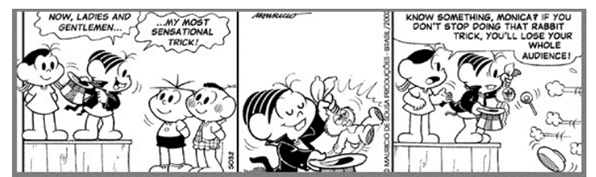
Disponível em: https://colorindonuvens.com/blog/2012/05/31/hq-monicas-gang-aprenda-ingles-turma-monica/Acesso em: 30 outubro 2025

 Conheça nossos planos