Questões de Concurso
Sobre advérbios e conjunções | adverbs and conjunctions em inglês
Foram encontradas 791 questões


Read TEXT 3 and answer question.
TEXT 3
THE PAPERLESS CLASSROOM IS COMING
Michael Scherer
Back-to-school night this year in Mr. G’s sixth-grade classroom felt a bit like an inquisition.
Teacher Matthew Gudenius, a boyish, 36-year-old computer whiz who runs his class like a preteen tech startup, had prepared 26 PowerPoint slides filled with facts and footnotes to deflect the concerns of parents. But time was short, the worries were many, and it didn’t take long for the venting to begin.
“I like a paper book. I don’t like an e-book,” one father told him, as about 30 adults squeezed into a room for 22 students. Another dad said he could no longer help his son with homework because all the assignments were online. “I’m now kind of taking out of the routine.”, he complained. Rushing to finish, Gudenius passed a slide about the debate over teaching cursive, mumbling, “We don’t care about handwriting.” In a flash a mother objected: “Yeah, we do.”
At issue was far more than penmanship. The future of K-12 education is arriving fast, and it looks a lot like Mr. G’s classroom in the northern foothills of California’s wine country. Last year, President Obama announced a federal effort to get a laptop, tablet or smartphone into the hands of every student in every school in the U.S. and to pipe in enough bandwidth to get all 49.8 million American kids online simultaneously by 2017. Bulky textbooks will be replaced by flat screens. Worksheets will be stored in the cloud, not clunky Trapper Keepers. The Dewey decimal system will give way to Google. “This one is a big, big deal,” says Secretary of Education Arne Duncan.
It’s a deal Gudenius has been working to realize for years. He doesn’t just teach a computer on every student’s desk; he also tries to do it without any paper at all, saving, by his own estimate, 46,800 sheets a year, or about four trees. The paperless learning environment, while not the goals of most fledgling programs, represents the ultimate result of technology transforming classroom.
Gudenius started teaching as a computer-lab instructor, seeing students for just a few hours each month. That much time is still the norm for most kids. American schools have about 3.6 students for every classroom computing device, according to Education Market Research, and only 1 in 5 school buildings has the wiring to get all students online at once. But Gudenius always saw computers as a tool, not a subject. “We don’t have a paper-and-pencil lab, he says. When you are learning to be a mechanic, you don’t go to a wrench lab.”
Ask his students if they prefer the digital to the tree-based technology and everyone will say yes. It is not unusual for kids to groan when the bell rings because they don’t want to leave their work, which is often done in ways that were impossible just a few years ago. Instead of telling his students to show their work when they do an algebra equation, Gudenius asks them to create and narrate a video about the process, which can then be shown in class. History lessons are enlivened by brief videos that run on individual tablets. And spelling, grammar and vocabulary exercises have the feel of a game, with each student working at his own speed, until Gudenius – who tracks the kids’ progress on a smartphone – gives commands like “Spin it” to let the kids know to flip the screens of their devices around so that he can see their work and begin the next lesson.
Source: TIME- How to Eat Now. Education: The Paperless Classroom is Coming, p. 36-37; October 20, 2014
Words that went extinct
By Kimberly Joki
Dictionaries incorporate new words every year. Some are pop culture inventions like jeggings, photobomb, and meme. Other words, like emoji and upvote, spring up from technology and social media. Dictionaries respond by creating definitions for anyone who cares to know what a twitterer is. And thank goodness they do; you can learn what an eggcorn is simply by turning a few pages in your trusty updated dictionary.
Interestingly, not all newly added words are recent developments. The Oxford English Dictionary June 2015 new words list included autotune, birdhouse, North Korean, and shizzle! North Korea was founded in 1948. The initial release of the autotuner audio processor was in 1997. Before adding a slang term like shizzle, dictionary publishers weigh the current popularity, predicted longevity, and other factors. Just this year alone, the Merriam-Webster Dictionary welcomed about 1,700 new arrivals.
With more and more words coined every year, dictionaries couldn’t possibly add them all to their existing word banks. Can you imagine a dictionary containing all the words ever used in English? It would be impossible to lift! With each yearly edit, dictionary editors must discard some words to make room for new ones.
(…)
The Sami languages, spoken in Finland, Norway, and Sweden, reportedly include more than 150 words related to snow and ice. In the 1590s, the English language had a word for recently melted snow—snowbroth. Now, English speakers simply call it water or melted snow. In fact, words that are markedly specific seem more vulnerable to extinction. A 19th-century dictionary included Englishable, a term to describe how appropriate a word is for the English language. However, English is a dynamic language, always accepting and abandoning words. Apparently, Englishable itself isn’t Englishable; it’s now obsolete.
Do you favor any infrequently used words? If so, use them now and often. . . A word’s best defense against extinction is regular use.
(Source: http://www.grammarly.com/blog/2015/words-that-went-extinct/)
Fill in the blanks with the most appropriate words:
She was the ____________ woman I ever met. Besides, she was ____________ intelligent and creative. Also, she received the ___________ recognition of her time for _________ the first pianist of her country to receive an international award.
Atenção: Considere o texto para responder à questão.
Does an Email Hacking Software really Exist?
With my experience of over 10 years in the field of ethical hacking and information security, all I can tell you is that there exists no such ready-made software program (as shown and advertised on many websites) that can break into the service provider’s database and hack email passwords. This is just a myth! This may seem a bit disappointing for many, but this is the fact. However, it is still possible to easily hack email passwords using some of the alternative programs and ways as discussed below:
Working Ways to Hack an Email Password:
Even though it is impossible to hack the database and instantly crack the email password, it is still possible to trick the users so that they give away the password by themselves. This can be done using a handful of methods like keylogging, social engineering or phishing. However, the easiest and most effective way is by using keyloggers.
A keylogger is a small program that records each and every keystroke a user types on the keyboard of a specific computer. So when you install a keylogger on the computer from where the target person is likely to access his/her email, it is possible to capture the password. Though keyloggers are not designed to hack email passwords, they can still be used to accomplish the job. Here is a list of some of the interesting facts about keyloggers:
EASY TO USE: A keylogger does not require any special skills. Anyone with basic computer knowledge should be able to use it.
REMAINS UNDETECTED: A keylogger will remain undetected after installation and operates in a total stealth mode. So, you need not worry about being caught or traced back.
REMOTE INSTALLATION: In addition to installation on a location computer, keyloggers also support remote installation. That means you can also install it even on those computers for which you do not have physical access.
(Adapted form: http://www.gohacking.com/email-hacking-software/)
Atenção: Considere o texto para responder à questão.
Does an Email Hacking Software really Exist?
With my experience of over 10 years in the field of ethical hacking and information security, all I can tell you is that there exists no such ready-made software program (as shown and advertised on many websites) that can break into the service provider’s database and hack email passwords. This is just a myth! This may seem a bit disappointing for many, but this is the fact. However, it is still possible to easily hack email passwords using some of the alternative programs and ways as discussed below:
Working Ways to Hack an Email Password:
Even though it is impossible to hack the database and instantly crack the email password, it is still possible to trick the users so that they give away the password by themselves. This can be done using a handful of methods like keylogging, social engineering or phishing. However, the easiest and most effective way is by using keyloggers.
A keylogger is a small program that records each and every keystroke a user types on the keyboard of a specific computer. So when you install a keylogger on the computer from where the target person is likely to access his/her email, it is possible to capture the password. Though keyloggers are not designed to hack email passwords, they can still be used to accomplish the job. Here is a list of some of the interesting facts about keyloggers:
EASY TO USE: A keylogger does not require any special skills. Anyone with basic computer knowledge should be able to use it.
REMAINS UNDETECTED: A keylogger will remain undetected after installation and operates in a total stealth mode. So, you need not worry about being caught or traced back.
REMOTE INSTALLATION: In addition to installation on a location computer, keyloggers also support remote installation. That means you can also install it even on those computers for which you do not have physical access.
(Adapted form: http://www.gohacking.com/email-hacking-software/)
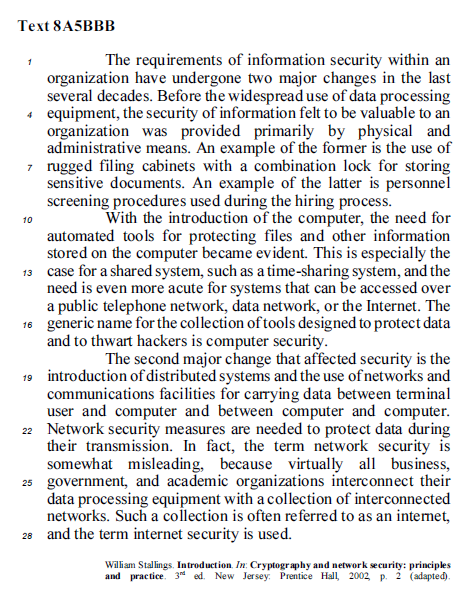
In text 8A5BBB, the word “often” ( .27) can be correctly replaced
by
.27) can be correctly replaced
by
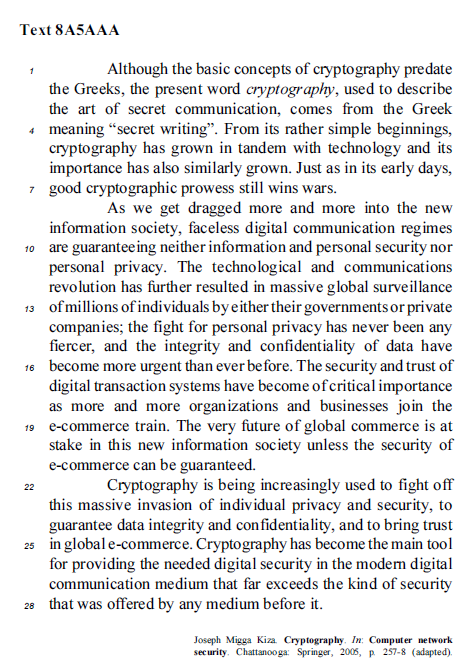
In text 8A5AAA, the word “unless” ( .20) conveys the idea of
What are the biggest Windows 10 problems Microsoft needs to fix?
by Edward Chester
03 July 2015
Windows 10 is shaping up to be a good upgrade over both Windows 7 and Windows 8, but with the release date of 29 July mere weeks away, there are still some issues that need sorting.
So, while there’s still just about time, here are some of the biggest Windows 10 problems that we’re hoping Microsoft will fix before the Windows 10 Technical Preview is closed and the final version is released to users.
1. Tabs in File Explorer
One of the longest-running requested features for a new Windows is simply to allow the File Explorer to have tabs. Just as web browsers can have multiple tabs open at the same time but all contained in a neat single-windowed view, we want the same thing for File Explorer.
It seems like it should be a simple thing to add, but seemingly Microsoft is against the idea, as it's already made considerable adjustments to File Explorer in Windows 10 without including this feature.
2. Finish updating icons
Windows 8 saw a new, more sharp-lined, high-contrast style brought to Windows, but it didn’t do a very good job of maintaining consistency throughout the OS, with many features still using the old style. Windows 10 has improved this, tweaking the majority of system icons and features to fit in with the new look. ...I... , the task still isn’t complete, and while it doesn’t make a huge difference to the day-to-day satisfaction of using your computer, it does speak to the apparent difference in philosophy between Apple and Microsoft.
When the former overhauled the look of iOS, it did so in a much more complete manner than Microsoft has managed over two major iterations of Windows.
3. Stability issues
The most obvious issue that Microsoft needs to address is simply making sure it really does solve any further performance and stability issues in Windows 10. While our experience has largely been smooth, we've nonetheless had moments of the system completely falling over while doing nothing particularly challenging, and there are many other reports of instability.
Microsoft certainly can’t be complacent when it comes to core stability. The company does need to ensure that what customers are buying at least works reliably out of the box.
(…)
(Adapted from: http://www.trustedreviews.com)
Welcome to the Drone Age
THE scale and scope of the revolution in the use of small, civilian drones has caught many by surprise. In 2010 America's Federal Aviation Authority (FAA) estimated that there would, by 2020, be perhaps 15,000 such drones in the country. More than that number are now sold there every month. And it is not just an American craze. Some analysts think the number of drones made and sold around the world this year will exceed 1 million. In their view, what is now happening to drones is similar to what happened to personal computers in the 1980s, when Apple launched the Macintosh and IBM the PS/2, and such machines went from being hobbyists' toys to business essentials.
That is probably an exaggeration. It is hard to think of a business which could not benefit from a PC, whereas many may not benefit (at least directly) from drones. But the practical use of these small, remote-controlled aircraft is expanding rapidly. These involve areas as diverse as agriculture, landsurveying, film-making, security, and delivering goods. Other roles for drones are more questionable. Their use to smuggle drugs and phones into prisons is growing. Instances have been reported in America, Australia, Brazil, Britain and Canada, to name but a few places. In Britain the police have also caught criminals using drones to scout houses to burgle. The crash of a drone on to the White House lawn in January highlighted the risk that they might be used for acts of terrorism. And in June a video emerged of a graffito artist using a drone equipped with an aerosol spray to deface one of New York's most prominent billboards.
How all this activity will be regulated and policed is, as the FAA's own flat-footed response has shown, not yet being properly addressed. There are implications for safety (being hit by an out-of-control drone weighing several kilograms would be no joke); for privacy, from both the state and nosy neighbours; and for sheer nuisance—for drones can be noisy. But the new machines are so cheap, so useful and have so much unpredictable potential that the best approach to regulation may simply be to let a thousand flyers zoom.
[Source: The Economist September 26th 2015- adapted]
Text 2
The advantage
1 CARE Acquiring a new aircraft is already a complex enough process. Acquiring a pre-owned aircraft can be an even more challenging task. The industry has its fair share of brokers and experts all willing to offer you the best deal in town but, regrettably, once you have signed and the aircraft is delivered, they tend to vanish as they move onto the next deal. Our philosophy is very different. Every Embraer aircraft we lease has passed through our own Embraer facilities. Every aircraft is treated with a level of service and care that can only come from those who built them in the first place.
2 SUPPORT In choosing one of our pre-owned aircraft, all of our customers share a common goal: to ensure that the aircraft delivered perform seamlessly from day one and continue to perform for many years to come. In response to this, we offer the Lifetime Program by Embraer. This program represents a first in the industry and is the result of a very detailed review between ECC and Embraer on how best to support our customers. The Lifetime Program is unique to preowned Embraer aircraft and offers a wide range of services from startup through operation.
3 RELIABLE So when an ECC pre-owned aircraft is offered for delivery to its new home you can rest assured that it will provide many years of happy, reliable service. Our focus does not end there since we value the relationships we build with our customers. Our Lifetime Program is testament to this. This is a unique and new service from Embraer to support our used aircraft. We invite you to learn, in greater detail, how it will not only enhance your operation, but also keep your Chief Financial Officer happy. Transparency in costs and flexibility in adapting to your needs. It is our way of showing that every Embraer aircraft we offer has our seal of approval. Coming from the manufacturer, that's no small thing.
Source: http://www.eccleasing.com/Pages/fator.aspx [slightly adapted

TEXT II
World Work Worker Workplace
Does your workplace offer affordances for #wellbeing? Natural light, movement, a view, informal areas to socialize or collaborate? 40% say no.

NASA’s Nuclear Frontier: The Plum Brook Reactor Facility
There are three main types of nuclear reactors: power, research, and test. Research and test reactors as scientific tools are more common than most people realize. While power reactors frequently appear in newspaper headlines and are conspicuous because of their size and power, research reactors can be quietly tucked away, even in the midst of a college campus. Power reactors generate heat, which can easily be converted to other useable forms of energy, such as electricity. Research reactors operate at very low thermal power levels – so low, in fact, that they do not even require any type of forced cooling. They are used to measure nuclear parameters and other characteristics, which can then be used to build other reactors or to design experiments for test reactors. Test reactors are more powerful than research reactors and are able to produce much more intense radiation fields. Though they are still much less powerful than the power reactors, they generate enough heat to require a closed-loop forced-circulation coolant system. This system will remove the heat from the reactor by transferring it to a secondary cooling system, which releases it into the atmosphere through cooling towers.
NASA’s Nuclear Frontier: The Plum Brook Reactor Facility. Pages 36 to 40.
Consider the words in bold and underlined in the following excerpts taken from the text.
I. “[...] power reactors frequently appear in newspaper headlines [...]”
II. “[...] research reactors can be quietly tucked away [...]”
III. “[...] which can easily be converted to other useable forms of energy [...]”
Choose the alternative in which the words in bold and underlined have the same grammar classification as the ones above.

 Conheça nossos planos