Questões de Concurso
Sobre advérbios e conjunções | adverbs and conjunctions em inglês
Foram encontradas 791 questões


Team Composition
In a large organization, it is often the case that different roles emerge. In Tayloristic teams, these different roles are grouped together as a number of role-based teams each of which contains members of the same role. In contrast, agile teams use cross-functional teams. Such a team draws together individuals performing all defined roles. Rotations from one role to another are common. It is also possible to have highly specialized experts (for example, security analysts and usability engineers) shared among several teams in an organization.
One advantage to role-based teams is that teams whose work products are independent of each other can work in parallel as long as there is not much knowledge flow among the different functional sub-team. However, in knowledgeintensive software development that demands information flow from different functional sub teams, role-based teams tend to lead to islands of knowledge and difficulty in its sharing among all the teams. As hand-offs between teams usually are based on document flow, the knowledge of one team that is required by the other team must be externalized and documented. Although reviews try to minimize the knowledge loss, externalization and documentation processes cannot guarantee that all knowledge is captured and even if most of it was rigorously captured, there is still no guarantee or way to check its correctness till the project sign-off.
Cross-functional teams should be used to facilitate better knowledge transfer. This is especially the case for agile methods since they are recommended to be used where there is a lot of uncertainty and unknown knowledge about the domain and system requirements, and the technologies to be used are new and unexplored.
Adaptado de: CHAU THOMAS, MAURER FRANK e MELNIK GRIGORI. Knowledge Sharing: Agile Methods vs. Tayloristic Methods. (WETICE´03) Proceedings of the Twelft IEEE International Workshop on Enabling Technologies: Infrastructure for Collaborative Enterprises, 2003.
Text for the item.
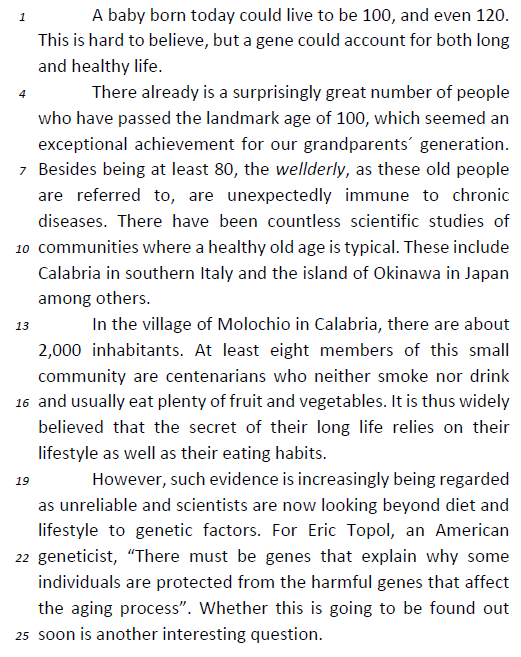
A long and healthy life?
Internet: <www.ngllife.com> (adapted).
Based on the text, judge the following item.
If is not a correct alternative for “Whether” in “Whether
this is going” (line 24).
Text for the item.
A long and healthy life?
Internet: <www.ngllife.com> (adapted).
Based on the text, judge the following item.
“Besides”, in “Besides being at least 80” (line 7), and in
addition to are synonyms.
Text for the item.
A long and healthy life?
Internet: <www.ngllife.com> (adapted).
Based on the text, judge the following item.
The term “wellderly” (line 7) refers to anyone who
turns 80.
Text for the question.
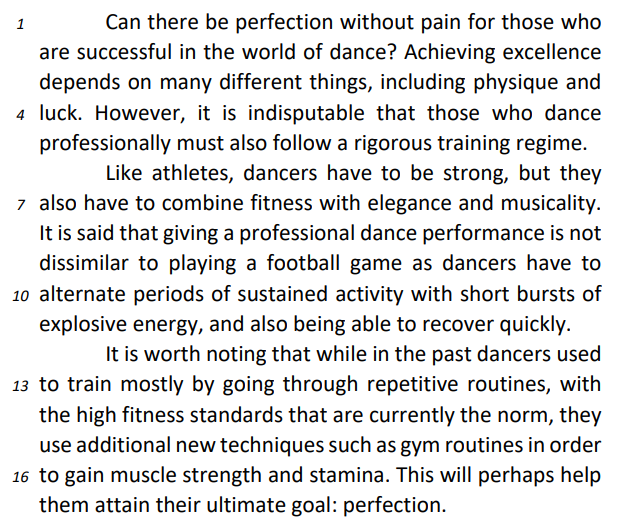
The route to perfection
TEXTO I
English for Specific Purposes
English for specific purposes (ESP) refers to language research and instruction that focuses on the specific communicative needs and practices of particular social groups. Emerging out of Halliday, Macintosh, and Strevens’ (1964) groundbreaking work nearly 40 years ago, ESP started life as a branch of English language teaching, promising a stronger descriptive foundation for pedagogic materials. In the years since, ESP has consistently been at the cutting-edge of both theory development and innovative practice in applied linguistics, making a significant contribution to our understanding of the varied ways language is used in particular communities. Drawing on a range of interdisciplinary influences for its research methods, theory, and practices, ESP has consistently provided grounded insights into the structures and meanings of texts, the demands placed by academic or workplace contexts on communicative behaviors, and the pedagogic practices by which these behaviors can be developed.
HYLAND, K. “English for specific purposes: some influences and impacts”. In: Cummins, J. and Davison, C., (eds.) The International Handbook of English language education. Springer: Norwell, Mass, 2006.


Based on the text, judge the following item.
The word “likely” (line 13) expresses probability.
Based on the text, judge the following item.
The adverb Actually cannot be used instead of “As a matter of fact” (line 7).

Based on the text, judge the following items.

Based on the text, judge the following item.
At the present time expresses the same idea as “Actually” (line 11).
Based on the text, judge the following item.
Rule of Law and Democracy: Addressing
the Gap Between Policies and Practices

The Declaration adopted on 24 September 2012 by the United Nations General Assembly at the High-level Meeting on the Rule of Law at the National and International Levels reaffirmed that “human rights, the rule of law and democracy are interlinked and mutually reinforcing and that they belong to the universal and indivisible core values and principles of the United Nations”. Indeed, government responsiveness to the interests and needs of the greatest number of citizens is strictly associated with the capacity of democratic institutions and processes to bolster the dimensions of rights, equality and accountability.
If considered not solely an instrument of the government but as a rule to which the entire society, including the government, is bound, the rule of law is fundamental in advancing democracy. Strengthening the rule of law has to be approached not only by focusing on the application of norms and procedures. One must also emphasize its fundamental role in protecting rights and advancing inclusiveness, in this way framing the protection of rights within the broader discourse on human development.
A common feature of both democracy and the rule of law is that a purely institutional approach does not say anything about actual outcomes of processes and procedures, even if the latter are formally correct. When addressing the rule of law and democracy nexus, a fundamental distinction has to be drawn between “rule by law”, whereby law is an instrument of government and government is considered above the law, and “rule of law”, which implies that everyone in society is bound by the law, including the government. Essentially, constitutional limits on power, a key feature of democracy, require adherence to the rule of law.
Another key dimension of the rule of law-democracy nexus is the recognition that building democracy and the rule of law may be convergent and mutually reinforcing processes whenever the rule of law is defined in broad, endsbased terms rather than in narrow, formal and exclusively procedural terms. The nexus is strong whenever the rule of law is conceived in its relationship with substantive outcomes, like justice and democratic governance.
(https://unchronicle.un.org/article/rule-law-and-democracy-addressinggap-between-policies-and-practices.
Adaptado)
Rule of Law and Democracy: Addressing
the Gap Between Policies and Practices
The Declaration adopted on 24 September 2012 by the United Nations General Assembly at the High-level Meeting on the Rule of Law at the National and International Levels reaffirmed that “human rights, the rule of law and democracy are interlinked and mutually reinforcing and that they belong to the universal and indivisible core values and principles of the United Nations”. Indeed, government responsiveness to the interests and needs of the greatest number of citizens is strictly associated with the capacity of democratic institutions and processes to bolster the dimensions of rights, equality and accountability.
If considered not solely an instrument of the government but as a rule to which the entire society, including the government, is bound, the rule of law is fundamental in advancing democracy. Strengthening the rule of law has to be approached not only by focusing on the application of norms and procedures. One must also emphasize its fundamental role in protecting rights and advancing inclusiveness, in this way framing the protection of rights within the broader discourse on human development.
A common feature of both democracy and the rule of law is that a purely institutional approach does not say anything about actual outcomes of processes and procedures, even if the latter are formally correct. When addressing the rule of law and democracy nexus, a fundamental distinction has to be drawn between “rule by law”, whereby law is an instrument of government and government is considered above the law, and “rule of law”, which implies that everyone in society is bound by the law, including the government. Essentially, constitutional limits on power, a key feature of democracy, require adherence to the rule of law.
Another key dimension of the rule of law-democracy nexus is the recognition that building democracy and the rule of law may be convergent and mutually reinforcing processes whenever the rule of law is defined in broad, endsbased terms rather than in narrow, formal and exclusively procedural terms. The nexus is strong whenever the rule of law is conceived in its relationship with substantive outcomes, like justice and democratic governance.
(https://unchronicle.un.org/article/rule-law-and-democracy-addressinggap-between-policies-and-practices.
Adaptado)
There are many different kinds of English as a Second Language (ESL) course books that are designed for students of all levels and ages. Therefore, the process of choosing the right course book for use in the classroom, especially at the college level, is a daunting task. […]
Disponível em: <http://iteslj.org/Articles/Chou-CourseBooks.html>. Acesso em: 15 fev. 2017.
No fragmento, o termo destacado é uma conjunção que indica
The Operations Function
Although somewhat ‘invisible’ to the marketplace the operations function in a typical company accounts for well over half the employment and well over half the physical assets. That, in itself, makes the operations function important. In a company’s organization chart, operations often enjoys parity with the other major business functions: marketing, sales, product engineering, finance control (accounting), and human resources (personnel, labor relations). Sometimes, the operations function is organized as a single entity which stretches out across the entire company, but more often it is embedded in the district, typically product-defined divisions into which most major companies are organized.
In many service businesses, the operations function is typically more visible. Service businesses are often organized into many branches, often with geographic responsibilities – field offices, retail outlets. In such tiers of the organization, operations are paramount.
The operations function itself is, often divided
.................two major groupings .................tasks:
line management and support services. Line management generally refers.................those managers directly concerned................the manufacture of the product or the delivery of the service. They are the ones who are typically close enough to the product or service that they can ‘touch’ it. Line management supervises the hourly, blue-collar workforce. In a manufacturing company, line management frequently extends to the stockroom (where material, parts, and semi-finished products – termed ‘work-in-process inventory – are stored), materials handling, the tool room, maintenance, the warehouse (where finished goods are stored), and distribution, as well as the so-called ‘factory floor’. In a service operation, what is considered line management can broaden considerably. Often, order-taking roles, in addition to orderfilling roles, are supervised by service line managers.
Support services for line management’s operations can be numerous. Within a manufacturing environment, support services carry titles such as quality control, production planning and scheduling, purchasing, inventory control, production control (which determines the status of jobs in the factory and what to do about jobs that may have fallen behind schedule), industrial engineering (which is work methods oriented), manufacturing engineering (which is hardware-oriented), on-going product engineering, and field service. In a service environment, some of the same roles are played but sometimes under vastly different names.
Thus, the managers for whom operational issues are central can hold a variety of titles. In manufacturing, the titles can range from vice-president – manufacturing, works manager, plant manager, and similar titles at the top of the hierarchy, through such titles as manufacturing or production manager, general superintendent, department manager, materials manager, director of quality control, and down to general foreman or foreman. Within service businesses, ‘operations manager’ is sometimes used but frequently the title is more general – business manager, branch manager, retail manager, and so on.
SCHMENNER, Roger W. Production/Operations Management.
5th Edition. Prentice-Hall, 1993.
“Although somewhat ‘invisible’ to the marketplace the operations function in a typical company accounts for well over half the employment and well over half the physical assets.”
The word in bold is a conjunction used to:
The Operations Function
Although somewhat ‘invisible’ to the marketplace the operations function in a typical company accounts for well over half the employment and well over half the physical assets. That, in itself, makes the operations function important. In a company’s organization chart, operations often enjoys parity with the other major business functions: marketing, sales, product engineering, finance control (accounting), and human resources (personnel, labor relations). Sometimes, the operations function is organized as a single entity which stretches out across the entire company, but more often it is embedded in the district, typically product-defined divisions into which most major companies are organized.
In many service businesses, the operations function is typically more visible. Service businesses are often organized into many branches, often with geographic responsibilities – field offices, retail outlets. In such tiers of the organization, operations are paramount.
The operations function itself is, often divided
.................two major groupings .................tasks:
line management and support services. Line management generally refers.................those managers directly concerned................the manufacture of the product or the delivery of the service. They are the ones who are typically close enough to the product or service that they can ‘touch’ it. Line management supervises the hourly, blue-collar workforce. In a manufacturing company, line management frequently extends to the stockroom (where material, parts, and semi-finished products – termed ‘work-in-process inventory – are stored), materials handling, the tool room, maintenance, the warehouse (where finished goods are stored), and distribution, as well as the so-called ‘factory floor’. In a service operation, what is considered line management can broaden considerably. Often, order-taking roles, in addition to orderfilling roles, are supervised by service line managers.
Support services for line management’s operations can be numerous. Within a manufacturing environment, support services carry titles such as quality control, production planning and scheduling, purchasing, inventory control, production control (which determines the status of jobs in the factory and what to do about jobs that may have fallen behind schedule), industrial engineering (which is work methods oriented), manufacturing engineering (which is hardware-oriented), on-going product engineering, and field service. In a service environment, some of the same roles are played but sometimes under vastly different names.
Thus, the managers for whom operational issues are central can hold a variety of titles. In manufacturing, the titles can range from vice-president – manufacturing, works manager, plant manager, and similar titles at the top of the hierarchy, through such titles as manufacturing or production manager, general superintendent, department manager, materials manager, director of quality control, and down to general foreman or foreman. Within service businesses, ‘operations manager’ is sometimes used but frequently the title is more general – business manager, branch manager, retail manager, and so on.
SCHMENNER, Roger W. Production/Operations Management.
5th Edition. Prentice-Hall, 1993.

 Conheça nossos planos