Foram encontradas 865 questões
Resolva questões gratuitamente!
Junte-se a mais de 4 milhões de concurseiros!


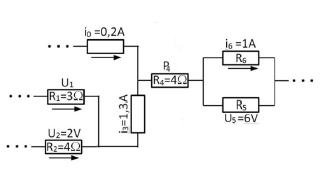
( ) A resistência elétrica no resistor R5 é de 3
 .
( ) A tensão elétrica no resistor R1 é de 2 V.
( ) A potência dissipada pelo resistor R4 é de 9 W.
( ) O valor da resistência elétrica R6 é de 6
.
( ) A tensão elétrica no resistor R1 é de 2 V.
( ) A potência dissipada pelo resistor R4 é de 9 W.
( ) O valor da resistência elétrica R6 é de 6
Assinale a alternativa que apresenta a sequência correta, de cima para baixo.
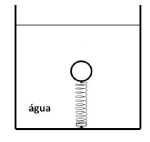
Com base nesse sistema, considere a seguinte situação: em uma determinada via, cuja velocidade limite é 60 km/h, a distância entre as bobinas é de 3,0 m. Ao passar um veículo por esse “radar”, foi registrado um intervalo de tempo de passagem entre as duas bobinas de 200 ms. Assinale a alternativa que apresenta a velocidade determinada pelo sistema quando da passagem do veículo.
Segundo a historiadora Regina da Luz Moreira, “o retorno dos contingentes da FEB precipitou (...) a queda de Vargas em 1945” (CPDOC. Disponível em:<http://cpdoc.fgv.br/producao/dossies/FatosImagens/FEB>).
Assinale a alternativa que justifica a declaração acima, relacionando a atuação do Brasil, por meio da Força Expedicionária Brasileira (FEB), na Segunda Guerra Mundial com o primeiro governo de Getúlio Vargas (1930-1945).
“A América para os Americanos” – Doutrina Monroe, 1865. “Todos somos americanos” – presidente Barack Obama, 17 de dezembro de 2014 (discurso sobre a reaproximação entre Estados Unidos e Cuba).
A respeito da postura dos Estados Unidos em sua política externa no continente americano, nos dois períodos históricos destacados acima, identifique como verdadeiras (V) ou falsas (F) as seguintes afirmativas:
( ) A Doutrina Monroe defendia a autonomia dos países americanos frente ao domínio da Europa, após a emancipação das colônias hispânicas. Ao longo do século XIX, tal ideário serviu para justificar a política de preponderância norte-americana sobre os demais países do continente americano. ( ) O presidente Obama defende a reconciliação entre os Estados Unidos e Cuba após o rompimento diplomático ocasionado pela Guerra Hispano-Americana. Por meio do pan-americanismo, os norte-americanos defendem a implantação da democracia e da modernização em Cuba. ( ) A Doutrina Monroe defendia a união aduaneira dos países do continente americano, inspirada no ideário panamericano, após a emancipação das colônias hispânicas. Ao longo do século XIX, essa política favoreceu o domínio norte-americano sobre os países latinos produtores de matéria-prima. ( ) O presidente Obama defende a reconciliação entre os Estados Unidos e Cuba após o rompimento das relações diplomáticas durante a Guerra Fria. Ao mesmo tempo em que reivindicam de Cuba o respeito aos direitos humanos, os Estados Unidos mantêm domínio sobre a baía de Guantánamo.
Assinale a alternativa que apresenta a sequência correta, de cima para baixo.
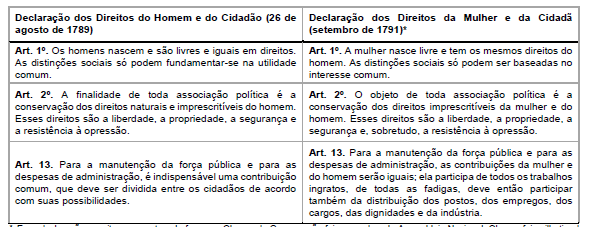
* Essa declaração, escrita e proposta pela francesa Olympe de Gouges, não foi aprovada pela Assembleia Nacional; Olympe foi guilhotinada por ordem de Robespierre em 1793.
Compare as duas declarações e assinale a alternativa que identifica a principal diferença entre o texto de 1789 e o de 1791.
A partir desse excerto e dos conhecimentos sobre o período medieval europeu, assinale a alternativa que relaciona as universidades com seu contexto de surgimento e expansão.
Considere o trecho abaixo, que integra o livro Lavoura Arcaica, de Raduan Nassar:
“[...] aprenderei ainda muitas outras tarefas, e serei sempre zeloso no cumprimento de todas elas, sou dedicado e caprichoso no que faço, e farei tudo com alegria, mas pra isso devo ter um bom motivo, quero uma recompensa para o meu trabalho, preciso estar certo de poder apaziguar a minha fome neste pasto exótico, preciso do teu amor, querida irmã, e sei que não exorbito, é justo o que te peço, é a parte que me compete, o quinhão que me cabe, a ração a que tenho direito”, e, fazendo uma pausa no fluxo da minha prece, aguardei perdido em confusos sonhos, meus olhos caídos no dorso dela, meu pensamento caído numa paragem inquieta, mas tinha sido tudo inútil, Ana não se mexia, continuava de joelhos, tinha o corpo de madeira, nem sei se respirava [...] (p. 124)
Sobre esse trecho, assinale a alternativa correta.
O texto a seguir é referência para a questão.
Famílias em transformação
Identifique como verdadeiras (V) ou falsas (F) as seguintes afirmativas sobre o uso de expressões e/ou sinais de pontuação no texto.
( ) O diálogo com o leitor é marcado no texto pelo uso da expressão “alguém aí”, na segunda linha, e pelo uso recorrente da interrogação.
( ) A expressão sublinhada em “a Câmara dos Deputados tem a resposta que considera a certa” antecipa para o leitor a adesão da autora à definição de família aprovada para o projeto de lei do Estatuto da Família.
( ) No trecho “direitos das famílias – essas que se encaixam na definição proposta –”, a expressão entre travessões alerta o leitor para a restrição do conceito de família mencionado.
( ) As expressões “desde o início da segunda metade do século passado” e “até então” (3º parágrafo) introduzem informações situadas em um mesmo período.
O texto a seguir é referência para a questão.
Vontade de punir
Deu no Datafolha que 87% dos brasileiros querem baixar a maioridade penal. Maiorias assim robustas, que já são raras em questões sociais, ficam ainda mais intrigantes quando se considera que, entre especialistas, o assunto é controverso. Como explicar o fenômeno?
Estamos aqui diante de um dos mais fascinantes aspectos da natureza. Se você pretende produzir seres sociais, precisa encontrar um modo de fazer com que eles colaborem uns com os outros e, ao mesmo tempo, se protejam dos indivíduos dispostos a explorá-los. A fórmula que a evolução encontrou para equacionar esse e outros dilemas foi embalar regras de conduta em instintos, emoções e sentimentos que provocam ações que funcionam em mais instâncias do que não funcionam.
Assim, para evitar a superexploração pelos semelhantes, desenvolvemos verdadeiro horror àquilo que percebemos como injustiças. Na prática, isso se traduz no impulso que temos de punir quem tenta levar vantagem indevida. Quando não podemos castigá-los diretamente, torcemos para que levem a pior, o que, além de garantir o sucesso de filmes de Hollywood, torna a justiça retributiva algo popular em nossa espécie.
Isso, porém, é só parte do problema. Uma sociedade pautada apenas pelo ideal de justiça soçobraria. Se cada mínima ofensa exigisse imediata reparação e todos tivessem de ser tratados de forma rigorosamente idêntica, a vida comunitária seria impossível. A natureza resolve isso com sentimentos como amor e favoritismo, que permitem, entre outras coisas, que mães prefiram seus próprios filhos aos de desconhecidos.
Nas sociedades primitivas, bandos de 200 pessoas onde todos tinham algum grau de parentesco, o sistema funcionava razoavelmente bem. Os ímpetos da justiça retributiva eram modulados pela empatia familiar. Agora que vivemos em grupos de milhões sem vínculos pessoais, a vontade de punir impera inconteste.
SCHWARTSMAN, Hélio. Folhaonline, em 24 jun. 2015.

Rick Jervis, September 24, 2015
SANTIAGO DE CUBA – I've always been fairly skeptical about how much power one man can exercise, even if that man commands the attention of 1.2 billion Roman Catholics.
I understand that Pope John Paul II visited Poland in the 1970s and '80s and gave speeches so stirring that they helped launch the Solidarity opposition movement and lead to the collapse of communism in the country. And I know that popes throughout history have had influential moments.
But, really, how much can one man and one microphone do? How literally do people take his message? These were the questions that kept my mind busy when I left for Cuba last week to cover Pope Francis' four-day trip. I was curious to see how much impact the words of this 78-year-old man can have on a population of 11 million.
I'm becoming fairly familiar with Cuba. I've been to the island three times this year, five times overall, and grew up in southern Florida. My parents are Cubans who left the country in 1962. Cuba today continues to fascinate and dismay. It's a place of beauty and jolting contradictions. The re-establishment of relations between the U.S. and Cuban governments, begun last December, continue to stir excitement and hope in Cubans, and changes are trickling in.
I followed Pope Francis from Havana to Santiago and heard him talk of reconciliation, love for mankind and the importance of family. I interviewed Cubans who glowed with the fervor of the faithful as they pledged their love for the Pope and promised to follow his message. But my question remained: What does all of this mean? How does it translate to actual change on the island?
To help me sort through this, I visited Father Jorge Catasus, a popular parish priest here who helped welcome the Pope to the city. We sat in the cool, cavernous back room of his 18th-century church, safe from the 37-degree heat outside. Catasus said “don't focus on any grand political or social changes stemming from the papal visit". The most important changes, he said, come from within. That's what Pope Francis offered as a first step, and that's what Cubans across the island, in chants, cheers and tearful acceptance, agreed to abide by.
“The lives of men are decided in their hearts", Catasus told me. “That's where we'll see the change". This may not be 1980s Poland, and Solidarity may still not be anywhere in sight. But first things first. A change of heart can often lead to a world of good.
Rick Jervis, September 24, 2015
SANTIAGO DE CUBA – I've always been fairly skeptical about how much power one man can exercise, even if that man commands the attention of 1.2 billion Roman Catholics.
I understand that Pope John Paul II visited Poland in the 1970s and '80s and gave speeches so stirring that they helped launch the Solidarity opposition movement and lead to the collapse of communism in the country. And I know that popes throughout history have had influential moments.
But, really, how much can one man and one microphone do? How literally do people take his message? These were the questions that kept my mind busy when I left for Cuba last week to cover Pope Francis' four-day trip. I was curious to see how much impact the words of this 78-year-old man can have on a population of 11 million.
I'm becoming fairly familiar with Cuba. I've been to the island three times this year, five times overall, and grew up in southern Florida. My parents are Cubans who left the country in 1962. Cuba today continues to fascinate and dismay. It's a place of beauty and jolting contradictions. The re-establishment of relations between the U.S. and Cuban governments, begun last December, continue to stir excitement and hope in Cubans, and changes are trickling in.
I followed Pope Francis from Havana to Santiago and heard him talk of reconciliation, love for mankind and the importance of family. I interviewed Cubans who glowed with the fervor of the faithful as they pledged their love for the Pope and promised to follow his message. But my question remained: What does all of this mean? How does it translate to actual change on the island?
To help me sort through this, I visited Father Jorge Catasus, a popular parish priest here who helped welcome the Pope to the city. We sat in the cool, cavernous back room of his 18th-century church, safe from the 37-degree heat outside. Catasus said “don't focus on any grand political or social changes stemming from the papal visit". The most important changes, he said, come from within. That's what Pope Francis offered as a first step, and that's what Cubans across the island, in chants, cheers and tearful acceptance, agreed to abide by.
“The lives of men are decided in their hearts", Catasus told me. “That's where we'll see the change". This may not be 1980s Poland, and Solidarity may still not be anywhere in sight. But first things first. A change of heart can often lead to a world of good.
By Menchie Mendoza, Tech Times | May 20, 10:10 AM

Drivers who continue to use their smartphones while driving are not only distracted when they call and text. Apart from calling and texting, drivers are also browsing the Internet, tweeting, video chatting, taking selfies and sending email with their devices, according to a study by AT&T.
The research was conducted as part of the carrier's "It Can Wait" campaign launched in 2010. It hopes to increase awareness of the dangers posed by using smartphones while one is behind the wheel. The study polled 2,067 U.S. residents ages 16-65 who use their smartphone and drive once or more per day.
Seventy percent of those surveyed admit they use their smartphones for a number of activities while they are driving: 61 percent say they text and 33 percent send email while they are behind the wheel. Posting or interacting on social media is also one of the most common activities that drivers engage in. Using Facebook ranks first on the list, with 27 percent of drivers logging in while driving. Other social media channels that keep drivers "multitasking" include Instagram and Twitter (14 percent) and Snapchat (11 percent).
The results also show that there is a deeper problem involved when people use social media while driving. Among those surveyed, 22 percent blame their addiction to social media.
Other revelations show 62 percent keep their smartphones within easy reach, and that 30 percent of those who post to Twitter while driving do it "all the time". Drivers also don't seem to run out of other activities using their smartphones since most apps are now easily accessed with just a simple tap. Because of this, 28 percent of drivers browse the web; 17 percent take selfies (or groupies); and 10 percent video chat.
"One in 10 say they do video chat while driving", said Lori Lee, AT&T's senior VP for global marketing. "I don't even have words for that". AT&T plans to expand the "It Can Wait" campaign in order to add more focus on the topic of texting while driving by including other driving distractions that result from using the smartphones. "When we launched 'It Can Wait' five years ago, we pleaded with people to realize that no text is worth a life", said Lee. "The same applies to other smartphone activities that people are doing while driving. For the sake of you and those around you, please keep your eyes on the road, not on your phone". AT&T will also launch a nationwide virtual reality tour in summer in order to spread the word that driving and using a smartphone don't and will never mix.
Adapted from <http://www.techtimes.com/>.
1. to expand its campaign and include other smartphone distractions.
2. to expand its campaign to other parts of the world.
3. to improve smartphone use with new apps.
4. to invest in a virtual reality tour as part of their awareness efforts.
According to the text, the correct items are:
By Menchie Mendoza, Tech Times | May 20, 10:10 AM
Drivers who continue to use their smartphones while driving are not only distracted when they call and text. Apart from calling and texting, drivers are also browsing the Internet, tweeting, video chatting, taking selfies and sending email with their devices, according to a study by AT&T.
The research was conducted as part of the carrier's "It Can Wait" campaign launched in 2010. It hopes to increase awareness of the dangers posed by using smartphones while one is behind the wheel. The study polled 2,067 U.S. residents ages 16-65 who use their smartphone and drive once or more per day.
Seventy percent of those surveyed admit they use their smartphones for a number of activities while they are driving: 61 percent say they text and 33 percent send email while they are behind the wheel. Posting or interacting on social media is also one of the most common activities that drivers engage in. Using Facebook ranks first on the list, with 27 percent of drivers logging in while driving. Other social media channels that keep drivers "multitasking" include Instagram and Twitter (14 percent) and Snapchat (11 percent).
The results also show that there is a deeper problem involved when people use social media while driving. Among those surveyed, 22 percent blame their addiction to social media.
Other revelations show 62 percent keep their smartphones within easy reach, and that 30 percent of those who post to Twitter while driving do it "all the time". Drivers also don't seem to run out of other activities using their smartphones since most apps are now easily accessed with just a simple tap. Because of this, 28 percent of drivers browse the web; 17 percent take selfies (or groupies); and 10 percent video chat.
"One in 10 say they do video chat while driving", said Lori Lee, AT&T's senior VP for global marketing. "I don't even have words for that". AT&T plans to expand the "It Can Wait" campaign in order to add more focus on the topic of texting while driving by including other driving distractions that result from using the smartphones. "When we launched 'It Can Wait' five years ago, we pleaded with people to realize that no text is worth a life", said Lee. "The same applies to other smartphone activities that people are doing while driving. For the sake of you and those around you, please keep your eyes on the road, not on your phone". AT&T will also launch a nationwide virtual reality tour in summer in order to spread the word that driving and using a smartphone don't and will never mix.
Adapted from <http://www.techtimes.com/>.
By Menchie Mendoza, Tech Times | May 20, 10:10 AM
Drivers who continue to use their smartphones while driving are not only distracted when they call and text. Apart from calling and texting, drivers are also browsing the Internet, tweeting, video chatting, taking selfies and sending email with their devices, according to a study by AT&T.
The research was conducted as part of the carrier's "It Can Wait" campaign launched in 2010. It hopes to increase awareness of the dangers posed by using smartphones while one is behind the wheel. The study polled 2,067 U.S. residents ages 16-65 who use their smartphone and drive once or more per day.
Seventy percent of those surveyed admit they use their smartphones for a number of activities while they are driving: 61 percent say they text and 33 percent send email while they are behind the wheel. Posting or interacting on social media is also one of the most common activities that drivers engage in. Using Facebook ranks first on the list, with 27 percent of drivers logging in while driving. Other social media channels that keep drivers "multitasking" include Instagram and Twitter (14 percent) and Snapchat (11 percent).
The results also show that there is a deeper problem involved when people use social media while driving. Among those surveyed, 22 percent blame their addiction to social media.
Other revelations show 62 percent keep their smartphones within easy reach, and that 30 percent of those who post to Twitter while driving do it "all the time". Drivers also don't seem to run out of other activities using their smartphones since most apps are now easily accessed with just a simple tap. Because of this, 28 percent of drivers browse the web; 17 percent take selfies (or groupies); and 10 percent video chat.
"One in 10 say they do video chat while driving", said Lori Lee, AT&T's senior VP for global marketing. "I don't even have words for that". AT&T plans to expand the "It Can Wait" campaign in order to add more focus on the topic of texting while driving by including other driving distractions that result from using the smartphones. "When we launched 'It Can Wait' five years ago, we pleaded with people to realize that no text is worth a life", said Lee. "The same applies to other smartphone activities that people are doing while driving. For the sake of you and those around you, please keep your eyes on the road, not on your phone". AT&T will also launch a nationwide virtual reality tour in summer in order to spread the word that driving and using a smartphone don't and will never mix.
Adapted from <http://www.techtimes.com/>.
1. More than two thousand residents in the United States were interviewed.
2. 70% of the people surveyed said they use smartphones to perform several activities.
3. Less than one tenth of the polled people said they use Snapchat.
4. About one third of the polled people said they send e-mails.
5. People said it is all right to use smartphones provided that they are able to multitask.
Which of the statements above are TRUE, according to the text?
By Menchie Mendoza, Tech Times | May 20, 10:10 AM
Drivers who continue to use their smartphones while driving are not only distracted when they call and text. Apart from calling and texting, drivers are also browsing the Internet, tweeting, video chatting, taking selfies and sending email with their devices, according to a study by AT&T.
The research was conducted as part of the carrier's "It Can Wait" campaign launched in 2010. It hopes to increase awareness of the dangers posed by using smartphones while one is behind the wheel. The study polled 2,067 U.S. residents ages 16-65 who use their smartphone and drive once or more per day.
Seventy percent of those surveyed admit they use their smartphones for a number of activities while they are driving: 61 percent say they text and 33 percent send email while they are behind the wheel. Posting or interacting on social media is also one of the most common activities that drivers engage in. Using Facebook ranks first on the list, with 27 percent of drivers logging in while driving. Other social media channels that keep drivers "multitasking" include Instagram and Twitter (14 percent) and Snapchat (11 percent).
The results also show that there is a deeper problem involved when people use social media while driving. Among those surveyed, 22 percent blame their addiction to social media.
Other revelations show 62 percent keep their smartphones within easy reach, and that 30 percent of those who post to Twitter while driving do it "all the time". Drivers also don't seem to run out of other activities using their smartphones since most apps are now easily accessed with just a simple tap. Because of this, 28 percent of drivers browse the web; 17 percent take selfies (or groupies); and 10 percent video chat.
"One in 10 say they do video chat while driving", said Lori Lee, AT&T's senior VP for global marketing. "I don't even have words for that". AT&T plans to expand the "It Can Wait" campaign in order to add more focus on the topic of texting while driving by including other driving distractions that result from using the smartphones. "When we launched 'It Can Wait' five years ago, we pleaded with people to realize that no text is worth a life", said Lee. "The same applies to other smartphone activities that people are doing while driving. For the sake of you and those around you, please keep your eyes on the road, not on your phone". AT&T will also launch a nationwide virtual reality tour in summer in order to spread the word that driving and using a smartphone don't and will never mix.
Adapted from <http://www.techtimes.com/>.
( ) take pictures.
( ) chat by using video.
( ) interact in social media.
( ) send text messages.
( ) watch video clips.
Mark the alternative which presents the correct sequence, from top to bottom.
Fonte: Folha de S. Paulo, 29 de agosto de 2015.
A redução da quantidade de arrotos pode ajudar a controlar o aquecimento do planeta porque diminui a emissão de:
Bactérias são encontradas nos grupos:
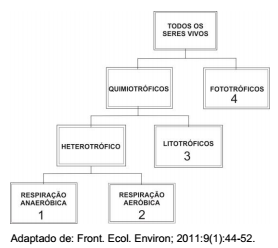
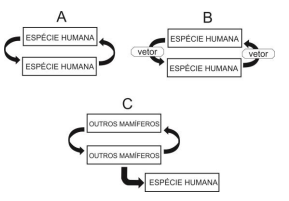
Dengue e tuberculose têm seus principais modos de transmissão representados, respectivamente, em:

 Conheça nossos planos