Questões Militares
Foram encontradas 14.723 questões
Resolva questões gratuitamente!
Junte-se a mais de 4 milhões de concurseiros!


• “A princípio, ficou confuso com a situação...”
• “A teoria que engendrou, no entanto, era muito diferente do que ditaria o senso comum...”
• “Assim, matriculara-se no curso para aprender a testar sua hipótese, tendo em vista a quantidade de indícios que já acumulara.”
As expressões destacadas podem ser substituídas, respectivamente, sem prejuízo ao sentido original e de acordo com a norma-padrão, por:
• “... depois de um colega fazer um comentário casual...” (1º parágrafo)
• “A teoria que engendrou, no entanto, era muito diferente...” (2º parágrafo)
• “... tendo em vista a quantidade de indícios que já acumulara.” (2º parágrafo)
No contexto em que foram empregadas, as palavras destacadas são, correta e respectivamente, sinônimas de
Texto I
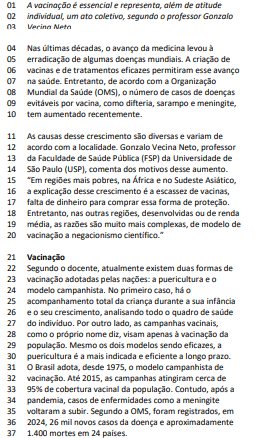
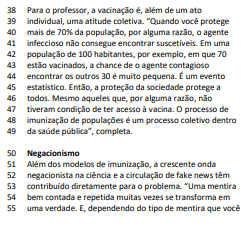
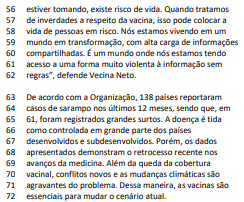
Negacionismo científico influencia no aumento de doenças evitáveis por vacina no mundo
https://jornal.usp.br/radio-usp/negacionismo-cientifico-influencia-no-aumento-de-doencas-evitaveis-por-vacina-no-mundo/Acesso em: 12 jun. 2025. (Adaptado)
Relacione corretamente os termos destacados nos trechos apresentados a seguir com suas respectivas funções sintáticas, numerando os parênteses abaixo de acordo com a seguinte indicação:
1. Objeto direto;
2. Predicativo do sujeito;
3. Adjunto adverbial;
4. Predicado.
( ) “Quando você protege mais de 70% da população, [...]” (linhas 39-40)
( ) “[...] por alguma razão, o agente infeccioso não consegue encontrar suscetíveis.” (linhas 40-41)
( ) “[...] as vacinas são essenciais para mudar o cenário atual. (linhas 71-72)
( ) “Então, a proteção da sociedade protege a todos.” (linhas 45-46)
A sequência correta, de cima para baixo, é:
“I don’t study chemistry ___ Monday.”
“David and Clara have been married ___ 2001.”
“She will arrive at the airport ___ 9 pm.”
“He lives ___ New York.”
“John and Carol have been married ___ three years.”
Read the text and answer the question.
One man in a boat
L.G. Alexander
Fishing is my favourite sport. I often fish for hours without catching anything. But this does not worry me. Some fishermen are unlucky. Instead of catching fish, they catch old boots and rubbish. I am even less lucky. I never catch anything ‐ not even old boots. After having spent whole mornings on the river, I always go home with an empty bag. “You must give up fishing!” my friends say. “It’s a waste of time.” But they don’t realize one important thing. I’m not really interested in fishing. I am only interested in sitting in a boat and doing nothing at all!
PRACTICE AND PROGRESS ‐ An Integrated Course for Pre‐Intermediate Students, L.G Alexander, Longman Group Limited, London.
Read the text and answer the question.
Why man’s best friend is still a four‐legged substitute parent?
Márcio Paulo Barbosa Pena Mascarenhas
Man’s best friends is actually a substitute parent, fulfilling deep emotional needs that humans fail to meet, according to a leading dog expert. People bond with dogs as much as babies do with mothers, and reap unconditional love, security and protection from the relationship.
Dr. Valerie O’ Farrel ‐ a psychologist ‐ says that dogs can also compensate for an unhappy childhood. People perceive in their pets qualities lacking in their parents. According to him, most dogs perform remarkably well as “emotional sponges”, soaking up owners’ hang‐ups. “Dogs obviously cannot understand the nature of their owners’ predicaments in the way that a sympathetic human listener can. Because the dog does not get upset or angry or go away, the owner can imagine he understands”, states the doctor.
As well as protection, concern for our well‐being and unconditional love, we often assign to dogs a fourth parental function: providing a safe and welcoming base to come home to. Some canines take this duty very seriously, Dr. O’ Farrel reveals. She describes the experience of a 37‐year‐old beauty therapist with her faithfull mongrel. “He would follow me to the station each morning to see me off”. I would watch him from the carriage and see him about to turn and go home. Invariably, he would be there to meet me when I got off the train at night. And what’s more surprising ‐ we lived about a mile and a half from the station.
Grade 1, Student’s book, Belo Horizonte,14th edition.
Read the text and answer the question.
Why man’s best friend is still a four‐legged substitute parent?
Márcio Paulo Barbosa Pena Mascarenhas
Man’s best friends is actually a substitute parent, fulfilling deep emotional needs that humans fail to meet, according to a leading dog expert. People bond with dogs as much as babies do with mothers, and reap unconditional love, security and protection from the relationship.
Dr. Valerie O’ Farrel ‐ a psychologist ‐ says that dogs can also compensate for an unhappy childhood. People perceive in their pets qualities lacking in their parents. According to him, most dogs perform remarkably well as “emotional sponges”, soaking up owners’ hang‐ups. “Dogs obviously cannot understand the nature of their owners’ predicaments in the way that a sympathetic human listener can. Because the dog does not get upset or angry or go away, the owner can imagine he understands”, states the doctor.
As well as protection, concern for our well‐being and unconditional love, we often assign to dogs a fourth parental function: providing a safe and welcoming base to come home to. Some canines take this duty very seriously, Dr. O’ Farrel reveals. She describes the experience of a 37‐year‐old beauty therapist with her faithfull mongrel. “He would follow me to the station each morning to see me off”. I would watch him from the carriage and see him about to turn and go home. Invariably, he would be there to meet me when I got off the train at night. And what’s more surprising ‐ we lived about a mile and a half from the station.
Grade 1, Student’s book, Belo Horizonte,14th edition.
Read the text and answer the question.
Why man’s best friend is still a four‐legged substitute parent?
Márcio Paulo Barbosa Pena Mascarenhas
Man’s best friends is actually a substitute parent, fulfilling deep emotional needs that humans fail to meet, according to a leading dog expert. People bond with dogs as much as babies do with mothers, and reap unconditional love, security and protection from the relationship.
Dr. Valerie O’ Farrel ‐ a psychologist ‐ says that dogs can also compensate for an unhappy childhood. People perceive in their pets qualities lacking in their parents. According to him, most dogs perform remarkably well as “emotional sponges”, soaking up owners’ hang‐ups. “Dogs obviously cannot understand the nature of their owners’ predicaments in the way that a sympathetic human listener can. Because the dog does not get upset or angry or go away, the owner can imagine he understands”, states the doctor.
As well as protection, concern for our well‐being and unconditional love, we often assign to dogs a fourth parental function: providing a safe and welcoming base to come home to. Some canines take this duty very seriously, Dr. O’ Farrel reveals. She describes the experience of a 37‐year‐old beauty therapist with her faithfull mongrel. “He would follow me to the station each morning to see me off”. I would watch him from the carriage and see him about to turn and go home. Invariably, he would be there to meet me when I got off the train at night. And what’s more surprising ‐ we lived about a mile and a half from the station.
Grade 1, Student’s book, Belo Horizonte,14th edition.
Read the text and answer the question.
Why man’s best friend is still a four‐legged substitute parent?
Márcio Paulo Barbosa Pena Mascarenhas
Man’s best friends is actually a substitute parent, fulfilling deep emotional needs that humans fail to meet, according to a leading dog expert. People bond with dogs as much as babies do with mothers, and reap unconditional love, security and protection from the relationship.
Dr. Valerie O’ Farrel ‐ a psychologist ‐ says that dogs can also compensate for an unhappy childhood. People perceive in their pets qualities lacking in their parents. According to him, most dogs perform remarkably well as “emotional sponges”, soaking up owners’ hang‐ups. “Dogs obviously cannot understand the nature of their owners’ predicaments in the way that a sympathetic human listener can. Because the dog does not get upset or angry or go away, the owner can imagine he understands”, states the doctor.
As well as protection, concern for our well‐being and unconditional love, we often assign to dogs a fourth parental function: providing a safe and welcoming base to come home to. Some canines take this duty very seriously, Dr. O’ Farrel reveals. She describes the experience of a 37‐year‐old beauty therapist with her faithfull mongrel. “He would follow me to the station each morning to see me off”. I would watch him from the carriage and see him about to turn and go home. Invariably, he would be there to meet me when I got off the train at night. And what’s more surprising ‐ we lived about a mile and a half from the station.
Grade 1, Student’s book, Belo Horizonte,14th edition.
 Conheça nossos planos