Selecionar segmento
Estude com questões de diferentes segmentos
Atenção: Isso limpará todos os campos já preenchidos no filtro!
Foram encontradas 8.419 questões
Resolva questões gratuitamente!
Junte-se a mais de 4 milhões de concurseiros!


Ano: 2025
Banca:
Aeronáutica
Órgão:
EEAR
Prova:
Aeronáutica - 2025 - EEAR - Sargento - CFS - Código 81 |
Q3515702
Inglês
Texto associado
Read the text and answer question.
Global coral reef bleaching event underway as oceans get
warmer
The world’s oceans experience unprecedented rising
temperatures: last month, the average global sea surface
temperature reached a record 21° Celsius. Last week, the National
Oceanic and Atmospheric Administration (NOAA) reported the
4th global bleaching event on record. A press release stated,
“Within the last 14 months, significant coral bleaching has been
documented in the Northern and Southern Hemispheres of each
major ocean basin. Since 2023, the problem has become more
frequent in the Atlantic, Pacific and Indian oceans.”
According to NOAA, warmer ocean temperatures can result
in expulsion of algae that live in the coral tissue, leaving the coral
completely white - something known as ‘coral bleaching’. This
does not necessarily mean corals will die, as they can recover if
the strain on their ecosystems is reduced. At a local level, storms,
disease, sediments and changes in salinity can cause corals to
bleach. However, mass bleaching, which is when several varieties
of coral reefs are bleached, is largely caused by increased sea
temperatures. When these events are sufficiently severe or
prolonged, they can cause coral mortality, which hurts the people
who depend on the coral reefs for their livelihoods.
In 2019, NOAA published a study that provided “resiliencebased management practices” and __________ the importance of
coral restoration. “We are on the frontlines of coral reef research,
management and restoration, and are actively and aggressively
implementing the recommendations of the 2019 study.” A buoy
in Florida reported an ocean temperature of 38° Celsius in July
2023, according to meteorologists at the time. In response, NOAA
started a program to attempt to offset the effects of global
climate change on the local coral reefs by moving coral nurseries
to deeper, cooler waters and deploying sunshades to protect
corals in other areas.
Adapted. Intemet: www.abcnews.go.com/International.
According to the text, warm sea temperatures
Ano: 2025
Banca:
Aeronáutica
Órgão:
EEAR
Prova:
Aeronáutica - 2025 - EEAR - Sargento - CFS - Código 81 |
Q3515700
Inglês
Texto associado
Read the text and answer question.
Global coral reef bleaching event underway as oceans get
warmer
The world’s oceans experience unprecedented rising
temperatures: last month, the average global sea surface
temperature reached a record 21° Celsius. Last week, the National
Oceanic and Atmospheric Administration (NOAA) reported the
4th global bleaching event on record. A press release stated,
“Within the last 14 months, significant coral bleaching has been
documented in the Northern and Southern Hemispheres of each
major ocean basin. Since 2023, the problem has become more
frequent in the Atlantic, Pacific and Indian oceans.”
According to NOAA, warmer ocean temperatures can result
in expulsion of algae that live in the coral tissue, leaving the coral
completely white - something known as ‘coral bleaching’. This
does not necessarily mean corals will die, as they can recover if
the strain on their ecosystems is reduced. At a local level, storms,
disease, sediments and changes in salinity can cause corals to
bleach. However, mass bleaching, which is when several varieties
of coral reefs are bleached, is largely caused by increased sea
temperatures. When these events are sufficiently severe or
prolonged, they can cause coral mortality, which hurts the people
who depend on the coral reefs for their livelihoods.
In 2019, NOAA published a study that provided “resiliencebased management practices” and __________ the importance of
coral restoration. “We are on the frontlines of coral reef research,
management and restoration, and are actively and aggressively
implementing the recommendations of the 2019 study.” A buoy
in Florida reported an ocean temperature of 38° Celsius in July
2023, according to meteorologists at the time. In response, NOAA
started a program to attempt to offset the effects of global
climate change on the local coral reefs by moving coral nurseries
to deeper, cooler waters and deploying sunshades to protect
corals in other areas.
Adapted. Intemet: www.abcnews.go.com/International.
The word livelihoods, in bold in the text, refers to
Ano: 2025
Banca:
Aeronáutica
Órgão:
EEAR
Prova:
Aeronáutica - 2025 - EEAR - Sargento - CFS - Código 81 |
Q3515698
Inglês
Texto associado
Read the text and answer question.
Global coral reef bleaching event underway as oceans get
warmer
The world’s oceans experience unprecedented rising
temperatures: last month, the average global sea surface
temperature reached a record 21° Celsius. Last week, the National
Oceanic and Atmospheric Administration (NOAA) reported the
4th global bleaching event on record. A press release stated,
“Within the last 14 months, significant coral bleaching has been
documented in the Northern and Southern Hemispheres of each
major ocean basin. Since 2023, the problem has become more
frequent in the Atlantic, Pacific and Indian oceans.”
According to NOAA, warmer ocean temperatures can result
in expulsion of algae that live in the coral tissue, leaving the coral
completely white - something known as ‘coral bleaching’. This
does not necessarily mean corals will die, as they can recover if
the strain on their ecosystems is reduced. At a local level, storms,
disease, sediments and changes in salinity can cause corals to
bleach. However, mass bleaching, which is when several varieties
of coral reefs are bleached, is largely caused by increased sea
temperatures. When these events are sufficiently severe or
prolonged, they can cause coral mortality, which hurts the people
who depend on the coral reefs for their livelihoods.
In 2019, NOAA published a study that provided “resiliencebased management practices” and __________ the importance of
coral restoration. “We are on the frontlines of coral reef research,
management and restoration, and are actively and aggressively
implementing the recommendations of the 2019 study.” A buoy
in Florida reported an ocean temperature of 38° Celsius in July
2023, according to meteorologists at the time. In response, NOAA
started a program to attempt to offset the effects of global
climate change on the local coral reefs by moving coral nurseries
to deeper, cooler waters and deploying sunshades to protect
corals in other areas.
Adapted. Intemet: www.abcnews.go.com/International.
The word underway, in the title of the text, means that
something is
Ano: 2025
Banca:
Aeronáutica
Órgão:
EEAR
Prova:
Aeronáutica - 2025 - EEAR - Sargento - CFS - Código 81 |
Q3515679
Física
Em relação aos fenômenos elétricos, marque V para
verdadeiro ou F para falso. Em seguida, assinale a alternativa com
a sequência correta.
( ) Na corrente contínua (CC), o fluxo de cargas elétricas ocorre em um único sentido. Esse tipo de corrente é produzido por pilhas e células fotovoltaicas. O sentido da corrente continua real é dado pelo sentido do fluxo dos portadores das cargas negativas.
( ) A corrente alternada (CA) é um fluxo oscilante de cargas elétricas que ora se movimenta em um sentido, ora em outro. Esse tipo de corrente é produzido por baterias e hidroelétricas. O sentido da corrente alternada real é dado pelo sentido do fluxo dos portadores das cargas positivas.
( ) O fenômeno de emissdo de luz que ocorre quando uma corrente elétrica passa através de um gás rarefeito é conhecido como efeito térmico.
( ) Para medir a tensão aplicada aos terminais de um resistor, um voltímetro deve ser inserido a este de forma paralela. Além disso, para não influenciar no circuito medido, o voltímetro deve possuir a maior resistência interna possível, fazendo com que a corrente que o atravessa seja insignificante.
( ) Na corrente contínua (CC), o fluxo de cargas elétricas ocorre em um único sentido. Esse tipo de corrente é produzido por pilhas e células fotovoltaicas. O sentido da corrente continua real é dado pelo sentido do fluxo dos portadores das cargas negativas.
( ) A corrente alternada (CA) é um fluxo oscilante de cargas elétricas que ora se movimenta em um sentido, ora em outro. Esse tipo de corrente é produzido por baterias e hidroelétricas. O sentido da corrente alternada real é dado pelo sentido do fluxo dos portadores das cargas positivas.
( ) O fenômeno de emissdo de luz que ocorre quando uma corrente elétrica passa através de um gás rarefeito é conhecido como efeito térmico.
( ) Para medir a tensão aplicada aos terminais de um resistor, um voltímetro deve ser inserido a este de forma paralela. Além disso, para não influenciar no circuito medido, o voltímetro deve possuir a maior resistência interna possível, fazendo com que a corrente que o atravessa seja insignificante.
Ano: 2025
Banca:
Aeronáutica
Órgão:
EEAR
Prova:
Aeronáutica - 2025 - EEAR - Sargento - CFS - Código 81 |
Q3515671
Física
Uma família de 5 pessoas mora em uma residência que é
alimentada por uma tensdo igual a 127 V. Todos os dias, cada
membro da família toma 1 banho durante 20 minutos, e dois
membros utilizam um secador de cabelo por 30 minutos cada.
Sabendo que as potências do chuveiro e do secador de cabelo
são, respectivamente, 5000 W e 1667 W, e que a empresa de
eletricidade cobra R$ 0,30 por kWh, assinale a alternativa que
indica, aproximadamente, a contribuição do consumo mensal de
energia, em R$, do chuveiro e do secador de cabelo. Considere o mês com 30 dias. Adote 1 KWh = 3,6.106J.
Ano: 2025
Banca:
Aeronáutica
Órgão:
EEAR
Prova:
Aeronáutica - 2025 - EEAR - Sargento - CFS - Código 81 |
Q3515654
Matemática
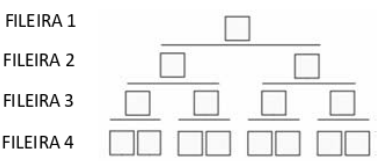
A figura representa uma pilha de caixas em uma prateleira
de supermercado, contendo 4 fileiras. Se aumentarmos a
quantidade de fileiras para 10, mantendo o mesmo padrão de
montagem, ou seja, uma caixa sendo apoiada por duas, então a
quantidade de caixas utilizadas para formar as 10 fileiras
será _____.
Ano: 2025
Banca:
Aeronáutica
Órgão:
EEAR
Prova:
Aeronáutica - 2025 - EEAR - Sargento - CFS - Código 81 |
Q3515634
Português
Assinale, entre as orações reduzidas de gerundio destacadas
nas alternativas abaixo, aquela que pode ser classificada como
coordenada aditiva.
Ano: 2025
Banca:
Aeronáutica
Órgão:
EEAR
Prova:
Aeronáutica - 2025 - EEAR - Sargento - CFS - Código 83 |
Q3513824
Português
Leia as sentenças abaixo atentando para os termos destacados e, a seguir, assinale a alternativa correta.
I‐ Honrado, seu nome de prestígio pesa‐lhe os ombros diante da situação.
II‐ Mostrou ao pai alguns amigos especiais, João, que corria como ninguém; Pedro, que era bom de bola; Tonico, que conhecia muitas histórias; Abel, Joaquim, Beto...
III‐ Diz Feliciano a verdade. O que não quero mesmo é desistir de meu sonho.
IV‐ Por ambas as torcidas, ainda que respirassem rivalidade, o Hino Nacional era entoado com emoção.
Os termos em destaque são, respectivamente,
Q3487270
Inglês
“The first parachute was invented by Leonardo da Vinci.”
This sentence has the same meaning as:
Q3487268
Inglês
Choose the alternative with the correct Tag Question.
Q3487267
Inglês
“What are gliders? They are planes without engines.” The
underlined word can be correctly replaced by
Q3487266
Inglês
Match the columns. Then choose the alternative with
correct sequence.
1 – Who
2 – Why
3 – What
4 – When
5 – Which
6 – Where
( ) do you live?
( ) is your father?
( ) are you crying?
( ) were you born?
( ) color is the sky?
( ) do you prefer: tea or coffee?
1 – Who
2 – Why
3 – What
4 – When
5 – Which
6 – Where
( ) do you live?
( ) is your father?
( ) are you crying?
( ) were you born?
( ) color is the sky?
( ) do you prefer: tea or coffee?
Q3487265
Inglês
Choose the correct alternative to complete the dialog.
Alex: Can you see the soldier in the camouflaged uniform? Camille: __________________. There are two.
Alex: Can you see the soldier in the camouflaged uniform? Camille: __________________. There are two.
Q3487264
Inglês
Choose the correct alternative to complete the five
sentences.
I‐ It was a long and __________ journey.
II‐ __________ children tend to be agitated.
III‐ That’s quite an __________ idea, actually!
IV‐ Why do you have this __________ look on your face?
V‐ I don’t know how to motivate those __________ students.
I‐ It was a long and __________ journey.
II‐ __________ children tend to be agitated.
III‐ That’s quite an __________ idea, actually!
IV‐ Why do you have this __________ look on your face?
V‐ I don’t know how to motivate those __________ students.
Q3487263
Inglês
Choose the correct alternative to complete the
conversation.
John: We’re having dinner in the Sergeants’ Mess Hall on Thursday. _____________?
Marcos: Yes, I’d love to.
John: We’re having dinner in the Sergeants’ Mess Hall on Thursday. _____________?
Marcos: Yes, I’d love to.
Q3487262
Inglês
Choose the alternative that contains a group of
uncountable nouns.
Q3487261
Inglês
Texto associado
Read the text and answer question.
How long will you live?
Everyone wants to live a long and healthy life. Today, many
scientists are trying to find the habits that help people live
longer. In 1970, some scientists talked to 7,000 people in the
United States and got information about ___________ habits.
Then they checked to see how long the people lived.
The scientists learned that the people with the longest
lives did seven things. (1) They ate breakfast every day. (2) They
didn’t eat snacks between meals. (3) They weren’t too heavy or
too thin. (4) They exercised regularly. (5) They slept seven to
eight hours every night not more, and not less. (6) They didn’t
smoke. (7) They didn’t drink more than two alcoholic drinks per
day.
These were the habits that made a big difference. People
who did all of these things lived 12 years longer than people
who did only one to three of the things.
Scientists say that you should change your habits slowly.
Make one small change every week. You need about 21 days to
make a new habit.
Adapted. World English 1B. 2010. Heinle Cengage Learning.
According to the text, people
Q3487260
Inglês
Texto associado
Read the text and answer question.
How long will you live?
Everyone wants to live a long and healthy life. Today, many
scientists are trying to find the habits that help people live
longer. In 1970, some scientists talked to 7,000 people in the
United States and got information about ___________ habits.
Then they checked to see how long the people lived.
The scientists learned that the people with the longest
lives did seven things. (1) They ate breakfast every day. (2) They
didn’t eat snacks between meals. (3) They weren’t too heavy or
too thin. (4) They exercised regularly. (5) They slept seven to
eight hours every night not more, and not less. (6) They didn’t
smoke. (7) They didn’t drink more than two alcoholic drinks per
day.
These were the habits that made a big difference. People
who did all of these things lived 12 years longer than people
who did only one to three of the things.
Scientists say that you should change your habits slowly.
Make one small change every week. You need about 21 days to
make a new habit.
Adapted. World English 1B. 2010. Heinle Cengage Learning.
Choose the correct word to complete the text.
Q3487259
Inglês
Texto associado
Read the text and answer question.
How long will you live?
Everyone wants to live a long and healthy life. Today, many
scientists are trying to find the habits that help people live
longer. In 1970, some scientists talked to 7,000 people in the
United States and got information about ___________ habits.
Then they checked to see how long the people lived.
The scientists learned that the people with the longest
lives did seven things. (1) They ate breakfast every day. (2) They
didn’t eat snacks between meals. (3) They weren’t too heavy or
too thin. (4) They exercised regularly. (5) They slept seven to
eight hours every night not more, and not less. (6) They didn’t
smoke. (7) They didn’t drink more than two alcoholic drinks per
day.
These were the habits that made a big difference. People
who did all of these things lived 12 years longer than people
who did only one to three of the things.
Scientists say that you should change your habits slowly.
Make one small change every week. You need about 21 days to
make a new habit.
Adapted. World English 1B. 2010. Heinle Cengage Learning.
Choose the correct alternative to replace the underlined
word in the text, without changing the meaning.
Q3487258
Inglês
Texto associado
Read the text and answer question.
How long will you live?
Everyone wants to live a long and healthy life. Today, many
scientists are trying to find the habits that help people live
longer. In 1970, some scientists talked to 7,000 people in the
United States and got information about ___________ habits.
Then they checked to see how long the people lived.
The scientists learned that the people with the longest
lives did seven things. (1) They ate breakfast every day. (2) They
didn’t eat snacks between meals. (3) They weren’t too heavy or
too thin. (4) They exercised regularly. (5) They slept seven to
eight hours every night not more, and not less. (6) They didn’t
smoke. (7) They didn’t drink more than two alcoholic drinks per
day.
These were the habits that made a big difference. People
who did all of these things lived 12 years longer than people
who did only one to three of the things.
Scientists say that you should change your habits slowly.
Make one small change every week. You need about 21 days to
make a new habit.
Adapted. World English 1B. 2010. Heinle Cengage Learning.
According to the text, scientists

 Conheça nossos planos