Questões Militares
Comentadas para pm-sp
Foram encontradas 4.777 questões
Resolva questões gratuitamente!
Junte-se a mais de 4 milhões de concurseiros!


Chego em casa à noite, exausto. A mesa vazia. Nada sobre o fogão. Nem no forno. Nem na geladeira. Não há jantar! No dia seguinte, revolto-me diante da empregada.
- Passei fome!
-Ih! Achei que o senhor não vinha jantar!
Solto faíscas que nem um fio desencapado ao ouvir o verbo “achar" em qualquer conjugação. É um perigo achar. Não no sentido de expressar alguma coisa, mas de supor alguma coisa.
Tenho trauma, é verdade!
Tudo começou aos 9 anos de idade, quando pedi à professora para ir ao banheiro. Ela não permitiu e voltei agoniado à carteira. Cruzei as pernas, cruzei de novo, torci os pés, mas foi impossível escrever ou ouvir a lição... De repente, senti algo morno escorrendo pelas pernas. Fiz xixi nas calças!
Alguém gritou:
- Olha, ele fez xixi!
Dali a pouco toda a classe ria. E a professora, surpresa:
- Ih . eu achei que você pediu para sair só por malandragem.
Tomei horror ao “achismo" e aprendi: sempre que alguém “acha" alguma coisa, “acha" errado.
Meu assistente, Felippe, é mestre no assunto.
- Não botei gasolina no carro porque achei que ia dar! - explica ele, enquanto, desesperado, faço sinais na estrada tentando carona até algum posto.
Quem trabalha comigo, agora, não pode mais achar. Tem de saber!
Outro dia ouvi uma história melancólica. Dois colegas de classe se encontraram trinta anos depois. Ambos com vida amorosa péssima e casamento desfeito. Com a sinceridade que só a passagem do tempo permite, ele desabafou:
- Eu era apaixonado por você, mas achei que você não ia querer nada comigo.
Ela suspirou, decepcionada.
- Eu achava você o máximo! Como nunca se aproximou, achei que não tinha atração por mim!
Os dois se encararam arrasados. E se tivessem namorado? Talvez a vida deles fosse diferente! Mas o que fazer com os trinta anos passados?
Por isso, quando alguém me diz:
-Eu acho que .
Respondo:
- Não ache, ninguém perdeu nada.
E sempre que posso, insisto:
- Se não sabe, pergunte!
É o lema que adotei: melhor que achar, sempre é verificar!
(Walcyr Carrasco, Veja SãoPaulo, 19.05.2010. Adaptado)
Chego em casa à noite, exausto. A mesa vazia. Nada sobre o fogão. Nem no forno. Nem na geladeira. Não há jantar! No dia seguinte, revolto-me diante da empregada.
- Passei fome!
-Ih! Achei que o senhor não vinha jantar!
Solto faíscas que nem um fio desencapado ao ouvir o verbo “achar" em qualquer conjugação. É um perigo achar. Não no sentido de expressar alguma coisa, mas de supor alguma coisa.
Tenho trauma, é verdade!
Tudo começou aos 9 anos de idade, quando pedi à professora para ir ao banheiro. Ela não permitiu e voltei agoniado à carteira. Cruzei as pernas, cruzei de novo, torci os pés, mas foi impossível escrever ou ouvir a lição... De repente, senti algo morno escorrendo pelas pernas. Fiz xixi nas calças!
Alguém gritou:
- Olha, ele fez xixi!
Dali a pouco toda a classe ria. E a professora, surpresa:
- Ih . eu achei que você pediu para sair só por malandragem.
Tomei horror ao “achismo" e aprendi: sempre que alguém “acha" alguma coisa, “acha" errado.
Meu assistente, Felippe, é mestre no assunto.
- Não botei gasolina no carro porque achei que ia dar! - explica ele, enquanto, desesperado, faço sinais na estrada tentando carona até algum posto.
Quem trabalha comigo, agora, não pode mais achar. Tem de saber!
Outro dia ouvi uma história melancólica. Dois colegas de classe se encontraram trinta anos depois. Ambos com vida amorosa péssima e casamento desfeito. Com a sinceridade que só a passagem do tempo permite, ele desabafou:
- Eu era apaixonado por você, mas achei que você não ia querer nada comigo.
Ela suspirou, decepcionada.
- Eu achava você o máximo! Como nunca se aproximou, achei que não tinha atração por mim!
Os dois se encararam arrasados. E se tivessem namorado? Talvez a vida deles fosse diferente! Mas o que fazer com os trinta anos passados?
Por isso, quando alguém me diz:
-Eu acho que .
Respondo:
- Não ache, ninguém perdeu nada.
E sempre que posso, insisto:
- Se não sabe, pergunte!
É o lema que adotei: melhor que achar, sempre é verificar!
(Walcyr Carrasco, Veja SãoPaulo, 19.05.2010. Adaptado)
Chego em casa à noite, exausto. A mesa vazia. Nada sobre o fogão. Nem no forno. Nem na geladeira. Não há jantar! No dia seguinte, revolto-me diante da empregada.
- Passei fome!
-Ih! Achei que o senhor não vinha jantar!
Solto faíscas que nem um fio desencapado ao ouvir o verbo “achar" em qualquer conjugação. É um perigo achar. Não no sentido de expressar alguma coisa, mas de supor alguma coisa.
Tenho trauma, é verdade!
Tudo começou aos 9 anos de idade, quando pedi à professora para ir ao banheiro. Ela não permitiu e voltei agoniado à carteira. Cruzei as pernas, cruzei de novo, torci os pés, mas foi impossível escrever ou ouvir a lição... De repente, senti algo morno escorrendo pelas pernas. Fiz xixi nas calças!
Alguém gritou:
- Olha, ele fez xixi!
Dali a pouco toda a classe ria. E a professora, surpresa:
- Ih . eu achei que você pediu para sair só por malandragem.
Tomei horror ao “achismo" e aprendi: sempre que alguém “acha" alguma coisa, “acha" errado.
Meu assistente, Felippe, é mestre no assunto.
- Não botei gasolina no carro porque achei que ia dar! - explica ele, enquanto, desesperado, faço sinais na estrada tentando carona até algum posto.
Quem trabalha comigo, agora, não pode mais achar. Tem de saber!
Outro dia ouvi uma história melancólica. Dois colegas de classe se encontraram trinta anos depois. Ambos com vida amorosa péssima e casamento desfeito. Com a sinceridade que só a passagem do tempo permite, ele desabafou:
- Eu era apaixonado por você, mas achei que você não ia querer nada comigo.
Ela suspirou, decepcionada.
- Eu achava você o máximo! Como nunca se aproximou, achei que não tinha atração por mim!
Os dois se encararam arrasados. E se tivessem namorado? Talvez a vida deles fosse diferente! Mas o que fazer com os trinta anos passados?
Por isso, quando alguém me diz:
-Eu acho que .
Respondo:
- Não ache, ninguém perdeu nada.
E sempre que posso, insisto:
- Se não sabe, pergunte!
É o lema que adotei: melhor que achar, sempre é verificar!
(Walcyr Carrasco, Veja SãoPaulo, 19.05.2010. Adaptado)
Instrução: Leia o texto para responder a questão.
The Big Destructiveness Of The Tiny Bribe
Alexandra Wrage 03.01.2010
The smallest bribes can be the most vexing. Not suitcases full of money and transfers to offshore accounts, but the thousands of everyday payments people make to Indian building inspectors, Chinese customs officials and Nigerian airport functionaries, just to get things done. They’re payments for routine government services that a government official is legally obliged to perform but for which he’s hoping to skim off a little extra.
Unlike more serious bribes, these very modest payouts, formally known as “facilitating payments”, are not against the laws of the U.S., Canada, Australia, New Zealand or South Korea, when made abroad. They’re illegal for Great Britain, but the Serious Fraud Office there has taken the extraordinary public position that they’re unlikely to give rise to a prosecution.
Why don’t governments that lead the fight against large-scale bribery fall in line with what is already the practice of many major companies? They don’t want to outlaw such small-scale graft in foreign places, they say, because they don’t have the manpower to prosecute violators. By that logic, communities with just enough resources to handle murder and armed robbery would give a green light to shoplifting. You’d think a government could at least go after a few high-profile cases to set an example and a precedent. Permitting these smaller payments has to impede the effort to crack down on the larger ones. Companies know this.
“Facilitating” bribes are not tips. Tipping is voluntary, and you decide to do it after a service has been rendered. You don’t pay it at the outset to induce the waiter to bring the food, and you can always go somewhere else to eat next time should the service be bad.
Nor are they welfare for underpaid civil servants. If government workers are underpaid, we should compensate them for the cost of customs inspections or airport security by aboveboard means, through taxation and so forth. Payment to individuals not only slows service but also encourages entrepreneurial civil servants to increase their income by creating more and greater obstacles.
Nor are they a mere distraction from the fight against bigger bribes. Rather, they fuel the problem. Junior officials who look for small bribes rise to higher positions by paying off those above them. Corruption creates pyramids of illegal payments flowing upward. Legalizing the base of the pyramid gives it a strong and lasting foundation.
Nor are these payments legal where they’re made. They may not be banned by the wealthy countries mentioned above, but they are outlawed in the countries where they’re actually a problem. Do developed countries want to say they wouldn’t tolerate such payments at home but don’t care if they’re made abroad? And since they’re illegal in the countries where they’re paid, companies can’t put them on their books. The classic cover for a bribe is to call it a “consulting fee”, but that is a books and records violation that is illegal in any country.
(www.forbes.com. Adaptado.)
Instrução: Leia o texto para responder a questão.
The Big Destructiveness Of The Tiny Bribe
Alexandra Wrage 03.01.2010
The smallest bribes can be the most vexing. Not suitcases full of money and transfers to offshore accounts, but the thousands of everyday payments people make to Indian building inspectors, Chinese customs officials and Nigerian airport functionaries, just to get things done. They’re payments for routine government services that a government official is legally obliged to perform but for which he’s hoping to skim off a little extra.
Unlike more serious bribes, these very modest payouts, formally known as “facilitating payments”, are not against the laws of the U.S., Canada, Australia, New Zealand or South Korea, when made abroad. They’re illegal for Great Britain, but the Serious Fraud Office there has taken the extraordinary public position that they’re unlikely to give rise to a prosecution.
Why don’t governments that lead the fight against large-scale bribery fall in line with what is already the practice of many major companies? They don’t want to outlaw such small-scale graft in foreign places, they say, because they don’t have the manpower to prosecute violators. By that logic, communities with just enough resources to handle murder and armed robbery would give a green light to shoplifting. You’d think a government could at least go after a few high-profile cases to set an example and a precedent. Permitting these smaller payments has to impede the effort to crack down on the larger ones. Companies know this.
“Facilitating” bribes are not tips. Tipping is voluntary, and you decide to do it after a service has been rendered. You don’t pay it at the outset to induce the waiter to bring the food, and you can always go somewhere else to eat next time should the service be bad.
Nor are they welfare for underpaid civil servants. If government workers are underpaid, we should compensate them for the cost of customs inspections or airport security by aboveboard means, through taxation and so forth. Payment to individuals not only slows service but also encourages entrepreneurial civil servants to increase their income by creating more and greater obstacles.
Nor are they a mere distraction from the fight against bigger bribes. Rather, they fuel the problem. Junior officials who look for small bribes rise to higher positions by paying off those above them. Corruption creates pyramids of illegal payments flowing upward. Legalizing the base of the pyramid gives it a strong and lasting foundation.
Nor are these payments legal where they’re made. They may not be banned by the wealthy countries mentioned above, but they are outlawed in the countries where they’re actually a problem. Do developed countries want to say they wouldn’t tolerate such payments at home but don’t care if they’re made abroad? And since they’re illegal in the countries where they’re paid, companies can’t put them on their books. The classic cover for a bribe is to call it a “consulting fee”, but that is a books and records violation that is illegal in any country.
(www.forbes.com. Adaptado.)
Instrução: Leia o texto para responder a questão.
The Big Destructiveness Of The Tiny Bribe
Alexandra Wrage 03.01.2010
The smallest bribes can be the most vexing. Not suitcases full of money and transfers to offshore accounts, but the thousands of everyday payments people make to Indian building inspectors, Chinese customs officials and Nigerian airport functionaries, just to get things done. They’re payments for routine government services that a government official is legally obliged to perform but for which he’s hoping to skim off a little extra.
Unlike more serious bribes, these very modest payouts, formally known as “facilitating payments”, are not against the laws of the U.S., Canada, Australia, New Zealand or South Korea, when made abroad. They’re illegal for Great Britain, but the Serious Fraud Office there has taken the extraordinary public position that they’re unlikely to give rise to a prosecution.
Why don’t governments that lead the fight against large-scale bribery fall in line with what is already the practice of many major companies? They don’t want to outlaw such small-scale graft in foreign places, they say, because they don’t have the manpower to prosecute violators. By that logic, communities with just enough resources to handle murder and armed robbery would give a green light to shoplifting. You’d think a government could at least go after a few high-profile cases to set an example and a precedent. Permitting these smaller payments has to impede the effort to crack down on the larger ones. Companies know this.
“Facilitating” bribes are not tips. Tipping is voluntary, and you decide to do it after a service has been rendered. You don’t pay it at the outset to induce the waiter to bring the food, and you can always go somewhere else to eat next time should the service be bad.
Nor are they welfare for underpaid civil servants. If government workers are underpaid, we should compensate them for the cost of customs inspections or airport security by aboveboard means, through taxation and so forth. Payment to individuals not only slows service but also encourages entrepreneurial civil servants to increase their income by creating more and greater obstacles.
Nor are they a mere distraction from the fight against bigger bribes. Rather, they fuel the problem. Junior officials who look for small bribes rise to higher positions by paying off those above them. Corruption creates pyramids of illegal payments flowing upward. Legalizing the base of the pyramid gives it a strong and lasting foundation.
Nor are these payments legal where they’re made. They may not be banned by the wealthy countries mentioned above, but they are outlawed in the countries where they’re actually a problem. Do developed countries want to say they wouldn’t tolerate such payments at home but don’t care if they’re made abroad? And since they’re illegal in the countries where they’re paid, companies can’t put them on their books. The classic cover for a bribe is to call it a “consulting fee”, but that is a books and records violation that is illegal in any country.
(www.forbes.com. Adaptado.)
Instrução: Leia o texto para responder a questão.
The Big Destructiveness Of The Tiny Bribe
Alexandra Wrage 03.01.2010
The smallest bribes can be the most vexing. Not suitcases full of money and transfers to offshore accounts, but the thousands of everyday payments people make to Indian building inspectors, Chinese customs officials and Nigerian airport functionaries, just to get things done. They’re payments for routine government services that a government official is legally obliged to perform but for which he’s hoping to skim off a little extra.
Unlike more serious bribes, these very modest payouts, formally known as “facilitating payments”, are not against the laws of the U.S., Canada, Australia, New Zealand or South Korea, when made abroad. They’re illegal for Great Britain, but the Serious Fraud Office there has taken the extraordinary public position that they’re unlikely to give rise to a prosecution.
Why don’t governments that lead the fight against large-scale bribery fall in line with what is already the practice of many major companies? They don’t want to outlaw such small-scale graft in foreign places, they say, because they don’t have the manpower to prosecute violators. By that logic, communities with just enough resources to handle murder and armed robbery would give a green light to shoplifting. You’d think a government could at least go after a few high-profile cases to set an example and a precedent. Permitting these smaller payments has to impede the effort to crack down on the larger ones. Companies know this.
“Facilitating” bribes are not tips. Tipping is voluntary, and you decide to do it after a service has been rendered. You don’t pay it at the outset to induce the waiter to bring the food, and you can always go somewhere else to eat next time should the service be bad.
Nor are they welfare for underpaid civil servants. If government workers are underpaid, we should compensate them for the cost of customs inspections or airport security by aboveboard means, through taxation and so forth. Payment to individuals not only slows service but also encourages entrepreneurial civil servants to increase their income by creating more and greater obstacles.
Nor are they a mere distraction from the fight against bigger bribes. Rather, they fuel the problem. Junior officials who look for small bribes rise to higher positions by paying off those above them. Corruption creates pyramids of illegal payments flowing upward. Legalizing the base of the pyramid gives it a strong and lasting foundation.
Nor are these payments legal where they’re made. They may not be banned by the wealthy countries mentioned above, but they are outlawed in the countries where they’re actually a problem. Do developed countries want to say they wouldn’t tolerate such payments at home but don’t care if they’re made abroad? And since they’re illegal in the countries where they’re paid, companies can’t put them on their books. The classic cover for a bribe is to call it a “consulting fee”, but that is a books and records violation that is illegal in any country.
(www.forbes.com. Adaptado.)
Instrução: Leia o texto para responder a questão.
The Big Destructiveness Of The Tiny Bribe
Alexandra Wrage 03.01.2010
The smallest bribes can be the most vexing. Not suitcases full of money and transfers to offshore accounts, but the thousands of everyday payments people make to Indian building inspectors, Chinese customs officials and Nigerian airport functionaries, just to get things done. They’re payments for routine government services that a government official is legally obliged to perform but for which he’s hoping to skim off a little extra.
Unlike more serious bribes, these very modest payouts, formally known as “facilitating payments”, are not against the laws of the U.S., Canada, Australia, New Zealand or South Korea, when made abroad. They’re illegal for Great Britain, but the Serious Fraud Office there has taken the extraordinary public position that they’re unlikely to give rise to a prosecution.
Why don’t governments that lead the fight against large-scale bribery fall in line with what is already the practice of many major companies? They don’t want to outlaw such small-scale graft in foreign places, they say, because they don’t have the manpower to prosecute violators. By that logic, communities with just enough resources to handle murder and armed robbery would give a green light to shoplifting. You’d think a government could at least go after a few high-profile cases to set an example and a precedent. Permitting these smaller payments has to impede the effort to crack down on the larger ones. Companies know this.
“Facilitating” bribes are not tips. Tipping is voluntary, and you decide to do it after a service has been rendered. You don’t pay it at the outset to induce the waiter to bring the food, and you can always go somewhere else to eat next time should the service be bad.
Nor are they welfare for underpaid civil servants. If government workers are underpaid, we should compensate them for the cost of customs inspections or airport security by aboveboard means, through taxation and so forth. Payment to individuals not only slows service but also encourages entrepreneurial civil servants to increase their income by creating more and greater obstacles.
Nor are they a mere distraction from the fight against bigger bribes. Rather, they fuel the problem. Junior officials who look for small bribes rise to higher positions by paying off those above them. Corruption creates pyramids of illegal payments flowing upward. Legalizing the base of the pyramid gives it a strong and lasting foundation.
Nor are these payments legal where they’re made. They may not be banned by the wealthy countries mentioned above, but they are outlawed in the countries where they’re actually a problem. Do developed countries want to say they wouldn’t tolerate such payments at home but don’t care if they’re made abroad? And since they’re illegal in the countries where they’re paid, companies can’t put them on their books. The classic cover for a bribe is to call it a “consulting fee”, but that is a books and records violation that is illegal in any country.
(www.forbes.com. Adaptado.)
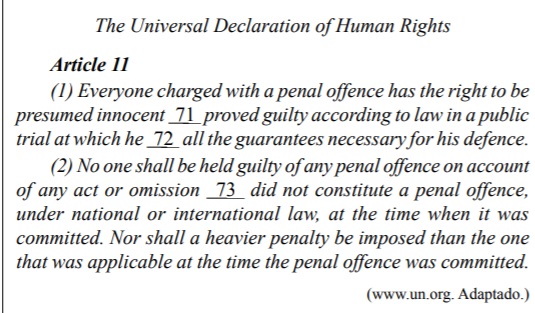
Instrução: Leia o artigo 11 da Declaração Universal dos Direitos Humanos, em inglês, para responder a questão, assinalando a alternativa que completa corretamente as respectivas lacunas.
The Universal Declaration of Human Rights
Article 11
(1) Everyone charged with a penal offence has the right to be
presumed innocent —— 71 proved guilty according to law in a public
trial at which he —— 72 all the guarantees necessary for his defence.
(2) No one shall be held guilty of any penal offence on account
of any act or omission — 73
— did not constitute a penal offence,
under national or international law, at the time when it was
committed. Nor shall a heavier penalty be imposed than the one
that was applicable at the time the penal offence was committed.
(www.un.org. Adaptado.)
Leia os versos de Ricardo Reis, heterônimo de Fernando Pessoa.
Quando, Lídia, vier o nosso Outono
Com o Inverno que há nele, reservemos
Um pensamento, não para a futura
Primavera, que é de outrem,
Nem para o estio, de quem somos mortos,
Senão para o que fica do que passa –
O amarelo atual que as folhas vivem
E as torna diferentes.
Nesses versos, as estações do ano constituem metáforas pelas
quais o eu lírico
Instrução: O texto a seguir é base para a questão.
Não é possível idear nada mais puro e harmonioso do que o perfil dessa estátua de moça.
Era alta e esbelta. Tinha um desses talhes flexíveis e lançados, que são hastes de lírio para o rosto gentil; porém na mesma delicadeza do porte esculpiam-se os contornos mais graciosos com firme nitidez das linhas e uma deliciosa suavidade nos relevos.
Não era alva, também não era morena. Tinha sua tez a cor das pétalas da magnólia, quando vão desfalecendo ao beijo do sol. Mimosa cor de mulher, se a aveluda a pubescência* juvenil, e a luz coa pelo fino tecido, e um sangue puro a escumilha** de róseo matiz. A dela era assim.
Uma altivez de rainha cingia-lhe a fronte, como diadema cintilando na cabeça de um anjo. Havia em toda a sua pessoa um quer que fosse de sublime e excelso que a abstraía da terra. Contemplando-a naquele instante de enlevo, dir-se-ia que ela se preparava para sua celeste ascensão.
(José de Alencar, Diva.)
* Pubescência: puberdade.
** Escumilha: borda sobre escumilha (tecido).
Instrução: O texto a seguir é base para a questão.
Não é possível idear nada mais puro e harmonioso do que o perfil dessa estátua de moça.
Era alta e esbelta. Tinha um desses talhes flexíveis e lançados, que são hastes de lírio para o rosto gentil; porém na mesma delicadeza do porte esculpiam-se os contornos mais graciosos com firme nitidez das linhas e uma deliciosa suavidade nos relevos.
Não era alva, também não era morena. Tinha sua tez a cor das pétalas da magnólia, quando vão desfalecendo ao beijo do sol. Mimosa cor de mulher, se a aveluda a pubescência* juvenil, e a luz coa pelo fino tecido, e um sangue puro a escumilha** de róseo matiz. A dela era assim.
Uma altivez de rainha cingia-lhe a fronte, como diadema cintilando na cabeça de um anjo. Havia em toda a sua pessoa um quer que fosse de sublime e excelso que a abstraía da terra. Contemplando-a naquele instante de enlevo, dir-se-ia que ela se preparava para sua celeste ascensão.
(José de Alencar, Diva.)
* Pubescência: puberdade.
** Escumilha: borda sobre escumilha (tecido).
Instrução: O texto a seguir é base para a questão.
Não é possível idear nada mais puro e harmonioso do que o perfil dessa estátua de moça.
Era alta e esbelta. Tinha um desses talhes flexíveis e lançados, que são hastes de lírio para o rosto gentil; porém na mesma delicadeza do porte esculpiam-se os contornos mais graciosos com firme nitidez das linhas e uma deliciosa suavidade nos relevos.
Não era alva, também não era morena. Tinha sua tez a cor das pétalas da magnólia, quando vão desfalecendo ao beijo do sol. Mimosa cor de mulher, se a aveluda a pubescência* juvenil, e a luz coa pelo fino tecido, e um sangue puro a escumilha** de róseo matiz. A dela era assim.
Uma altivez de rainha cingia-lhe a fronte, como diadema cintilando na cabeça de um anjo. Havia em toda a sua pessoa um quer que fosse de sublime e excelso que a abstraía da terra. Contemplando-a naquele instante de enlevo, dir-se-ia que ela se preparava para sua celeste ascensão.
(José de Alencar, Diva.)
* Pubescência: puberdade.
** Escumilha: borda sobre escumilha (tecido).
Leia o trecho do texto publicado na Folha de S.Paulo, em 22.07.2010.
Semanas atrás, a Folha noticiou a proposta de criar-se uma agência especial para pesquisar os supostos efeitos medicinais da maconha, patrocinada pela Secretaria Nacional Antidrogas do governo federal.
Esse debate nos dias atuais, tal qual ocorreu com o tabaco na década de 60, ilude sobretudo os adolescentes e aqueles que não seguem as evidências científicas sobre danos causados pela maconha no indivíduo e na sociedade.
Na revisão científica feita por Robim Room e colaboradores (“Cannabis Policy”, Oxford University, 2010), fica claro que a maconha produz dependência, bronquite crônica, insuficiência respiratória, aumento do risco de doenças cardiovasculares, câncer no sistema respiratório, diminuição da memória, ansiedade e depressão, episódios psicóticos e, por fim, um comprometimento do rendimento acadêmico ou profissional. Apesar disso, o senso comum é o de que a maconha é “droga leve, natural, que não faz mal”.
(Ronaldo Ramos Laranjeira e Ana Cecilia Petta Roselli Marques.)
Os autores do texto
Instrução: A questão baseia-se nos textos a seguir.
Texto I, de Luís Vaz de Camões
Os bons vi sempre passar
No mundo graves tormentos;
E para mais me espantar,
Os maus vi sempre nadar
Em mar de contentamentos.
Cuidando alcançar assim
O bem tão mal ordenado,
Fui mau, mas fui castigado.
Assim que, só para mim,
Anda o mundo concertado.
Texto II, de Leonardo Mota
O mundo está de tal forma
Que ninguém pode entender:
Uns devem, porém não pagam,
Outros pagam sem dever.
Instrução: A questão baseia-se nos textos a seguir.
Texto I, de Luís Vaz de Camões
Os bons vi sempre passar
No mundo graves tormentos;
E para mais me espantar,
Os maus vi sempre nadar
Em mar de contentamentos.
Cuidando alcançar assim
O bem tão mal ordenado,
Fui mau, mas fui castigado.
Assim que, só para mim,
Anda o mundo concertado.
Texto II, de Leonardo Mota
O mundo está de tal forma
Que ninguém pode entender:
Uns devem, porém não pagam,
Outros pagam sem dever.
Observe a imagem exposta no aeroporto de Brasília, em maio de 2010.
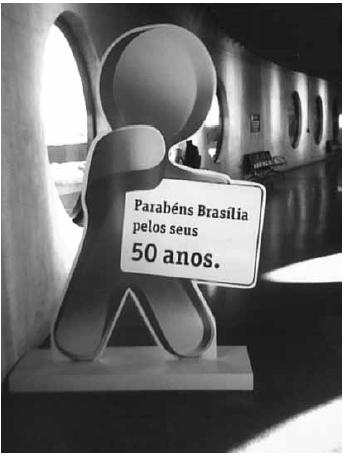
Em conformidade com a norma-padrão, a frase contida na
foto deve ser assim redigida:
A Marquesa de Alegros ficara viúva aos quarenta e três anos, e passava a maior parte do ano retirada em sua quinta de Carcavelos. (...) As suas duas filhas, educadas no receio do Céu e nas preocupações da Moda, eram beatas e faziam o chic falando com igual fervor da humildade cristã e do último figurino de Bruxelas. Um jornalista de então dissera delas: – Pensam todos os dias na toilette com que hão de entrar no Paraíso.
(Eça de Queirós. O crime do padre Amaro.)
O comentário do jornalista deve ser entendido por um viés
 Conheça nossos planos