Questões Militares
Para exército
Foram encontradas 14.912 questões
Resolva questões gratuitamente!
Junte-se a mais de 4 milhões de concurseiros!


Q504239
Inglês
The player was about to take corner when he _______________ at him.
Q504238
Inglês
___________ the Fifa president and vice president will be in Brazil for the World Soccer Cup.
Q504237
Inglês
There are many forms of prejudice and oppression, __________ based on race, but on gender, class, sexual orientation, etc.
Q504236
Inglês
On average, women continue to earn considerably less than men. In 2012, female full-time workers made only 77 cents for every dollar earned by men, a gender wage gap ____ 23 percent.
Q504235
Inglês
“I have a dream that one day, on the red hills of Georgia, the sons of former slaves and the sons of former slave owners _________________ sit down together at the table of brotherhood.” (Martin Luther King)
Q504234
Inglês
_______________ the legislation promising them a fair share of opportunity, Dalits (lower caste) Hindus continue to form among the poorest sections of indian society.
Q504233
Inglês
During the Second World War, approximately 6 million european jews __________ mass murdered in concentration camps and forced labour.
Q504231
Inglês
Texto associado
Text 2
What’s in a name?
Henry Louis Gates Jr. (1989)
The question of color takes up much space in these pages, but the question of color, especially in this country, operates to hide the graver questions of the self.
- James Baldwin, 1961
… blood, darky, Tar baby, Kaffir, shine… moor, blackamoor, Jim Crow, spook… quadroon, meriney, red bone, high yellow… Mammy, porch monkey, home, homeboy, George… spearchucker, Leroy, Smokey…mouli, buck, Ethiopian, brother, sistah…
- Trey Ellis, 1989
I had forgotten the incident completely, until I read Trey Elli’s essay, “Remember My Name,” in a recent issue of the Village Voice (June 13, 1989). But there, in the middle of an extended italicized list of the bynames of “the race” (“the race” or “our people” being the terms my parents used in polite or reverential discourse, “jigaboo” or “nigger” more commonly used in anger, jest, or pure disgust), it was: “George”. Now the events of that very brief exchange return to my mind so vividly that I wonder why I had forgotten it.
My father and I were walking home at dusk from his second job. He “moonlighted” as a janitor in the evenings for the telephone company. Every day, but Saturday, he would come home at 3:30 from his regular job at the paper Mill, wash up, eat supper, then at 4:30 head downtown to his second job. He used to make jokes frequently about a union official who moonlighted. I never got the joke, but he and his friends thought it was hilarious. All I knew was that my family always ate well, that my brother and I had new clothes to wear, and that all of the white people in Piedmont, West Virginia, treated my parents with an odd mixture of resentment and respect that even we understood at the time had something directly to do with a small but certain measure of financial security.
He had left a little early that evening because I was with him and I had to be in bed early. I could not have been more than five or six, and we had stopped off at the Cut-Rate Drug Store (where no black person in town but my father could sit down to eat, and eat off real plates with real silverware) so that I could buy some caramel ice cream, two scoops in a wafer cone, please, which I was busy licking when Mr. Wilson walked by.
Mr. Wilson was a very quiet man, whose stony, brooding, silent manner seemed designed to scare off any overtures of friendship, even from white people. He was Irish as was one-third of our village (another third being Italian), the more affluent among whom sent their children to “Catholic School” across the bridge in Maryland. He had white straight hair, like my Uncle Joe, whom he uncannily resembled, and he carried a black worn metal lunch pail, the kind that Riley carried on the television show. My father always spoke to him, and for reasons that we never did understand, he always spoke to my father.
“Hello, Mr. Wilson,” I heard my father say.
“Hello, George.” I stopped licking my ice cream cone, and asked my Dad in a loud voice why Mr. Wilson had called him “George.”
“Doesn’t he know your name, Daddy? Why don’t you tell him your name? Your name isn’t George.”
For a moment I tried to think of who Mr. Wilson was mixing Pop up with. But we didn’t have any Georges among the colored people in Piedmont; nor were there colored Georges living in the neighboring towns and working at the Mill.
“Tell him your name, Daddy.”
“He knows my name, boy,” my father said after a long pause. “He calls all colored people George.” A long silence ensued. It was “one of those things”, as my Mom would put it. Even then, that early, I knew when I was in the presence of “one of those things”, one of those things that provided a glimpse, through a rent curtain, at another world that we could not affect but that affected us. There would be a painful moment of silence, and you would wait for it to give way to a discussion of a black superstar such as Sugar Ray or Jackie Robinson.
“Nobody hits better in a clutch than Jackie Robinson.”
“That’s right. Nobody.”
I never again looked Mr. Wilson in the eye.
What’s in a name?
Henry Louis Gates Jr. (1989)
The question of color takes up much space in these pages, but the question of color, especially in this country, operates to hide the graver questions of the self.
- James Baldwin, 1961
… blood, darky, Tar baby, Kaffir, shine… moor, blackamoor, Jim Crow, spook… quadroon, meriney, red bone, high yellow… Mammy, porch monkey, home, homeboy, George… spearchucker, Leroy, Smokey…mouli, buck, Ethiopian, brother, sistah…
- Trey Ellis, 1989
I had forgotten the incident completely, until I read Trey Elli’s essay, “Remember My Name,” in a recent issue of the Village Voice (June 13, 1989). But there, in the middle of an extended italicized list of the bynames of “the race” (“the race” or “our people” being the terms my parents used in polite or reverential discourse, “jigaboo” or “nigger” more commonly used in anger, jest, or pure disgust), it was: “George”. Now the events of that very brief exchange return to my mind so vividly that I wonder why I had forgotten it.
My father and I were walking home at dusk from his second job. He “moonlighted” as a janitor in the evenings for the telephone company. Every day, but Saturday, he would come home at 3:30 from his regular job at the paper Mill, wash up, eat supper, then at 4:30 head downtown to his second job. He used to make jokes frequently about a union official who moonlighted. I never got the joke, but he and his friends thought it was hilarious. All I knew was that my family always ate well, that my brother and I had new clothes to wear, and that all of the white people in Piedmont, West Virginia, treated my parents with an odd mixture of resentment and respect that even we understood at the time had something directly to do with a small but certain measure of financial security.
He had left a little early that evening because I was with him and I had to be in bed early. I could not have been more than five or six, and we had stopped off at the Cut-Rate Drug Store (where no black person in town but my father could sit down to eat, and eat off real plates with real silverware) so that I could buy some caramel ice cream, two scoops in a wafer cone, please, which I was busy licking when Mr. Wilson walked by.
Mr. Wilson was a very quiet man, whose stony, brooding, silent manner seemed designed to scare off any overtures of friendship, even from white people. He was Irish as was one-third of our village (another third being Italian), the more affluent among whom sent their children to “Catholic School” across the bridge in Maryland. He had white straight hair, like my Uncle Joe, whom he uncannily resembled, and he carried a black worn metal lunch pail, the kind that Riley carried on the television show. My father always spoke to him, and for reasons that we never did understand, he always spoke to my father.
“Hello, Mr. Wilson,” I heard my father say.
“Hello, George.” I stopped licking my ice cream cone, and asked my Dad in a loud voice why Mr. Wilson had called him “George.”
“Doesn’t he know your name, Daddy? Why don’t you tell him your name? Your name isn’t George.”
For a moment I tried to think of who Mr. Wilson was mixing Pop up with. But we didn’t have any Georges among the colored people in Piedmont; nor were there colored Georges living in the neighboring towns and working at the Mill.
“Tell him your name, Daddy.”
“He knows my name, boy,” my father said after a long pause. “He calls all colored people George.” A long silence ensued. It was “one of those things”, as my Mom would put it. Even then, that early, I knew when I was in the presence of “one of those things”, one of those things that provided a glimpse, through a rent curtain, at another world that we could not affect but that affected us. There would be a painful moment of silence, and you would wait for it to give way to a discussion of a black superstar such as Sugar Ray or Jackie Robinson.
“Nobody hits better in a clutch than Jackie Robinson.”
“That’s right. Nobody.”
I never again looked Mr. Wilson in the eye.
According to Gates’ description in text 2, we can say that Mr Wilson was
Q504230
Inglês
Texto associado
Text 2
What’s in a name?
Henry Louis Gates Jr. (1989)
The question of color takes up much space in these pages, but the question of color, especially in this country, operates to hide the graver questions of the self.
- James Baldwin, 1961
… blood, darky, Tar baby, Kaffir, shine… moor, blackamoor, Jim Crow, spook… quadroon, meriney, red bone, high yellow… Mammy, porch monkey, home, homeboy, George… spearchucker, Leroy, Smokey…mouli, buck, Ethiopian, brother, sistah…
- Trey Ellis, 1989
I had forgotten the incident completely, until I read Trey Elli’s essay, “Remember My Name,” in a recent issue of the Village Voice (June 13, 1989). But there, in the middle of an extended italicized list of the bynames of “the race” (“the race” or “our people” being the terms my parents used in polite or reverential discourse, “jigaboo” or “nigger” more commonly used in anger, jest, or pure disgust), it was: “George”. Now the events of that very brief exchange return to my mind so vividly that I wonder why I had forgotten it.
My father and I were walking home at dusk from his second job. He “moonlighted” as a janitor in the evenings for the telephone company. Every day, but Saturday, he would come home at 3:30 from his regular job at the paper Mill, wash up, eat supper, then at 4:30 head downtown to his second job. He used to make jokes frequently about a union official who moonlighted. I never got the joke, but he and his friends thought it was hilarious. All I knew was that my family always ate well, that my brother and I had new clothes to wear, and that all of the white people in Piedmont, West Virginia, treated my parents with an odd mixture of resentment and respect that even we understood at the time had something directly to do with a small but certain measure of financial security.
He had left a little early that evening because I was with him and I had to be in bed early. I could not have been more than five or six, and we had stopped off at the Cut-Rate Drug Store (where no black person in town but my father could sit down to eat, and eat off real plates with real silverware) so that I could buy some caramel ice cream, two scoops in a wafer cone, please, which I was busy licking when Mr. Wilson walked by.
Mr. Wilson was a very quiet man, whose stony, brooding, silent manner seemed designed to scare off any overtures of friendship, even from white people. He was Irish as was one-third of our village (another third being Italian), the more affluent among whom sent their children to “Catholic School” across the bridge in Maryland. He had white straight hair, like my Uncle Joe, whom he uncannily resembled, and he carried a black worn metal lunch pail, the kind that Riley carried on the television show. My father always spoke to him, and for reasons that we never did understand, he always spoke to my father.
“Hello, Mr. Wilson,” I heard my father say.
“Hello, George.” I stopped licking my ice cream cone, and asked my Dad in a loud voice why Mr. Wilson had called him “George.”
“Doesn’t he know your name, Daddy? Why don’t you tell him your name? Your name isn’t George.”
For a moment I tried to think of who Mr. Wilson was mixing Pop up with. But we didn’t have any Georges among the colored people in Piedmont; nor were there colored Georges living in the neighboring towns and working at the Mill.
“Tell him your name, Daddy.”
“He knows my name, boy,” my father said after a long pause. “He calls all colored people George.” A long silence ensued. It was “one of those things”, as my Mom would put it. Even then, that early, I knew when I was in the presence of “one of those things”, one of those things that provided a glimpse, through a rent curtain, at another world that we could not affect but that affected us. There would be a painful moment of silence, and you would wait for it to give way to a discussion of a black superstar such as Sugar Ray or Jackie Robinson.
“Nobody hits better in a clutch than Jackie Robinson.”
“That’s right. Nobody.”
I never again looked Mr. Wilson in the eye.
What’s in a name?
Henry Louis Gates Jr. (1989)
The question of color takes up much space in these pages, but the question of color, especially in this country, operates to hide the graver questions of the self.
- James Baldwin, 1961
… blood, darky, Tar baby, Kaffir, shine… moor, blackamoor, Jim Crow, spook… quadroon, meriney, red bone, high yellow… Mammy, porch monkey, home, homeboy, George… spearchucker, Leroy, Smokey…mouli, buck, Ethiopian, brother, sistah…
- Trey Ellis, 1989
I had forgotten the incident completely, until I read Trey Elli’s essay, “Remember My Name,” in a recent issue of the Village Voice (June 13, 1989). But there, in the middle of an extended italicized list of the bynames of “the race” (“the race” or “our people” being the terms my parents used in polite or reverential discourse, “jigaboo” or “nigger” more commonly used in anger, jest, or pure disgust), it was: “George”. Now the events of that very brief exchange return to my mind so vividly that I wonder why I had forgotten it.
My father and I were walking home at dusk from his second job. He “moonlighted” as a janitor in the evenings for the telephone company. Every day, but Saturday, he would come home at 3:30 from his regular job at the paper Mill, wash up, eat supper, then at 4:30 head downtown to his second job. He used to make jokes frequently about a union official who moonlighted. I never got the joke, but he and his friends thought it was hilarious. All I knew was that my family always ate well, that my brother and I had new clothes to wear, and that all of the white people in Piedmont, West Virginia, treated my parents with an odd mixture of resentment and respect that even we understood at the time had something directly to do with a small but certain measure of financial security.
He had left a little early that evening because I was with him and I had to be in bed early. I could not have been more than five or six, and we had stopped off at the Cut-Rate Drug Store (where no black person in town but my father could sit down to eat, and eat off real plates with real silverware) so that I could buy some caramel ice cream, two scoops in a wafer cone, please, which I was busy licking when Mr. Wilson walked by.
Mr. Wilson was a very quiet man, whose stony, brooding, silent manner seemed designed to scare off any overtures of friendship, even from white people. He was Irish as was one-third of our village (another third being Italian), the more affluent among whom sent their children to “Catholic School” across the bridge in Maryland. He had white straight hair, like my Uncle Joe, whom he uncannily resembled, and he carried a black worn metal lunch pail, the kind that Riley carried on the television show. My father always spoke to him, and for reasons that we never did understand, he always spoke to my father.
“Hello, Mr. Wilson,” I heard my father say.
“Hello, George.” I stopped licking my ice cream cone, and asked my Dad in a loud voice why Mr. Wilson had called him “George.”
“Doesn’t he know your name, Daddy? Why don’t you tell him your name? Your name isn’t George.”
For a moment I tried to think of who Mr. Wilson was mixing Pop up with. But we didn’t have any Georges among the colored people in Piedmont; nor were there colored Georges living in the neighboring towns and working at the Mill.
“Tell him your name, Daddy.”
“He knows my name, boy,” my father said after a long pause. “He calls all colored people George.” A long silence ensued. It was “one of those things”, as my Mom would put it. Even then, that early, I knew when I was in the presence of “one of those things”, one of those things that provided a glimpse, through a rent curtain, at another world that we could not affect but that affected us. There would be a painful moment of silence, and you would wait for it to give way to a discussion of a black superstar such as Sugar Ray or Jackie Robinson.
“Nobody hits better in a clutch than Jackie Robinson.”
“That’s right. Nobody.”
I never again looked Mr. Wilson in the eye.
Which of the following conclusions can be drawn from text 2?
Q504228
Inglês
Texto associado
Text 1
Luis Suárez joins anti-racism calls after Dani Alves banana incident
The Barcelona defender Dani Alves has sparked a social media campaign against racism in football as support flooded in from fellow professionals for his decision to eat a banana thrown at him by an opposition fan.
Luis Suárez, Neymar, Hulk, Mario Balotelli and Sergio Agüero were among those who posted pictures of themselves taking bites out of bananas in tribute to Alves' actions in his side's La Liga match at Villarreal on Sunday.
The Fifa president Joseph Blatter has branded the abuse directed at Alves an "outrage" and promised zero tolerance towards discrimination at the World Cup, while Villarreal took swift action by identifying the culprit and handing him a lifetime stadium ban.
Alves' response to the banana being thrown on to the pitch in front of him as he prepared to take a corner was to nonchalantly pick it up, peel it and take a bite before continuing with the game. The 30-year- old, who has been the victim of racist abuse before during his time in La Liga, said: "You need to take these situations with a dose of humour."
Players across Europe paid homage on Twitter and Instagram, including Suárez, who served an eight-match ban for racially abusing Patrice Evra.
Alves's Barça and Brazil team-mate Neymar led the way after posting a picture on Instagram of himself holding a banana, while writing "We are all monkeys". Balotelli, Milan's former Manchester City striker, posted a picture of himself in a similar pose.
Suárez posted a picture on Twitter of himself and Liverpool team-mate Philippe Coutinho taking bites out of bananas, along with the words: "#SayNoToRacism #WeAreAllMonkeys."
(...)
Barça gave their player their "complete support and solidarity" and thanked Villarreal for their "immediate condemnation" of the incident. Villarreal later revealed they had, with the help of fans, found out who the culprit was, had withdrawn his season ticket and banned him from the El Madrigal stadium for life.

Luis Suárez joins anti-racism calls after Dani Alves banana incident
The Barcelona defender Dani Alves has sparked a social media campaign against racism in football as support flooded in from fellow professionals for his decision to eat a banana thrown at him by an opposition fan.
Luis Suárez, Neymar, Hulk, Mario Balotelli and Sergio Agüero were among those who posted pictures of themselves taking bites out of bananas in tribute to Alves' actions in his side's La Liga match at Villarreal on Sunday.
The Fifa president Joseph Blatter has branded the abuse directed at Alves an "outrage" and promised zero tolerance towards discrimination at the World Cup, while Villarreal took swift action by identifying the culprit and handing him a lifetime stadium ban.
Alves' response to the banana being thrown on to the pitch in front of him as he prepared to take a corner was to nonchalantly pick it up, peel it and take a bite before continuing with the game. The 30-year- old, who has been the victim of racist abuse before during his time in La Liga, said: "You need to take these situations with a dose of humour."
Players across Europe paid homage on Twitter and Instagram, including Suárez, who served an eight-match ban for racially abusing Patrice Evra.
Alves's Barça and Brazil team-mate Neymar led the way after posting a picture on Instagram of himself holding a banana, while writing "We are all monkeys". Balotelli, Milan's former Manchester City striker, posted a picture of himself in a similar pose.
Suárez posted a picture on Twitter of himself and Liverpool team-mate Philippe Coutinho taking bites out of bananas, along with the words: "#SayNoToRacism #WeAreAllMonkeys."
(...)
Barça gave their player their "complete support and solidarity" and thanked Villarreal for their "immediate condemnation" of the incident. Villarreal later revealed they had, with the help of fans, found out who the culprit was, had withdrawn his season ticket and banned him from the El Madrigal stadium for life.
In text 2, “What’s in a name?”, we can infer that the narrator is
Q504224
Inglês
Texto associado
Text 1
Luis Suárez joins anti-racism calls after Dani Alves banana incident
The Barcelona defender Dani Alves has sparked a social media campaign against racism in football as support flooded in from fellow professionals for his decision to eat a banana thrown at him by an opposition fan.
Luis Suárez, Neymar, Hulk, Mario Balotelli and Sergio Agüero were among those who posted pictures of themselves taking bites out of bananas in tribute to Alves' actions in his side's La Liga match at Villarreal on Sunday.
The Fifa president Joseph Blatter has branded the abuse directed at Alves an "outrage" and promised zero tolerance towards discrimination at the World Cup, while Villarreal took swift action by identifying the culprit and handing him a lifetime stadium ban.
Alves' response to the banana being thrown on to the pitch in front of him as he prepared to take a corner was to nonchalantly pick it up, peel it and take a bite before continuing with the game. The 30-year- old, who has been the victim of racist abuse before during his time in La Liga, said: "You need to take these situations with a dose of humour."
Players across Europe paid homage on Twitter and Instagram, including Suárez, who served an eight-match ban for racially abusing Patrice Evra.
Alves's Barça and Brazil team-mate Neymar led the way after posting a picture on Instagram of himself holding a banana, while writing "We are all monkeys". Balotelli, Milan's former Manchester City striker, posted a picture of himself in a similar pose.
Suárez posted a picture on Twitter of himself and Liverpool team-mate Philippe Coutinho taking bites out of bananas, along with the words: "#SayNoToRacism #WeAreAllMonkeys."
(...)
Barça gave their player their "complete support and solidarity" and thanked Villarreal for their "immediate condemnation" of the incident. Villarreal later revealed they had, with the help of fans, found out who the culprit was, had withdrawn his season ticket and banned him from the El Madrigal stadium for life.
Luis Suárez joins anti-racism calls after Dani Alves banana incident
The Barcelona defender Dani Alves has sparked a social media campaign against racism in football as support flooded in from fellow professionals for his decision to eat a banana thrown at him by an opposition fan.
Luis Suárez, Neymar, Hulk, Mario Balotelli and Sergio Agüero were among those who posted pictures of themselves taking bites out of bananas in tribute to Alves' actions in his side's La Liga match at Villarreal on Sunday.
The Fifa president Joseph Blatter has branded the abuse directed at Alves an "outrage" and promised zero tolerance towards discrimination at the World Cup, while Villarreal took swift action by identifying the culprit and handing him a lifetime stadium ban.
Alves' response to the banana being thrown on to the pitch in front of him as he prepared to take a corner was to nonchalantly pick it up, peel it and take a bite before continuing with the game. The 30-year- old, who has been the victim of racist abuse before during his time in La Liga, said: "You need to take these situations with a dose of humour."
Players across Europe paid homage on Twitter and Instagram, including Suárez, who served an eight-match ban for racially abusing Patrice Evra.
Alves's Barça and Brazil team-mate Neymar led the way after posting a picture on Instagram of himself holding a banana, while writing "We are all monkeys". Balotelli, Milan's former Manchester City striker, posted a picture of himself in a similar pose.
Suárez posted a picture on Twitter of himself and Liverpool team-mate Philippe Coutinho taking bites out of bananas, along with the words: "#SayNoToRacism #WeAreAllMonkeys."
(...)
Barça gave their player their "complete support and solidarity" and thanked Villarreal for their "immediate condemnation" of the incident. Villarreal later revealed they had, with the help of fans, found out who the culprit was, had withdrawn his season ticket and banned him from the El Madrigal stadium for life.
Text 2
What’s in a name?
Henry Louis Gates Jr. (1989)
The question of color takes up much space in these pages, but the question of color, especially in this country, operates to hide the graver questions of the self.
- James Baldwin, 1961 … blood, darky, Tar baby, Kaffir, shine… moor, blackamoor, Jim Crow, spook… quadroon, meriney, red bone, high yellow… Mammy, porch monkey, home, homeboy, George… spearchucker, Leroy, Smokey…mouli, buck, Ethiopian, brother, sistah…
- Trey Ellis, 1989
I had forgotten the incident completely, until I read Trey Elli’s essay, “Remember My Name,” in a recent issue of the Village Voice (June 13, 1989). But there, in the middle of an extended italicized list of the bynames of “the race” (“the race” or “our people” being the terms my parents used in polite or reverential discourse, “jigaboo” or “nigger” more commonly used in anger, jest, or pure disgust), it was: “George”. Now the events of that very brief exchange return to my mind so vividly that I wonder why I had forgotten it. My father and I were walking home at dusk from his second job. He “moonlighted” as a janitor in the evenings for the telephone company. Every day, but Saturday, he would come home at 3:30 from his regular job at the paper Mill, wash up, eat supper, then at 4:30 head downtown to his second job. He used to make jokes frequently about a union official who moonlighted. I never got the joke, but he and his friends thought it was hilarious. All I knew was that my family always ate well, that my brother and I had new clothes to wear, and that all of the white people in Piedmont, West Virginia, treated my parents with an odd mixture of resentment and respect that even we understood at the time had something directly to do with a small but certain measure of financial security. He had left a little early that evening because I was with him and I had to be in bed early. I could not have been more than five or six, and we had stopped off at the Cut-Rate Drug Store (where no black person in town but my father could sit down to eat, and eat off real plates with real silverware) so that I could buy some caramel ice cream, two scoops in a wafer cone, please, which I was busy licking when Mr. Wilson walked by. Mr. Wilson was a very quiet man, whose stony, brooding, silent manner seemed designed to scare off any overtures of friendship, even from white people. He was Irish as was one-third of our village (another third being Italian), the more affluent among whom sent their children to “Catholic School” across the bridge in Maryland. He had white straight hair, like my Uncle Joe, whom he uncannily resembled, and he carried a black worn metal lunch pail, the kind that Riley carried on the television show. My father always spoke to him, and for reasons that we never did understand, he always spoke to my father. “Hello, Mr. Wilson,” I heard my father say. “Hello, George.”
I stopped licking my ice cream cone, and asked my Dad in a loud voice why Mr. Wilson had called him “George.” “Doesn’t he know your name, Daddy? Why don’t you tell him your name? Your name isn’t George.” For a moment I tried to think of who Mr. Wilson was mixing Pop up with. But we didn’t have any Georges among the colored people in Piedmont; nor were there colored Georges living in the neighboring towns and working at the Mill. “Tell him your name, Daddy.” “He knows my name, boy,” my father said after a long pause. “He calls all colored people George.” A long silence ensued. It was “one of those things”, as my Mom would put it. Even then, that early, I knew when I was in the presence of “one of those things”, one of those things that provided a glimpse, through a rent curtain, at another world that we could not affect but that affected us. There would be a painful moment of silence, and you would wait for it to give way to a discussion of a black superstar such as Sugar Ray or Jackie Robinson. “Nobody hits better in a clutch than Jackie Robinson.” “That’s right. Nobody.” I never again looked Mr. Wilson in the eye.
Texts 1 and 2 deal with the same theme: racism. From text 1, we can infer that
What’s in a name?
Henry Louis Gates Jr. (1989)
The question of color takes up much space in these pages, but the question of color, especially in this country, operates to hide the graver questions of the self.
- James Baldwin, 1961 … blood, darky, Tar baby, Kaffir, shine… moor, blackamoor, Jim Crow, spook… quadroon, meriney, red bone, high yellow… Mammy, porch monkey, home, homeboy, George… spearchucker, Leroy, Smokey…mouli, buck, Ethiopian, brother, sistah…
- Trey Ellis, 1989
I had forgotten the incident completely, until I read Trey Elli’s essay, “Remember My Name,” in a recent issue of the Village Voice (June 13, 1989). But there, in the middle of an extended italicized list of the bynames of “the race” (“the race” or “our people” being the terms my parents used in polite or reverential discourse, “jigaboo” or “nigger” more commonly used in anger, jest, or pure disgust), it was: “George”. Now the events of that very brief exchange return to my mind so vividly that I wonder why I had forgotten it. My father and I were walking home at dusk from his second job. He “moonlighted” as a janitor in the evenings for the telephone company. Every day, but Saturday, he would come home at 3:30 from his regular job at the paper Mill, wash up, eat supper, then at 4:30 head downtown to his second job. He used to make jokes frequently about a union official who moonlighted. I never got the joke, but he and his friends thought it was hilarious. All I knew was that my family always ate well, that my brother and I had new clothes to wear, and that all of the white people in Piedmont, West Virginia, treated my parents with an odd mixture of resentment and respect that even we understood at the time had something directly to do with a small but certain measure of financial security. He had left a little early that evening because I was with him and I had to be in bed early. I could not have been more than five or six, and we had stopped off at the Cut-Rate Drug Store (where no black person in town but my father could sit down to eat, and eat off real plates with real silverware) so that I could buy some caramel ice cream, two scoops in a wafer cone, please, which I was busy licking when Mr. Wilson walked by. Mr. Wilson was a very quiet man, whose stony, brooding, silent manner seemed designed to scare off any overtures of friendship, even from white people. He was Irish as was one-third of our village (another third being Italian), the more affluent among whom sent their children to “Catholic School” across the bridge in Maryland. He had white straight hair, like my Uncle Joe, whom he uncannily resembled, and he carried a black worn metal lunch pail, the kind that Riley carried on the television show. My father always spoke to him, and for reasons that we never did understand, he always spoke to my father. “Hello, Mr. Wilson,” I heard my father say. “Hello, George.”
I stopped licking my ice cream cone, and asked my Dad in a loud voice why Mr. Wilson had called him “George.” “Doesn’t he know your name, Daddy? Why don’t you tell him your name? Your name isn’t George.” For a moment I tried to think of who Mr. Wilson was mixing Pop up with. But we didn’t have any Georges among the colored people in Piedmont; nor were there colored Georges living in the neighboring towns and working at the Mill. “Tell him your name, Daddy.” “He knows my name, boy,” my father said after a long pause. “He calls all colored people George.” A long silence ensued. It was “one of those things”, as my Mom would put it. Even then, that early, I knew when I was in the presence of “one of those things”, one of those things that provided a glimpse, through a rent curtain, at another world that we could not affect but that affected us. There would be a painful moment of silence, and you would wait for it to give way to a discussion of a black superstar such as Sugar Ray or Jackie Robinson. “Nobody hits better in a clutch than Jackie Robinson.” “That’s right. Nobody.” I never again looked Mr. Wilson in the eye.
Texts 1 and 2 deal with the same theme: racism. From text 1, we can infer that
Ano: 2014
Banca:
Exército
Órgão:
IME
Prova:
Exército - 2014 - IME - Aluno - Matemática, Química e Física |
Q503359
Química
Considere a rota sintética descrita na sequência abaixo onde cada etapa ocorre em temperatura e pressão adequadas:
1a Etapa: o composto A (C7H6O) sofre oxidação em solução básica de permanganato de potássio. O produto gerado, após neutralizado, é o ácido benzoico;
2a Etapa: o ácido benzoico reage com etanol em solução ácida, produzindo o composto B e água;
3a Etapa: o composto B sofre forte redução com hidreto de lítio-alumínio em éter, gerando dois produtos que, depois de neutralizados, formam então o composto C e o etanol.
Considerando as etapas supracitadas, são feitas as seguintes afirmações:
I) o composto A e o composto C são isômeros.
II) o composto B é um éster.
III) o composto B é o acetato de benzila.
Com base na análise das afirmações acima, assinale a opção correta.
1a Etapa: o composto A (C7H6O) sofre oxidação em solução básica de permanganato de potássio. O produto gerado, após neutralizado, é o ácido benzoico;
2a Etapa: o ácido benzoico reage com etanol em solução ácida, produzindo o composto B e água;
3a Etapa: o composto B sofre forte redução com hidreto de lítio-alumínio em éter, gerando dois produtos que, depois de neutralizados, formam então o composto C e o etanol.
Considerando as etapas supracitadas, são feitas as seguintes afirmações:
I) o composto A e o composto C são isômeros.
II) o composto B é um éster.
III) o composto B é o acetato de benzila.
Com base na análise das afirmações acima, assinale a opção correta.
Ano: 2014
Banca:
Exército
Órgão:
IME
Prova:
Exército - 2014 - IME - Aluno - Matemática, Química e Física |
Q503358
Química
Considere as etapas sequenciais de mistura/filtração do processo não contínuo a seguir.
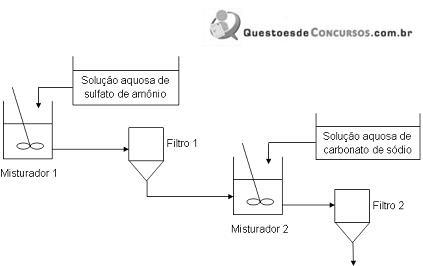
No Misturador 1, antes da adição de 100 mL de uma solução aquosa de sulfato de amônio 20 g/L, encontram-se 100 mL de uma solução aquosa composta por massas iguais de nitrato de prata, nitrato cúprico e nitrato de chumbo (II), de concentração total 60 g/L.
Ao Misturador 2, que contém o material passante do Filtro 1, adicionam-se 100 mL de uma solução aquosa de carbonato de sódio 40 g/L e uma pequena quantidade de uma solução de hidróxido de sódio objetivando o adequado ajuste do pH de precipitação para, em seguida, proceder a filtração. Sobre os produtos de filtração, pode se dizer que:
No Misturador 1, antes da adição de 100 mL de uma solução aquosa de sulfato de amônio 20 g/L, encontram-se 100 mL de uma solução aquosa composta por massas iguais de nitrato de prata, nitrato cúprico e nitrato de chumbo (II), de concentração total 60 g/L.
Ao Misturador 2, que contém o material passante do Filtro 1, adicionam-se 100 mL de uma solução aquosa de carbonato de sódio 40 g/L e uma pequena quantidade de uma solução de hidróxido de sódio objetivando o adequado ajuste do pH de precipitação para, em seguida, proceder a filtração. Sobre os produtos de filtração, pode se dizer que:
Ano: 2014
Banca:
Exército
Órgão:
IME
Prova:
Exército - 2014 - IME - Aluno - Matemática, Química e Física |
Q503357
Química
Assinale a alternativa correta.
Ano: 2014
Banca:
Exército
Órgão:
IME
Prova:
Exército - 2014 - IME - Aluno - Matemática, Química e Física |
Q503356
Química
Um isótopo radioativo X transforma-se em um elemento estável Y após reações de desintegração radioativa com emissão de radiação α, radiação β negativa e radiação ϒ. Assinale a alternativa correta.
Ano: 2014
Banca:
Exército
Órgão:
IME
Prova:
Exército - 2014 - IME - Aluno - Matemática, Química e Física |
Q503355
Engenharia Química e Química Industrial
Uma certa reação química a pressão e temperatura constantes apresenta uma pequena variação da Energia Livre (ΔG), de valor próximo de zero, uma variação positiva da entropia (ΔS) e uma variação negativa da entalpia (ΔH). Considerando-se apenas estes dados, pode-se afirmar que a reação
Ano: 2014
Banca:
Exército
Órgão:
IME
Prova:
Exército - 2014 - IME - Aluno - Matemática, Química e Física |
Q503354
Química
Dados os elementos abaixo,
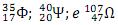
marque a alternativa correta, considerando-se as condições de 1 atm e 25 ?.
marque a alternativa correta, considerando-se as condições de 1 atm e 25 ?.
Ano: 2014
Banca:
Exército
Órgão:
IME
Prova:
Exército - 2014 - IME - Aluno - Matemática, Química e Física |
Q503353
Química
Considere os compostos abaixo enumerados.
I. Acetona;
II. Neopentano;
III. Fluoreto de lítio;
IV. Etanamida;
V. Pentano.
Assinale a alternativa que apresenta a sequência correta, conforme a ordem crescente de ponto de ebulição.
I. Acetona;
II. Neopentano;
III. Fluoreto de lítio;
IV. Etanamida;
V. Pentano.
Assinale a alternativa que apresenta a sequência correta, conforme a ordem crescente de ponto de ebulição.
Ano: 2014
Banca:
Exército
Órgão:
IME
Prova:
Exército - 2014 - IME - Aluno - Matemática, Química e Física |
Q503352
Química
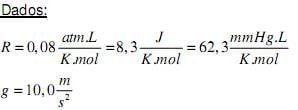
Um pesquisador verificou, em uma determinada posição geográfica, por meio da análise de amostras de água do mar extraídas do local, que a massa específica média da água do mar era 1,05 g/mL, a concentração média de espécies dissolvidas era 0,80 mol/L e a temperatura média era de 290 K. O mesmo pesquisador, com o objetivo de colher água doce em seu estudo, planeja envolver, com uma membrana semipermeável ideal, uma das extremidades abertas de um longo tubo, a qual será imersa na água do mar. A que profundidade mínima, em metros, o tubo deveria ser imerso?
Ano: 2014
Banca:
Exército
Órgão:
IME
Prova:
Exército - 2014 - IME - Aluno - Matemática, Química e Física |
Q503351
Química
Um volume V1 de uma solução aquosa de HCl6 mol/L contém inicialmente uma massa m0 de íons Fe+3 . São realizadas n extrações utilizando, em cada uma delas, o mesmo volume V2 de éter etílico, o qual é um solvente seletivo para FeCl3. Sabendo que o coeficiente de partição do ferro entre o éter e a solução aquosa de HCl vale K, qual das expressões abaixo é equivalente à massa de íons Fe+3 remanescente na fase aquosa ao final do processo? Suponha que a extração do soluto não altera o volume da solução de HCl.

 Conheça nossos planos