Read text VII to answer question.The Versificator - acrylic ...
Read text VI to answer question.
The internet went into overdrive when the song "Heart on My Sleeve" first dropped in 2023. Fans were on cloud nine, fully convinced that Drake and The Weeknd had just casually dropped a surprise collaboration. Social media lit up with excitement as listeners praised the track, thinking it was another hit from two of music's biggest creators - and could a whole album be on the way?
But as the song racked up millions of streams on TikTok, the truth surfaced this wasn't a new Drake and The Weeknd collab.
AI-generated music is a polarizing topic; depending on who you ask, it's either the next big innovation or a cultural catastrophe waiting to happen.
These technologically capable algorithms compose everything from background music to full-fledged songs.
But here's the flip side: AI doesn't understand human emotion.
Looking out for tomorrow, what does AI mean for the future of creativity?
As AI continues to evolve, artists and creators will have to find ways to use AI as a tool while ensuring that the heart of music its ability to move, inspire, and connect remains in human hands.
Adapted from
Read text VII to answer question.
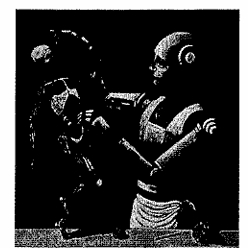
The Versificator - acrylic on canvas 600mm x 600mm
The title for this painting comes from George Orwell's dystopian novel Nineteen Eighty Four and refers to a fictional device employed by Ingsoc, the ruling party of Oceania. Its primary purpose is to act as a 'writing machine' to produce both literature and music, whose target audience is the working-class people. The Versificator provides a means of creating output without having any of the party members actually engaged in a creative thought, as it can be seen in the excerpt from Orwell's book:
"The tune had been haunting London for weeks past. It was one of countless similar songs published for the benefit of the proles by a sub-section of the Music Department. The words of these songs were composed without any human intervention whatever on an instrument known as a Versificator. But the woman sang so tunefully as to turn the dreadful rubbish into an almost pleasant sound."
Adapted from: https://www.shardcore.org/spx/2023/11/08/the-versificator/
It is possible to state that both modern Artificial Intelligence and the Versificator machine, in George Orwell's Nineteen Eighty Four, are capable of writing songs that:
 Conheça nossos planos