Questões Militares Sobre vocabulário | vocabulary em inglês

Foram encontradas 644 questões

Q3446674 Inglês

Directions: Read text I to answer question.


Teach your children – Crosby Stills Nash and Young
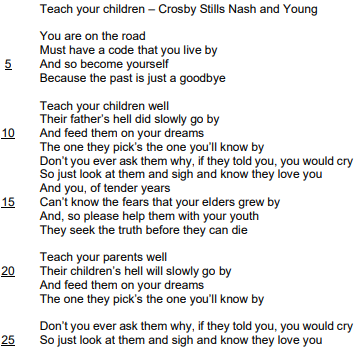


ingles_1.png (359×349)


            Available on https://www.letras mus.br/crosby-stills-nash-young/9142/ accessed on March 21st, 2024.

In the following sentence, “Their father’s hell did slowly go by” (l. 9), the word in bold stands for  
Alternativas
Q3446670 Inglês

Directions: Read text I to answer question.


Teach your children – Crosby Stills Nash and Young


ingles_1.png (359×349)


            Available on https://www.letras mus.br/crosby-stills-nash-young/9142/ accessed on March 21st, 2024.

The word “code” (l. 4) refers to a/an 
Alternativas
Q3266713 Inglês

Leia o texto, para responder à questão. 


    One pathway for converting explicit to implicit knowledge is suggested by skill acquisition theory, a branch of cognitive science studying how people develop skills. In this theory, knowledge is first seen to be declarative (conscious); then, through practice and the application of learning strategies, declarative knowledge becomes proceduralized so that it becomes automatic. Automatic processes are quick and do not require attention or conscious awareness. Many second/ foreign language learners memorize and practice vocabulary items or “chunks” of language such as greetings, idioms or collocations. Frequent practice in using these forms helps the language items to become automatic in the sense that the learner can use them quickly and unconsciously.

    Pienemann (1989) proposes that second/ foreign language learners will not acquire a new structure until they are developmentallly ready to do so. If there were no connection between the development of explicit knowledge about a grammar point and the eventual restructuring of the unconscious linguistic system to accommodate the point in the learner’s interlanguage, then, indeed, grammar instruction would not be of much use. However, it has been suggested that there is a connection, so grammar instruction is ultimately useful. Further, practice of language points can lead to automatization, thus bypassing natural order teachability considerations.


(FOTOS, Sandra. Cognitive Approaches to Grammar Instruction.

In Marianne Celce-Murcia. 3rd ed. Teaching English as a second or foreign

language. 3rd edition. Boston, Massachusstes: Heinle&Heinle. 2002.

Adaptado274)


The second half of the first paragraph, starting “Many second/foreign language learners memorize and practice vocabulary”,

Alternativas
Q3266701 Inglês

Leia o texto, para responder à questão.


    The disjunction between method as conceptualized by theorists and method as conducted by teachers is the direct consequence of the inherent limitations of the concept of method itself. First and foremost, methods are based on idealized concepts geared toward idealized contexts. Since language learning and teaching needs, wants, and situations are unpredictably numerous, no idealized method can visualize all the variables in advance in order to provide situation-specific suggestions that practicing teachers need to tackle the challenges they are confronted with every day of their professional lives.

    Not anchored in any specific learning and teaching context, and caught up in the whirlwind of fashion, methods tend to wildly drift from one theoretical extreme to the other. At one time, grammatical drills were considered the right way to teach; at another, they were given up in favor of communicative tasks. At one time, explicit error correction was not only favored but considered necessary; at another, it was frowned upon. These extreme swings create conditions where certain aspects of learning and teaching get overly emphasized while certain others are utterly ignored, depending on which way the pendulum swings.

    The limitations of the concept of method gradually led to statements such as “the term method is a label without substance” (Clarke, 1983, p. 109), and that it has “diminished rather than enhanced our understanding of language teaching” (Pennycook, 1989, p. 597). This realization has resulted in a widespread dissatisfaction with the concept of method.


(Kumaravadivelu, B. Beyond Methods: Macrostrategies for language teaching. Haven and London: Yale University Press. 2003. Adaptado)


In the fragment from the second paragraph – These extreme swings create conditions where certain aspects of learning and teaching... –, the bolded word can be correctly replaced by: 

Alternativas
Ano: 2024 Banca: VUNESP Órgão: PM-SP Prova: VUNESP - 2024 - PM-SP - Aluno-Oficial |
Q3234482 Inglês

Leia o texto e o gráfico para responder à questão.


    The 2020s have brought a degree of chaos not seen in decades. A pandemic was followed by a full-scale war in Europe; both sent food and fuel prices surging. Extreme weather events have shown that climate change is beginning to bite. The phrase “unprecedented times” soon sounded too common.

    This all affected the global standards of living. One measure of this, the United Nations’ Human Development Index (HDI), fell in 2020 for the first time since its launch. It fell again in 2021. The HDI is one of the most widely used measures of countries’ development, after the Gross Domestic Product (GDP). It is not complete, though. It does not account for economic inequality, for example, or disparities between ethnicities and genders.

    The latest figures show that the global HDI is rising again, but progress has been slow and uneven. It seems the long-term trend appears to have suffered a permanent setback since the pandemic. This setback will deeply affect the world’s poorest.

    Yet there are reasons for hope. The chaos of the 2020s has also shown that governments can collaborate on some big issues. During the pandemic, vaccines were developed, produced and distributed at remarkable speed, saving an estimated 20 million lives in their first year alone. At the 28th United Nations Climate Change Conference (COP28) in 2023 the world proved that it could agree on a deal to tackle climate change (even if fulfilling it is another matter). More of that will be needed to overcome the setbacks from the start of the decade.


TEXTO39-44.png (392×367)

O trecho do quarto parágrafo “(even if fulfilling it is another matter)” indica 
Alternativas
Ano: 2024 Banca: VUNESP Órgão: PM-SP Prova: VUNESP - 2024 - PM-SP - Aluno-Oficial |
Q3234481 Inglês

Leia o texto e o gráfico para responder à questão.


    The 2020s have brought a degree of chaos not seen in decades. A pandemic was followed by a full-scale war in Europe; both sent food and fuel prices surging. Extreme weather events have shown that climate change is beginning to bite. The phrase “unprecedented times” soon sounded too common.

    This all affected the global standards of living. One measure of this, the United Nations’ Human Development Index (HDI), fell in 2020 for the first time since its launch. It fell again in 2021. The HDI is one of the most widely used measures of countries’ development, after the Gross Domestic Product (GDP). It is not complete, though. It does not account for economic inequality, for example, or disparities between ethnicities and genders.

    The latest figures show that the global HDI is rising again, but progress has been slow and uneven. It seems the long-term trend appears to have suffered a permanent setback since the pandemic. This setback will deeply affect the world’s poorest.

    Yet there are reasons for hope. The chaos of the 2020s has also shown that governments can collaborate on some big issues. During the pandemic, vaccines were developed, produced and distributed at remarkable speed, saving an estimated 20 million lives in their first year alone. At the 28th United Nations Climate Change Conference (COP28) in 2023 the world proved that it could agree on a deal to tackle climate change (even if fulfilling it is another matter). More of that will be needed to overcome the setbacks from the start of the decade.


TEXTO39-44.png (392×367)

No trecho do quarto parágrafo “governments can collaborate on some big issues”, um exemplo de “big issues” é 
Alternativas
Ano: 2024 Banca: VUNESP Órgão: PM-SP Prova: VUNESP - 2024 - PM-SP - Aluno-Oficial |
Q3234480 Inglês

Leia o texto e o gráfico para responder à questão.


    The 2020s have brought a degree of chaos not seen in decades. A pandemic was followed by a full-scale war in Europe; both sent food and fuel prices surging. Extreme weather events have shown that climate change is beginning to bite. The phrase “unprecedented times” soon sounded too common.

    This all affected the global standards of living. One measure of this, the United Nations’ Human Development Index (HDI), fell in 2020 for the first time since its launch. It fell again in 2021. The HDI is one of the most widely used measures of countries’ development, after the Gross Domestic Product (GDP). It is not complete, though. It does not account for economic inequality, for example, or disparities between ethnicities and genders.

    The latest figures show that the global HDI is rising again, but progress has been slow and uneven. It seems the long-term trend appears to have suffered a permanent setback since the pandemic. This setback will deeply affect the world’s poorest.

    Yet there are reasons for hope. The chaos of the 2020s has also shown that governments can collaborate on some big issues. During the pandemic, vaccines were developed, produced and distributed at remarkable speed, saving an estimated 20 million lives in their first year alone. At the 28th United Nations Climate Change Conference (COP28) in 2023 the world proved that it could agree on a deal to tackle climate change (even if fulfilling it is another matter). More of that will be needed to overcome the setbacks from the start of the decade.


TEXTO39-44.png (392×367)

No trecho do quarto parágrafo “Yet there are reasons for hope”, o termo sublinhado indica 
Alternativas
Ano: 2024 Banca: IDECAN Órgão: CBM-MG Prova: IDECAN - 2024 - CBM-MG - Oficial - Cadete |
Q3231808 Inglês
A rich vocabulary is crucial as it enables precise and nuanced expression, enhancing written and verbal communication. It also aids in better comprehending and interpreting texts, allowing for deeper analysis and understanding. According to the text, considering the word "cartridges" is correct to say it is
Alternativas
Ano: 2024 Banca: PM-MG Órgão: PM-MG Prova: PM-MG - 2024 - PM-MG - Cadete |
Q3043500 Inglês
TEXT I

“All crimes are not created equal in the harm they cause: homicide is many times more harmful than shoplifting but in crime statistics where offences are counted by number, they appear equivalent. For example, in the UK for the year ending September 2019, there were 3,578,000 incidents of theft and 729 homicides (Office for National Statistics, 2019). An increase of 500 thefts would be a small change in the overall number of thefts and have little impact on police resources. 500 extra homicides would have large consequences both for the harm caused and the impact on police resources. In a number-only count, the additional 500 thefts or homicides would result in the same overall number of crimes, yet clearly the impacts are disparate.

This reality has led to the proposition of a “Harm Index” to measure how harmful different crimes are in proportion to the others. This approach adds a larger weight to more harmful crimes (e.g. homicide, rape and grievous bodily harm with intent), distinguishing them from less harmful types of crime (e.g. minor thefts, criminal damage and common assault). Practically, adoption of a harm index can allow targeting of the highestharm places, the most harmful offenders, the most harmed victims, and can assist in identifying victimoffenders. Experimentally, use of a harm index can add an additional dimension to the usual measures of success or failure, by considering harm prevented as well as reductions in prevalence or frequency. For the police, creation of harm index could allow them to invest scarce resources in proportion to the harm of each offence type.

Sherman, Neyroud and Neyroud (2016) propose that any index needs to meet three requirements in order to be considered a legitimate measure of harm: An index must meet a democratic standard, be reliable and also be adopted at minimal cost to the end user. To meet these requirements, Sherman, Neyroud and Neyroud (2016) opted for using sentence starting points rather than maximum or average actual sentences. The sentencing starting point is used to calculate crime harm as it provides a baseline penalty relative to the crime. We propose that it is a better measure of harm caused by the crime than average actual sentences, which are offender-focused and thus substantially affected by previous offending history.

The Cambridge Crime Harm Consensus proposes creation of seven statistics for counting crime, usefully including separation of historic crime reports, creation of a harm detection fraction and separation of public reported crime and those detected by proactive police activity, with the aim of providing the public with a more reliable and realistic assessment of trends, patterns and differences in public safety.

Counting crime by harm is an idea that has spread beyond the United Kingdom with indices published for Denmark (Andersen and Mueller-Johnson, 2018), Sweden (Karrholm et al. 2020), Western Australia (House and Neyroud, 2018), California (Mitchell, 2017), New Zealand and other countries.”


Cambridge Centre for Evidence-Based Policing. Available at: https://www.cambridge-ebp.co.uk/thechi Accessed on: June 30, 2024.
Choose the alternative that best matches the meaning of the word 'disparate' as used in the sentence:

“In a number-only count, the additional 500 thefts or homicides would result in the same overall number of crimes, yet clearly the impacts are disparate”.
Alternativas
Q3605848 Inglês
Leia o texto a seguir e responda à questão.


Why NASA spacesuits are white


    What do Neil Armstrong, Ed White, and today's ISS (International Space Station) astronauts have in common? They all wore a white spacesuit. And they're not alone. Beyond NASA, space programs in countries like Russia and China also use white suits. Not the colors of the Russian flag or China's iconic yellow and red, just white. That basic color has saved countless astronaut lives. NASA didn't always have white spacesuits. Their very first manned spaceflight featured silver suits, but none of those astronauts actually explored the vacuum of space. And that's the key because out there, spacesuits have to be highly reflective. And the best color for that isn't silver, it's white.

    Here on Earth, our atmosphere shields us from 77% of the sun's radiation. But astronauts in space don't have that natural shield, which makes them vulnerable to blistering temperatures, severe sunburn, and even cancer-causing cell damage. So to combat that, they wear white suits that reflect the sun's harmful radiation.

    But those white EVA (extra-vehicular activity) suits aren't the only garment in an astronaut's closet. When heading into space or coming home, NASA astronauts wear a bright orange suit because that loud orange stands out against the blue ocean and sky and is perfect for attracting attention, so if there's a malfunction during landing and astronauts have to abandon ship, so to speak, they need to be easy to spot for rescue crews.

    That being said, times are changing. Nowadays we have more sophisticated ways of locating astronauts in need of rescue, like GPS trackers and transponders, so space agencies are now free to get creative with their color choices. NASA and other programs are already starting to use other colors like deep blue and mustard yellow. And in the future, they could look a lot different because NASA is heading to Mars. It will be the longest crewed space mission to date, taking as long as three years from start to finish, and during that time, astronauts could suffer from boredom or depression. That's where colorful spacesuits could be useful.

Adapted from https://www.businessinsider.com/why-are-nasa-spacesuits-white-2019-4 
Choose the alternative that correctly substitutes countless in the sentence "That basic color has saved countless astronaut lives." (paragraph 1)
Alternativas
Q3605844 Inglês
Leia o texto a seguir e responda à questão.


Identical twins go on separate vegan and meat diets to see difference they make to body


    In 2021, a set of identical twins took part in an experiment that involved one going vegan while the other consumed meat to see which of these two diets is (1) ________. The diets are complete polar opposites, but which one is being (2) ________ to your body?

    Well, explorers Hugo and Ross Turner decided to put the plant-based and omnivore diets to the test to see which was better - with Hugo ditching meat and dairy and Ross sticking to a diet that included meat, dairy and fish. The twins took part in the Kings College London study over a 12-week period (3) ________ the same number of calories each day as well as carrying out the same gym training.

    Hugo admitted that the switch to a plant-based diet hadn't been easy, but he eventually ended up feeling more energetic. "I was on the vegan diet and it really does take a hit on your body. I was now having to eat fruit and nuts and alternatives that didn't have any dairy in them - and so that meant I was eating a lot more wholesome food, which meant that my sugar levels were a lot satiated during the day. I felt like I had more energy." 

    On the other hand, Ross' meat-eating journey was a little different. As he said, his gym performance was 'up and down a little bit more'. He added that on some days of the challenge he felt 'very energetic' and on others he would have 'huge lulls'.

    By the end of the 12-week study, the men found that the differences between the two diets weren't very significant, after all.

Adapted from https://www.ladbible.com/community/twins-vegan-meat-diet-233165-20230217
In the sentence "He added that on some days of the challenge he felt 'very energetic' and on others he would have 'huge lulls'." (paragraph 4), the word lulls means Ross felt
Alternativas
Ano: 2023 Banca: Exército Órgão: EsSA Prova: Exército - 2023 - EsSA - Sargento - Geral |
Q2509782 Inglês

Choose the option that correctly corresponds to the blank spaces.


“Remember that where ________ courageous soldiers, _________ eternal glory.” 

Alternativas
Q2280163 Inglês

Leia o texto a seguir para responder a questão  

On the surface, there is little to distinguish the Woolf Social Club from any other hipster hangout in Seoul, South Korea. Customers perch on wooden stools at formica tables, tapping on laptops while they sip their coffee. Records and cds line the walls, soft jazz trickles from speakers. On the white wall above the bar, in big black letters, is the statement: “More dignity, less bullshit”.

It is only on closer inspection that you realise this is more than just another coffee shop. On the mugs are cartoon drawings of Virginia Woolf, an angry wolf roaring from her shirt. A bookshelf contains South Korean feminist novels and works of self-help (titles include “Lessons on Being Unmarried”) alongside “The Second Sex” by Simone de Beauvoir and “The Handmaid’s Tale” by Margaret Atwood. On the wall is a poster for an exhibition of feminist art at a nearby gallery.

“I wanted a space for like-minded women to meet and talk,” says Kim Jina, a 47-year-old former advertising executive and politician who founded the café six years ago. Kim was inspired by Woolf’s dictum that in order to write fiction, a woman needed “five hundred [pounds] a year and a room with a lock on the door”. That is, financial independence and a place to think. The café’s casual vibe is deliberate: she wanted to avoid creating barriers to entry for women who were merely curious, rather than fully committed to the movement. Besides, she adds, “If I limited myself to feminist customers, I could never make a living.” 

South Korea, even its trendy capital, is a difficult place to be a woman. The wage gap between the sexes is the highest in the rich world. Traditional expectations about gender roles, beauty standards and the way women should conduct themselves remain pervasive. “Misogyny surrounds you so naturally that you barely even notice it,” says Kim. “I had no role models, so my idea of how a successful woman should be came straight from ‘Sex and the City’.” For much of her 20s and 30s, she spent most of her money on make-up and expensive handbags, partying every weekend and dreaming about meeting her version of Mr Big, the rich, smooth-talking love interest of the show’s main character, Carrie.

“I never worried about misogyny because I thought being sexually attractive was a form of power,” says Kim. “But eventually I realised that men with real power don’t wear make-up and expensive dresses.” Her epiphany came when she was passed over for promotion in favour of a male colleague. “My boss said, ‘He needs it more than you because he has a wife and a child to take care of,’ and I realised that I had been wrong to think that all I needed to do was work hard and be good at my job.” 

Kim’s burgeoning feminism crystallised in the summer of 2016, after a woman was murdered in a public toilet in an upmarket part of Seoul. The killer initially claimed that he had done it because he had been ignored by women. “I lived right around the corner, and I thought: that could have been me,” says Kim. Like many other women, she was upset by media coverage that ignored the misogynist motives for his crime and blamed it entirely on his mental-health problems.

The murder prompted South Korean women to come together, initially in online communities, and discuss how to fight back against sexism. Then they took to the streets. In 2018 there was a series of protests against the widespread practice of recording illegal footage of women by hiding small cameras in public toilets or changing rooms.

Kim founded the Woolf Social Club in 2017. “I thought, we talk to each other on the internet, but it would be good to have a physical space in which to do that,” she says. “If you walk around Seoul, you see all these cafés aimed at couples, where women look pretty and lower their voices. I wanted a space where they could raise them.”

[Fonte: Lena Schipper. “Virginia Woolf is inspiring South Korean feminists”. In: The Economist, 09/05/2022,<http://www.economist.com/1843/2022/05/09/virginia-woolf-is-inspiring-south-korean-feminists>. Adaptado. Data de acesso: 27/08/2023.]


In the excerpt from the third paragraph “I wanted a space for like-minded women to meet and talk,” the underlined term expresses an idea of:
Alternativas
Q2280161 Inglês

Leia o texto a seguir para responder a questão  

On the surface, there is little to distinguish the Woolf Social Club from any other hipster hangout in Seoul, South Korea. Customers perch on wooden stools at formica tables, tapping on laptops while they sip their coffee. Records and cds line the walls, soft jazz trickles from speakers. On the white wall above the bar, in big black letters, is the statement: “More dignity, less bullshit”.

It is only on closer inspection that you realise this is more than just another coffee shop. On the mugs are cartoon drawings of Virginia Woolf, an angry wolf roaring from her shirt. A bookshelf contains South Korean feminist novels and works of self-help (titles include “Lessons on Being Unmarried”) alongside “The Second Sex” by Simone de Beauvoir and “The Handmaid’s Tale” by Margaret Atwood. On the wall is a poster for an exhibition of feminist art at a nearby gallery.

“I wanted a space for like-minded women to meet and talk,” says Kim Jina, a 47-year-old former advertising executive and politician who founded the café six years ago. Kim was inspired by Woolf’s dictum that in order to write fiction, a woman needed “five hundred [pounds] a year and a room with a lock on the door”. That is, financial independence and a place to think. The café’s casual vibe is deliberate: she wanted to avoid creating barriers to entry for women who were merely curious, rather than fully committed to the movement. Besides, she adds, “If I limited myself to feminist customers, I could never make a living.” 

South Korea, even its trendy capital, is a difficult place to be a woman. The wage gap between the sexes is the highest in the rich world. Traditional expectations about gender roles, beauty standards and the way women should conduct themselves remain pervasive. “Misogyny surrounds you so naturally that you barely even notice it,” says Kim. “I had no role models, so my idea of how a successful woman should be came straight from ‘Sex and the City’.” For much of her 20s and 30s, she spent most of her money on make-up and expensive handbags, partying every weekend and dreaming about meeting her version of Mr Big, the rich, smooth-talking love interest of the show’s main character, Carrie.

“I never worried about misogyny because I thought being sexually attractive was a form of power,” says Kim. “But eventually I realised that men with real power don’t wear make-up and expensive dresses.” Her epiphany came when she was passed over for promotion in favour of a male colleague. “My boss said, ‘He needs it more than you because he has a wife and a child to take care of,’ and I realised that I had been wrong to think that all I needed to do was work hard and be good at my job.” 

Kim’s burgeoning feminism crystallised in the summer of 2016, after a woman was murdered in a public toilet in an upmarket part of Seoul. The killer initially claimed that he had done it because he had been ignored by women. “I lived right around the corner, and I thought: that could have been me,” says Kim. Like many other women, she was upset by media coverage that ignored the misogynist motives for his crime and blamed it entirely on his mental-health problems.

The murder prompted South Korean women to come together, initially in online communities, and discuss how to fight back against sexism. Then they took to the streets. In 2018 there was a series of protests against the widespread practice of recording illegal footage of women by hiding small cameras in public toilets or changing rooms.

Kim founded the Woolf Social Club in 2017. “I thought, we talk to each other on the internet, but it would be good to have a physical space in which to do that,” she says. “If you walk around Seoul, you see all these cafés aimed at couples, where women look pretty and lower their voices. I wanted a space where they could raise them.”

[Fonte: Lena Schipper. “Virginia Woolf is inspiring South Korean feminists”. In: The Economist, 09/05/2022,<http://www.economist.com/1843/2022/05/09/virginia-woolf-is-inspiring-south-korean-feminists>. Adaptado. Data de acesso: 27/08/2023.]


In the excerpt from the second paragraph “A bookshelf contains South Korean feminist novels and works of self-help (titles include “Lessons on Being Unmarried”) alongside “The Second Sex” by Simone de Beauvoir and “The Handmaid’s Tale” by Margaret Atwood”, the underlined word expresses an idea of:
Alternativas
Q2280158 Inglês
Leia o texto a seguir para responder a questão. 

Read Your Way Through Salvador 

By Itamar Vieira Junior and translated by Johnny Lorenz. July 19, 2023.

I was born in Salvador, in the Brazilian state of Bahia, and lived in the general vicinity until I reached the age of 15. But it was when I left that I really came to know my city. How was I able to discover more about my birthplace while traveling far from home? It might sound rather clichéd but, I assure you, literature made this possible: It took me on a journey, long and profound, back home, enveloping me in words and imagination. 

To understand the formation of our unique society and, consequently, the cityscape of Salvador, one should read, before anything else, “The Story of Rufino: Slavery, Freedom and Islam in the Black Atlantic,” by João José Reis, Flávio dos Santos Gomes and Marcus J.M. de Carvalho. Rufino was an alufá, or Muslim spiritual leader, born in the Oyo empire in present-day Nigeria and enslaved during his adolescence. “The Story of Rufino” is an epic tale, encapsulating the life of one man in search of freedom as well as the history of the development of Salvador itself, a place inextricably linked with the diaspora across the Black Atlantic. Another book for which I have deep affection is “The City of Women,” by the American anthropologist Ruth Landes. It offers an intriguing perspective, focusing on matriarchal power in candomblé, an Afro-Brazilian sacred practice, and revealing how the social organization of its spiritual communities reverberates across the city.

If you want to feel the intensity of life on the streets of Salvador, these two books, both by Amado, are indispensable: “Captains of the Sands” and “Dona Flor and Her Two Husbands.” The first is a coming-of-age story in which we follow a group of children and adolescents living on the streets and on the beaches around the Bay of All Saints. Written more than 80 years ago, the book was banned and even burned in the public square during the dictatorship of Getúlio Vargas in the first half of the 20th century. As a portrait of Salvador, it is still relevant and reveals our deep inequalities. “Dona Flor and her Two Husbands” is one of Amado’s most popular novels, translated into more than 30 languages and adapted many times for theater, cinema, and television. The book is a kind of manifesto for a woman’s liberation. Dona Flor possesses great culinary talent, and oppressed by a patriarchal society, finds herself divided between two men, one being her deceased husband. While the novel captures the daily life of the city in the 1940s, it is also a wonderful guide to the cuisine of Salvador, with its African and Portuguese influences.

I invite readers to travel into the interior of Bahia, many hours by car from Salvador to the region known as the Sertão, whose name translates loosely to “backwoods.” Two books can also transport you there, and they are sides of the same story: “Backlands: The Canudos Campaign,” by Euclides da Cunha, and “The War of the End of the World,” by Mario Vargas Llosa. 

“Backlands” is one of the most important works in the history of Brazilian literature. It is a journalistic telling that introduces us not only to the brutal War of Canudos, but also to the intriguing landscape of the Sertão, a place so full of contradictions. In his writing of the conflict, da Cunha tells the story of the genesis of the tough sertanejo: a mythic, cowboyesque figure of the drought-stricken, lawless interior. “The War of the End of the World” is an essential epic that amplifies the narrative of “Backlands,” bringing a more imaginative, creative aspect to the story of Antônio Conselheiro, the spiritual leader of a rebellion, and of the multitude that followed him to their deaths.

[Fonte: “Read Your Way Through Salvador”. In: The New York Times, 19/07/2023,<http://www.nytimes.com/2023/07/19/books/salvador-bahia-brazil-books.html> . Adaptado. Data de acesso: 01/09/2023.]
No trecho do terceiro parágrafo “While the novel captures the daily life of the city in the 1940s, it is also a wonderful guide to the cuisine of Salvador” o termo sublinhado pode ser substituído, sem alteração de sentido, por:
Alternativas
Q2280157 Inglês
Leia o texto a seguir para responder a questão. 

Read Your Way Through Salvador 

By Itamar Vieira Junior and translated by Johnny Lorenz. July 19, 2023.

I was born in Salvador, in the Brazilian state of Bahia, and lived in the general vicinity until I reached the age of 15. But it was when I left that I really came to know my city. How was I able to discover more about my birthplace while traveling far from home? It might sound rather clichéd but, I assure you, literature made this possible: It took me on a journey, long and profound, back home, enveloping me in words and imagination. 

To understand the formation of our unique society and, consequently, the cityscape of Salvador, one should read, before anything else, “The Story of Rufino: Slavery, Freedom and Islam in the Black Atlantic,” by João José Reis, Flávio dos Santos Gomes and Marcus J.M. de Carvalho. Rufino was an alufá, or Muslim spiritual leader, born in the Oyo empire in present-day Nigeria and enslaved during his adolescence. “The Story of Rufino” is an epic tale, encapsulating the life of one man in search of freedom as well as the history of the development of Salvador itself, a place inextricably linked with the diaspora across the Black Atlantic. Another book for which I have deep affection is “The City of Women,” by the American anthropologist Ruth Landes. It offers an intriguing perspective, focusing on matriarchal power in candomblé, an Afro-Brazilian sacred practice, and revealing how the social organization of its spiritual communities reverberates across the city.

If you want to feel the intensity of life on the streets of Salvador, these two books, both by Amado, are indispensable: “Captains of the Sands” and “Dona Flor and Her Two Husbands.” The first is a coming-of-age story in which we follow a group of children and adolescents living on the streets and on the beaches around the Bay of All Saints. Written more than 80 years ago, the book was banned and even burned in the public square during the dictatorship of Getúlio Vargas in the first half of the 20th century. As a portrait of Salvador, it is still relevant and reveals our deep inequalities. “Dona Flor and her Two Husbands” is one of Amado’s most popular novels, translated into more than 30 languages and adapted many times for theater, cinema, and television. The book is a kind of manifesto for a woman’s liberation. Dona Flor possesses great culinary talent, and oppressed by a patriarchal society, finds herself divided between two men, one being her deceased husband. While the novel captures the daily life of the city in the 1940s, it is also a wonderful guide to the cuisine of Salvador, with its African and Portuguese influences.

I invite readers to travel into the interior of Bahia, many hours by car from Salvador to the region known as the Sertão, whose name translates loosely to “backwoods.” Two books can also transport you there, and they are sides of the same story: “Backlands: The Canudos Campaign,” by Euclides da Cunha, and “The War of the End of the World,” by Mario Vargas Llosa. 

“Backlands” is one of the most important works in the history of Brazilian literature. It is a journalistic telling that introduces us not only to the brutal War of Canudos, but also to the intriguing landscape of the Sertão, a place so full of contradictions. In his writing of the conflict, da Cunha tells the story of the genesis of the tough sertanejo: a mythic, cowboyesque figure of the drought-stricken, lawless interior. “The War of the End of the World” is an essential epic that amplifies the narrative of “Backlands,” bringing a more imaginative, creative aspect to the story of Antônio Conselheiro, the spiritual leader of a rebellion, and of the multitude that followed him to their deaths.

[Fonte: “Read Your Way Through Salvador”. In: The New York Times, 19/07/2023,<http://www.nytimes.com/2023/07/19/books/salvador-bahia-brazil-books.html> . Adaptado. Data de acesso: 01/09/2023.]
No trecho do terceiro parágrafo “As a portrait of Salvador, it is still relevant and reveals our deep inequalities”, o termo sublinhado contém um prefixo de negação. Assinale a alternativa que apresenta o termo que NÃO contém prefixo de negação.
Alternativas
Q2259764 Inglês
      “It’s a very nice book and very lively, but in the section on ‘Processes’ for example all the exercises are about unusual things for our country. We are a hot country and also have many Muslims. The exercises are about snow, ice, cold mornings, and making wine. I can tell you I can’t do making wine and smoking pot in my country!” (Experienced school teacher from the Ivory Coast, Africa)
      “Previous materials were not based on life in Brazil which is why I don’t think they worked very well …” (Brazilian teacher of English in school)
      “Sir … what is opera?” (Iraqi student in mixed nationality class using materials designed to practise reading narrative)
     The implications of these three quotations are not simply linguistic; rather, they address the problem of appropriate contextual realisation for materials. For the teacher in the Ivory Coast, the materials offered would be outside the cultural experience of his students (possibly even threatening) and thus effectively useless; conversely, for the Brazilian teacher, the choice of Brazilian settings and familiar mores would have clear advantages over distant foreign contexts as they are essentially more motivating. The quote from the Iraqi student suggests that complete unfamiliarity with the notion of opera may reduce the efficacy of the reading exercises, but in this case the student is curious and likely to regard the material as exotic rather than merely alien.


(D. Jolly e R. Bolitho, A framework for materials writing.
In B. Tomlinson, (ed). Material Development in Language Teaching.
Cambridge: CUP. 1998/2011. Adaptado)
No quarto parágrafo, é um adjetivo a palavra
Alternativas
Q2259763 Inglês
      “It’s a very nice book and very lively, but in the section on ‘Processes’ for example all the exercises are about unusual things for our country. We are a hot country and also have many Muslims. The exercises are about snow, ice, cold mornings, and making wine. I can tell you I can’t do making wine and smoking pot in my country!” (Experienced school teacher from the Ivory Coast, Africa)
      “Previous materials were not based on life in Brazil which is why I don’t think they worked very well …” (Brazilian teacher of English in school)
      “Sir … what is opera?” (Iraqi student in mixed nationality class using materials designed to practise reading narrative)
     The implications of these three quotations are not simply linguistic; rather, they address the problem of appropriate contextual realisation for materials. For the teacher in the Ivory Coast, the materials offered would be outside the cultural experience of his students (possibly even threatening) and thus effectively useless; conversely, for the Brazilian teacher, the choice of Brazilian settings and familiar mores would have clear advantages over distant foreign contexts as they are essentially more motivating. The quote from the Iraqi student suggests that complete unfamiliarity with the notion of opera may reduce the efficacy of the reading exercises, but in this case the student is curious and likely to regard the material as exotic rather than merely alien.


(D. Jolly e R. Bolitho, A framework for materials writing.
In B. Tomlinson, (ed). Material Development in Language Teaching.
Cambridge: CUP. 1998/2011. Adaptado)
Considering the whole context of the first quotation (paragraph 1), the expression “I can´t do making wine” means
Alternativas
Q2259755 Inglês
      Since ChatGPT can engage in conversation and generate essays and graphs that closely resemble those created by humans, educators worry students may use it to cheat. The main reason students cheat is their academic motivation. Sometimes they are just motivated to get a high grade, whereas other times they wish to learn all that they can about a topic. The decision to cheat or not often relates to how academic assignments and tests are constructed and assessed, not on the availability of technological shortcuts.
       Research demonstrates that students are more likely to cheat when assignments are designed in ways that encourage them to outperform their classmates. There is less cheating when teachers assign academic tasks that prompt them to work collaboratively and to focus on mastering content instead of getting a good grade.
      An important way to boost students’ confidence is to provide them with opportunities to experience success. For example, suppose students are asked to attempt to design a hypothetical vehicle that can use gasoline more efficiently than a traditional car. Students who struggle with the project can use ChatGPT to break down the larger problem into smaller challenges or tasks. ChatGPT might suggest they first develop an overall concept for the vehicle before determining the size and weight of the vehicle and deciding what type of fuel will be used. Teachers could also ask students to compare the steps suggested by ChatGPT with steps that are recommended by other sources. 

(Kui Xie e Eric M. Anderman. http://www.theconversation.com. 06.06.2023. Adaptado)
Read this short except.
There are three areas where our behaviour can directly influence our students’ continuing participation: goals and goal setting; learning environment; interesting classes.

(J. Harmer, The practice of English language teaching. 4th ed. Essex: Pearson Longman, 2007. Adaptado)

The task proposed in the last paragraph of the text on ChatGPT illustrates the following motivational behavior on the part of teachers:

Alternativas
Q2259754 Inglês
      Since ChatGPT can engage in conversation and generate essays and graphs that closely resemble those created by humans, educators worry students may use it to cheat. The main reason students cheat is their academic motivation. Sometimes they are just motivated to get a high grade, whereas other times they wish to learn all that they can about a topic. The decision to cheat or not often relates to how academic assignments and tests are constructed and assessed, not on the availability of technological shortcuts.
       Research demonstrates that students are more likely to cheat when assignments are designed in ways that encourage them to outperform their classmates. There is less cheating when teachers assign academic tasks that prompt them to work collaboratively and to focus on mastering content instead of getting a good grade.
      An important way to boost students’ confidence is to provide them with opportunities to experience success. For example, suppose students are asked to attempt to design a hypothetical vehicle that can use gasoline more efficiently than a traditional car. Students who struggle with the project can use ChatGPT to break down the larger problem into smaller challenges or tasks. ChatGPT might suggest they first develop an overall concept for the vehicle before determining the size and weight of the vehicle and deciding what type of fuel will be used. Teachers could also ask students to compare the steps suggested by ChatGPT with steps that are recommended by other sources. 

(Kui Xie e Eric M. Anderman. http://www.theconversation.com. 06.06.2023. Adaptado)
While reading the text, students mention they do not understand the word “boost” in “An important way to boost students’ confidence”. One of the ways to arrive at meaning of the word without resorting to the dictionary is by means of the compensatory strategy named
Alternativas
Respostas
81: D
82: B
83: D
84: B
85: E
86: D
87: A
88: A
89: C
90: C
91: E
92: C
93: C
94: C
95: E
96: C
97: B
98: D
99: A
100: A